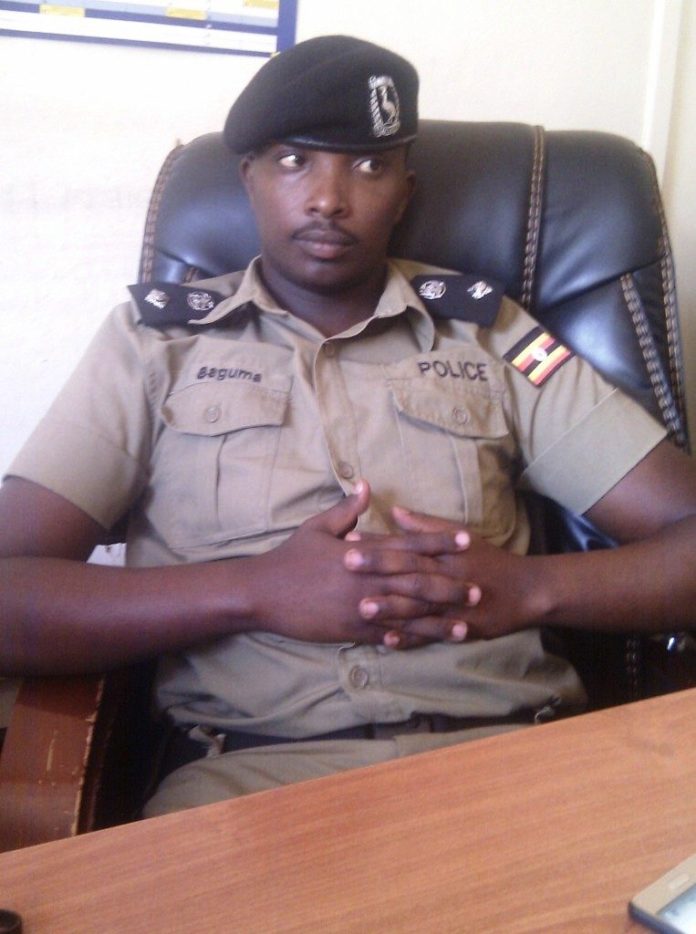
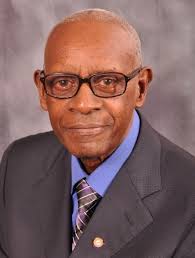
CLEARED OF MURDER CHARGES: Former CPS DPC Aaron Baguma
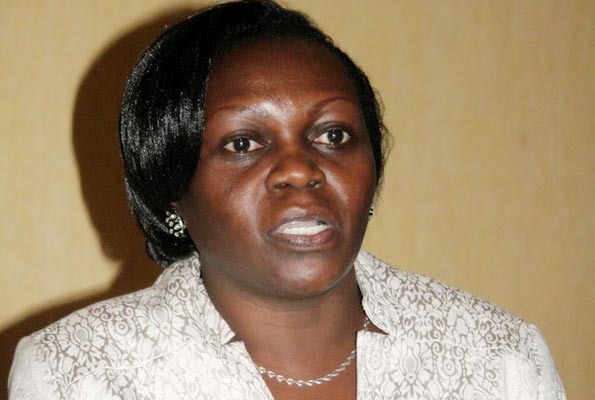
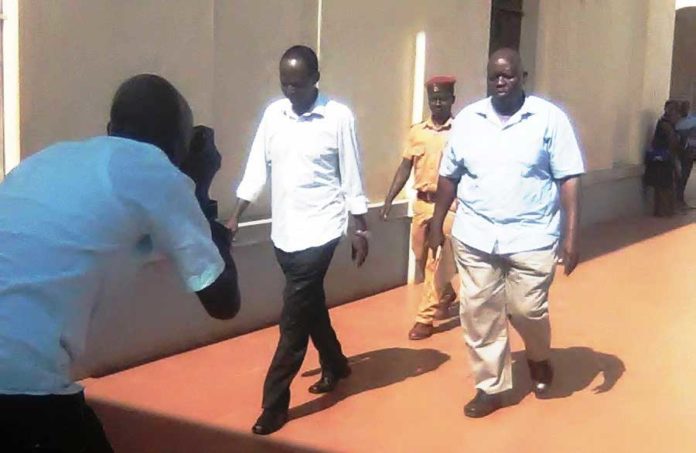
The Director of Public Prosecutions (DPP) has today withdrawn all murder charges brought against the former Central Police Station (CPS) District Police Commander (DPC) Aaron Baguma, charged in relation to the murder of businesswoman Donah Katushabe.
Superintendent of Police (SP) Baguma has been facing the murder charges with among others, Muhammad Sebuwufu, a used car dealer, who was allegedly owed Shs9 million by Ms. Katushabe.
And today, while appearing before High court judge Justice Flavia Anglin Ssenoga, Principal State Attorney Alex OJok presented the DPP’s withdraw of charges letter signed by Mike Chibita W’aDuallo on December 21, 2017, in effect discontinuing the murder charges against SP Baguma.
In 2016 Katushabe’s relatives wrote to DPP requesting that charges against SP Baguma be dropped, owing to the support he had rendered the family of the deceased, which, among others, includes facilitating the relatives to meet the Inspector General of Police (IGP) General Kale Kayihura.
‘Your Lordship, we request that SP Aaron Baguma be dropped from among the accused persons and this of the because following reason: From the day we got to know about the death of our sister, it was Aron Baguma who as DPC of CPS who helped us uncovering the rot that some other officers in police had done in ensuring that the murderers of our sister walk away Scot free’ Alex Masereka Epafura, a brother to the deceased, wrote.
Masereka Epafura was further quoted as writing: ‘It was Baguma who helped us in accessing the Inspector General of Police (IGP) Gen. Kale Kayihura, who in turn helped us find a team of new investigators when the former team had been grossly compromised’.
The court has, however, adjourned Baguma’s matter to February 5, 2018.
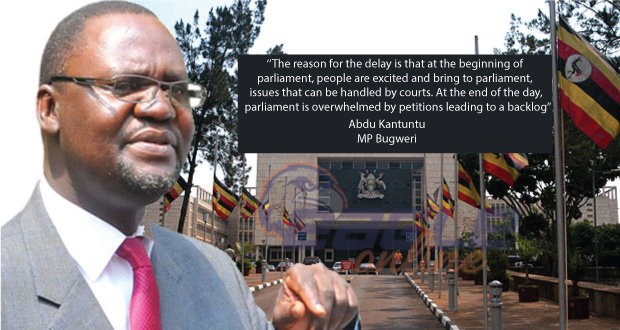
A photo montage of Bugweri County MP Abdu Katuntu and the Parliament
Mid last year, Raphael Magyezi, the Member of Parliament representing Igara West, mooted an idea to have the presidential age limit cap of 75 years expunged from the Constitution.
Magyezi tabled his motion, a ‘private members bill’, and in a record time, it was ‘debated’, forwarded to the legal committee of Parliament, passed and assented to.
And, much as many did not deem it a priority, with many others saying it was floated to benefit only one individual, Magyezi’s bill that seemed like an offshoot from the thinking of Arua Municipality MP Ibrahim Abiriga and State Minister for Privatisation and Koboko Woman MP Evelyn Anite, is now law!
Needless to say however, almost every year there is a complaint about parliamentary committees’ failure to handle their designated work on time.
Indeed, at Parliament’s end of year Party in 2014, Speaker Rebecca Kadaga expressed displeasure at the slow approach with which most House committees handled business.
As the legislators sipped on glasses of wine and celebrated with glee, the Speaker warned she will go hard on sluggish committees and as if to buttress her assertions, she announced a travel ban out of the city for the MPs until work was seen to be done.
She also said that henceforth, she was going to be strictly ruthless on the 45-day rule within which work had to be done by committees—the legislators in attendance sipped and nodded with promising reaction.
In executing its representation role, Parliament receives petitions from the public. The petitions, which simply put are complaints on public policy and governance issues, are expected to be investigated and recommendations be made by Parliament.
Click on the link below for list of the unresolved petitions.
However, a study by Eagle Online shows that out of close to 100 petitions brought to Parliament between 2011 and 2016, over sixty remain unresolved. Most of the petitions have now been over taken by events or the petitioners simply lost hope and gave up.
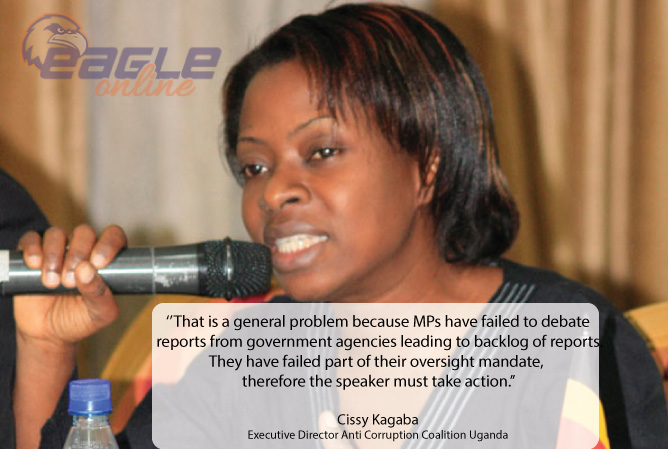
Anti-Corruption Coalition of Uganda (ACCU) boss Cissy Kagaba
“That is a general problem because MPs have failed to debate reports from government agencies leading to backlog of reports,” said Ms Cissy Kagaba, a political commentator and Executive Director of Anti-Corruption Coalition Uganda. She added: “They have failed part of their oversight mandate, therefore the Speaker must take action.”
Among committees with a high level of backlog is the committee on gender (seven petitions), the committee on physical infrastructure (8 pending petitions), the committee on trade and industry (7) the House Committee on Education (7) and the committee on finance.
Rationalizing the committees’ failure to do the their work in perspective, Political Scientist Dr Frederick Kisekka-Ntale, says the reason for this unfinished business is that in most cases many people are elected to Parliament due to political factors.
According to Dr. Kisekka-Ntale, whereas MPS are expected to do legislative representation and constituency work, they, in most cases concentrate more on ‘constituency legislation’ as opposed to legislative representation.
“This because the people who voted them never did so basing on the ability of them being able to be good legislators but good politicians (omuntu wa bantu, omwana waffe). Therefore, this makes MPS concentrate on attending burials, weddings, funeral rites rather than performing their legislative role in Parliament, leaving a backlog,” Dr. Kisekka-Ntale emphasises.
Further still, the political science researcher and don notes that the caliber of the people sent to Parliament is not up to the task.
“Many of them do not understand what takes place in Parliament. They just find themselves in Parliament because of certain factors; for example a situation where the incumbent is weak or not liked by the electorate and hence the need to replace him with anybody.
“There is also a case of seasonal political events like age limit bill, marriage and divorce bill, domestic violence bill which reduces their capacity to perform,” Dr. Kisekka-Ntale said adding that the way forward is for Parliament to focus on its legislative role and concentrate less on ‘constituency representation’.
Asked whether having a backlog means Parliament has not done its work, the former Makerere Institute of Social Research (MISR) scholar said: “No, because Parliament is autonomous and performance can be measured by whatever little they have been able to accomplish.”
Some of the pending petitions include a petition by now Minister Chris Baryomunsi tabled in 2012 but brought to Parliament by timber dealers, regarding the embargo imposed by the Minister of Water and Environment on the sawing of trees for timber.
Another is a 2012 petition tabled by now Opposition Chief Whip, Ibrahim Ssemujju Nganda – brought by councillors of Kiira Town Council – on matters pertaining to the mismanagement of Council funds.
In 2013, MP Joseph Ssewungu tabled a petition brought by pupils, parents and the school management committee of Nakasero Primary School, on the grabbing of land at Plot 34A Kyadondo Road and Plot 5C Mackinnon Road measuring 0.657 hectares, by Prestigious Apartments Limited in collusion with Uganda Land Commission.
Yet still, in 2014 the Community of Lira District petitioned the Parliament of Uganda on the low Status of Life Saving Emergency Services for Pregnant Women and Newborns in the Health Centers IIIs and IVs of Lira. This was referred to the Committee on Health ‘for scrutiny’.
Similarly, a 2012 petition against illegal/unjust removal from service and breach of contract by the Uganda Public Employees Union is captured as ‘report ready but the issue is in court; so matter halted in Committee’.
Also, the status of a 2012 petition by children living with HIV/AIDS against the challenges faced accessing HIV/AIDS health care is captured as ‘still under consideration’.
Further, a petition by ‘Strategic Leadership Forum’ on the closure of Primary Teachers Training Colleges tabled by now primary education state minister Rosemary Sseninde in 2011 collected dust and was overtaken by events.
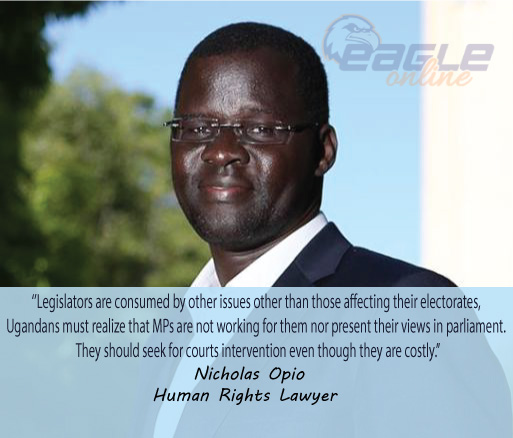
Political activist and Human Rights lawyer Nicholas Opio
“Legislators are consumed by other issues other than those affecting their electorates, Ugandans must realize that MPs are not working for them nor present their views in Parliament,” internationally acclaimed Human Rights defender and local political pundit, Nicholas Opio says. “They should seek for courts intervention even though they are costly”
However, senior legislator and celebrated committee on Statutory Authorities and State Enterprises (COSASE) chair, Abdu Katuntu, says the delay should be partly blamed on ‘rural excitement’ by voters who, at the beginning of Parliament, raise petty issues with their MPs.
“They bring to Parliament issues that can be handled by courts. At the end of the day, Parliament is overwhelmed by petitions leading to a backlog. Secondly it depends on the leadership of the committees where the reports are directed. Some committee leaders prioritize certain petitions reports at the expense others hence leaving some ignored, Katuntu said.
“Sometimes it as a result of events Parliament and the country generally like the recently passed presidential age limit bill turning the attention of Parliament from some issues and concentrating on others. It also makes the petitioners to lose interest in their petitioners,” he said, adding that the backlog notwithstanding, people still have faith in the institution.
“By the time the citizens petition Parliament, they have hope in the citizens to solve their problems, wrangles, and others. It is a great disappointment on our side as leaders when we do not deliver. On whether Parliament has not done its job; no, we can do better,” Katuntu said.
His Ajuri County colleague Hamson Obua, says petitioners should be proactive in nature and make follow ups through their lead petitioners.
“Parliament has rules and procedures to follow; it is the duty of the Speaker to ensure that these are respected and followed. When a petition is sent a committee, a report is expected within 45 days and failure to do so is inefficiency and ineffectiveness. On whether this means Parliament has betrayed the electorate, yes, but this calls for improvement in efficiency and effectiveness,” Obua said.
Obua’s assertion is buttressed by Mbale Woman MP Connie Nakayenze, who says sometimes committees finish the investigations but fail to get their reports on the order paper for presentation.
“This does not mean that the committee has not done its work but the Clerk to Parliament or the Leader of Government Business may have some priority business that they may want handled thus creating backlog.
“As a way forward, the petitioners should follow up their petitions with the Office of the Speaker and committee leadership. Our people need to understand that this does not mean that Parliament has failed in its duty but it is as a result of the busy schedule of Parliament,” she said.
Parliament’s Director of Communications and Public Affairs, Chris Obore, could not be got for a comment and is yet to reply to text messages from our reporters.
Legislative researcher Hippo Twebaze blamed the backlog of petitions and bills in Parliament on Parliamentarians, saying they concentrate more on political matters and other matters that are considered to be of national importance.
“This makes MPS to put most of their energy on such matters that the political regime has interest in. The implication of this an indication of poor performance on the side of the Parliamentarians. If someone is elected to represent its electorate and the term ends without completion its business, its total incompetence,” Twebaze said.
Twebaze added: “The way forward is for Parliament to follow its rules of procedure and ensure that whatever is before Parliament way must find its way on the order paper. There must be a mechanism of balancing political issues and issues affecting the citizens directly.”
MultiChoice officials announcing the DStv and GOtv packages
MultiChoice Uganda, through DStv and GOtv channels, has announced that it will be broadcasting the 2018 Total African Nations Championship (CHAN) for Ugandan subscribers to support the Uganda Cranes.
The CHAN 2018 football tournament is the true test of Africa’s strongest league, pitting 16 of Africa’s best teams comprised of only home-based players in the domestic league, to compete in the tourney.
The tournament starts on Saturday January 12, and will be available to both DStv and GOtv subscribers on SuperSport Channels Select 2, Select 10, SS4, SS6, SS8, SS9 and SS10.
MultiChoice Public Relations Officer Tina Wamala, while addressing the media at MultiChoice head office in Kololo, said that Uganda’s participation in CHAN 2018 makes the tournament special.
“There are many local talents that Uganda is going to showcase at this tournament, therefore subscribers should expect outstanding and marvelous football,” she said.
Albert Nga, GOtv Marketing Manager said: “GOtv prides itself in being the home to premium entertainment. African and most especially Ugandan football on the International stage is one of the sports avenues we seek to promote. CHAN is one of the platforms to look out for outstanding Ugandan talent.”
Nga said DStv and GOtv subscribers will now enjoy the best of African football nurtured in the various domestic leagues on the continent as they tussle it out for football supremacy on SuperSport channels.
DStv Sales Manager Herbert Walugembe said: “We realized how important this tournament is to Ugandans most especially the domestic league fans. They want to be able to see how their players play against Africa’s best at on the international stage. We seek to promote the love for local sport and talent.”
Mr. Walugembe added: “We encourage football enthusiasts and local league supporters to renew their subscription and be able to catch the action. The CHAN tournament is the platform for our boys to make a mark for greatness. So why not allow their supporters at home witness how these talents perform as they show their patriotic duty by cheering them on.”
There was a verbal exchange on the floor of Parliament between Sarah Opendi, the State Minister of Health-General Duties and MPs over the ‘outbreak’ of the Congo Crimean fever in Nakaseke district.
It all started when MP Luttamaguzi Ssemakula (Nakaseke South) took to the floor demanding for a statement from government about the reported outbreak of the dreaded disease.
In his remarks, Luttamaguzi said that eight people have lost their lives to the disease, while 22 residents remain in isolation.
But when Opendi came to respond to the matter, she lashed out at Luttamaguzi for ‘hijacking the role of the Ministry’.
According to the Minister, it is only experts from the Ministry of Health who are mandated declare any outbreak, ‘not individuals without any health knowledge’.
However, several legislators took fault with Opendi’s response with many booing, as some stood up calling the Minister to ‘order’.
Jacob Oulanyah, Deputy Speaker saved the day and calmed the MPs, telling Minister Opendi that the matter at hand was the eight deaths and other imminent deaths, ‘not who is responsible for announcing the outbreak’.
“You aren’t in order to say that nobody else is supposed to talk about these matters,” Oulanyah said.
But Opendi was not done and fired back: “The Ministry does declare, we haven’t registered any death. We had this outbreak in August. We had cases but old cases are negative.”
The Minister’s response however did no go unchallenged, with Patrick Nsamba asking her to explain why 22 people are condoned off and why the eight died.
“The Congo Fever does normally occur in the cattle corridor and there were suspicious cases collected. So far all samples collected, all have turned out negative,” the Minister answered.
However, that response elicited more protests, forcing Minister Opendi to promise to return with a more concrete explanation.
Wilson Kyambadde, trade minister Amelia Kyambadde’s husband, has been released from Luzira prison after spending six months in civil prison.
On July 10 last year Mr. Kyambadde was committed by High Court executions division to the correctional facility after he failed to pay a Shs1 billion debt to city businessman Amdan Khan.
Businessman Khan accused Kyambadde of defrauding him in 2012, telling court that the latter approached him with a forged letter from State House, claiming that President Yoweri Museveni had given him a house, and that he (Kyambadde) was vending it.
Khan offered to buy the house and gave US$300,000 to Kyambadde as down payment but the house never existed and this forced the businessman to seek redress from court, resulting in Mr. Kyambadde’s arrest and subsequent incarceration.
And contacted today, Uganda Prisons spokesperson Frank Baine confirmed the release but said he wouldn’t divulge details because he was requested by Mr. Kyambadde to treat the matter as private.
“What is special about Kyambadde? Ask the wife whether he has reached home. He asked me for privacy but for now ask his family.” Mr. Baine told EagleOnline.
Meanwhile, after Mr. Kyambadde serving the six-month civil prison, he could face criminal charges if he fails to pay up, and the judgment debtor presses on with litigation.
MADE 'SHITHOLE' COMMENT? US President Donald Trump
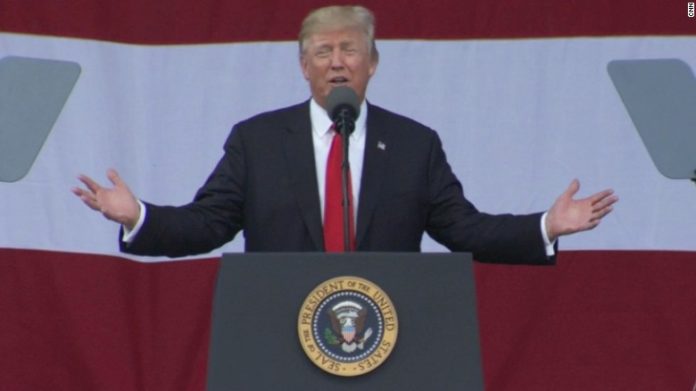
US President Donald Trump has been ‘awarded’ the ‘Overall Achievement in Undermining Global Press Freedom’ award by the Committee to Protect Journalists (CPJ).
This follows the CPJ naming its ‘Global Press Oppressors’, described by the journalists’ lobby group as the world leaders who use rhetoric, legal action, and censorship to try to silence their critics.
The list also features leaders from China, Egypt, Myanmar, Poland, Russia, Turkey, all of who have gone out of their way to attack the press and undermine the norms that support freedom of the media at a time when a record number of journalists are being jailed for their work.
“It’s staggering to see the extent to which some world leaders are so fearful of their critics and the truth,” said CPJ Advocacy Director Courtney Radsch, from Washington, DC, adding: “At a time when the number of journalists in prison globally is at a record high the failure of President Donald Trump and other leaders to stand up for press freedom risks weakening democracy and human rights.”
The Global Press Oppressors list includes four categories as well as an award for the one of President Donald Trump, the Overall Achievement in Undermining Global Press Freedom.
Most Thin-skinned
President Recep Tayyip Erdoğan, Turkey
Runner-Up: President Donald Trump, United States Most Outrageous Use of Terror Laws Against the Press
President Recep Tayyip Erdoğan, Turkey
Runner-Up: President Abdel Fattah el-Sisi, Egypt Tightest Grip on Media*
President Xi Jinping, China
Runner-Up: President Vladimir Putin, Russia
*This category excludes countries with no independent media, such as North Korea and Eritrea.
Biggest Backslider in Press Freedom
State Counselor and de facto leader Aung San Suu Kyi, Myanmar
Runner-Up: President Andrzej Duda, Poland
Overall Achievement in Undermining Global Press Freedom
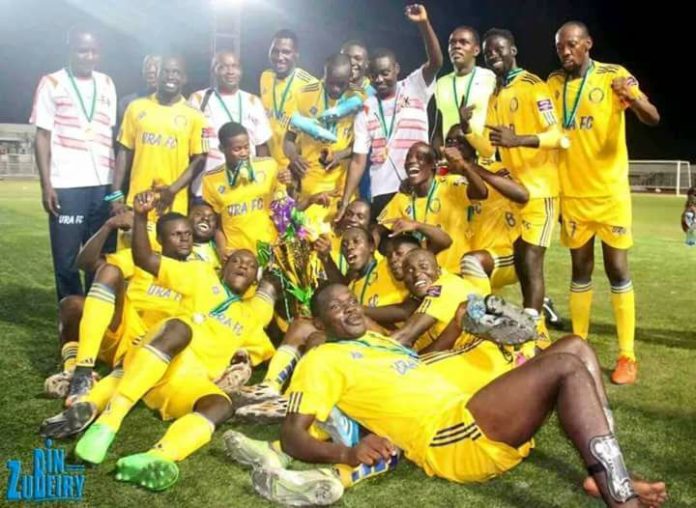
Uganda Revenue Authority (URA) Football Club, Uganda’s representatives in the Mapinduzi Cup, have qualified for the semifinals after defeating Tanzanian side Simba 1-0 in the final group game.
The only goal of the game was scored by Deboss Kalama in added time of the first half.
The Ugandan tax collectors, who won three games in a row, led group A with 10 points from four games, qualifying out of the group alongside Azam which had 9 points.
Three Tanzanian clubs qualified to the semi-finals after both SC Yanga and Singida United drew 1-1 to advance to the knock-out stage from group B.
The semifinals will be played on Wednesday, January 10.
The final of the 2018 Mapinduzi Cup is scheduled for Saturday January 13, 2018 at 8:15pm at the Amaan Stadium in Zanzibar.
URA are the defending champions of the Mapinduzi Cup. The knockout tournament is held every January in Zanzibar and involves clubs especially in the CECAFA region.
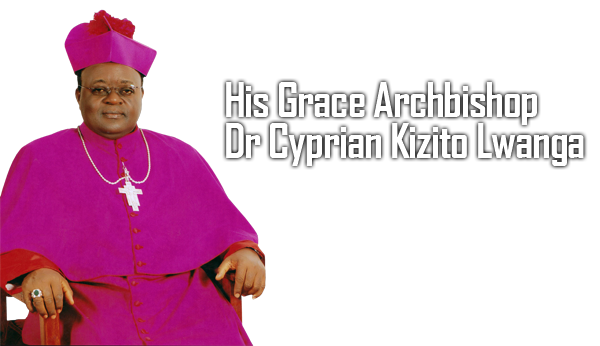
The Catholic Archbishop of Kampala Diocese Dr. Cyprian Kizito Lwanga has today said the churches are not at variance with the state. This is after he implored Ugandans to resist bad politics following the amendment of Article 102 (b) that removed both the lower and upper presidential age limit that was set at 35 and 75 years, respectively.
“Political issues affects lives of every Ugandan; every Ugandan is entitled to freedom of speech and expression conscience and belief,” said Archbishop Lwanga, in his New Year’s Day message.
“The church is not an enemy of the state,” added Archbishop Lwanga who came into limelight after he vehemently opposed the lifting of the presidential age limit bill, which was signed into law by President Yoweri Museveni in December last year, in the process expunging the 75-year cap.
Archbishop Lwanga, who was addressing mourners at the burial of the late Anglican Archbishop Livingstone Mpalanyi Nkoyoyo, said instead that the ‘church is the conscience of the state’.
“The remarks we make are none other than those telling the truth because the church is the conscience of the State,” the outspoken prelate told the congregation that also included President Museveni, who recently assented to the controversial bill.
Since then there has been an exchange of words between government officials and various clerics, with the latter imploring the former to restrain themselves from commenting on political issues.
President Museveni is one of those politicians, and in his New Year’s message to Ugandans, urged clerics to stay clear of politics, and accusing some of them of being arrogant.
“They talk most authoritatively on all and everything even when they have not bothered to find out the truth,” Museveni said.
Meanwhile, President Museveni has hailed Archbishop Nkoyoyo, saying he contributed to fighting poverty and uniting Ugandans despite their beliefs.
The retired Archbishop, who succumbed to pneumonia last week aged 79, has this afternoon been laid to rest at Namugongo Christian Martyrs Shrine.
Archbishop Nkoyoyo is survived by a widow, Ruth Nkoyoyo, and children.
Three of the six MPs who were suspended by Speaker Rebecca Kadaga in December 2017 over the controversial age limit bill return tomorrow, Deputy Speaker Jacob Oulanyah has informed the House.
According to Oulanyah, Anthony Akol, Ibrahim Ssemujju and Gerald Karuhanga, all of who had been suspended for three sittings, return to work tomorrow while Allan Ssewanyana, Jonathan Odur and Mubarak Munyagwa, who had been suspended for seven sittings, will reseme their duties on Wednesday, January 17, 2018.
Oulanyah also called for unity among all players across the political divide, in light of the signing into law of the sharply divisive Age Limit Bill by President Yoweri Museveni.
His remarks came after members of the leading Opposition party, the Forum for Democratic Change (FDC) urged Ugandans to shun MPs that championed expunging of age limit clause in the Constitution.
In that respect the Deputy Speaker urged all MPs to put their differences behind and work to fulfill the expectations of their voters.
“I urge members to work together not divide, to see that we fulfill the expectations of our people as Parliamentarians in carrying out our oversight works, representations. We should promote harmony, understanding, dialogue and engage ourselves other than doing the contrary,” Oulanyah implored.
The Deputy Speaker noted that 2017 was a very challenging for Uganda’s Parliament, and implored the MPs to work collectively to ensure that the unbecoming incidences don’t ever recur.
“I urge the leadership of Leader of Opposition, Prime Minister and all Whips to dialogue that we shouldn’t execute our responsibilities effectively and efficiently but also ensure all parties across political divide coexist because they need each other,” Oulanyah said, and argued that it is time for all parties to dialogue.
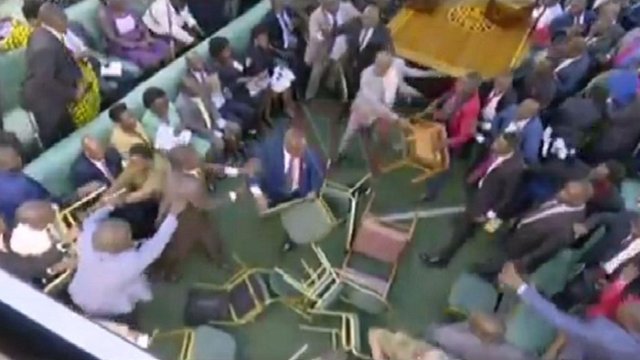
His remarks were in resonance with the September 27, 2017 brawl that occurred in the Parliament chambers where plain clothed security operatives sieged the house and violently ejected opposition MPs.
The violent exchange between MPs opposed to lifting of Presidential Age Limit and security forces followed a communication by Kadaga, suspending 25 MPs over what she termed as ‘indiscipline’.
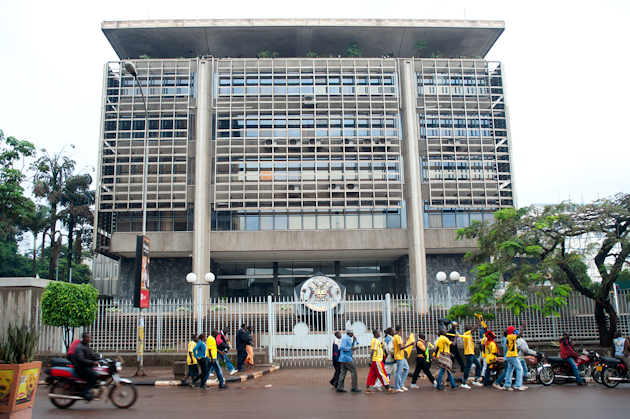
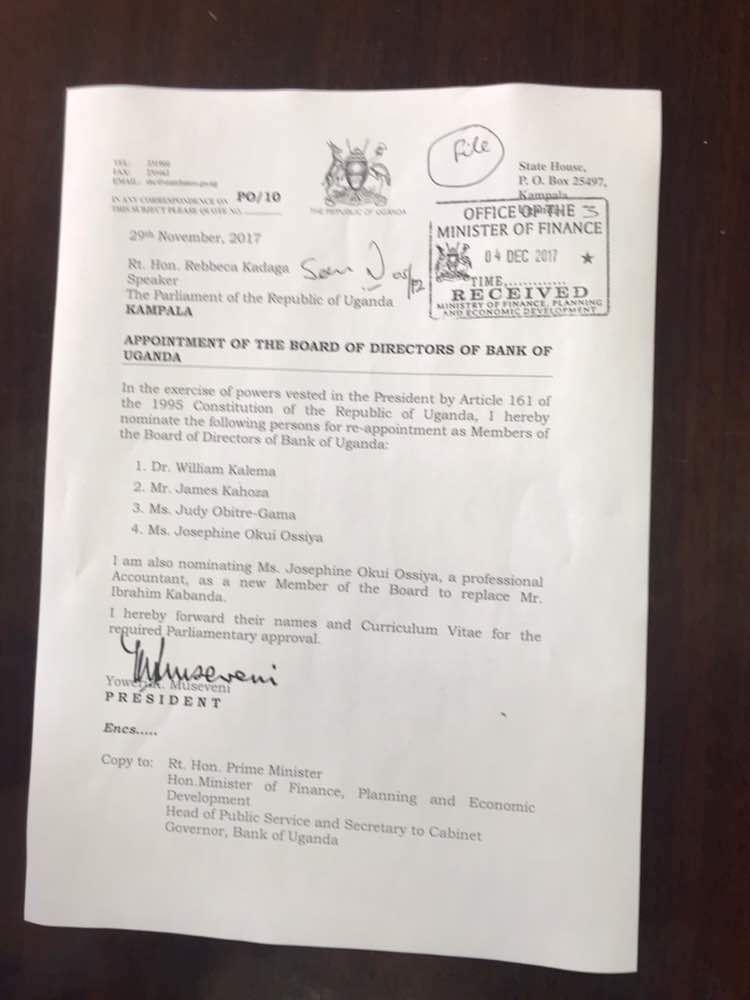
President yoweri Museveni has appointed new board members to Bank of Uganda.
In a letter dated November 29, 2017 to Speaker of Parliament, Mr Museveni nominated Dr. Willam Kalema, Mr. James Kahoza, Ms Jude Obitre Gama for reappointment while Ms Josephine Okui Ossiya was appointed to replace Mr brahim Kabanda.
“In the exercise of powers vested in the President by Article 161 of the 1995 Constitution of the Republic of Uganda, I hereby nominate the following persons for re-appointment as members of the board of directors for Bank of Uganda.” Mr Museveni wrote
Adding “I hereby forward their names and curriculum vitae for the required Parliamentary approval” he wrote in a letter copied to the Prime Minister, Minister of Finance, Planing and Economic Development, Head of Public Service and Secretary to Cabinet and Governor Bank of Uganda.
Bank of Uganda lately has embroiled in many scandals mainly under its supervisory department with over two big commercials banks closed in a period of less than four years while at the same time the bank is under spotlight for overspending on procurement of pens and hiring of private lawyers.