Ugandans at the Katuna border after blocking traffic to the Uganda's southern neighbour, Rwanda
Ugandans residing at the Katuna border post in Kabale have blocked traffic from crossing to and fro Rwanda, accusing the southern neighbour of arresting Ugandans at will.
The development follows the arrest of one Justus Twongyeirwe, allegedly by the Rwanda Police on hitherto unsubstantiated charges.
‘The businessman banked 170 million shillings at the boarder (sic) with intent to move to Kigali and purchase goods as his usual business. He wasn’t aware that Kigali Police was right outside waiting for him; he was first charged with forgery and immediately taken to prison,’ an unofficial document seen by this Website indicates in part.
According to the document, the police turned around and later claimed that Twongyeirwe was taking the money to aid ‘subversive elements’ in Rwanda.
‘Rwanda has now turned around claiming this money was for (Lt. Gen. Faustin) Kayumba, (exiled former Rwanda Defence Forces commander), that it is meant to organize crime in Rwanda after failing to show forgery,’ the document adds.
This development comes in the wake of seemingly frosty relations between Uganda and Rwanda, with the latter arresting police officers allegedly linked to the kidnap and subsequent repatriation of Rwandan refugees and asylum seekers including one Lt. Joel Mutabazi, a former bodyguard of Rwandan President Paul Kagame.
Lt. Mutabazi was subsequently arraigned before the court martial and sentenced to life in prison, a senior police officer, Commissioner of Police (CP) Joel Aguma, is currently being charged by the Army Court Martial for among other crimes, Mutabazi’s forceful return to Rwanda.
Meanwhile, in a related development it has been reported that Rwanda’s High Commissioner to Uganda Major General Frank mugambage has written a ‘protest note’ (Note Verbale) to the Ministry of Foreign Affairs, protesting the alleged arrest of Rwandan nationals in Uganda.
Mengo officials and those from Sadolin led by AkzoNobel’s planning and execution manager, Deon Nieuwoudt, at Masengere Building
Masengere Building, one of the properties of Buganda Kingdom, will get a facelift as Uganda’s top paint manufacturer, Sadolin, has kicked off activities to repaint it since was commissioned in 2015 by the Kabaka – Ronald Mwenda Mutebi II.
Some of the paint to be used at Masengere Building. In the background are the Painters
The function to kick-start the repainting of the building located in Mengo was presided over by her Royal Highness Princess Joan Nassolo, who commended Sadolin, a brand of AkzoNobel, for the good Christmas gesture, adding that Buganda Kingdom intends to work with the company for the years to come.
Princess Nassolo, who said Sadolin has worked with Mengo in the past, appreciated the management and directors of AkzoNobel for always giving back to the community. She urged other companies to emulate Sadolin.
AkzoNobel’s planning and execution manager, Deon Nieuwoudt, who together with Mengo officials commissioned the painting, said the gesture was part of the company’s social corporate responsibility.
Nieuwoudt said Sadolin as a brand of AkzoNobel was grateful in partnering with Buganda Kingdom.
“We take great pride in giving back to communities,” he said adding that the company’s focus is on serving both customers and consumers well. “We have the culture of winning with the people that we serve,” he said.
Nieuwoudt lauded the painters, clad in Sadolin-branded overalls, who have voluntarily decided to paint the building free of charge. He said the company remains committed to partnering with Buganda Kingdom in the future.
Speaking at the function the Speaker of the Buganda Lukiiko, Nelson Kawalya, said Sadolin’s decision to paint the historical building was a good cause.
“All of us are going to benefit,” Mr. Kawalya said, adding that he has been using Sadolin paint on his house.
The function was also attended by Buganda State minister of culture and tourism, Yusuf Wamala Ggaganga.
Sadolin Paints re-launched on the Ugandan market and announced Crown Group, manufacturers of Regal Paints as their new local partners. Through a toll agreement and partnership, Crown Group will oversee the Sadolin Paints sales and distribution network.
In December, Sadolin Paints financially supported the Uganda Society of Architects Annual General Meeting (AGM) in Kampala, which was also part of the company’s corporate social responsibility. Sadolin was founded by Gunnar Sadolin in 1907and has been owned by AkzoNobel since 1987.
Meanwhile, Sadolin is investing US$3 million in a new paint plant in Namanve industrial Park expected to be launched next year.
Applicants registering for Tuskys Internship programme
Regional retailer Tusker Mattresses has announced plans to unveil a training exchange programme for Ugandan nationals seeking to advance their careers in retail management.
Commencing January next year, Tuskys Uganda subsidiary will nominate and send entry level and mid-level management trainees to undertake an all-expense paid practical training module at the Joram Kamau Leadership School.
According to Tusker Mattresses Group CEO, Mr. Dan Githua, the training exchange programme is part of the firm’s commitment to foster regional formal retail management talent.
As part of the firm’s human resource development programme, Githua said there are plans to facilitate training for more than 600 Ugandan nationals working at the firm’s seven branches locally and in Kenya.
The training programme for Ugandans, Githua said, comes hot on the heels of the recent rollout of a similar project in Kenya.
“At Tuskys, we are committed to advancing formal retail management by nurturing talent at an academic and practical level as part of our contribution to social economic growth in East Africa,” Githua said.
“For this reason, we’ll have the first cohort of 15 Ugandans commencing their studies at our Joram Kamau Leadership School this January,” he added.
Plans to host the second group featuring more than 50 trainees, Githua said, are also at an advanced stage.
The Ugandan nationals picked to undergo training will undertake comprehensive hands on training in retail operations and management.
Established in 2015, the school provides academic and practical skills training for entry level students wishing to pursue formal retail careers. Studies at the Joram Kamau Leadership School cover both elementary and management level retail studies.
Plans are already underway to certify the school’s training curriculum with Kenya Institute of Curriculum Development at certificate, diploma and degree levels.
Tuskys’ ongoing corporate transformation efforts recently received a global commendation at the prestigious 4th World Branding Awards held at the Kensington Palace in London.
In a rare commendation for a local brand, Tuskys won the Kenya Supermarket Brand of the Year category. The World Branding Awards is the premier awards of the World Branding Forum for corporates drawn from the Commonwealth.
The win completes an awards hat-trick for Tuskys which was recently adjudged an East Africa Superbrand Top 20 and Samsung Africa’s most valued distributor in East Africa.
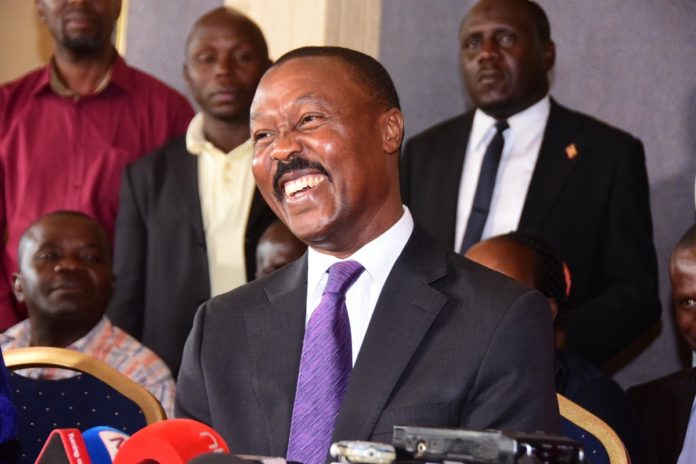
Former Forum for Democratic Change (FDC) president Major General Mugisha Muntu has said Ugandans need to come together and ensure that the country is governed in accordance to the law.
Muntu’s message comes in the wake of yesterday’s expunging of Article 102 (b) that capped the presidential age limit at 75 years.
The MPs, majority from the ruling National Resistance Movement (NRM), voted 317 against 97, to sail through the controversial bill that was tabled by Igara West legislator Raphael Magyezi.
The legislators, ‘borrowing’ part of a majority Report by the legal and parliamentary affairs committee chaired by Jacob Oboth-Oboth, also surprisingly extended their term of office from five to seven years during a stormy session that was chaired by Speaker Rebecca Kadaga.
Against such a background, Muntu encouraged Ugandans to support each other irrespective of party affiliation.
“Let us reach out across party lines and build good will among potential partners in the struggle. Let us get our young people to understand the struggle to change this country’s politics, in fact the struggle to better their future,” Gen. Muntu, a former Army Commander, wrote.
He added: “Stand up for what you believe in despite all odds because we are on the right side of the history of this country in whatever path we choose in our quest to wrest power from dictatorship.”
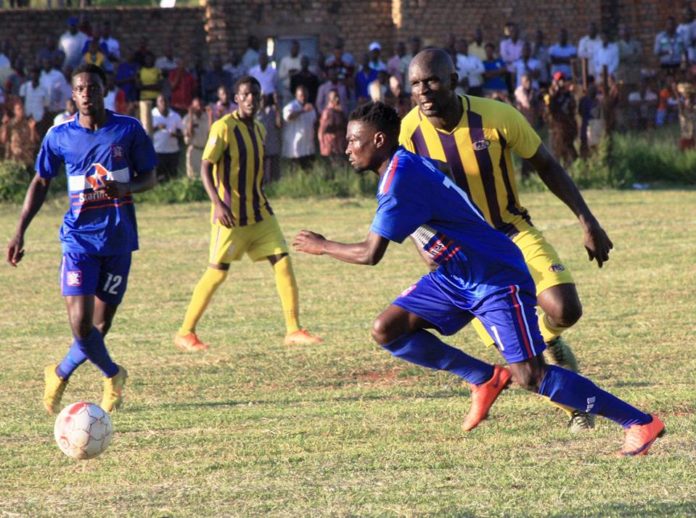
SC Villa players (in blue) playing against Proline. Both teams have qualified for the Round of 16
After the completion of the matchday 14 fixtures, SC Villa opened a five point gap at the top of the table after defeating Proline 2-1 in a game played at the Masaka Recreational Stadium on Wednesday.
The Jogoos came from behind to win their 10th game of the season with goals from Yahaya Kakooza and Martin Kizza after Musa Mukasa’s own goal that had put Proline ahead.
The Masaka-based club now have 31 points, five ahead of defending champions KCCA. Villa will now go into the first round break at the top of the table as the players to prepare for the CHAN tournament scheduled for the beginning of next month.
The Jogoos are looking for their first league title in 14 years, their last coming in 2004 when still managed by former Cranes boss Micho Sredojevic.
Meanwhile, SC Villa travel to Jinja on Saturday for their final game of the first round to face Kirinya Jinja S.S at the Kyabazinga stadium in Bugembe.
The Uganda Medical Association (UMA) president Ekwaro Obuku was last evening attacked by unknown goons at his home in Kira municipality, and is currently admitted to Case Hospital in Kampala.
It is said that Dr. Obuku sustained minor injuries as he waited for his gate to be opened.
Dr. Obuku has been the face of the medical workers industrial action that started on October 30, 2017 after government failed to heed to the doctors’ pleas for better pay and favorable working conditions.
Some Somali lawmakers said on Wednesday they plan to impeach the president in a mounting political crisis that could put the fledgling government on a violent collision course with one of the country’s most powerful clans.
The political turmoil endangers fragile gains against the Islamist al Shabaab insurgency and could derail the government of President Mohamed Abdullahi. Universally known by his nickname ‘Farmajo’, the dual U.S.-Somali citizen took power earlier this year in a UN-backed process.
The Horn of Africa state’s parliament adjourned last week until the end of February, but some legislators want it to reconvene on an emergency basis, lawmaker Mahad Salad said.
“Ninety-six lawmakers have asked the Speaker to reopen the session so that the impeachment against the president kicks off. The president is accused of violation of the constitution, treason, destruction of the federal states and so on,” he said.
The letter had not yet been delivered to the Speaker. There are 275 lawmakers and two-thirds would have to vote against the president to impeach him.
The motion follows a deadly raid on Sunday on the home of an opposition leader, Abdirahman Abdishakur Warsame, who ran for the presidency against Farmajo. Somali security agents arrived at his house around midnight and engaged his guards in a firefight, killing five people.
The minister of security said Warsame resisted arrest and he would be charged with treason. He appeared in court on Tuesday but no warrant was shown for his arrest, a witness said. A Wednesday court hearing was postponed until Thursday.
The information minister did not return calls seeking comment. A statement from the security minister and attorney general said they were “investigating the crimes of Somalis who were involved in treason, terror and the destruction of government systems”.
Powerful clan
Warsame comes from Somalia’s formidable Habar Gidir clan, which is spread across south-central Somalia. Although both his supporters and the government stress that his detention is political, rather than a clan issue, it will further sour relations between the two sides.
If that sparks fighting it could split Somalia’s security forces, which are composed mostly of clan-based militias. In September, a battle between the police, intelligence, and military killed nine people in Mogadishu’s Habar Gidir district.
“It’s a lose-lose situation for the government. If they pursue this, they face a showdown with the Habar Gidir, who are powerful, wealthy and well-armed and provide many units in the SNA,” said a Somalia security analyst who spoke on condition of anonymity, referring to the Somali National Army.
“If they back down, they look weak. It’s very hard to see how the administration could survive this crisis.”
In August, a joint U.S.-Somali raid in the town of Bariire killed 10 Habar Gidir members. The U.S. military said they were Islamist militants but clan elders said they were civilians.
In May, a soldier accidentally killed the minister of public works in a case of mistaken identity. A Habar Gidir clan member, the soldier was sentenced to death, angering clan members who felt that blood money should have been accepted.
Political problems
Somalia’s new government has won plaudits from diplomats for trying to assess the extent of mismanagement and corruption in the armed forces and the International Monetary Fund has praised it for fiscal reforms.
But at home, the government has many problems.
It has hired and fired a string of top security officials. Al Shabaab militants, skilled at exploiting clan divisions, stepped up a campaign of deadly bombings in Mogadishu. One October bomb killed more than 500 people.
A split between Qatar and the United Arab Emirates, both of which have supported Somali factions, has fuelled a spat between the president and leaders of Somalia’s regional administrations, damaging security cooperation.
This month, the U.S. government announced it was suspending aid to most of the military over accountability concerns.
Now many parliamentarians are angry that a government that promotes itself as reformist is arresting critics like Warsame, said Abdirizak Mohamed, a lawmaker and former security minister.
“MPs are concerned about freedom of expression and association. This was an unnecessary crisis when they already had a lot on their plate.”
City tycoon Sudhir Ruparelia discusses with his lawyers and friends after the court ruling
City tycoon Sudhir Ruparelia has floored lawyers Timothy Masembe Kanyerezi and David Mpanga, who were representing the Bank of Uganda in a Shs400 billion case involving Crane Bank, now in receivership.
Sudhir Ruparelia with friends and his lawyers after the ruling
In a ruling delivered by Commercial Court Registrar Lillian Bucyana on behalf of Justice David Wangututsi, she said it would defeat the importance of secrecy because Mpanga and Kanyerezi knew that there existed a substantial relation between the applicant and them.
“A lot of information must have flown between them; conflict of interest may not exist but secrecy. Mr. Mpanga negotiated and drafted the Confidential Settlement Agreement. The Settlement Agreement however, developed disagreements. The moment Mpanga drafted the agreement he should have known that this was part of the assignments with the applicant. And therefore his status as a potential witness is known,” Ms. Bucyana said.
“The first and second defendants have found themselves in a very difficult situation because they have ever represented the applicant. The first and second defendants are disqualified from the main suit,” she added.
Eric Adriko, who represented Masembe, told court that he had been instructed to appeal the ruling.
“We shall be lodging the final notice of appeal by the end of the day,” Adriko said.
However, speaking to the press shortly after the ruling, Mr. Ruparelia said the two lawyers wanted money.
“It is all about money (legal fees), that these lawyers are fighting for. But justice has prevailed; we need to go to the next level and we are ready for mediation,” Mr Ruparelia said.
Mr. Ruparelia went to the Commercial Court arguing that by representing BoU in the case Masembe of MMAKS Advocates and Mpanga of AF Mpanga Advocates, were acting in conflict of interest because they had represented him and his companies for over a decade and, should therefore act as witnesses in Uganda’s biggest commercial case.
At the time, while pleading his case, Sudhir’s lawyers from Kampala Associated Advocates led by Peter Kabatsi said his two professional colleagues are privy to confidential information that could be prejudicial to the businessman’s case.
Another lawyer, Bruce Musinguzi adduced evidence of numerous transactions to court, in which Masembe and Mpanga represented Crane Bank, Sudhir Ruparelia and Meera investments.
Sudhir’s lawyers further argued that Masembe and Mpanga’s actions violated the advocate-client relationship and the professional conduct regulations.
Geneber Outspan Organic Investment Club from Amolatar wins the top prize of UGX25m in Season 1 of the dfcu Investment Club Challenge in partnership with NTV & PwC
The dfcu Bank, in partnership with NTV Uganda and Price Waterhouse Coopers (PwC) have just concluded a nationwide campaign targeted at driving a savings and investment culture in Uganda.
The campaign, which has been running over the last three months, was a TV show competition dubbed ‘Battle for Cash’ won by Geneber Outspan Organic Farmers which walked away with Shs25 million and coming in second, The Peak Investment Club, which won Shs15 Million.
The third winner Sikyomu Development Organisation got Shs10 million while the fourth and fifth clubs both got Shs5 million each.
The Battle for Cash challenge has been running on NTV every Thursday at 8:00pm and between June and August, dfcu Bank had teams going round the country carrying out regional saving and financial literacy workshops.
Some of the topics covered included among other themes ‘Why and how to save’, ‘where to invest money so it can grow’ and ‘things to think about when thinking of investing’, all aimed at changing the attitudes about money, savings and investments.
dfcu Bank received applications from close to 200 Investment Clubs across the country, which were independently vetted by PwC and zeroed down to 20 clubs that entered the TV competition.
As part of the application process, clubs were tasked to develop a Business plan for an innovative investment project. So at the start of the show all shortlisted 20 clubs had to defend the business plan they wrote to a panel of judges to make it to the next show.
The clubs were trained in different aspects and assigned weekly tasks to demonstrate their ability to put into practice what they had been taught.
“We are grateful to dfcu Bank for championing this cause as part of financial literacy in Uganda. An enlightened community will always invest wisely so we encourage all able men and women should come together and form savings clubs to guarantee their future,” said Ag. Managing Director, NTV Uganda Johnson Omolo.
Meanwhile, in recognition of the role of women and youth in development there was a special category for both categories.
Head of Consumer Banking Denis Kibukamusoke awards best Youth group in the Battle for Cash competition
The best youth club price was scooped by Plus Save Group and Soroti Women Cooperative Union were awarded in the best women club category. Both clubs walked away with Shs7.5 million each.
Speaking during the Battle for Cash grand finale and awards gala, the dfcu Bank Executive Director and Chief of Business William Sekabembe said; “In terms of changing culture, you will appreciate that it takes some time. What we have seen though, over the last six (6) months, is growth in the number of investment clubs opened with dfcu Bank across the country. Even more important we have seen several Clubs reorganizing themselves and becoming more focused in terms of developing ideas for investment.”
dfcu Bank introduced the Investment Clubs program in 2007 providing a conducive platform to foster group savings. The dfcu Bank program has since grown with over 10,000 Investment Clubs that cut across all segments including students, the professionals, women and youth holding a savings turnover in hundreds of billions of shillings.
“It is not enough to simply save money if it is not growing so the Investment Club challenge was also about challenging the investments clubs and the public to think through how to grow & multiply their savings,” Sekabembe added.
“We have had a lot of learning from specialists in different areas of business. The exposure that we have got has been very important and it has helped improve the running of our businesses. It has been a great opportunity to get ideas on how to handle different business challenges,” said Geneber Outspan Organic Farmers, winners of the Battle for Cash finale.
Speaking at the event, PwC Country Assurance Manager, Uthman Mayanja said PwC was proud to be part of this initiative supporting transformational ideas.
“Our role in this initiative is to facilitate and support the different teams, and transform them from simple savings’ clubs to sophisticated investment clubs,” he added.
According to the Ambassador of France to Uganda, Stephanie Rivoal, chief guest at the grand finale and awards gala, Uganda’s young population presents an incredible opportunity to spur growth and achieve Vision 2040 of a transformed, modern and prosperous country.
“Government together with the private sector can make this dream a reality through policies and ventures that favour entrepreneurship, innovation, sustainable investments and a savings culture among the population. dfcu Bank’s Investments Clubs initiative deserves an applause,” she added.
During the Battle for Cash challenge, emphasis was put on two special groups of women and youth.
Clubs with 100% composition of these special groups applied to enter the competition and were added into a special category for Women and Youth clubs, increasing their chances of winning.
This was in belief that these two categories play a major role in the development of communities and Uganda as a whole.
An amount totaling to Shs100 million in prize money was set aside for the Investment Club challenge including regional draws carried out in different parts of the country.
Additionally, one delegate from each of the 20 selected clubs that entered the competition is to be sponsored to attend a study tour in Nairobi in January 2018.
This as the top seven clubs will receive free advisory services for a period of one year courtesy of PwC.
EPRC Research Fellow, Brian Sserunjogi, presents the BCI findings to participants during a dissemination workshop held in Mbale. Photo by Mouris Opolot
The second Business Climate Index (BCI) research dissemination held in the Northern and Eastern region for the financial year 2017/18 saw business owners and local leader’s list difficulties affecting their smooth operation and growth.
During the Northern region workshop held in Lira, Charles Onencan, a member-Uganda National Chamber of Commerce and Industry for Gulu District decried the unfair tax regime, which he says, favours foreigners. “Tax waivers to foreigners pits local firms who are left with no choice than opt out of business,” he said.
Alex Oremo Alot, the Lira District Chairperson called for harmonization of interest rates to ease borrowing among local traders and producers. “You cannot grow when you are getting loans at very high interest rates; once the collateral is attached to the loan by lenders, business owners lose morale,” he noted.
He urged parliament to intervene in bringing the interest rate down to enable a favourable business environment.
Oremo said that Lira District was striving hard to become a very powerful industrial city for the northern region and asked that local governments be given 40 percent of the national resource envelope to achieve tangible outcomes in key areas such as service delivery.
He warned local entrepreneurs against taking business matters lightly, stating carelessness in the running of businesses has led to the collapse of many ventures as the proprietors fail to overcome dangerous conditions.
The business community reported that the process of certification of products by the Uganda National Bureau of Standards (UNBS) is riddled with bureaucracy.
They further noted that UNBS lacked capacity in terms of finance and human resource to enforce standards. They noted that UNBS major capacity in their localities was confiscation of weighing scales and did not sensitize the business community on what to look for before buying a correct weighing scale.
The businessmen noted that maize exports to Kenya were fetching very little due to low quality.
“Uganda’s maize to Kenya is only suitable for animal consumption,” they argued.
On inadequacy of information regarding business registration, Susan Auma, the Uganda Registration Services Bureau (URSB) official for Lira district asked business people to always look out for information to avoid being misled.
“Look for those institutions and find out what they do, when you have the information you are very rich, you will not be cheated by brokers. Registration of business is Shs24, 000 and one time we had a case where one person was charged over Shs200, 000 by suspecting agents,” She said.
The disseminations were spearheaded by EPRC Research Fellows, Paul Corti Lakuma and Brian Sserunjogi. It provided a platform for closer and meaningful engagement of the private sector and research with a view of fostering research uptake by the business community and policy makers.