Stanbic Bank
Stanbic Bank
19.8 C
Kampala
Stanbic Bank
Stanbic Bank
Home Blog Page 1726

Bamugereire Commission given six-month extension

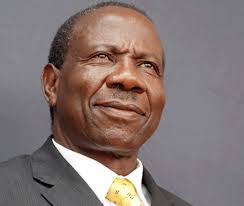
Justice Catherine Bamugemereire

President Yoweri Museveni has extended the span of Commission of Inquiry into Land Matters for another six months following the expiry of their tenure on 9th November.

The committee headed by Justice Catherine Bamugemereire was appointed on December 8, 2016 and sworn in on February 17, to inquire into the Effectiveness of Law, Policies and Processes of land Acquisition, Land Administration, Land Management and Land Registration in Uganda.

It opened its public hearings on May 9 at the National Records Centre and Archives under the Ministry of Public Service.

According to the Amendment of Legal Notice No. 2 of 2017 dated November 5, President Museveni wrote: “…this Notice shall be deemed to have come into force on the 10th day of November 2017…The Commission shall execute its mandate under this Notice, within six months from the date of publication of this Notice”.

Justice Catherine Bamugemereire acknowledged the President’s directive, saying it is an endorsement of the work of the Commission by the appointing authority.

The Commission has over the past few months, conducted several public hearings in and outside Kampala as well as unearthing a number of wrongful land evictions and mismanagement. Field visits have been conducted in the areas of Wakiso, Nakaseke, Luwero, Mukono, Jinja, Hoima, Mubende, Masaka, Gulu and Mbarara, among others.

The other Commissioners are Owekitiibwa Robert Ssebunnya; Mrs. Mary Oduka Ochan; Mrs. Joyce Gunze Habaasa; Dr. Rose Nakayi; Mr. Fredrick Ruhindi and Mr. George Bagonza Tinkamanyire. The support team has: Ms. Olive Kazaarwe Mukwaya (Commission Secretary), Dr. Douglas Singiza (Assistant SecretaryResearch), Mr. Ebert Byenkya (Lead Counsel) and Mr. John Bosco Rujagaata Suuza (Assistant Lead Counsel).

Stories Continues after ad

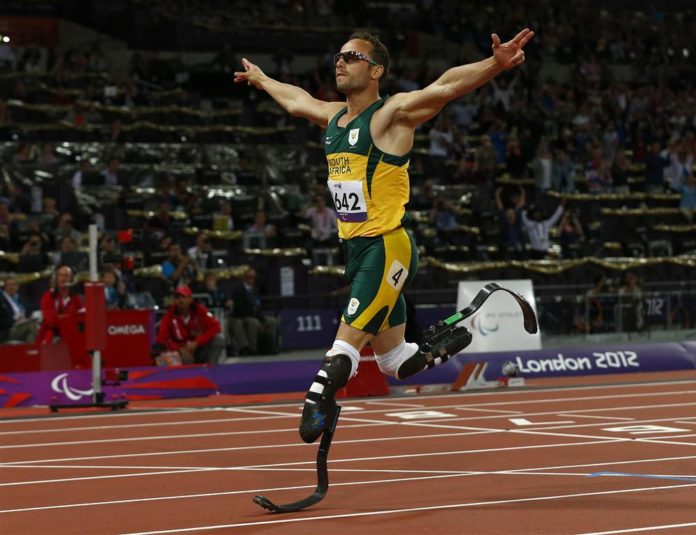
DStv to Screen Oscar Pistorius: Blade Runner Killer on Lifetime

Oscar-Pistorius

A biopic movie which tells the story of the rise and fall of Paralympian Oscar Pistorius, ‘Oscar Pistorius: Blade Runner Killer’ will air on Lifetime (DStv channel 131) this Saturday November, 18.

The made-for-television movie, written by Amber Benson and co-produced by ThinkFactory Media, is based on a true story and public records.

The movie tells the story of the world-renowned sprint runner Oscar Pistorius (played by Andreas Damm) who was dubbed the ‘Blade Runner’ and his rise to fame as a gold medalist Paralympic champion and as the first double-leg amputee to participate in the Olympics.

The movie looks at Oscar’s resilience to overcome his disability, combined with his apparent fairy tale relationship with model Reeva Steenkap (played by Toni Garrn).

On Valentines’ Day of 2013, Oscar Pistorius shot and killed his model girlfriend Reeva Steenkamp behind a closed bathroom door, saying he thought he was shooting at an intruder.


He has since been convicted and is serving time in jail. Oscar Pistorius: Blade Runner Killer also looks at how Reeva’s brutal death shocked the world and details the court room drama that followed.

The families of Oscar and Reeva did not participate in the making of this movie. The movie is produced by Eric Tomosunas and Swirl Films for Thinkfactory Media and executive produced by Leslie Greif. Norman Stone directs it.


Stories Continues after ad

BoU should use the scarce taxpayers’ resources prudently

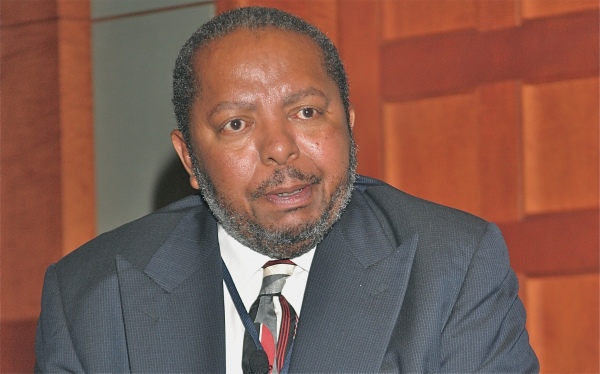
THERE IS NEED FOR PRUDENTIAL EXPENDITURE: BoU Governor Emmanuel Tumusime -Mutebile

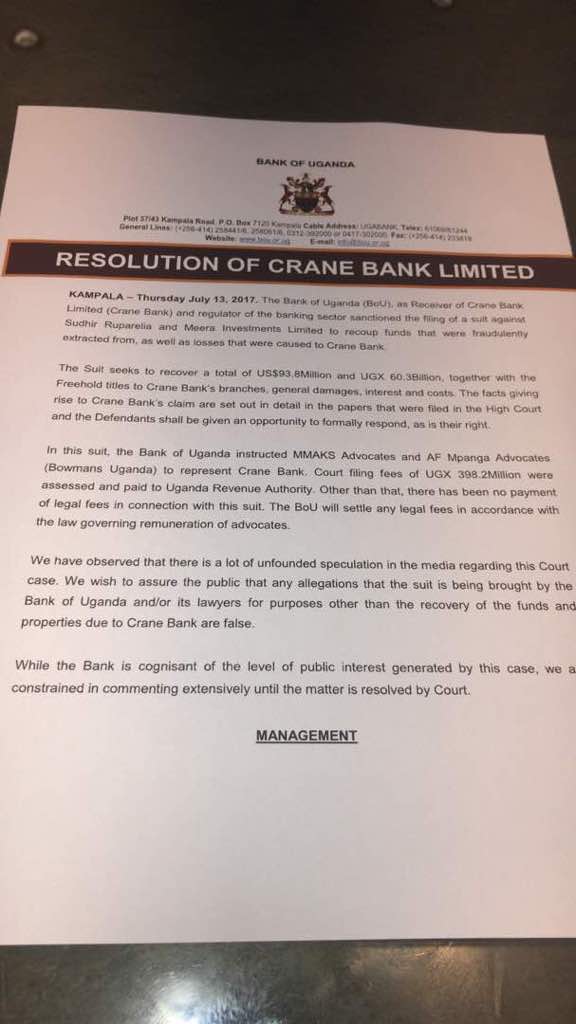
The Bank of Uganda and tycoon Sudhir Ruparelia have agreed to settle the dispute regarding the closure of Crane Bank through mediation.

This move by the two parties is laudable and depicts a level of maturity that was lacking at the beginning of the whole saga, a development which led the central bank to plough billions of taxpayers’ money to pay lawyers to pursue the case against Mr. Ruparelia.

Surely, the country is financially constrained and can ill-afford to splurge out the hard-earned money on a few individuals, yet the majority of Ugandans are suffering, some even going without food for days.

Currently, almost the whole public sector is on strike owing to the poor pay and working conditions. Against such a background therefore, the country badly needs value-for-money expenditures, mostly from institutions that are established to supervise monetary policy and also to regulate the supply of money in the country. Why then spend Shs4 billion on litigation when it can solve other pressing needs? And why did BoU deny that they hadn’t paid money to lawyers in the first place? All these calls for a thoroughly investigations into activities of BoU especially its supervisory role.

Without prejudice, Mr. Ruparelia was employing hundreds of people, in the process helping improve the lives of so many including his employees’ dependents. Also, it is worth noting that through his various companies, Mr. Ruparelia was also one of the biggest contributors to the national kitty.

Of course the above do not exonerate Mr. Ruparelia from pursuing the duties of a good citizen, but on the other hand his huge investments in the country should provide him with a leveraging point for negotiations that lead to an amicable resolution of any disputes that might arise.

That said, henceforth the BoU should strive to ensure that commercial banks in the country are managed in a manner that does not destabilise the economy.

In other words, the central bank should strengthen its bank supervision directorate to ensure that the commercial banks adhere to the fiduciary management guidelines as set by the BoU.

Stories Continues after ad

Okello Oryem, envoys discuss political situation in South Sudan

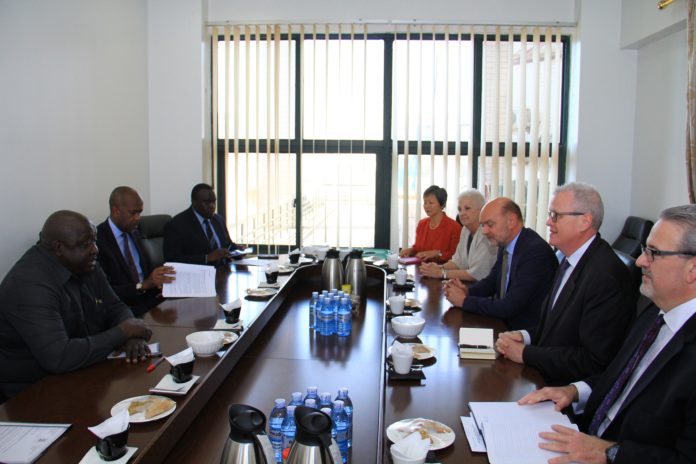
Trioka officials at the meeting with Minister Okello Oryem

The Minister of State for Foreign Affairs Henry Okello Oryem on Friday met with representatives of the South Sudan peace-guarantor from Norway, the United Kingdom and the United States.

The ‘Troika’ representatives, Mr Paul Sutphin (USA), Mr Chris Trott (UK) and Mr Erling Skjonsberg (Norway), discussed the current political situation in South Sudan and the resultant refugee crisis in the neighboring countries, especially in Uganda.

During the meeting at the ministry headquarters, the members of the Troika reiterated their strong support for the combined efforts of the African Union (AU), Intergovernmental Authority on Development (IGAD), and United Nations to end the conflict in South Sudan, and joined their recent calls on all armed parties, including the Government of South Sudan, the Sudan People’s Liberation Movement in Opposition, and other armed groups, to commit to a ceasefire.

They emphasized that the dire humanitarian crisis in South Sudan is the direct result of the conflict and called on all parties to cease violence against humanitarian workers and obstruction of humanitarian assistance.

The Troika also endorsed the ongoing efforts by IGAD and praised Uganda’s peace initiative which aimed at bringing the warring parties to the negotiating table, positively noting that this initiative was endorsed by both parties to the conflict.

The Troika expressed pleasure that Uganda is in full support of the IGAD process and also endorsed the work of the UN Mission in the Republic of South Sudan, and the deployment of its Regional Protection Force.

On his part minister Okello Oryem stressed the importance of the support being extended towards all the peace initiatives, and assured them that Uganda will continue playing a mediatory and conciliatory role between the belligerent parties to ensure that an agreement is reached.

In attendance at the meeting were the Heads of Diplomatic Missions of the Troika resident in Kampala and senior officials of the Ministry of Foreign Affairs.


Stories Continues after ad

Museveni threatens to dismiss striking doctors

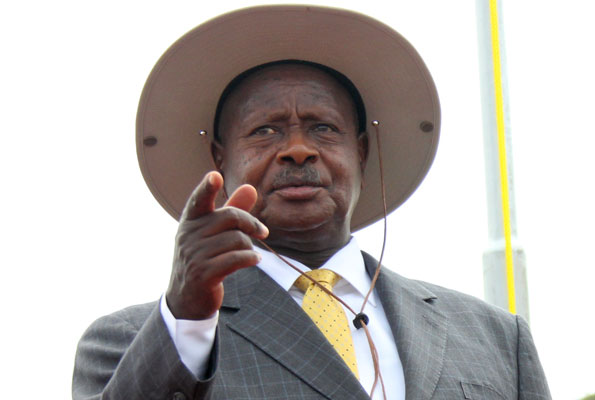
President Museveni

President Yoweri Museveni has threatened to sack striking medics, saying government is soon getting ‘good doctors’ to replace them.

Addressing a rally at Karambi sub county headquarters in Kabarole district, president Museveni lauded the doctors there for not engaging in the strike and vowed that his government will not allow medics who want Ugandans to die. “The striking doctors have betrayed me,” he said.

Two weeks ago, medical workers under their umbrella body, the Uganda Medical Association (UMA), opted for industrial action, protesting government failure to increase their salaries and improve their working conditions.

But according to president Museveni, the doctors decided to go on strike before tabling of a bill that will harmonise the salary structures of all civil servants.

“They have resorted to telling lies on propaganda radios; I can even close those radios,” he threatened.

Last week president Museveni directed the Resident District Commissioners (RDCs) to monitor all health centres and report doctors who do not turn up for duty but that had no effect as the doctors have not returned to work.


Stories Continues after ad

Kiir, former SPLA Commander ‘reconcile’

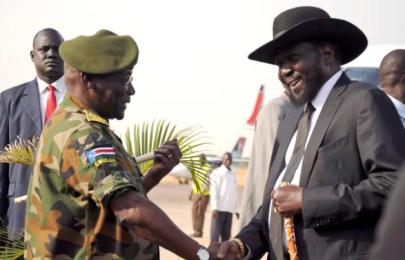
IN HAPPIER TIMES: South Sudan's President Salva Kiir and the now fired Chief of General Staff of the Sudan People's Liberation Army (SPLA) Paul Malong Awan. Photo credit/sudantribune.com

South Sudan’s President Salva Kiir and his former army chief of staff apparently have reconciled, a week after a tense standoff in Juba threatened to escalate into violence.

The reconciliation happened Thursday at a prayer service at the president’s residence in Juba. Pictures surfaced on the internet showing Paul Malong hugging Kiir.

The coziness seems a world away from events last week in Juba, when tanks and dozens of government troops surrounded Malong’s house after he refused to release a platoon of soldiers guarding him.

Malong had been under house arrest at his residence since May, after a string of resignations by military officials who alleged there was ethnic bias in the army, and that soldiers were committing war crimes in the context of South Sudan’s civil war.

Earlier on Thursday, the UN secretary-general’s special representative in South Sudan, David Shearer, praised the Kiir administration for peacefully resolving the weeklong standoff with Malong.

The tanks and troops were withdrawn Saturday after Malong agreed to release 26 of his 30 bodyguards. Shearer said the move calmed tensions.

Shearer told reporters at a U.N. base in Juba that it’s important for South Sudanese to resolve their conflicts internally.

“This conclusion came down simply to the choice of putting South Sudan and stability in Juba before all other concerns. We are grateful for the statesmanlike way in which the situation was resolved,” said Shearer.


Shearer said he hoped the UN Security Council would renew the mandate for the U.N. peacekeeping in mission in South Sudan, which is due to expire a month from now.

A review team is scheduled to arrive in Juba from UN headquarters in New York within two weeks. Shearer said the team would assess the security situation and consult with officials from the government and aid agencies operating in South Sudan.

“This team will also spend two days in Addis Ababa, where it will meet with other South Sudanese groups, including the opposition,” said Shearer.

The review team will provide a report to UN Secretary-General Antonio Guterres, who will report the team’s findings to the Security Council. Shearer said the report would influence the Security Council’s decision on whether to renew the U.N. Mission in South Sudan (UNMISS) mandate.

If the team determines that security conditions have improved in South Sudan, Shearer said the U.N. would help coordinate the “voluntary safe return” of more than 200,000 internally displaced persons (IDPs) sheltering in six U.N. camps across the country.

That number has fluctuated depending on the security situation, but “the trend is now showing a slow decline,” said Shearer.

The UN special representative cautioned, however, that the UN was still far from announcing that conditions are safe for IDPs to return.

Shearer welcomed Kiir’s recent decree ordering security forces and local leaders to allow aid workers unfettered access to 6.2 million people in need of assistance across the country.

“We will continue to monitor the process of that access. The fact that it comes from the top means we anticipate and we expect others right down the chain of the security forces to follow that order,” said Shearer.


Stories Continues after ad

Uganda now able to fight money laundering-FATF

Finance Minister Matia Kasaija

Uganda’s financial system is now robust enough to adequately identify and fight money laundering and the financing of terrorism, prompting the country’s removal from the Financial Action Task Force (FATF) Grey List of countries that face challenges of illicit money transfers.

In a statement to the press, Finance Minister Matia Kasaija said Uganda’s exit from the FATF and the International Cooperation Review Group (FATF/ICRG) review process means the country will no longer be subjected to the FATF’s on-going Global Ant-Money laundering (AML) and combating the financing of terrorism (CFT) compliance processes, easing the way for correspondent banking and other investment and financial flows in the country.

“All countries are required to periodically update the FATF Secretariat on the steps they have taken in that regard. Therefore, being on the FATF Grey List amounted to an indictment on Uganda’s financial system and was therefore a major constraint to correspondent banking; Foreign Direct Investment; and other financial flows to and from Uganda, and thus presented a significant risk to our quest to accelerate economic growth and development outcomes,” Minister Kasaija says.

According to the Minister, FATF urged Uganda to continue working with the Eastern and Southern Africa Anti-Money Laundering Group (ESAAMLG) to sustain improvements in, and effectiveness of, Uganda’s Anti Money Laundering /CFT Regime.

Minister Kasaija says to fight money laundering, government has adequately criminalized terrorist financing, as well as establishing and implementing an adequate legal framework for identifying, tracing and freezing terrorist assets.

He says government has ensured effective record keeping requirements as well as put in place a fully operational Financial Intelligence Unit.

Among others, he says government has ensured appropriate laws and procedures with regard to international cooperation for the FIU and supervisory authorities.

According to Kasaija, Uganda has signed and ratified all the relevant UN Conventions on money laundering, put in place  The Anti-Money Laundering (Amendment) Act, 2017, Anti-Terrorism Act, 2002 has been amended and The Anti-Terrorism (Amendment) Act, 2015. He says government also has laws that govern capital markets and insurance sector as it fights money laundering, not leaving out laws to curb narcotic drugs business.

According to the statement, the Financial Intelligence Authority, in collaboration with other government agencies has put up ML /FT National Risk Assessment (NRA), which provides recommendations and an Action Plan and assigns specific responsibilities to particular public and private entities with respect to AML/CFT.


Stories Continues after ad

Angola’s President fires Dos Santos’ daughter as Sonangol boss

END OF THE ROAD: Isabel dos Santos

Angolan President Joao Lourenco dismissed Isabel dos Santos as chair of state-owned oil company Sonangol as he takes aim at the family of former President Jos Africa’s richest woman was relieved of her post along with the entire board of Sonangol, according to a presidential statement.
Later Wednesday the government ordered the state television station to terminate contracts for the management of a local and an international state-owned channel with two of Dos Santos’ younger children, according to a statement from the Ministry of Social Communications. e Eduardo dos Santos.
Since replacing the 75-year-old Dos Santos as president in September, Lourenco has vowed to end monopolies and fight corruption in a country where the former leader’s family and their allies control huge sectors of the economy. Before today’s dismissals, Lourenco fired the governor of the central bank, the head of diamond company Endiama and the boards of all three state-owned media companies.
Dos Santos’ dismissal “wasn’t unexpected given the changes that we saw taking place before today,” Gary van Staden, an analyst at NKC African Economics in Paarl, South Africa, said by phone. “I think this is the start of the end of the Dos Santos’ family influence in Angola.”
Another child, Jose Filomeno, heads Angola’s $5 billion sovereign wealth fund, and has come under fire this month following a report by Swiss newspaper Le Matin Dimanche claiming the fund’s assets are being mismanaged.
Wednesday’s decisions mark the first time Lourenco has directly targeted the family of Dos Santos, who ruled Africa’s second-biggest oil producer for 38 years and appointed his eldest daughter to the helm of Sonangol last year.
She will be replaced by Carlos Saturnino, whom she fired from Sonangol last year. Saturnino was recently appointed secretary of state for oil and put in charge of a 30-day review of the sector.
Isabel Dos Santos’ spokesman in Lisbon wasn’t immediately able to comment.
Apart from her former job at Sonangol, Isabel dos Santos also controls Unitel, Angola’s largest mobile-phone company. She owns Candando, a supermarket chain, and has stakes in Angolan lenders Banco BIC and BFA and several companies in Portugal. Bloomberg estimates her net worth at $2.5 billion.
More than a third of Angola’s population of 27 million lives on less than $2 a day, according to the World Bank. The country is struggling to recover from a drop in crude prices and the impact of a civil war that ended in 2002.

Stories Continues after ad

Museveni shakes up the army

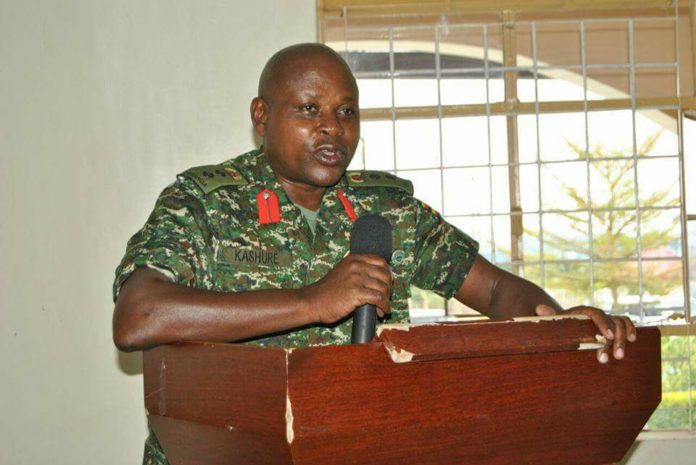
Brig Stephen Kashure

President Yoweri Museveni who is also the Commander in Chief of armed forces has made in the army moving Brig Stephen Kashure who has been the Director Operations Wealth Creation (OWC) has been appointed the Deputy Commandant of the UPDF senior command and Staff College, Kimaka in Jinja district.

Brig. Kasure will be replaced at OWC by Col. Mesach Matte who has been in the army’s logistics department.
Brig. Chris Bossa who has been the deputy commandant at Kimaka has been moved to the Logistics and Engineering department.
Also moved is Col. Hubert Mbonye from the AMISOM deployment in Somalia to Ugandan Embassy in Abuja, Nigeria as military advisor.Col. Mbonye is a seasoned army spy and previously worked in Chieftaincy of Military Intelligence.
Another officer moved from AMISOM is Col. Charles Byaruhanga who is now taking over as the Commandant at Kaweweta Recruit Training school.

In other changes, Col. Kefa Nangego is the new Director of Personnel; Col. Bob Ogik is heading to Kimaka as staff coordinator; Col. Paul Eswapu is appointed Chief of Staff for Uganda Rapid Deployment Capability Centre while Col. Ceazer Bahwezi is the new director for records.

Stories Continues after ad

World Cup teams seeded after completion of qualification process

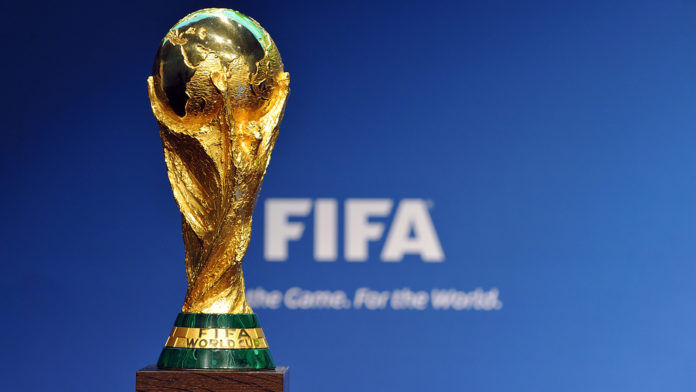
The FIFA World Cup Trophy

After a qualification process involving 209 national football teams and lasting for more than two years, the list of the 32 sides to take part in the FIFA World Cup 2018 in Russia has been confirmed, after Peru booked the 32nd and last place at next summer’s tournament.

Each continent is to be represented at the tournament with five teams from Africa, 13 from Europe, four from Asia, five from South America,  one from Oceania, three from North and Central America and Caribbean and the host nation.

The teams have been seeded according to the October 2017 FIFA world rankings. The seven highest-ranked teams are pot 1, the next eight in pot two, the following eight in pot three and the lowest ranked eight in pot four.

One team from each pot is drawn into a group, making eight groups of four nations. There can be no more than two teams from Europe in any one pot, and no more than one nation from any other confederation.

The Final Draw will take place on Friday 1 December at Moscow’s State Kremlin Palace in Russia.


Pot 1: Russia, Germany, Brazil, Portugal, Argentina, Belgium, Poland, France

Pot 2: Spain, Peru, Switzerland, England, Colombia, Mexico, Uruguay, Croatia

Pot 3: Denmark, Iceland, Costa Rica, Sweden, Tunisia, Egypt, Senegal, Iran

Pot 4: Serbia, Nigeria, Australia, Japan, Morocco, Panama, South Korea, Saudi Arabia

Stories Continues after ad