Stanbic Bank
Stanbic Bank
16.6 C
Kampala
Stanbic Bank
Stanbic Bank
Home Blog Page 1827

KCCA FC one point away from Confederations Cup quarter finals

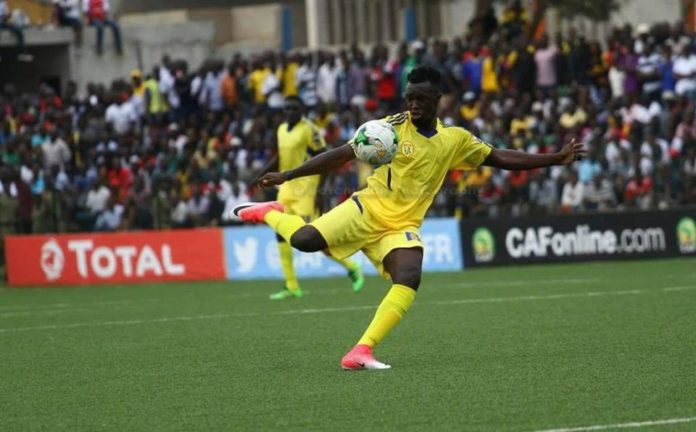
KCCA FC travel to Tunisia in their final game of  Group A Confederations Cup group stages against Club Africain.

The Uganda premier league champions aim to continue their fine form and keep their quarter final hopes on track after a comfortable 3-1 win over Moroccan side FUS Rabat on Sunday at Lugogo.

Geoffrey Sserunkuuma, Saddam Juma and Isaac Muleme were the goal scorers before the visitors pulled one back through Lamine Diakite in the closing minutes of the game.

KCCA just need a point to reach the quarter finals of the 2017 CAF Confederation Cup but can still qualify when they lose only if the match between FUS Rabat and Rivers United ends in a draw.

A draw for KCCA and Africain on Friday will assure the two sides of quarter finals places.

Habib Kavuma is back in the squad after missing the FUS Rabat game due to suspension to boost the team’s confidence.

The first leg in Kampala ended 2-1 with a comeback from KCCA thanks to goals from playmaker Derrick Nsibambi and Tom Matsiko after Mokhtar Belkhither gave the North Africans an early lead.

KCCA are second with 9 points on level with table leaders Club Africain who lead on goal difference while Rabat and Rivers United are both locked on 6 points.

At the same time, FUS Rabat from Morocco will play host to Nigeria’s Rivers United FC.

Friday, 7th July 2017

Group A                                                           

Club Africain Vs KCCA FC, At the Stade Olympique de Radès, Tunis.

FUS Rabat Vs Rivers United, Complexe Sportif Moulay Abdallah.


Stories Continues after ad

Chameleone celebrates concert success by selling beers

Following the success of his ‘Legend Hit after Hit’ shows that fetched him over Shs100 million, singer Jose Chameleone appears to still want more.

He was last night seen at Jinja Road based hangout joint, Space Lounge acting as a bar attendant.

He spent most of last night selling drinks to the club’s customers. We are yet to establish how much he was paid for the work but what we know is that he bagged over Shs100 million from his shows held last weekend.

According to a reliable source, Chameleone was paid Shs80 million for the shows by events promoter Balaam Barugahare. At the time of receiving the money, both Balaam and Chameleone were scared the show would end up into a flop a reason why they settled for a relatively small sum of Shs80 million.

But following the success of the first show held at Cricket Oval, Lugogo, Chameleone is said to have demanded for more and was added Shs30 million bringing the sum of money received to Shs110million. Indeed his show at Freedom City Mall was also a success.


Stories Continues after ad

Kampala Restaurant Week returns for third straight year

Uganda Breweries Limited Head of Beers, Estella Muzito with a colleague at the event.

The 3rd edition of the Kampala Restaurant Week was launched yesterday at the Sheraton Hotel Kampala and will see Kampala host the largest restaurant showcase.

Organised by Pearl Guide Uganda and powered by Uganda Breweries Limited’s premium beer, Tusker Lite, the Kampala Restaurant Week will run till July 15, 2017.

The yearly event has allowed more than 15,000 people to annually discover the best priced restaurants to have a meal at in Kampala.

All diners at the participating Restaurants will be handed a complimentary drink of Tusker Lite.Tusker Lite was introduced into the East African market in 2011 as a low carb beer uniquely brewed with natural ingredients. It delivers an easy drinking experience. The idea behind its introduction was to bring a new taste.

Speaking at the launch of this year’s Kampala Restaurant Week, Uganda Breweries Limited’s Head of Beers, Muzito Estella said; “We believe that our partnership with the Pearl Guide Uganda for the 3rd edition of Kampala Restaurant Week is intertwined in the above aspects. There is no better way to enjoy a meal with friends without a Tusker Lite by your side.”

Tusker Lite has firmly established itself as a beer that easily blends with any activity or event, be it a house party, a rugby match or a concert.

“We hope to increase the awareness of the Kampala Restaurant Week and adopt a fresh and exciting lifestyle targeting consumers who are always aware of what is happening around them and love a good meal,” added Estella.

“Kampala Restaurant Week is about creativity, discounts and good value. For one week, we convene over 40 of the city’s best restaurants and get them to each make new creative dishes over and above their usual dishes. Unlike the previous editions, this year, selected restaurants in Entebbe, Mbarara and Jinja will be taking part in the third edition of Kampala Restaurant Week,” Said Philip Kalibwani, the Business Development Manager at Pearl Guide Uganda.

The Kampala Restaurant Week will be capped off with an awards ceremony on the 15th July at the Sheraton Hotel Kampala. This will be to recognize the most outstanding chefs, restaurants and other participants in this edition.

In line with its support for responsible drinking, Tusker Lite will be maintaining a strict ‘over 18 only’ policy for sale of alcohol.


Stories Continues after ad

Man sentenced to six years for killing wife

High Court Kampala, the seat of justice

The High Court in Arua has sentenced a man to six years in prison over killing his wife.

High Court judge, Stephen Mubiru found a one John Mawa guilty of having killed his wife.According to the evidence brought in court, Mawa on January 2, 2014 at Ewadromati village in Arua District murdered his wife,Florence Esaburu Draleru. During the hearing, Mawa was pinned to his wife’s death by among other people Richard Ambayo, of Arua Regional Police Clinic was admitted.

He told court that by the time he conducted a postmortem on Draleru’s body at the crime scene, he found it lying on the back. The clothing was covered by soil and “there were weapons, short pieces of wood (cut logs) on the side of the deceased”.

“The superficial appearance of the body, there were multiple injuries, and widespread external marks of violence. The head was grossly normal, the trunk had multiple abrasions and bruises, the limbs had multiple and widespread bruises with a dislocated elbow joint. The cause of death was multiple body injuries resulting from blunt force trauma.  The weapons used were pieces of wood and the injuries were consistent with violence.”

The area LC 1 and a neighbor, Marino Arile also testified against Mawa. He told court that his home was next to that of Mawa. On that day ( January  2, 2014) he was at home when Mawa fought with his wife at 3.00 am and he was surprised when the accused came to him and told him he had beaten his wife and she was down there at his home.

Mawa requested “him to go and talk to his wife to return home because she had refused to return home”. The accused insisted that he should go with him. He went with him and on arrival he showed him where the victim was. She was lying down unconscious. He decided to call the chairman by phone. The Chairman told him the CID was on their way and that he should remain at the scene. The time was 5.00 am by then. By that time Mawa had gone to the police after realising that the wife had died.

Wadrif Sabino, a police who was at the station at the time when Mawa got there also testified against him, saying that that day at around 7.30 am, he was the duty officer and he had gone to check on the men who were on duty.

As he arrived at the station he saw a man running towards the police station. He was bare chest putting on a pair of shorts. He thought someone was chasing him. When he reached near the door he branched to the place where the national flag is hoisted. He held the pole on which the flag was and knelt down. He approached the accused and asked what the problem with him was. He replied, “I have killed a person.” He repeated “I have killed my wife.” He got hold of him and took him to the counter and opened up a case against him.

Ironically, Mawa made a U-turn in his defence at the trial. He claimed that he has two wives living in different homes and always celebrated Public Holidays at the home of his first wife

As he returned to the home of his second wife, the deceased, at around 2.30 am, he claimed to have met the L.C of the place Marino Arile in his compound. Immediately the accused asked him where he was coming from at that time.

He answered that he was from nearby. Mawa then entered his home and began calling his wife. He found the door was locked from outside. He then opened the door. He entered the house and did not find his wife. He then went out searching for her only to find her body on the way to the latrine. She was already dead. His lawyer, Oyarmoi Okello argued that the only ingredient he was challenging is that of malice aforethought.

“At the scene there were several pieces of broken sticks alleged to have been used in the beating of the deceased. The evidence of the doctor showed multiple injuries but not on the vital parts like the head. Not a single broken piece was brought for the court to see the size of the sticks. Malice cannot be assumed from multiple injuries. It must be proved and cannot be assumed. The charge of murder cannot stand and it can only be manslaughter.”

Justice Mubiru agreed with him and acquitted Mawa of the offence of murder, saying prosecution had failed to prove beyond reasonable doubt that the killing of the deceased was actuated by malice aforethought.

“The accused is acquitted of the offence of Murder c/s 188 and 189 of the Penal Code Act. According to section 87 of The Trial on Indictments Act, when a person is charged with an offence and facts are proved which reduce it to a minor cognate offence, he or she may be convicted of the minor offence although he or she was not charged with it. In the instant case, the facts establish the offence of manslaughter. In agreement with the joint opinion of the assessors, I accordingly convict the accused for the offence of Manslaughter.

“I have considered the fact that the convict is a first offender, a relatively young man at the age of 34 years when he committed the offence. I for that reason regard the period of ten (10) years’ imprisonment as justified in light of the mitigating factors.  In accordance with Article 23 (8) of the Constitution I observe that the convict was charged on 10th January 2014 and been in custody since then. I therefore sentence the convict to a term of imprisonment of six (6) years and seven (7) months, to be served starting from today.”


Stories Continues after ad

Uganda drops in latest FIFA rankings

The July 6 rankings released by FIFA have seen Uganda drop 3 places to 74th with a total of now 476 points.

Uganda was at 71 last month but drop in rankings despite an away 1-0 victory over Cape Verde in the 2019 AFCON qualifiers.

Uganda remains the best in East Africa with neighbours Kenya dropping ten slots to 84, Tanzania at 114, Burundi improving by 27 places to 121 and Rwanda moved up one place to 127.

Egypt is the best ranked nation in Africa at 24, Senegal follows closely at 27, DR Congo 28, Tunisia at 34 while African champions Cameroon at 36th completing the Africa’s top five countries.

Confederations Cup winners Germany regain their top spot with Brazil, Argentina, Portugal and Switzerland completing the top 5 in the world respectively.

Andorra was the most improved country after moving up by 57 slots to 129th with Namibia the worst after dropping 62 places to 156th.

The next Release of the FIFA rankings will be on 10 August 2017.


Stories Continues after ad

African SMEs need US$ 300 billion to expand -expert

Despite the existence of capital markets in African countries, SMEs and agri-businesses, among others continue to face a funding gap of over US $300 billion per year, Mr Evans Osana, the Director, Capital Markets Development, FSD Africa, has said.

“Local capital markets can provide long-term funds to growing businesses, infrastructure and housing,” he says, adding that the local currency capital markets have advantages over external lenders, for a low-income country like Uganda.

He says external source of raising capital such as the Euro bond market are expensive and expose African countries to foreign currency risk, “because these bonds are denominated in hard currencies, leading to higher chances of defaulting on the debt.”

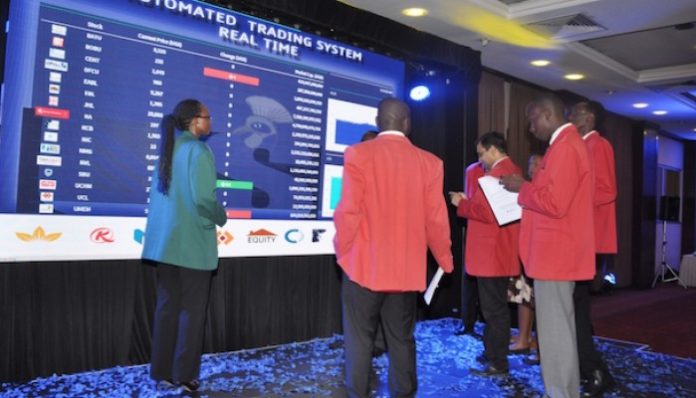
Mr Osana, a securities markets specialist in capital markets development, says local capital markets, like the Uganda Securities Exchange, if well-developed can support projects such as urban infrastructure, agri-businesses and housing projects as well as others like SMEs dealing in value addition.

Mr Osana advises that key infrastructure and housing investments should be dominated by local currency financing so as to cut the high costs that come with foreign financing. “By funding these investments in long-term local currency instruments, governments and the private sector avoid foreign exchange and refinancing risks,” Osana says.

He points out the Asian financial crisis in the 1990s and the Latin America economic crisis in the 1980s which he says were caused majorly by over relying on foreign currency loans, leading to the collapse of economies most countries.

He says the African banking sector which is very small has not helped much to fund medium and long term investment projects. “The banking sector remains characterised by high interest rate margins and high returns on equity and assets. This implies that the sector is not playing its intermediation role effectively,” he warns.

By developing capital markets, he says, African countries can facilitate the diversification of the financial sector, providing a useful complement to the banking sector.

Mr Osana says African capital markets can provide the public and private sectors access to long-term financing which is so hard to come by and help create new equity investments that broaden the sources of supply of finance.

Research shows that about US $1 trillion in assets are currently held by pension, insurance and collective investment vehicles across sub-Saharan Africa. But, these funds, the research says, have a serious problem finding enough investments that meet their risk and return requirements.


Stories Continues after ad

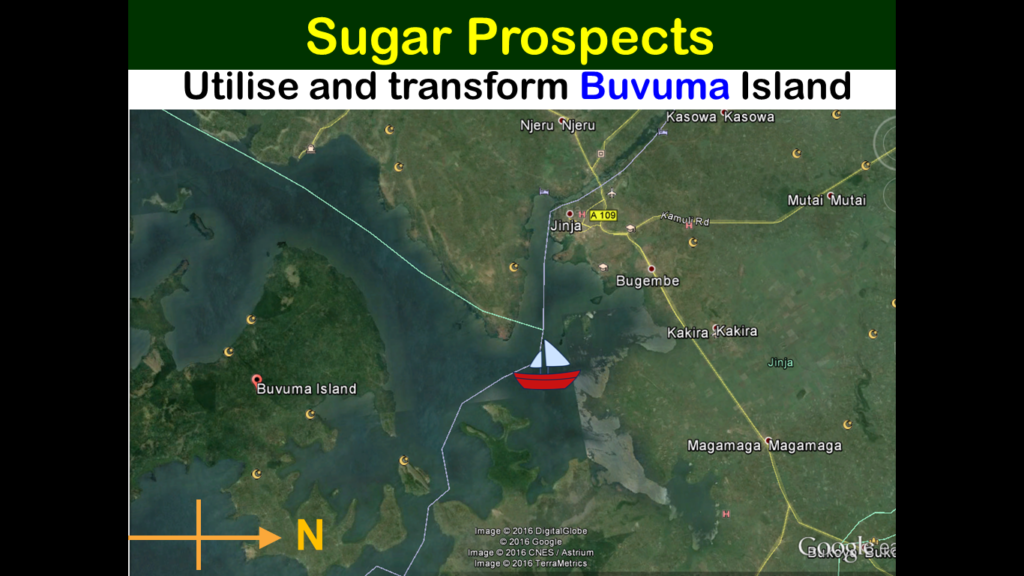
Madhivani Group wants Buvuma Island for cane growing

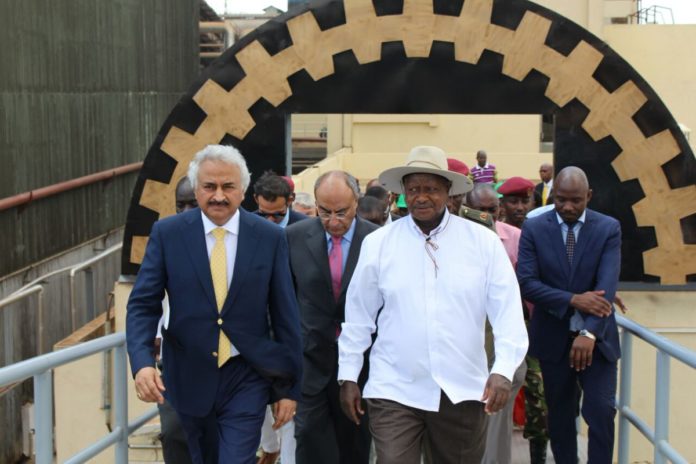
Kakira Sugar Works boss Madhvani and President Yoweri Museveni touring the facility.

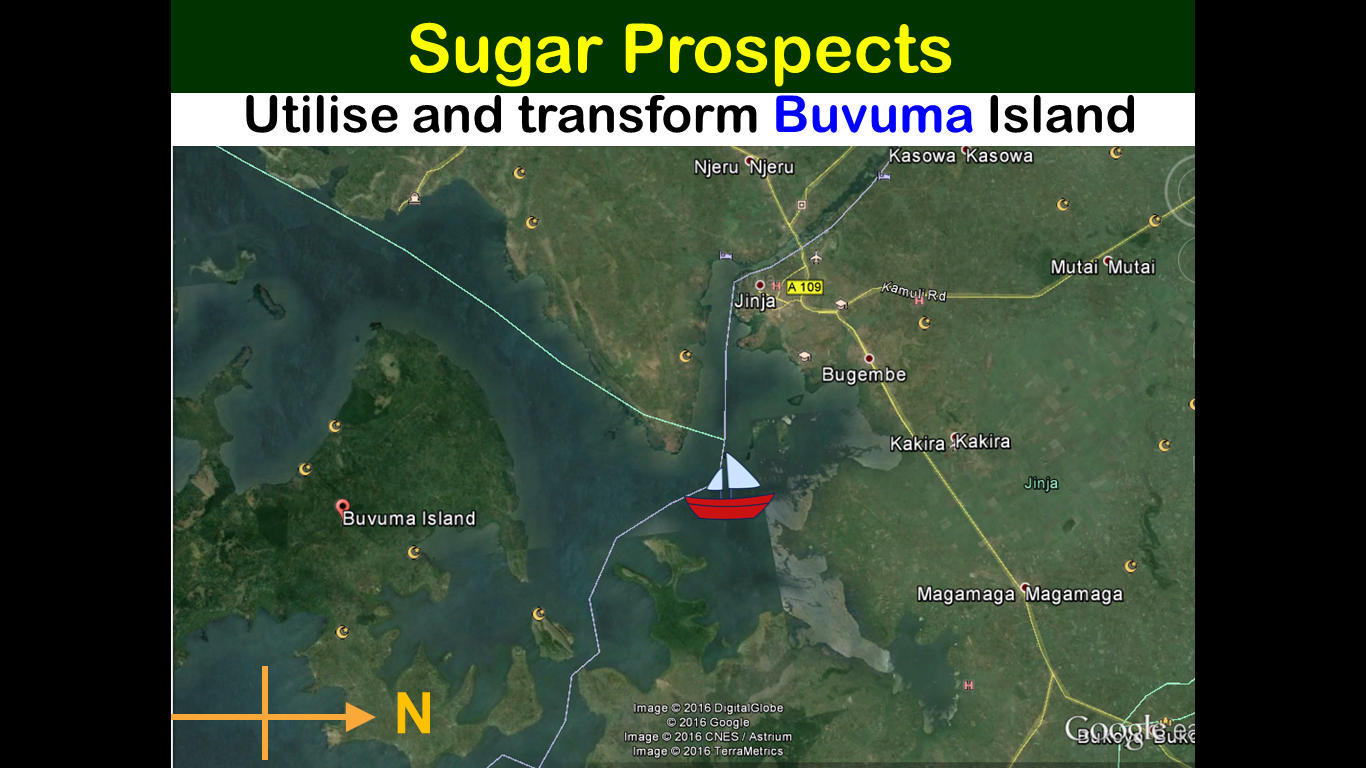
Madhvani Group’s Kakira Sugar works wants to get a piece of Buvuma Islands and turn it into a cane growing hub.

A power point presentation made in top management meeting sometime last year, a copy of which Eagle Online has, shows that the sugar producing agnate wants to spread to Buvuma islands as a response to the pressure brought about by the development of several sugar producing companies around the Kakira plant.

In the presentation, Kakira Sugar paints a picture of how, because of the raise of so many small sugar producers, the factory no longer enjoys a monopoly over out growers who now choose to sell to its competitors.
A source in Kakira Sugar who preferred anonymity said that although there are no robust plans to take on the island as of now, it has heard of the intention.

The corporation’s Assistant General Manager, Kenneth Barungi said, “No idea about Buvuma has ever crossed our mind.”

He however added, “We have mentioned it to government that if Bidico is not interested in Buvuma we would be interested in it. We are interested in land anywhere whether it is in Buvuma or Amuru and we are interested in buying.”
Kakira Sugar Works has been producing sugar from the 1960s with production rising from 50000 tonnes of cane (5,000 tonnes of sugar) in 1960 to 2,500,000 tonnes of cane (250,000 tonnes of sugar) in 2015 according to the power point presentation.

By 2015, it was the leading sugar in the country at 42 per cent followed by Kyinyara sugar with 28 per cent of the sugar consumed in the country.

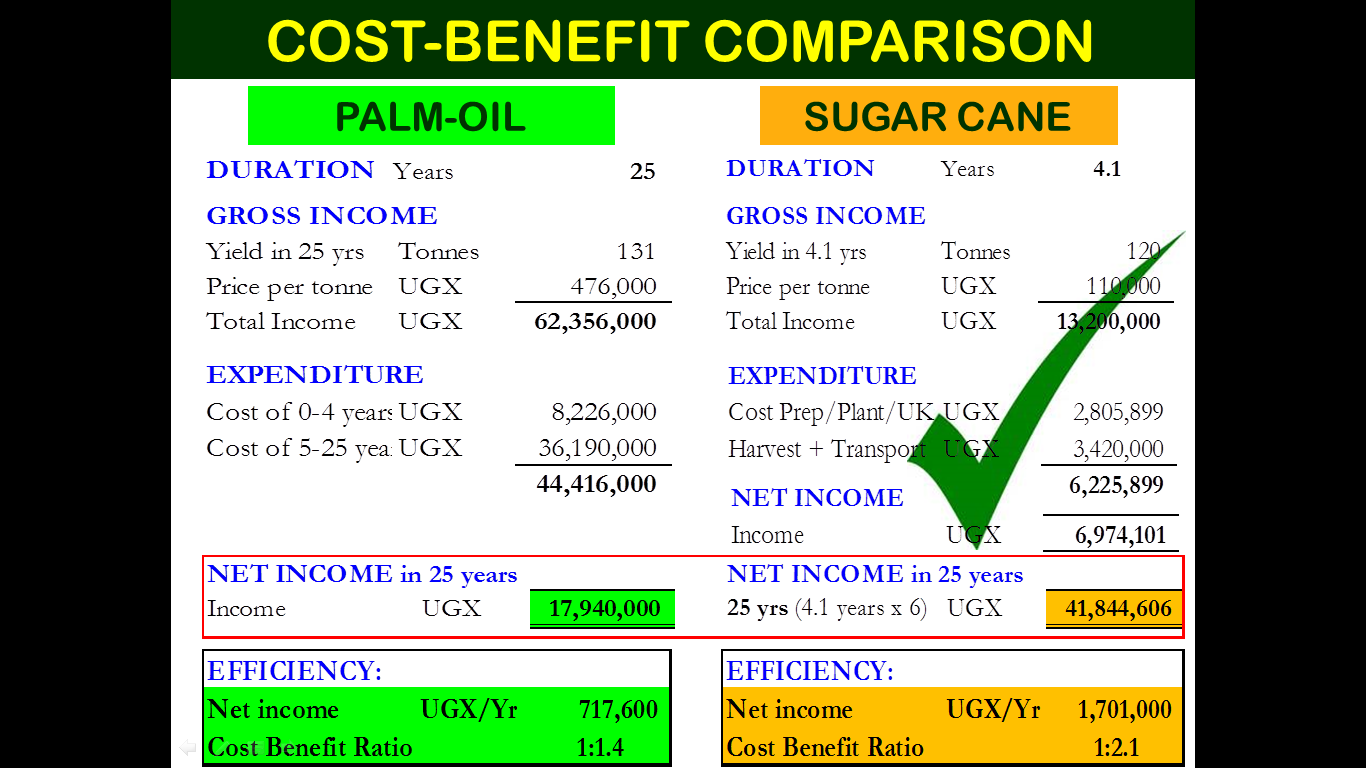
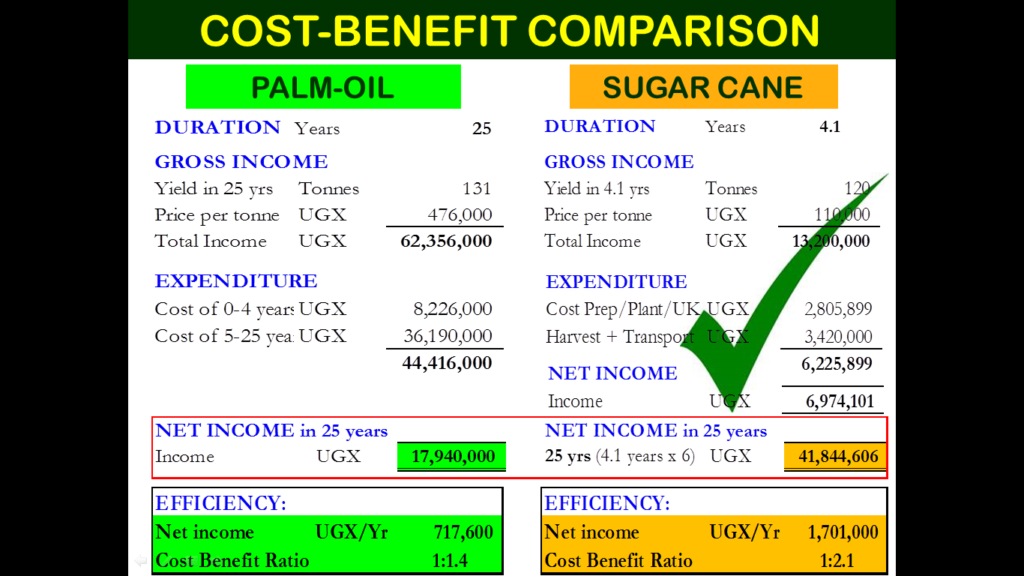
The power point presentation shows that planting cane on the island makes more fiscal sense than sugar.

It shows that while as Palm Oil has 25 year duration and makes a farmer only shs17.9M per tonne, Sugar cane growing rakes in shs41M over the same period per tonne.
However, using Busoga as an example, Buvuma Member of Parliament Robert Nduggwa  Migadde is opposed to sugar cane being grown on the island saying it doesn’t make economic sense.

“We shall not be part of an arrangement for sugarcane. As we talk the investor for palm oil is already in place and the nursery bed is already being planted.

“Land in Buvuma was acquired by government specifically for palm oil development there are activities that come with that including CSR which does not come with Kaikira. When you look at how palm oil has transformed people’s lives in Kalangala is not the same as sugarcanes have transformed the people in Busoga,” he said.
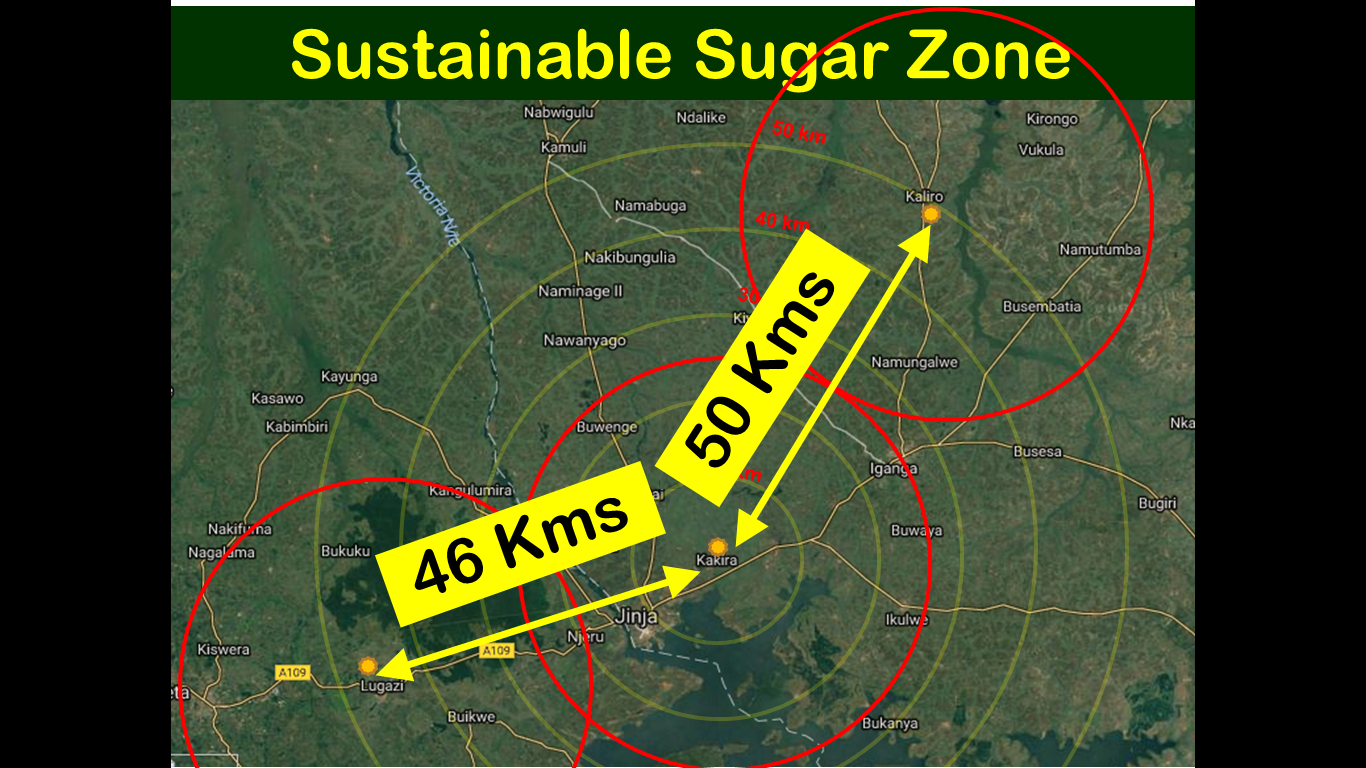
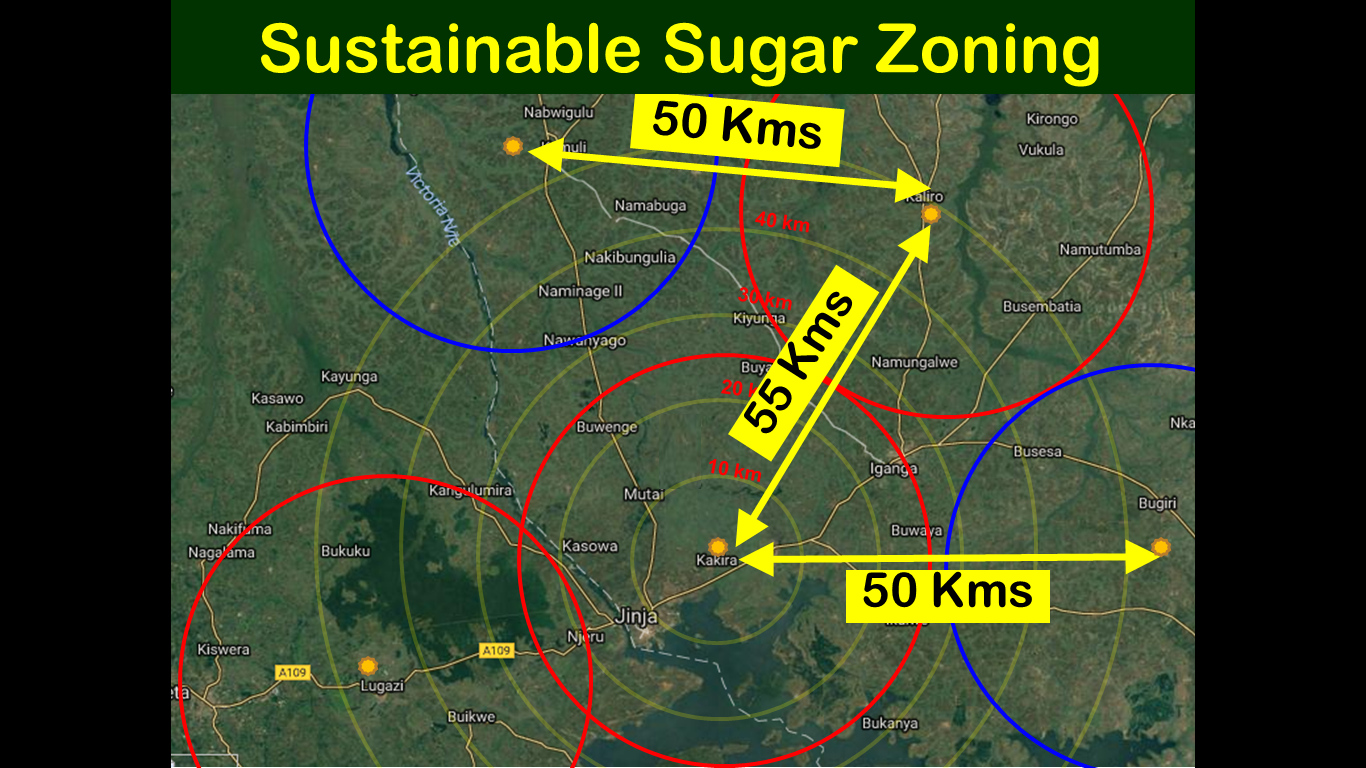
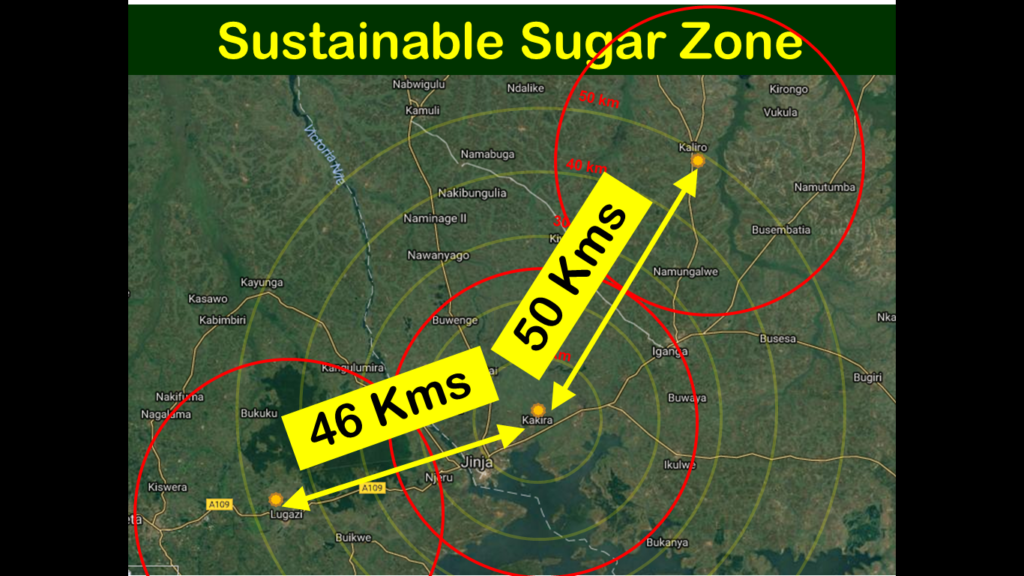
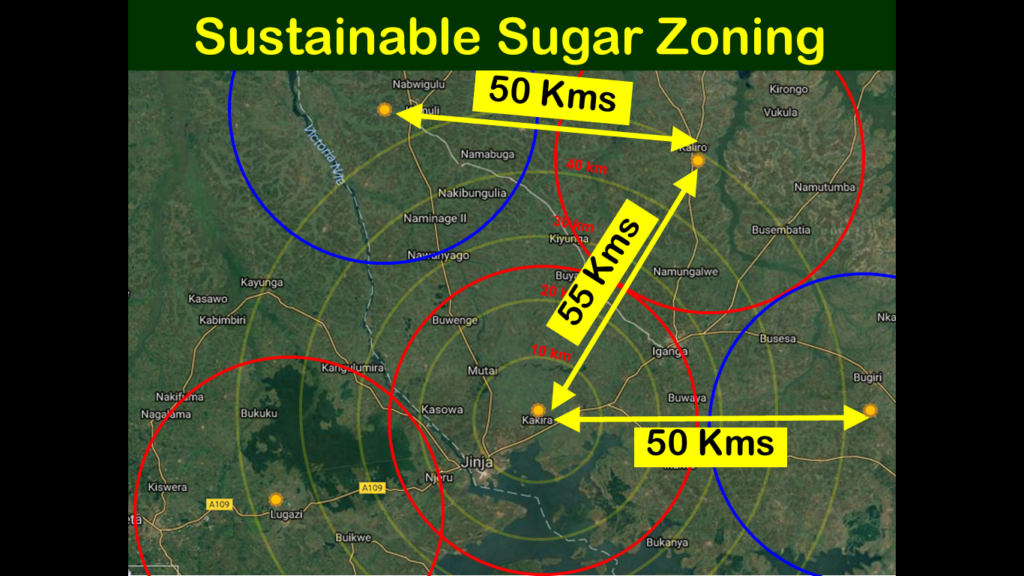
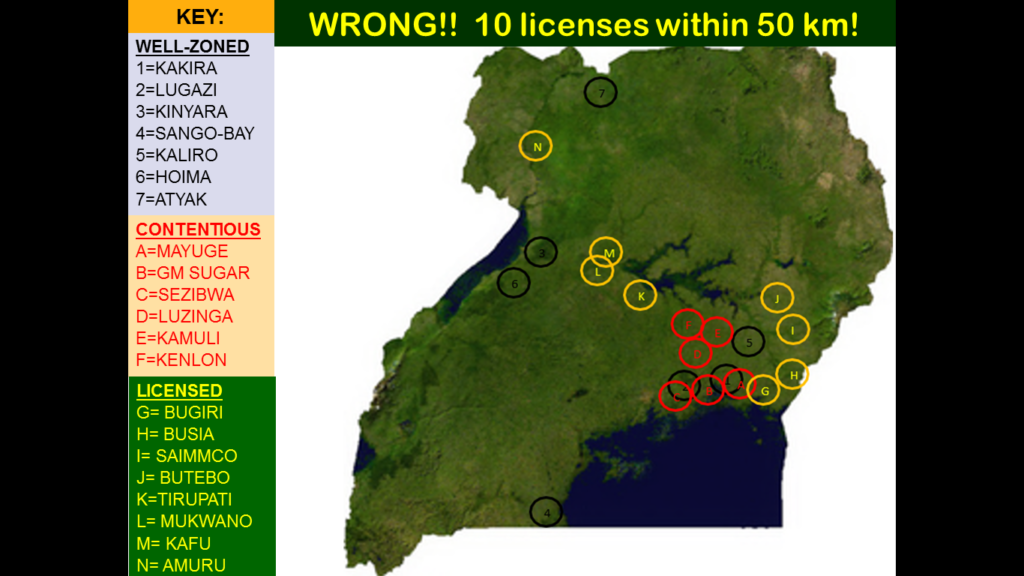
Over the years, Kakira sugar has been fighting the increasing rise of sugar producing factories within its armpits. Kakira wants sugar factories to be within a radius on 50KM away from each other so that the factories can have enough land to grow cane and also less competition for the out growers.

According to the national Sugar policy, in the spirit of harmonizing sugar growing, it is important that the existence and new sugar mills have sufficient acreage to grow and expand their plantations.

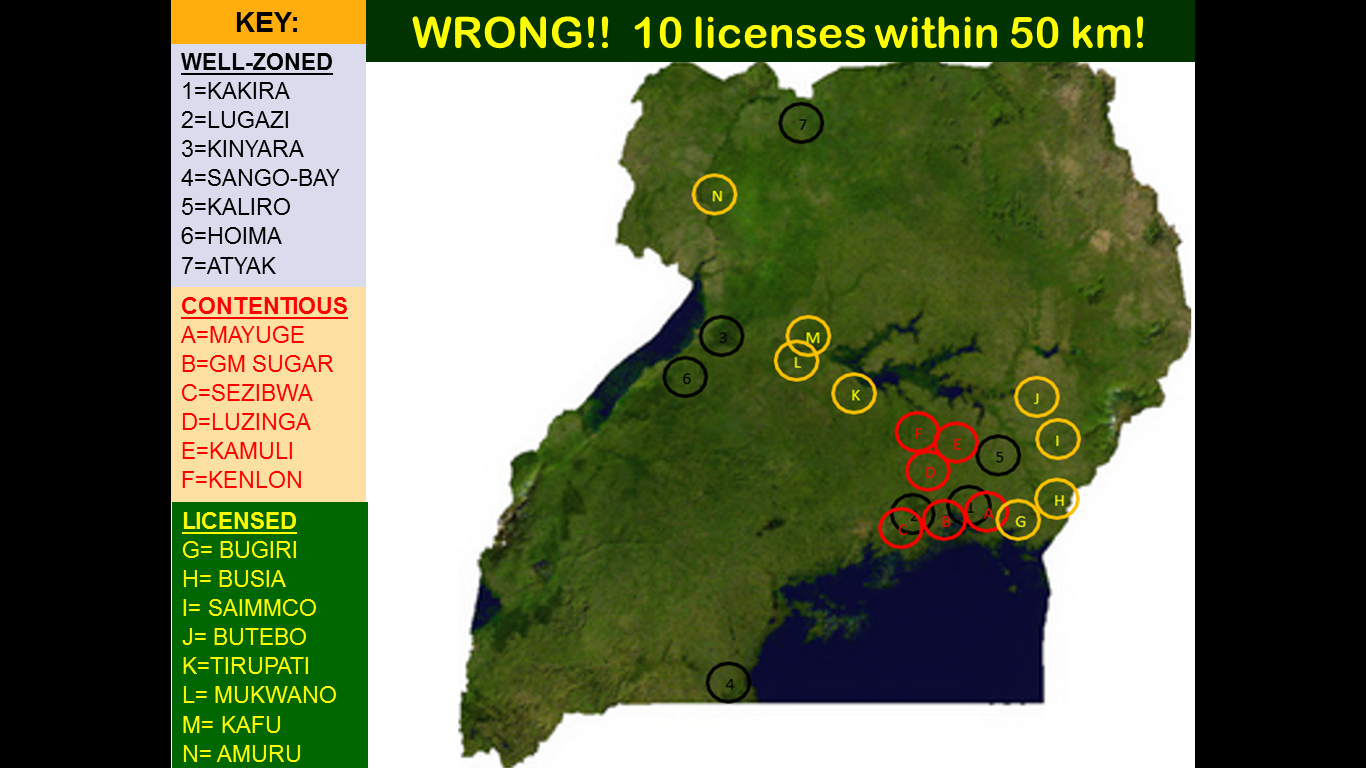
In the document, the sugar corporation argues that it is wrong to have 10 licenses within a radius of less than 50 kilometers. This is because it means little expansion space for cane growing.

It therefore calls for the relocation or cancellation of all licenses belonging to all the “misplaced” sugar factories that are parasitizing on its out growers and expansion areas.

The document paints a grim picture—a sugar shortage in the future— if the corporation does not get enough land for cane growing or if the ‘misplaced factories’ remain in place.
By 2015, according to the projections the document used, Uganda was having surplus of 70,000 tonnes. However, the document shows, with the population expected to grow to 47.3 million by 2020, there will be a shortfall of 78,012 tonnes because production will only be at 535,000 tonnes yet the country will have a demand of 613,012 tonnes.


Stories Continues after ad

Gov’t releases new salary structure for civil servants

Public Service Minister, Muruli Mukasa.

The government through Ministry of Public Service has released a new salary structure for the financial year 2017/2018 indicating increment in the salaries of some top officials.

In the new structure, the head of public service will earn Shs17 million a month, up from Shs4 million, while his deputy who has been earning Shs4 million, will now will take home Shs16 million.

Similarly, Permanent Secretaries are to earn Shs15 million monthly, up from Shs3.7 million.

Interestingly, salaries for Deputy Secretary to the Treasury, Accountant General and Auditor General have remained at Shs3 million each per month.

“Due to limited resources, government has not been able to enhance salaries for public servants for FY 2017/2018 except for teaching and non-teaching staff in the public universities whose wage has been enhanced by a total of Shs19.625 billion” reads a circular released by Ministry of Public Service.

The other beneficiaries are the Vice Chancellors of the Public Universities and other top dons in institutions of higher learning whose salaries have been increased, and in the new structure, a VC will earn Shs10 million up from Shs9 million monthly. Also, a professor will earn Shs8,487,707 up from Shs8,031,761, while an Associate Professor is going to earn Shs7,965,011 up from Shs7,537,144.

The government has also increased salaries for non-teaching staff, with a director at any institution earning Shs8, 487,708 up from Shs8, 031,761.

The salaries for other civil servants remain unchanged.

Below is the list 

Salary structure from Public Service (1)

Stories Continues after ad

Centenary Park Probe: Nyakanas warned over obstructing gov’t Projects

The Parliamentary Committee on Statutory Authorities and States Enterprises (COSASE) has warned the proprietor of Nalongo Estates Limited’s proprietor, Sarah Kizito, against obstructing government projects.

It is understood that in the ongoing feud between the Nyakanas and the Kampala Capital City Authority (KCCA), Ms Kizito refused to allow National Water and Sewerage Corporation access to the premises hence blocking them from laying sewerage pipes.

The Katuntu probe committee has ordered that the National Water should be allowed access.

“As we leave now, the Contractor of NWSC should be granted unfettered access to the land he needs to do the NWSC project. If we get to know that actually you have organized any obstruction, then we shall be involving other powers that we have as Parliament,” Mr Katuntu ordered.

The contractor National Water hired to lay the sewerage pipes fined the water authority Shs979m in loses they have incurred due to failure to do the job.

Presenting her case before MPs, Kizito accused Kampala Capital City Authority (KCCA) Executive Director, Jenifer Musisi of witch hunt, questioning why she defied Museveni’s orders to have her lease renewed. However, Kizito’s remarks infuriated Katuntu, who chipped in immediately, demanding to protect the office of President.

He schooled Ms Kizito on the powers of the President of Uganda, saying he governs the nation based on provisions of the Constitution.

Katuntu also informed Ms Kizito that Museveni has no powers to give out any land in Uganda and, shouldn’t be used as a scapegoat for bad deeds.

“What we will not tolerate is any sabotage of public infrastructure. Nobody should sabotage public infrastructure. You are Ugandans, this money, your children will pay back this money,” he said.

Ms Kizito’s husband Godfrey Nyakana, who introduced himself as Personal Assistant to his wife, asked Parliament to compel KCCA to renew its lease, so as it handles compensation of UNRA and NWSC in person.

“Whatever the case, NEL has a right and interest in the development at Centenary Park land. Giving it to UNRA without renewing the lease would kill Nalongo Estate’s right to compensation,” Nyakana’s statement read in part.

But Nyakana’s request left MPs perplexed especially after Nyakana had earlier admitted that Nalongo Estates’ lease expired and the land reverted back to KCCA.

The probe will continue tomorrow with Inspector General of Police, Gen. Kale Kayihura, set to appear before the Committee.

Kayihura is set to be questioned over security matters surrounding the premises, after issues arose on the floor that Nyakana has been organizing goons, to obstruct Government officials from accessing the premises.


Stories Continues after ad

CNOOC pays Shs600m to Uganda as exploration fees

Chinese Oil company, CNOOC Limited, with oil stakes in Uganda and listed on the Toronto Stock Exchange, has disclosed US $2.6 billion in payments to entities in a number of countries it operates, a communique from the company says.

The report released by the company’s Chief Finance Officer, Hua Zhong, shows that it paid Uganda’s Ministry of Energy and Mineral Development US $172, 000 (Shs602 million) in fees for operations in Areas 1A (EA1) at the Northern end of Lake Albert (in the Murchison Falls National Park), Exploration Area 2 (EA2) to the East of Lake Albert in the Butiaba region, and Exploration Area 3 (3A)-Kingfisher, in the Albertine Graben, which cost the company for a combined sum of US $900 million (about Shs3.2 trillion).

Other African countries that received payments from CNOOC include Algeria, Nigeria, Gabon and Congo. The payments included taxes, loyalties, bonuses and dividends.

The country also paid countries in North America, Asia, and South America.


Stories Continues after ad