The Kanyamunyus and lady friend Cynthia Munangwari in Nakawa court. T
Mathew Kanyamunyu, the city businessman accused of killing social worker Kenneth Akena is set to appear for a second bail in the High Court today.
Kanyamunyu, together with his brother Joseph Kanyamunyu and lady friend Cynthia Munangwari, is currently on remand in Luzira since November last year.
Last week the judiciary assigned Justice Yasin Nyanzi to hear the bail application after the first judge, Lady Justice Elizabeth Kabanda, denied the trio bail in February.
Prosecution avers that on November 12 last year, Mathew Kanyamunyu, in the company of lady friend Munangwari, fatally shot Akena.
Winnie Byanyima, an aunt to Mathew Kanyamunyu, while in court to stand surety for her nephews last month.
The Kanyamunyus are from Western Uganda and the death of Akena, an Acholi, polarized those concerned on both sides along ethnic lines, even drawing in Members of Parliament from the deceased’s ancestral home including Aruu County MP Samuel Odonga Otto, to protest against Winnie Byanyima, an aunt of the two brothers, to stand surety for them.
PROTESTS: Kenyans in Namanga demonstrate against the deportation of their countrymen from Tanzania
Kenyans in Namanga demonstrated against Tanzanian leader John Magufuli, saying he had deported their counterparts.
They paralysed transport by blocking the Kenya-Tanzania border road at Namanga and stormed businesses owned by Tanzanians.
They rounded the foreigners up and frog-marched them across the border to their country. Many from Magufuli’s country claimed they lost their stock and money.
Tanzanian barmaids working in Kenyan clubs were roughed up and their mobile phones taken away.
Businesses on the Kenyan side remained closed until after midday.
It was reported in January that Tanzanian authorities were targeting Kenyans living in their country illegally.
Several Kenyans, including those who were born in Tanzania before independence, have been told to leave if they cannot provide documents validating their stay.
Others were born by Kenyan parents living in Tanzania in the early 1960s and have no other links.
Samuel Ngeselai was forced to flee Longido district in Tanzania and move to Kenya, leaving his children and wife of 30 years across the border. He is now stateless.
Ngeselai said his grandfather, a Mau Mau activist who escaped to Tanzania early in the 1950, died there.
His mother is bedridden and still living in Tanzania.
Kajiado county commissioner Harsama Kello said the demonstrations began at the border after Tanzanian authorities arrested three Kenyans last Friday and arraigned for being in the country illegally.
“Countries carry out routine checks. Our people should respect the law and ensure they have valid immigration documents while in foreign countries,” Kello said.
The commissioner said a contingent of security personnel was sent to the border to end the protests. He said two weeks ago that the situation was under control.
As Kello addressed journalists, a group of Kenyans was seen destroying Kenya Power transformers to cut off the link with Tanzania. Police watched as they vandalised the transformers.
He added that top officials from the immigration department and local police officers were in a closed-door meeting in Namanga on restoring normalcy.
The Tanzanian High Commission in Nairobi denied that Operation Timua Wageni is a move to free up jobs for locals.
The High Commission said that the exercise that began in January is routine enforcement of the Tanzanian Immigration Act of 1995 and does not target any nationality.
“What I can tell you is that this is not something new. It has always been there,” said an official who did not want to be identified because of lacking authority to speak to the press.
The Tanzanian government launched a crackdown on foreign nationals who do not have both work and residence permits.
Only 680 foreigners have work permits, according to the country’s immigration department, while only 66 have applied for residence permits.
President Yoweri Museveni has summoned the National Security Council to deliberate over the security situation in the country include the several high-profile murders including that of Assistant Inspector General of Police (AIGP) Andrew Felix Kaweesi..
According to sources, the meeting with top security officials will also review operations of different agencies including the Uganda Police Force (UPF).
The NSC comprises officials from the police, Internal Security Organisation (ISO) and the Chieftaincy of Military Intelligence (CMI), all of which are currently involved in joint investigations to establish the killers of AIGP Kaweesi.
AIGP Kaweesi was brought down in a hail of gunfire near his home in Kulambiro by unidentified gunmen, and since then police has carried out several arrests of suspects, the most recent being that of Lt. Godfrey Musisi, a intelligence operative with the Internal Security Organisation (ISO).
And while addressing mourners at the deceased’s residence President Yoweri Museveni, who is also the Commander-in-Chief (C-I-C) directed the Inspector General of Police, Gen. Kale Kayihura, to ‘clean up his house’.
In a related development, Police spokesperson, Assistant Inspector General of Police (AIGP) Asan Kasingye has warned the public against speculations surrounding the death of his predecessor AIGP Andrew Felix Kaweesi.
According to Mr Kasingye, the police is currently holding suspects as the investigations are ongoing to establish who killed, organized and funded Mr Kaweesi’s death.
He also said they are investigating a social media group called the ‘Uganda Patriotic Freedom Fighters’ (UPFF) that claims knowledge of the high-profile killings in Uganda including that of AIGP Kaweesi.
Further, Mr. Kasingye urged the Uganda Communications Commission (UCC) to effect a years-old directive to mobile phone service providers, to disconnect all unregistered simcards in a bid to reduce on the number of criminal acts.
‘This follows a six months period that was given to every single person to register his/her simcards four years ago and whoever did not was supposed to be disconnected but up to now criminals are utilizing this chance claiming lives of many Ugandans,’ he said.
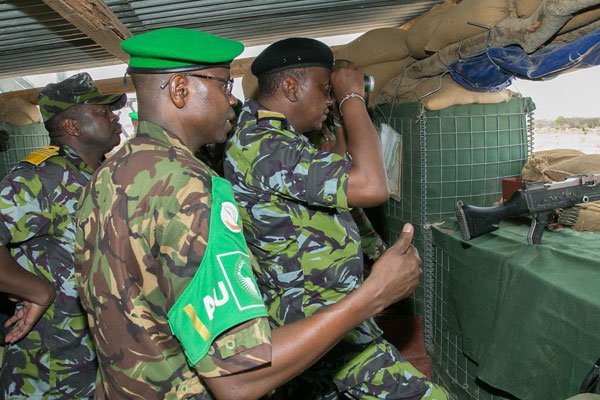
IN SOMALIA: Kenyan president Uhuru Kenyatta made a historic visit to Somalia, meeting Kenyan troops serving under the African union mission in Somalia at Dhobley
The Kenya Defence Forces (KDF) has killed 31 Al Shabaab militants during a late Sunday raid on a camp in Badhadhe, Somalia.
The release giving details about the attack
According to a March 27 release signed by Colonel Joseph Owuoth of the Public Affairs department, the army also captured an arms cache including 11 AK-47 rifles and Improvised Explosive Devices (IEDs).
The raid on the camp comes barely a week after Kenyan President and Commander-in-Chief Uhuru Kenyatta visited the KDF troops in Dhobley, Somalia, unannounced.
Singer Rihanna is reportedly considering reconciling with former beau and singer-songwriter Chris Brown. But her friends are concerned about her getting back with him.
“Her friends are shocked that she would consider it at all after everything he put her through back in the day. Friends of Rihanna want her to think about what he did to her and want her to move forward and not backwards,” a source told Hollywood Life magazine.
“They understand that she and Chris had a strong bond, but there are some things you just have to move on from. Her pals are hoping that she never returns to Chris even in a friend’s capacity,” the source added, reports aceshowbiz.com.
In February 2009, a day prior to the Grammys, Brown physically assaulted Rihanna, beating her black and blue. Brown got worked up when Rihaana confronted him for cheating on her after they came out of a pre-Grammy party.
Brown was on a six-year felony probation which ended in 2015.
Of all the people who thronged pastor Robert Kayanja’s 77 Days of Glory (DOGS), perhaps singer Papa Cidy has taken longest to receive his miracle.
However, like they say; patience pays. Indeed it has paid off for Papa Cidy, if we are to go by his claims. He says he has been in position to complete several projects but it wasn’t until the weekend that his miracle climaxed.
One of his fans promised to send him a phone beyond his dreams.
Whereas his dream phone had been an iPhone 6, apparently his fan pledged to buy him an iPhone 7.
“Thank you so much friends ….my friend from New Caledonia has told me she is gonna send me an iPhone 7……kaboom kabooommmm,” a rather delighted Papa Cidy up dated on social media.
This has been interpreted by his fans as one of the miracles from the 77DOGS
The Executive Director of Uganda Tourism Board Stephen Asiimwe has urged businessmen and Ugandans in the Diaspora to attend the 4th Accountants Congress in Kampala.
According to Asiimwe, the congress, organized by UTB in partnership with the Institute of Certified Public Accountants (ICPA) and slated for May 2-5 at Speke Resort Munyonyo, will help market tourism in Uganda.
“The inflow of the guest speaker Prof. P.L.O Lumumba, Director and CEO of Kenya School of Law, Ms. Asmaa Resmouki President Pan African Federation of Accountants, Ms. Rachel Grimes President International Federation of Accountants will act as a link in the marketing of Ugandan tourism industry,’’ Mr. Asiimwe said.
The president of ICPA Protazio Begumisa promised to market UTB priority services of development and business.
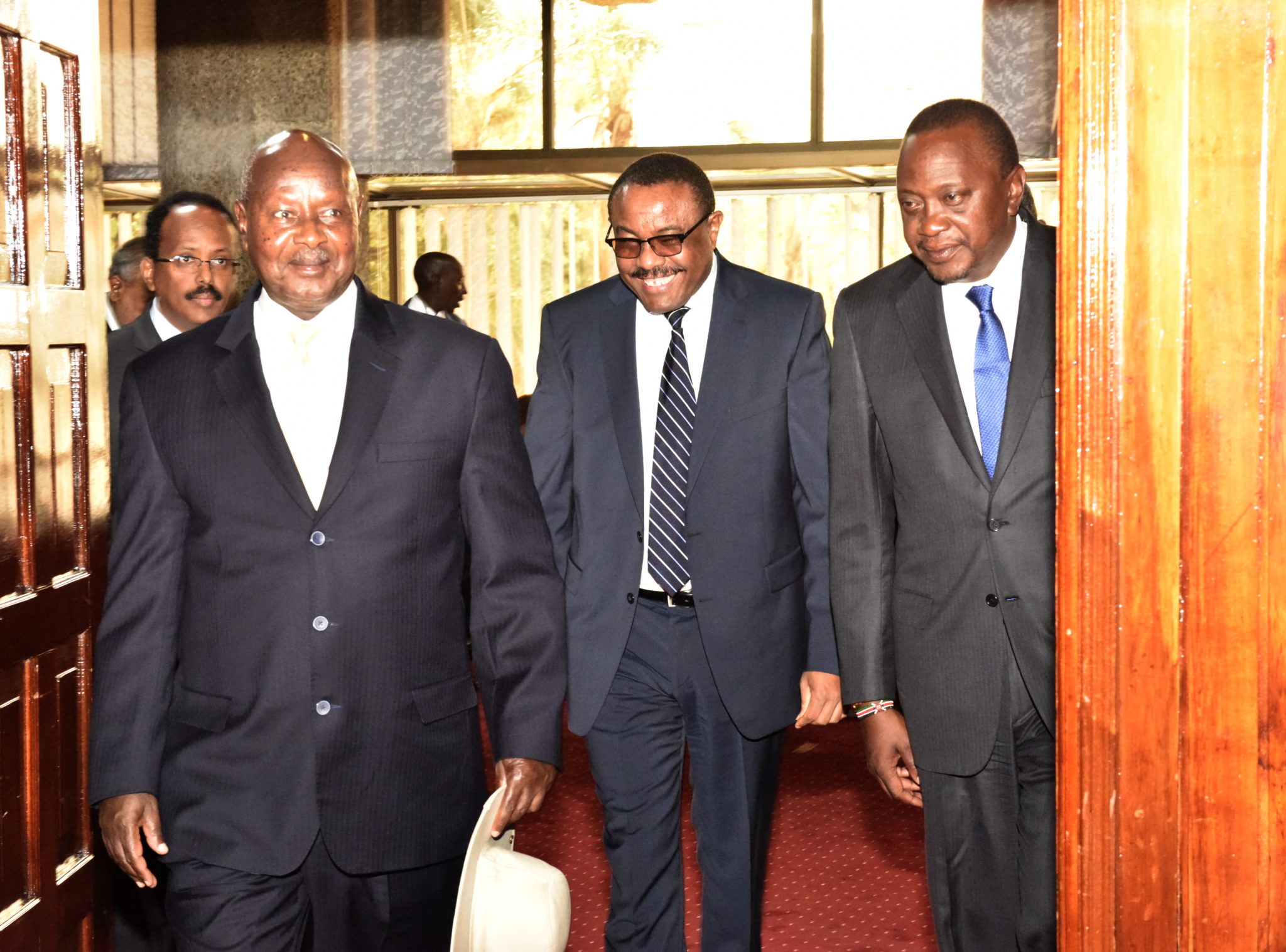
ADDRESSING SOMALI REFUGEE PROBLEM:Presidents Yoweri Museveni, Uhuru Kenyatta of Kenya, Salva Kiir of South Sudan, Ismael Omar Guelleh of Djibouti, Hassabo Mohammed Abdel Rahman the vice president of the Sudan, Hailemariam Desalegn Prime Minister of Ethiopia and chairman IGAD, Somalia President Mohamed Abdullahi Mohamed
President Yoweri Museveni has condemned sectarianism, saying it is the root cause for the soaring number of refugees in Africa.
Addressing a special IGAD summit on refugees from Somalia, Mr Museveni said: “Africans are categorized in four linguistic groups namely; Bantu, Nilotics, Sudanic and cushites. I have no problem with all these groups settling anywhere on the continent since they are all Africans and considered brothers and sisters. What concerns me most is the ideology of sectarianism where people are artificially divided along tribal, religious and other grounds.”
The summit at the Kenyatta International Conference Centre in Nairobi, Kenya and held under the theme ‘Towards durable Solutions for Somali Refugees and Sustainable Reintegration of Returnees in Somalia’, was hosted by President Uhuru Kenyatta of Kenya and chaired by Ethiopia Prime Minister Hailemariam Desalegn, who is also chair of IGAD.
IGAD leaderswent into a closed session immediately after the opening ceremony at Tsavo Hall
The IGAD leaders who went into a closed session immediately after the opening ceremony at Tsavo Hall are seeking a comprehensive plan of action towards solutions for the protracted internal displacement of people and with a focus on finding a lasting solution to Somali Refugee crisis.
President Museveni is quoted as telling IGAD leaders that the main causes of refugees and internally displaced peoples in Somalia and on the continent include; criminal actions by governments that threaten the safety of their citizens; weak states that are not able to defend their populations; criminals that have killed people in countries of origin, citing the intarahamwe of Rwanda who committed a genocide and fled to Congo and natural disasters such as drought being experienced in the region.
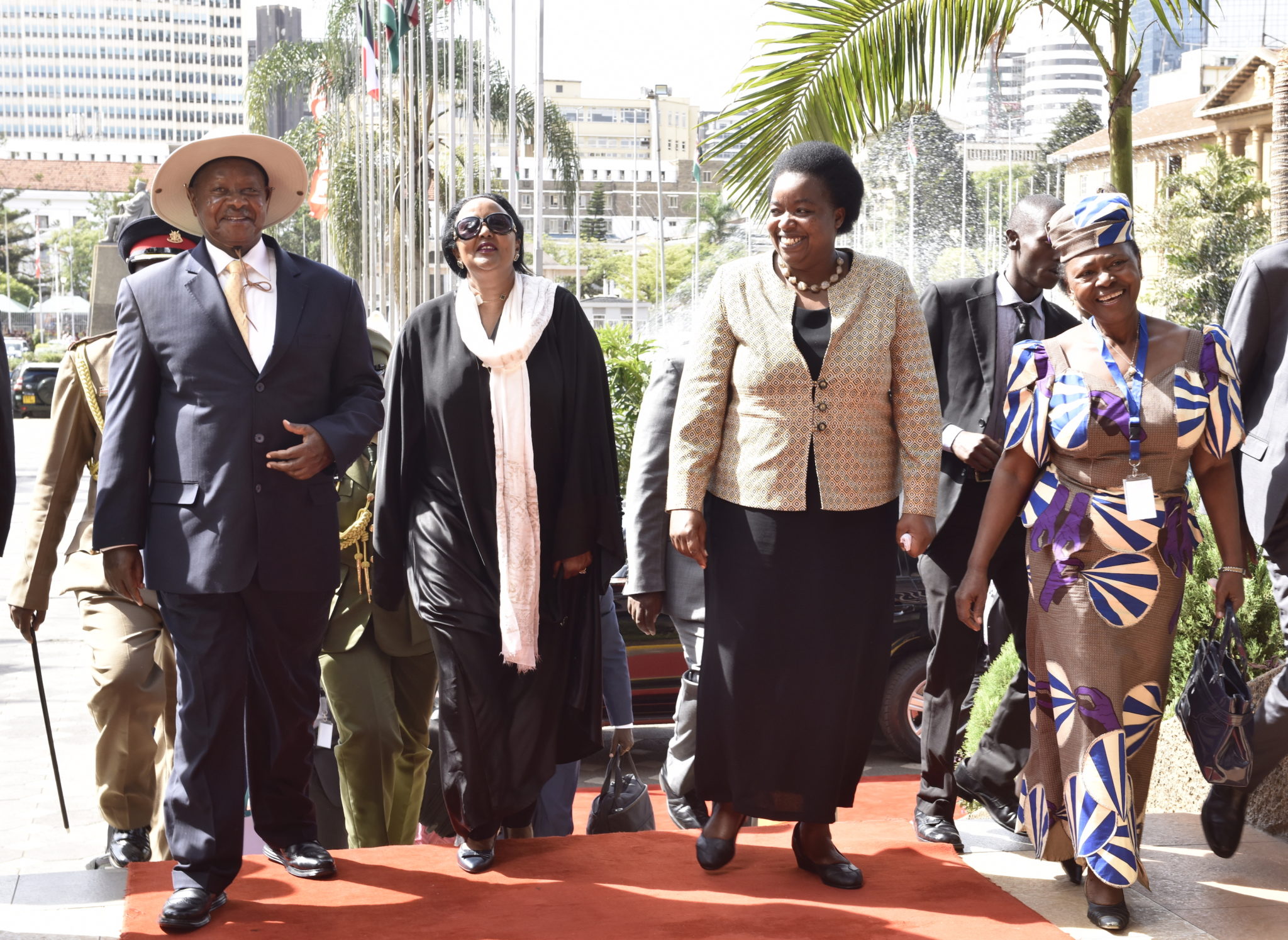
President Museveni with other delegates including Kenya’s foreign minister Amina Mohamed (in flowing robe) at the Summit
According to the President, Uganda is competing with Turkey in hosting refugees with the Pearl hosting about 1.3million refugees in the region; 900,000 South Sudanese, 50,000 Burundians, 20,000 Rwandans, 44,000 Somalis, 280,000 Congolese from the DRC, 13,000 Eritreans and 11,000 Sudanese.
The President called for immediate action to address issues relating to refugees and internally displaced people including relief during the time of refuge, clean water for domestic use, electricity to minimize environmental abuse, shelter that is environmentally friendly like prefabs to avoid destruction of trees etc.
“Refugees and displaced persons need an education so that they don’t lose time. They also need to acquire skills which can enable them participate in production in the countries where they are and also when they return home,” Museveni said.
He called on the international community to provide capital for small enterprises in development efforts as opposed to refugees being limited to the camps.
“Freedom of movement is important so that refugees can look for self sustaining opportunities. There should also have a right to return and an appropriate environment for their absorption in society,” he said.
On the issue of land, President Museveni said whereas Uganda’s liberal policy of providing land is praised, it is not sustainable as land can only be provided if available. He also cautioned that refugees should not be seen to be enjoying better amenities than the host communities and that when they leave, the situation of the local communities should not be worse off.
The summit was attended by leaders of member states of IGAD that included Presidents; Yoweri Museveni, Uhuru Kenyatta of Kenya, Salva Kiir of South Sudan, Ismael Omar Guelleh of Djibouti, Hassabo Mohammed Abdel Rahman the vice president of the Sudan, Hailemariam Desalegn Prime Minister of Ethiopia and chairman IGAD, Somalia President Mohamed Abdullahi Mohamed and several development partners.
While opening the IGAD Summit host President Uhuru Kenyatta commended IGAD Heads of State for their commitment saying that their presence in Kenya is reflection of the willingness to address the problem of refugees.
He said that a refugee camp is not a sustainable solution, indicating that now is the opportune time for Somalis to return and rebuild their country.
“A refugee camp was never meant to be a permanent home, nor is being a refugee a promise of losing your citizenship and your country. These people should participate in the building of their nation,” he said.
Commenting on the Daadab Refugee Camp in Kenya, Kenyatta said that life has not been easy for refugees there and that the camp has long lost its humanitarian character.
“It is not acceptable to us that a space that is supposed to provide safety and assistance is transformed to facilitate agents of terror and destruction,” said President Kenyatta.
Earlier President Yoweri Museveni held separate meetings with President Uhuru Kenyatta and President Salva Kiir.
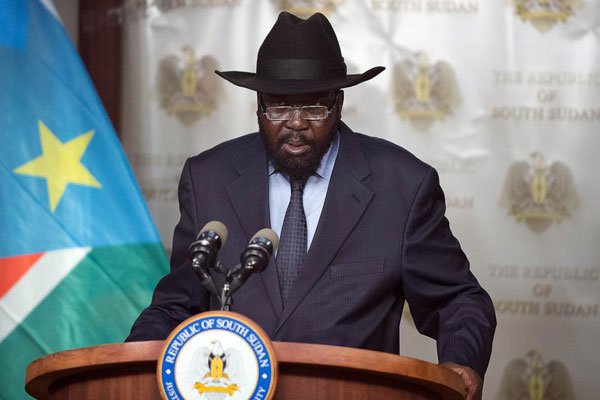
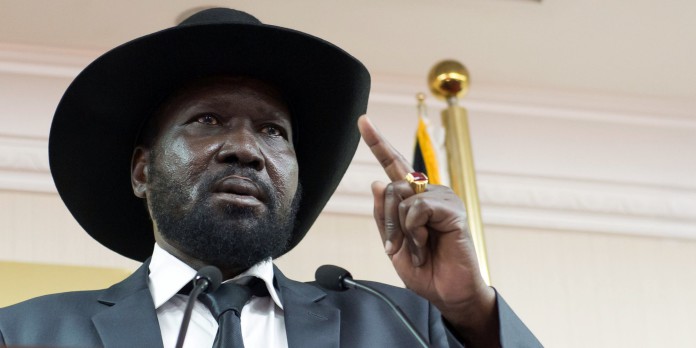
DECLARED THREE DAYS OF NATIONAL MOURNING: President Salva Kiir
South Sudan will not allow the participation of troops from countries outside the region in the regional protection force, the Presidential Security Advisor, Tut Kew Gatluak, has said.
Gatluak was responding to remarks by the outgoing head of UN. peacekeeping operations Hervé Ladsous, who told reporters in Juba last Tuesday that the additional 4000 peacekeepers, some from outside the region, would be deployed within weeks.
According to Ladsous, the force would include troops from Rwanda, Ethiopia, Nepal, Bangladesh, among others. But he didn’t mention Kenya.
But on Sunday Gatluak said that it would not make sense to accept the deployment of troops from countries outside the region as part of the protection force.
“The protection force was agreed to come from countries in the region and even if they come from countries in the region, they must be countries which do not have a direct interest in this country. So our brothers from Sudan and Uganda decided to not contribute because there are certain things which can make them bias(ed) in the protection force,” said the presidential advisor.
Gatluk added that the members of the government have to go over which countries would participate and what their motives would be.
“As the government we have accepted, we are aware certain countries will participate in the regional protection force. We will need a full briefing about the circumstances of their participation,” he said.
The presidential aide also maintained the position of the government to reject the inclusion of the airport and other key installations to the mandate of the protection force, saying the government was capable of providing protection to the airport as well as other key infrastructures in the country.
“There is no question about the airport; the position of the government has already been made clear. The airport will not be under the control of any foreign force, it is not going to happen. The government has the capability to provide protection,” stressed Gatluak.
The official went on to say that regional protection was to play a supplementary role to the national army and other security fractions, not to take complete responsibility from the army.
“Which countries in this world have their airports handed over to a foreign force? Tell me, which country in the world has ever given such a sovereign responsibility,” asked Gatluak when asked about the position of the government on the inclusion of Juba International airport to the mandate of the regional protection force.
Six aid workers have been killed in an ambush in famine-hit South Sudan, the United Nations said on Sunday, without specifying what organisation they worked for.
The victims were attacked on Saturday as they travelled from the capital, Juba, to the eastern town of Pibor, according to the UN Office for the Coordination of Humanitarian Affairs (OCHA).
“I am appalled and outraged by the heinous murder of six courageous humanitarians in South Sudan,” Eugene Owusu, the UN humanitarian coordinator for South Sudan, said in a statement.
“At a time when humanitarian needs have reached unprecedented levels, it is entirely unacceptable that those who are trying to help are being attacked and killed,” Owusu added.
According to OCHA, it was the highest number of humanitarian workers killed in one incident since the start of a civil war more than three years ago.
Saturday’s ambush followed two other attackson aid workers this month, shortly after South Sudan declared famine last month in two counties of Unity state, saying 100,000 people face starvation and another million are on the brink of famine.
After gaining independence from Sudan in 2011, the world’s youngest nation descended into war in December 2013 after President Salva Kiir accused his rival and former deputy Riek Machar of plotting a coup.
Tens of thousands have since died and 3.5 million people have been displaced, while a surge in fighting since July has devastated food production in areas that had been stable for farmers.
At least 79 humanitarians have been killed in South Sudan since the conflict began, including at least 12 killed this year, OCHA said.
“These attacks against aid workers and aid assets are utterly reprehensible,” Owusu said. “They not only put the lives of aid workers at risk, they also threaten the lives of thousands of South Sudanese who rely on our assistance for their survival.”
On Thursday, UN Secretary-General Antonio Guterres accusedSouth Sudan’s government of ignoring the plight of tens of thousands of people suffering from famine, 7.5 million in need of humanitarian aid and thousands fleeing the fighting.Earlier this month, the government announced plans to charge a levy of $10,000for each foreign aid worker, which along with the danger of abduction could hurt efforts to help the hungry.
“There is a strong consensus that South Sudanese leaders need to do more to demonstrate their commitment to the wellbeing of the country’s people, who are among the poorest in the world,” Guterres said during a UN Security Council briefing.
Joseph Moum Malok, South Sudan’s deputy UN ambassador, said the government “takes issue with the accusation”, adding that other parts of the country are affected by drought.
He also said the government “will spare no efforts to help address the situation and calls upon the international community to help address this urgent matter”.
A confidential UN report early this month, foundthat the famine was largely caused by Juba’s military operations.
“The bulk of evidence suggests that the famine in Unity state has resulted from protracted conflict and, in particular, the cumulative toll of repeated military operations undertaken by the government in southern Unity beginning in 2014,” the report said.
It also said the government is spending its oil revenue on weapons, even as the country descends into a famine.