Stanbic Bank
Stanbic Bank
18.5 C
Kampala
Stanbic Bank
Stanbic Bank
Home Blog Page 1977

‘Meet the Boss’: a niche interface promoted by Uptown Events Solutions

Is Business slow? Are you still waiting for that window of opportunity that will project your career to a whole new level? Or is the strain of everyday routine finally taking its toll on you and now you second guess yourself? Career choices have you stuck in one place for too long? Well, fret not, for Uptown Events Solutions brings you ‘Meet the Boss’, an event-campaign launched solely for the purpose of bringing together the corporates and business owners of all shades in Uganda with the aim of making their networking and marketing experiences easier.

The brains behind ‘Meet the Boss’.

Indeed, for the corporate individual who might have too busy a schedule to network or socialise, Meet the Boss offers a genuine and stress-free platform to meet, market and learn from those with the same expertise without the usual hustle and expense that defines business.

FEATURED ON MEDIA EDITION: Renowned journalist Simon Kasyate


FEATURED: Saxophonist Michael Kitanda

Started in 2015 by a group of young individuals who felt there was a need for focus on the movers and shakers of Uganda’s economy, with two successful events bagged, The Lawyers and PR editions hosted by ‘Bosses of the Night’ Oscar Kihika (Lawyer) and Henry Rugamba (PRAU President), respectively, Meet the Boss is on the move. The Uptown Events Solutions team will this year hosted Meet the Boss Media Edition, featuring renowned journalist Simon Kasyate as the ‘boss of the night’ and Saxophonist Michael Kitanda serenading the guests in jazz tunes as entertainer .

A recent report released by the International food and Agribusiness management indicated the various problems faced by the Maize industry in Uganda and marketing was one of them. The tourism industry constantly bemoans the lack of adequate advertisement and coverage and daily businesses are shut down and run to the ground due to the lack or insufficient number of customers. The need to bring awareness to one’s brand and what it has to offer is very important for one’s business or career to take flight.

Networking and marketing in business and other social spheres has not only proved to be an essential and effective tool, but a driving force when it comes to the growth, success and expansion of any projects. For example, business networking opens doors for individuals to meet those of the same trade who face the same challenges and obstacles while offering low-cost marketing opportunities that connect various business owners and decision makers on a more personal level. In so, doing individuals learn and connect with those at the top of their game while providing a conducive environment for the birth of new ideas and solutions to the major challenges faced in today’s economy and society including creation of personal ties that might result into future joint ventures.

“It really helps a lot especially for us business people who have no time to promote our businesses online; it is very important to network in this day and age, you never know what you can learn from a fellow businessman,” says Rajab Sibirimana, the CEO of Money Hub, a local money lending outfit in Kampala and one of the sponsors of the event.  The theme of these events is ‘professionalism’ and through profiling ‘Meet the Boss’ celebrates various professionals and their various achievements.

“We want to promote the concept of existential marketing and an interface where people can begin to appreciate the intrinsic value of our youth and what they are capable of achieving,” says Philbert Kagangure Mwebembezi, the Operations Director at Uptown Events Solutions.

With a foot in almost all fields of expertise Meet the Boss hopes to focus on real estate as another major key area with potential to birth economic growth on a considerable scale. The company launched its first magazine on December 6 this year.

“In five years’ time we are hopefully going to be ‘the best experiential and marketing company in Uganda” Mwebembezi says.

Stories Continues after ad

Aine’s wedding reunites former NRM colleagues

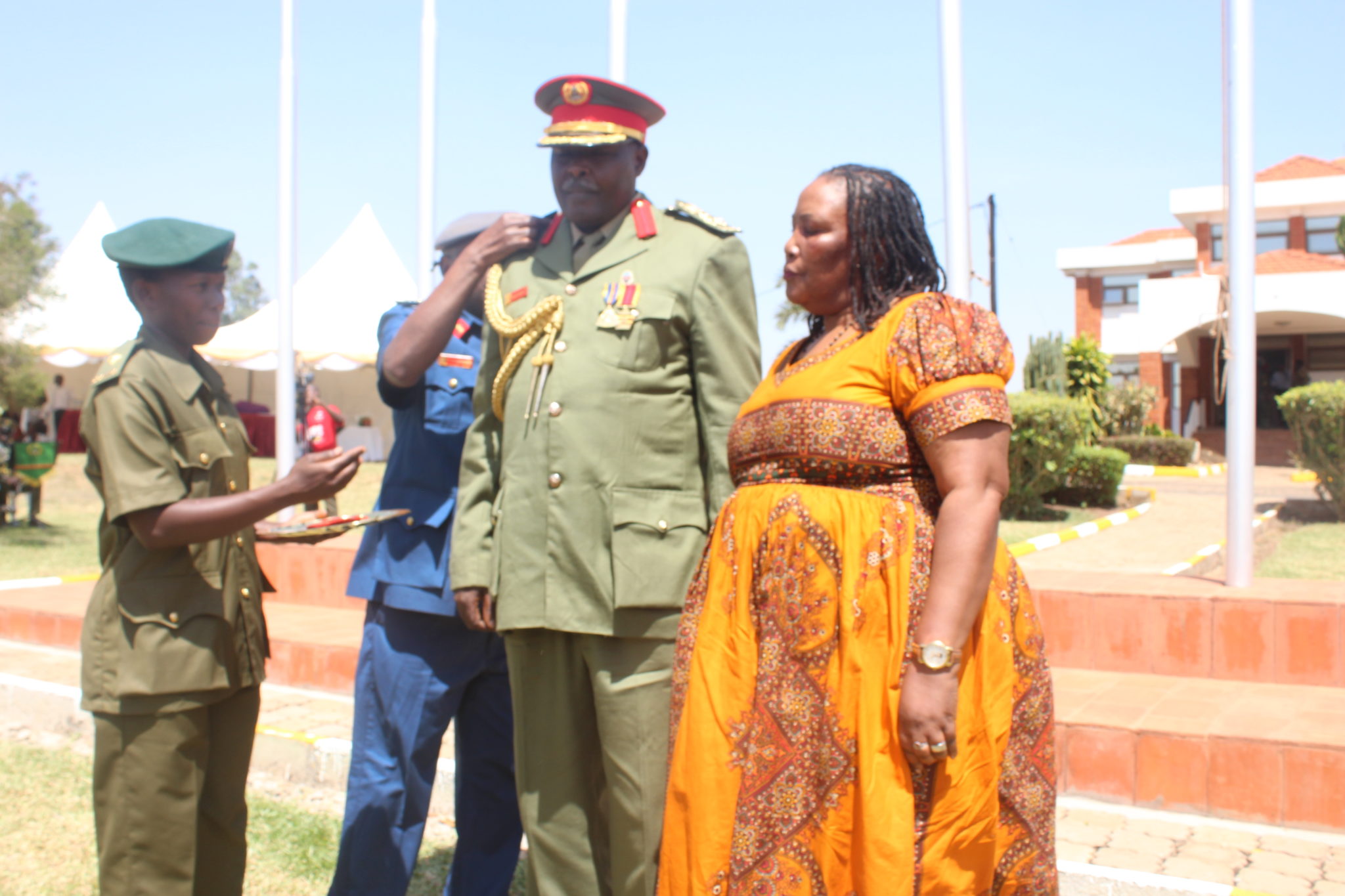
Former presidential candidate John Patrick Amama Mbabazi at the wedding of his former head of security Christopher Aine, who has married today.

After a very long time away from media scrutiny, former head of presidential candidate Amama Mbabazi’s private security detail, Christopher Aine, is back, this time with a Christmas surprise!

Christopher Aine and his newly-wedded wife. On Aine’s right is former presidential candidate John patrick Amama Mbabazi, a former Prime Minister. 

It is not that he has been missing or has resurfaced, but the man who kept security in Uganda on tenterhooks and even attracted a Shs20 million bounty on his head offered by the Inspector General of Police Gen Kale Kayihura, has wedded the love of his life!

The names of his bride were not readily available by press time however, the wedding has taken place a few minutes ago at Namirembe Cathedral and among the people in attendance is former presidential candidate, John Patrick Amama Mbabazi, a man the bridegroom has not met since this year began. Indeed, the two last met in December last year before Aine went missing for four months, only to resurface at the home of General Salim Saleh aka Rufu.

Meanwhile, sources at the wedding told EagleOnline that Mbabazi, who reunited and shared light jokes with some former NRM colleagues, has retreated to his home after the wedding and is set to return for the reception at Serena Hotel, Kampala.

Among other bigwigs expected to attend the reception is the Prime Minister Dr Ruhakana Rugunda and Gen Saleh, who has been keeping Aine ever since he resurfaced after months in hiding.

Congs Aine!


Stories Continues after ad

EU calls for investigation into Kasese killings

King Wesley Mumbere's palace in Kasese on fire.

The European Union (EU) has called for concrete investigations into the attack on Rwenzururu King Charles Wesley Mumbere’s palace in Kasese that resulted in the killing of over 100 people.

According to the EU, citing investigations being carried out by the Parliamentary Defence and Internal Affairs Committee and the Uganda Human Rights Commission, says the authorities in Uganda should ensure the investigations reflect the true nature of the cause of conflict. “The EU encourages full investigations in a timely, inclusive and transparent manner, according to due process and the rule of law.  The EU looks forward to the outcome of these investigations being made public, a release indicates”

The EU also says it ‘stands ready to assist – in addressing the root causes of conflict by all concerned through dialogue’.

The EU call for thorough investigations comes in the wake of King Mumbere facing multiple charges including treason, murder and aggravated robbery and his subsequent incarceration on remand in Luzira follows.

The move by the EU also comes at a time when leaders from Kasese including MPs are soliciting for signatures to pin the alleged perpetrators of the killings before the International Criminal Court (ICC) in The Hague.

The EU in Uganda is represented by the European Union Delegation, Austria, Belgium, Denmark, France, Germany, Ireland, Italy, Netherlands, Sweden and the United Kingdom.


Stories Continues after ad

Giovanni Kiyingi returns for Blankets & Wine Kampala

Ugandan folklore singer and song-writer Giovaani Kiyingi

Celebrated folklore singer-songwriter and Afro-fusion multi-instrumentalist, Giovanni Kiyingi, will be returning for the 15th Edition of Blankets and Wine that will take place at Lugogo Cricket Oval this Sunday, December 18.

Considered to be the biggest quarterly event on Uganda’s social calendar, the Tusker Malt Lager sponsored event and organised by House of Deejays, will be playing host to some of Uganda’s top socialites as they’re entertained by a variety of artists headlined by Africa’s number one artist, Tanzania’s Alikiba.

The organisers of the event have decided to return Giovanni Kiyingi for the 15th edition of Blankets and Wine Kampala.

Giovanni who performed at the previous edition was a crowd favorite and will be returning to showcase his talent come this Sunday.

We caught up with the ‘Amakondeere’ star who hopes to be the face of East Africa’s world music genre in five years and asked him a few questions ahead of this week’s event.


What inspired Giovanni to start singing and playing all the various instruments?

As I was growing up, the church choir inspired me. My music journey started in Kiboga, deep in the village called Vumba parish. I used go to church early in the morning and get a front row chair to enjoy the church choir which played music with traditional instruments.

What would you describe your music as?

My music is a fusion of my Ugandan roots and the influence of the worlds’ music.

What inspired your ‘Amakondeere’ album?

My Amakondeere album was inspired by the sound I wanted to put out and also many other various rhythm patterns.

What are some of your most memorable stage performances?

The one that stands out is when I performed for the Pope in 2015 at Kololo Airstrip Grounds with a full band on the song themed “New Day”. Then this year, I shared a stage with Michael kiwanuka at a festival in Belgium.

Are there any particular Ugandan artists you would wish to work with?

Yes there are quite a number of them. Cindy, Irene Ntale, Maurice Kirya, Sammy Kasule, Julian Kanyomozi and Irene Namubiru.

What is the funniest thing that has ever happened to you while performing on stage?

This one time, I did sound checking on stage and I was ready to play. On coming back to the stage, my guitar could not sound. I had left my battery running.

Are there any projects in the works that we should look out for?

Yes. The official Amakondeere release will be happening real soon and I plan to release two new albums “Mkatiko W’afirika” and “Kitengejja”.

What advice would you give to a young upcoming artist? 

Hard working is the song everywhere I go. But for upcoming artists in Uganda and East Africa, I would say we need to look into identity in sound now. How different you sound opens new markets all over because always the world is looking for something new! And East Africa’s sound is still virgin to the world.

What memories do you hold from your debut Blankets and Wine performance?

My debut at Blankets and Wine was rather interesting and fun. I remember I performed when it was raining and the stage had some water on it. But the highlight is how my friends and revelers kept on dancing in the rain. Even though it was raining, the sound was good and we just had fun.

This will be your second performance at Blankets and Wine Kampala. What should people expect from you?

People should come and we have a good time and continue from where we stopped the other time. With me it is a groove throughout the concert. Don’t miss it. Let us end the year with a bang!!!

A quarterly, picnic style music festival, Blankets and Wine is East Africa’s premier music experience, designed to showcase outstanding musicians in the emerging genres of afro-based music.

Entrance fee is 100,000 UGX at the Lugogo Cricket Oval and gates open at 12:00pm on December 18, 2016.


Revelers can buy early bird tickets by dialing *252# on MTN mobile money or at Definition stores at acacia mall, Garden city,  Uganda Wines & Spirits, Kanyana’s Bakery in Kiwatule, PayWay outlets & House of DJs Office in Bugolobi.


Stories Continues after ad

Beneath The Lies nominated for Africa Magic Viewers’ Choice Awards 2017

UNVEILED: Logo for the Fifth edition of the prestigious Africa Magic Viewers’ Choice Awards (AMVCAs)

Nominees for the fifth edition of the prestigious Africa Magic Viewers’ Choice Awards (AMVCAs) have been revealed.

Announcing the nominees was the duo of popular Nigerian actress and TV presenter, Mitchelle Dede, and renowned Kenyan actor, radio presenter and TV host Fareed Khimani during a special live broadcast which aired on all Africa Magic channels on DStv and GOtv.

The Nominees:

Best Soundtrack/Original Score

Oloibiri – Rex Ricketts

93 Days – George Kallis, Tunde Jegede and Banky W

No Good Turn – Brymo

The Encounter – Michael ‘The Truth’ Ogunlade

76 – Hyacinth Ogbu, Daps Agwom, Ukachi Nnachi

Best Cinematographer

Mrs Right Guy – Adze Ugah

93 Days – Yinka Edward

Happiness is a Four Letter Word – Lance Gewer

Oloibiri – Curtis Graham

76 – Yinka Edward


Best Actress in a Drama

Bimbo Akintola – 93 Days

Ivie Okujaye – Slow Country

Rita Dominic – 76

Adesua Etomi – The Arbitration

Zimkhita Nyoka – Vaya

Meg Ottamwa – Derailed

Hannah Ojo – Love is A Prank


Best Supporting Actress

Ivie Okujaye – Something Wicked

Somkele Idhalama – 93 Days

Adunni Ade – It’s Her Day

Ebele Okaro – Four One Love

Kehinde Bankole – 8 Bars and a Clef

Khanyi Mbau – Happiness is a Four Letter Word

Namundi Mbusi – Vaya


Best Supporting Actor Movie/TV series

Gideon Okeke – 93 Days

Warren Vasemole – Vaya

Kofi Adjorlolo – Ghana Must Go

Mpho Sebeng – The Jakes Are Missing

Rotimi Salami – Just Not Married

Nkem Owoh – Ghana Must Go


Best Art Director

76 – Pat Nebo

93 Days – Bola Bello

Oloibiri – Chima Adighije

Happiness is a Four Letter Word – Gary Smith

Ghana Must Go – Godwin Ashong


Best Actor in a Drama

RMD – Oloibiri

Ramsey Nouah – 76

Sambasa Nzeribe – Slow Country

Gregory Ojefua – The Encounter

Olu Jacobs – Oloibiri

Femi Jacobs – Femi Jacobs


Best Actress in a Comedy

Tina Mba – Meet the In-Laws

Uche Jombo – Wives on Strike

Dineo Moeketsi – Mrs Right Guy

Chioma Akpotha – Wives on Strike

Funke Akindele – Jenifa’s Diary

Funke Akindele – A Trip to Jamaica

Omoni Oboli – Wives on Strike


Best Actor in a Comedy

Imeh Umoh Bishop – The Boss is Mine

Ayo Makun – A Trip to Jamaica

Bovi Ugboma – It’s Her Day

Blossom Chukwujekwu – Ghana Must Go

Mike Ezuruonye – Brother Jekwu

Okey Uzoeshi – The Life of a Nigerian Couple

Amechi Munagor – Meet the In-Laws


Best Writer

76 – Emmanuel Okomaiyi

The CEO – Tunde Babalola

A Trip to Jamaica – AY Makun

Oloibiri – Samantha Iwowo

Ghana Must Go – Tunde Babalolo

Vaya – Akin Omotoso


Best Movie West Africa

93 Days

76

Oloibiri

A Trip to Jamaica

The CEO


Best Movie (South Africa)

Mrs Right Guy

Happiness is a Four Letter Word

Vaya

The Jakes Are Missing

All About Love


Best Movie East Africa

Aisha

Kati Kati

Epidemic

Homecoming


Best Overall Movie

Mrs Right Guy

Happiness is a Four Letter Word

Aisha

93 Days

76

Naomba Niseme


Best Short Film or Online Video

Ireti

Loot

Meet the Parents

Cat Face

Light Diaries: Spin Around


Best Documentary

Roots Gambia

Makoko: Futures Afloat

Alison

Amaka’s Kin: The Women of Nollywood

Petra’s Nebatean Heritage


Best Television Series

Jenifa’s Diary

Sokhulu and Partners

Duplicity

Beneath the Lies

Beyond Your Sight: The Police Story


Best Indigenous Language Movie or TV Series (Swahili)

Urembo

Siri Ya Mtungi (Season 2)

Mganga Bomba

Fihi

Zilizala


Best Indigenous Language Movie or TV Series (Igbo)

Amonye-bu-onye

Obi-Eze

Obi Nwanyi

Mmakwara series

Ikpe Omuma


Best Indigenous Language Movie or TV Series (Hausa)

Salim

Mafarin Tafiya

Yaki Da Zuciya

Maula


Best Indigenous Language Movie or TV Series (Yoruba)

Somewhere In The Dark

Ode Iku

Ajoke Aiye

Tobajewo

Iman


Best Costume Designer

Pat Egwurube- 76

Dele Akinyele/Chelsea Oliver- Oloibiri

Chiemela Nwagboso/ Asantewa Clara Adjoa- Ghana Must Go

Shileola Ibironke and Mojisola Sapara- Casino

Obijie- King Invincible


Best Lighting Designer 

Elliot Sewape- 93 Days

Amisu Alade/ Edwin Lau- Oloibiri

Yinka Edwards- 76

Lance Gewer Sasc- Happiness Is a Four Letter Word

Fabian Hooks- A Trip To Jamaica


Best Picture Editor (Movie/TV Series)

Nnodim Chigozie and Paula Peterson- Oloibiri

Vuyani Sondlo- Vaya

Emeka Ojukwu- 76

Antonio Ribeiro- 93 Days

Nicholas Costaras/ Melanie Jankes Golden- Happiness Is A Four Letter Word


Best Sound Editor (Movie/TV Series)

Mike Barnitt- Oloibiri

Pius Fatoke and Mzukisi Mtshiselo- 93 Days

Richard Mohlari/ Dave Hawkins- Vaya

Solomon Emmanuel- 76

Jean Niemandt- Mrs Right Guy


Best Make Up Artist (Movie/ TV Series)

Chinwe Elovah- 76

Hakeem Onilogbo Ajibola/ Perekeme Odon- Oloibiri

Ronwyn Jarrett- Umililo

Thema Ozzy Smith/ Lola Maja-Okojevoh/ Adetunmi Imoteda- 93 Days

Dianne Allen- Happiness Is A Four Letter Word


Best Director

Adze Ugah- Mrs Right Guy

Steve Gukas- 93 Days

Curtis Graham- Oloibiri

Izu Ojukwu- 76

Robert O Peters- A Trip to Jamaica

Frank Rajah-Ghana Must Go


Best Short Film

Ireti

Loot

Meet The Parents

Cat Face

Light Diaries: Spin Around


Attachments area


Stories Continues after ad

Kamadhi Series: Museveni women musketeers in supremacy battles

WE BEG YOU TO RULE AGAIN: Evelyn Anite, the State Minister for Finance in charge of Investments, asks President Yoweri Museveni to offer himself for presidency. This was during an NRM retreat in Kyankwanzi.

Joel Kamadhi was recently in Busoga, after he ‘landed an invitation to be home’ during President Yoweri Museveni’s tour of the eastern region that involved inspecting the massive wetland of River Mpologoma along the Mbale-Tirinyi road.

Kamadhi was still upbeat, telling members of the Mutungo Malwa Group that those who planned for the President’s visit ‘were kind enough to recognize my contribution to Ugandan society’.

“You see, I told you young men that I am important. I have served Uganda for over 40 years and people in my area recognize that,” Kamadhi said.

However, Hitler Eregu and Yorokamu Bwambale challenged Kamadhi as to why those in charge of the President’s protocol hadn’t introduced him to the ‘Big Man’. “I watched the whole programme on TV, how come I did not see them introducing you to the Big Man? You were even nowhere near the venue,” Bwambale, the Mukonzo colleague who last week was the victim of Kamadhi’s acerbic tongue, charged.

But Kamadhi is no push-over. “My friends, ndi mu kintu”! Kamadhi said, adding: “I met those who met those who met those who planned for that visit and told them the message to be forwarded to the Big Man.”

Eregu, the reformed former rebel from Teso (who incidentally claims patent rights over Malwa issues) and Bwambale, the less-combative Mukonzo who these days seems laid back after the attack on his King’s palace in Kasese, had no option but to give up the challenge, leaving Kamadhi with beaming a wide grin of triumph.

Kamadhi then went on an unrestricted rant, seeing that he had overcome Bwambale’s attempt at distracting him.

The Speaker of Parliament Rebecca Kadaga, currently considered the most powerful poilitician in Busoga.
COMPETING FOR SUPREMACY IN BUSOGA POLITICS? NRM Secretary General Kasule Lumumba

“It was during my interaction with the chain of representatives of the Big Man that I raised the issue of our Busoga Princesses who are involved in various battles of political supremacy. I told them to tell the Big Man about Speaker of Parliament Rebecca Alitwala Kadaga fighting with National Resistance Movement (NRM) Secretary General Justine Kasule Lumumba and, Bukono Princess and MP Persis Namuganza, who is also the State Minister of Lands, fighting with the ICT State Minister Aidah Nantaba Erios, a politician in the not-so-distant Kayunga district.

According to Kamadhi, Lumumba recently went on a land-buying spree in four different districts of the greater Busoga region, allegedly to ‘spread her wings’ in the region in an effort to wrest the Busoga women leadership from Kadaga. Kamadhi said information he gathered indicated that Lumumba apparently used a dubious fellow, an alleged land-grabber, to acquire the said land. “The said man is allegedly connected to some bigwig in the police but I don’t know how that will help him when issues of land grabbing arise,” Kamadhi quoted one of the aides as telling him.

AT WAR: ICT State Minister Aida Nantaba Erios

Kamadhi then briefly took the group members through the Namuganza-Nantaba fight: “Munna, you see these Busoga Princesses are no joke, Namuganza has even managed to silence Nantaba, a woman known for openly defying Museveni and still maintain a position in Cabinet!” Kamadhi said with a fake sense of pride.

He added: “You know it is our princess who replaced the Kayunga Iron Lady at the lands ministry and Namuganza is keen on showing her what Basoga women are made of!”

But Bwambale, as if recovering from slumber, shot back: “You seem to only know about the Busoga fights, yet you claim to be conversant with what goes on in the whole of Uganda. Havent you heard about other fights or your knowledge is limited to Busoga?”

Hahaha, Kamadhi chidingly laughed before replying: “Well, I was still narrating; it was after the detailed accounts of the Busoga women leaders’ battles that the Big Man’s aides also tasked me to update them with information on all the NRM women involved in different quarrels and scandals over the past three years.

LOOK IN FRONT NOT SIDEWAYS LUKWAGO SEEMS TO BE THINKING: KCCA Executive Director Jeniffer Musisi Semakula and Lord Mayor Erias Lukwago.

According to Kamadhi, his brain went racing back to 2013, and zeroed on a few of them including the recent one of Investment State Minister Evelyn Anite squaring it off with her boss Matia Kasaija; then there was KCCA Executive Director Jennifer Musisi Semakula fighting Lord Mayor Erias Lukwago, a battle lately joined by Kampala minister Beti Olive Kamya; the ‘cold war’ between Kamya and Musisi over who calls the shots in the city; Health Minister Dr Jane Ruth Aceng and Dr Diana Atwiine battles with former health PS Dr Asuman Lukwago.

NRM-EC Chairperson Dr. Tanga Odoi and SG-Justine Kasule Lumumba are normally ‘no-longer at ease’.
AT WAR WITH MPs LED BY NABILLAH NAGGAYI: Minister of Trade and Cooperatives Amelia Kyambadde.

Then there were also the battles involving NRM SG Justine Kasule Lumumba fighting Dr Tanga Odoi, the party’s Electoral Commission boss, over salary disparities of staff at the NRM Secretariat and the party EC; Trade Minister Amelia Kyambadde’s battle with Parliamentarians led by Kampala Woman MP Nabillah Naggayi Ssempala over the issue of Chinese petty traders in Kampala; Uganda National Chamber of Commerce and Industry (UNCCI) chairperson Olive Kigongo fight with enterpreneur Andrew Rugasira and Amina Hersi’s involvement in the ‘tripartite battle’; and last but not least, Kamadhi talked about the scandal that he said, has tainted the image of Uganda National Roads Authority (UNRA) Executive Director Allen Kagina, who signed documents authorizing dubious payments to a Chinese company, leading to a probable loss of about Shs32 billion.

ON THE SPOTLIGHT FOR AUTHORISING PAYMENT TO FAKE CHINESE COMPANY: UNRA Executive Director Allen Kagina.

“For Kagina, the aides told me the Big Man has not taken her calls for over four months now; and that she even reportedly resorted to using ‘third parties’ but Museveni is not budging; after all he said this is kisanja hakuna mchezo and he is fighting hard to ensure he doesn’t appear before Ugandans as a joker,” Kamadhi said.

Then he started enumerating some of the other stand-offs involving NRM women leaders, insisting however, on telling us the story of State Minister of Finance in charge of Investments Evelyn Anite and her boss, finance minister Matia Kasaija.

“Young men, I won’t go home before telling you this,” he started off, adding: “some of these youthful politicians are so powerful and are giving the veteran NRM fellows a run for their age.”

Privatisation and Investment State Minister, Evelyn Anite.

“Do you know that it is Anite who brought former Prime Minister and Museveni confidant Amama Mbabazi’s political career to an inglorious end after she knelt down while in Kyankwanzi and begged the Big Man to ‘rule for ever’ at a time Mbabazi thought he was next in the NRM queue? Do you know that recently she also almost brought the career of another NRM veteran politician Kasaija to an end after the two, in their capacities as ministers in the supervising ministry, appointed different people to chair the board of the Uganda Electricity Generation Company Limited? Do you know that she was even on maternity leave when she made her appointment? Do you know that she announced the appointment of Eng. Proscovia Njuki three days after getting the Minister’s letter appointing Eng. Frank Katusiime? Do you know that Kasaija has since recoiled and Anite’s choice, Eng. Njuki, is the UEGCL board chairman?” Kamadhi asked.

Well, after the raft of questions he posed that heralded no answers, Kamadhi announced he was retiring for the night, and promising to return with ‘even more scintillating stories’.

We all dispersed, leaving the ‘brewer’ Hellen to gather her implements.

This is a burlesque column that will be running every Friday.


Stories Continues after ad

The University Makerere should be (Part II)

DEEP KNOWLEDGE ABOUT MAKERERE: Author Professor ABK Kasozi.

Over the years Makerere University has had to contend with several challenges, prompting the authorities in government to seek for solutions. In the process several scholars have lent their expertise to that effort.

In the second of a three part series The EagleOnline documents Professor ABK Kasozi’s ‘humble’ contribution to this noble cause.

With an academic career spanning over 40 years, Prof Kasozi is a former Executive Director of the National Council of Higher Education (NCHE), among other notable appointments. 

CONT’D

Both Tanzania in 2005 and Kenya in 2012 have passed University Acts to change the governance of universities to match changing global and local forces impacting on university roles in society and their management (copies attached). What is painful to me is that the Uganda National Council for Higher Education participated in efforts of drafting our neighbour’s law but my heads in Uganda refused to listen. Roles of universities need defining and their governance brought in line if we are to avoid activisms and strikes by various university groups.

  1. Universities are not fulfilling their multiple roles


Due to the faulty governance model and underfunding, most of our universities are not fulfilling their multiple functions of knowledge production (through research, debate and other forms of innovation), advanced training, recruitment of social elites, and public service. Although there have been massive increases of student enrolment and number of universities, the Ugandan university has not been transformed into an engine of development. With the exception of a few faculties at Makerere and Mbarara, the Ugandan university has not added much to new knowledge for resolving national social problems in the last twenty years. It has remained a teaching institution. All we see are endless graduation ceremonies and wasteful graduation parties afterwards. Most of our universities are really glorified high schools teaching already known, and in most cases, imported knowledge. This may not be surprising since most of them are funded to mainly perform the teaching function of universities. Year after year, the NCHE publication, the State of Higher Education and Training has lamented the dearth of research in our universities. Even at Makerere, where there is a tradition of research, Cloete found that in 2007, the ratio of academic production per staff to be 0.20 compared 0.50 for South African universities. In a research of over twenty universities in the last two years, I found the average production ratio to be less than 0.1 for other institutions, Makerere and Mbarara excepted. Research output/production includes publications (hard and soft copies) in journals, books, the motion media, participation in critical public debates, obtaining patents and leadership in defining issues. 

  1. Funding of research


Much as a traditional campus based university is a complex multipurpose institution with many functions, research and knowledge production takes precedence over other roles. This is especially so in this knowledge driven global age. Institutional rankings, faculty promotions, grants and major donations are, in most of the world, based on research outputs. Although Uganda has many universities and many are proud to award certificates, diplomas, degrees and other terminal decorations, according to the surveys I have done, few of these institutions qualify to be called universities. They do not conduct research. Yet universities are the major producers of knowledge and leaders of national innovation systems. A recent study states that every state needs “ a national research system which is composed of universities, the private sector, public and private centres” to produce relevant knowledge to resolve social problems and participate in the larger global economy. As centres of research and producers of high level thinkers and workers, universities are the drivers of modern economic development.

The major obstacle to conducting research in our universities is insufficient funding of this critical function of these institutions. The underfunding of research is energized by a belief by many Ugandans that the major role of a university is to teach. On average, Ugandan universities spend about 2% or less of their budget on research. According to Mamdani in his book published in 2007, the Government of Uganda stopped effective and systematic funding of research in the 1990s and from then to date any money for postgraduate training is targeted to personnel needed by the civil service. In the decade 2000 to 2010, Uganda’s funding of public universities as a percentage of GDP averaged only about 0.3% compared to about 1.0% of Kenya and Tanzania and over 2.0% of the Asian giants in the same period. In research and development, the country’s investment declined from 0.74 % in 2003 to 0.5% as a percentage of GDP. It seems we have developed a perception that foreign donors are responsible for funding our knowledge production function of our universities. Musiige and Maassen wrote in 2015 that in 2013, 80% of Makerere’s  $85 million research funding came from foreign donors. There is nothing wrong in receiving money from foreign donors but dependence on this source for most of our funding is risky as such a source is not sustainable and is dependent on many fluctuating circumstances.

  1. Loss of sight of the role and position of a university in society

To develop inclusive governance, and hopefully democratic model for universities, the key stakeholders must be clear of, and should have, a shared view of the role of universities in society and how they should be governed. By pressuring the Government to directly make their salaries part of Government expenditure payable by the treasury, academic staff in public universities are not enhancing the position of universities that enables the latter to properly play their proper roles in society. Universities operate best when they are not hostile to, but free from, the state, their owners and the public. To secure their institutional autonomy, universities should receive unconditional grants from external sources including the Government and account for that money to the public, government and other stakeholders. If staff are paid by the state, then universities, which must respond to both national an international forces, will be required to adhere to government bureaucratic laws like other national institutions. This will undermine university autonomy, university traditions and the freedom of staff to control their researches and teaching agendas. What staff should demand is a change of the current university relationship with the Government as well as a change in the governance model through amending the act and the way public universities are funded. Such changes should increase options for universities to raise more resources. This has happened in Tanzania and Kenya where university acts have been enacted to spell out such relationships. Uganda is about ten years behind in this field. But current staff action and the way they are pressuring the state will increase the linkage of public universities to the state. In turn, this will affect the abilities of universities to fulfil their multiple functions, as University income will be determined by government budgetary constraints, as is now the case. They will become, like parastatal bodies, Government institutions responding to only local forces like high schools. Like Christopher Okigbo, striking staff are betraying their own cause and the cause of universities by taking actions that might destroy the universality of our universities.

  1. The academic profession reduced to a mere teaching role

Due to underfunding, mismanagement and laziness on the part of university workers, most of Ugandan university instructors have been reduced to being mere teachers because they do not add to known knowledge.  They therefore do not qualify to be members of the academic profession. They are teaching professionals. The Socratic and Humboldtian tradition emphasizes a synergy of research and teaching in a context of institution autonomy based on social responsibility and financial support by the state. Research energises teaching as a real academics share their findings with students who are, in many cases, more amazed by original rather than copied or plagiarized ideas. Student participation and involvement in the search and refinement of knowledge improves learning, teaching and production of knowledge. The combination of those activities makes a university a real community of learners, a “universitas”, whose aim is the search, refinement and transmission of knowledge.

To be continued Monday


Stories Continues after ad

DRC moves to block social media ahead of Kabila mandate expiry on Sunday

President Joseph Kabila of the Democratic Republic of the Congo.

Authorities in the Democratic Republic of Congo have ordered the blocking of social networking websites including Facebook and Twitter, as well as WhatsApp, before President Joseph Kabila’s mandate expires at midnight on Sunday.

The government order, sent to at least three internet providers, will probably hamper the organisation of public protests against Kabila.

It gave a non-exhaustive list of platforms subject to the block that includes Skype.The letter from Congo’s Posts and Telecommunications Regulatory Authority (ARPTC) requires the ‘temporary blocking of sharing of images, video and voice [data] over the network’ from 11:59pm local time (2259GMT) on Sunday, but gave no reason for the orders.

“In cases where partial blocking is not possible, you are required to block access to the relevant social networks entirely,” it said.

Text messages will continue to function as normal.

The government’s plan was first raised on Tuesday at a meeting of the ARPTC.

“The ARPTC verbally instructed us during the meeting to filter connections on social networks,” one internet company executive said, before adding: “trials are likely to be carried out overnight Thursday [into] Friday”.

“We will comply with what has been demanded,” said a manager at one of the affected internet providers. “It’s part of our [legal] obligations.”

An executive at another affected ISP said disregarding the order would result in offending providers having their licences terminated.

Political tensions are running high in the country in the run-up to the constitutional end of President Kabila’s second and final term on December 20.

No elections have been organised and the opposition accuses him of seeking to retain power.

Under a controversial ruling by the Constitutional Court, Kabila may remain in office beyond the end of his mandate.

Kabila’s failure to step aside has led to protests in which dozens have been killed.

On Monday, the European Union imposed travel bans and asset freezes on seven top DRC security officials because of ‘a disproportionate use of force’.

The opposition has warned of nationwide protests from Monday until Kabila quits office. But rallies are on hold while the Roman Catholic Church mediates last-ditch negotiations to bring about a political transition towards elections.


Stories Continues after ad

Rwenzururu PM arrested over ‘ICC signatures’

Mr. Johnson Thembo Kitsumbire, photo credit, NTV-Uganda.

Rwenzururu Prime Minister, Johnson Thembo Kitsumbire has been arrested by police.

Mr. Kitsumbire was picked from his home in Kasese Municipality and sources, speaking on condition of anonymity, say he is currently being questioned over his role in the collection of signatures to petition the International Criminal Court (ICC).

“Several Kasese leaders including MPs are currently involved in an exercise to gather signatures in a bid to petition the ICC over the Kasese clashes; this could be the reason for his arrest,” the sources said, without giving details.

Just a week, the leaders met with the ICC Registrar who was in the country to follow-up on the indicted Lord Resistance Army commander Dominic Ongwen who is currently facing charges of crimes against humanity

However, police remains tight-lipped on the reason why he was arrested, but have promised to address a presser later.

Meanwhile, sources say Mr. Kitsumbire is the second in hierarchy in the Rwenzururu kingdom and is the current caretaker of the kingdom affairs.

Police and other security agencies have arrested and charged152 people in relation to the killings in kasese.

Over 100 people died in the violence when the army and police attacked the King Mumbere’s palace.


Stories Continues after ad

BIG INTERVIEW: Morrison Rwakakamba, the man whose new job is to interface with citizens

Bridge School country Director, Morrison Rwakakamba.

From time to time government reviews its information dissemination capacities with a view to improving service delivery responses as carried out in various sectors. Against this background, the Government Citizen Interaction Centre (GCIC), has been iniatiated to strengthen the coordination of information with a view to capturing citizen participation and, in the process, delivering on outcomes.

The EagleOnline interviewed Morrison Rwakakamba, the newly appointed Director of the GCIC, and below are excerpts. 

I suppose congratulations are in order; a ‘Christmas Gift’ come early of sorts?

Thank you. Thank you so much. You see, I don’t look at this position as a ‘gift’ but rather as an opportunity that comes along with service offering to bring citizens and government in direct contact – and thus expand transparency and openness in government and put citizens at the center of monitoring how government services are doing. It will therefore, be a busy Christmas – besides family and faith obligations, I will be putting teams together, figuring out stuff – and consulting with and listening to citizens on effective ways to engage government and making things happen. Thanks again for best wishes.

Is your new appointment a promotion or demotion, given that you have been a Presidential Assistant, appointed by the Big Man himself? Anyway, is your new job station an appointment by the President?

I consider myself a public-spirited person. I am therefore comfortable with any opportunity availed to serve the public good. I am usually not bothered by kilograms that particular positions weigh. I therefore don’t look at this in terms of promotion or demotion. It’s just a call to public service. But for purposes of clarity, the President seconded me to head GCIC as an additional role to the work I have been doing in his office. I am therefore, holding the GCIC position on secondment of the President of the Republic of Uganda.

Is this job provided for under the normal Public Service structures; is it a cross transfer from one government institution to the other?

GCIC is in interim running as a program superintended over by the Ministry of ICT and National Guidance. GCIC’s mandate and functionality supports communication structures of government and is not in contradiction with relevant Public Service regulations and standard operating procedures.


What does the job entail; i.e. scope of work, when to carry out the work and how to carry out the work?

Certainly, we all agree that, timely, cost-effective and data driven communication between Government and Citizens is a critical aspect in service delivery, ideas generation, innovations and citizens participating in their governance. How then will GCIC deliver on this? Pointedly, GCIC will primarily aggregate data from MDAs and transform it into crisp, simplified, visualized and analyzed information – and channel it to responsible dissemination/ communication centers of government. GCIC shall have a dedicated team of data miners to specifically deal with breakdown of for example budget allocations and releases up to sub county level. We want people to follow their money, know and monitor what’s going on. We strongly believe this will result into effectiveness of public policy performance by enhancing monitoring of service delivery and provision of real time channel for feedback, suggestions and action from citizens. Therefore, our scope is broad and only supportive. We believe it’s surmountable – and we shall measure our success on verifiable indicators that show that citizens are enjoying better and efficient services from government. It is as bold as that.

 So, is there any relationship between your job and that of the Government’s Media Centre?

There will be a strong complementary relationship with Government Media Center. In fact, besides the President and Minister of ICT& National Guidance, the Executive Director of the Government Media Center was part of the GCIC Conceptualization. GCIC is well located within ecosystem of Government data and outreach function. GCIC shall provide analyzed and visualized data to all MDA’s spokespersons, government communication agencies like Media Center and myriad Internet based platforms. GCIC’s analyzed and packaged data will feed web portals of MDA’s and other media platforms (blogs, social media sites etc.). To effectively execute this function, GCIC shall primarily work closely with Office of the President, Office of Prime Minister, Ministry of Finance, Planning and Economic Development (MFPED), Uganda National Bureau of Statistics and other Agencies of Government.

The issue of streamlining government communications seems to be an evolving problem; won’t your appointment further complicate the situation by causing multiple duplications arising out of different ‘reporting centres’?

Need to streamline Government Communications is partly why GCIC was created. It was out of realization that there was no centralized place to aggregate government performance data and transform it into messages that feed government and other platforms to keep citizens updated about what’s going on. Even when Ministries, Departments and Agencies (MDA’s) websites were built, most of them largely remain with limited updated information communicating government messages. GCIC will supportively work with Government Communication staffers to change this.

Second, there was no central and direct platform for citizens to constantly share their views about what they want and need, what they like and dislike, and their overall expectation from Government. Listening to the people by Government will therefore yield better and effective delivery of services to citizens, tweaking of policies to comply with needs of citizenry and will create more transparency and accountability.

Therefore, in order to harmonize government communication and increase contact with citizens, H.E the President directed the Hon. Minister for ICT and National Guidance to set up a Government Call Centre and other information technology (IT) propelled facilities that have capability to harness data and information to promote citizen’s communications with Government. This again, is why the Government Citizen Interaction Centre (GCIC) was initiated.

Anyhow, has the government abandoned the idea of Barazas, which involves the interaction between communities and the various public servants with varying degrees of internalizing and interpreting the themes of debate, and instead settled for the centralization of the function under only one man and his ‘small’ team? 

Government never abandoned Barazas. At Sub county level, Braraza’s are happening. The office of the Prime Minister is keen on Barazas and continues to support them. You may recall that, in his inaugural dialogue with stakeholders, the Minister of ICT & National Guidance, Hon. Frank Tumwebaze articulated that the Ministry shall conduct syndicated open government sessions featuring Ministry-by-Ministry to engage the media aimed at securing citizen buy-in in policy formulation, execution and monitoring. This is expected to expand compliance in regard to service delivery targets by agencies of government. People will hear quite often what the government is doing. GCIC will be backstopping these processes and actions to reach and get more citizens engaged.

What are the probable budgetary implications that might arise as a result of your new appointment?

Budgets and set up of requisite technology are handled by Ministry of ICT through its agency NITA-U. I am focused on putting together a team to get things done.

What are some of the urgent roles you plan to handle immediately?

Building a team from ground up and letting citizens know services that GCIC shall be offering.

 Will this position also handle patriotism given that our values as a Ugandans are at not the best today?

Government is keen on nurturing a population that is patriotic. GCIC will be reaching out to citizens with information that raise awareness about Uganda and common values that connect us and make us a proud nation. That’s perhaps the only considered way that GCIC shall contribute to patriotism. It’s indeed a duty of everybody to be patriotic and to promote patriotism – and broadly image of Uganda. It’s the only Country we have.


Stories Continues after ad