MISS WORLD WINNER: Stephanie Del Valle of Puerto Rico.
Miss Kenya, Evelyn Njambi on Sunday emerged among the top five beauty queens in the world, beating Miss USA, UK and over 100 others. Njambi is the first Kenyan and East African to reach that level.
The pageant was won by Stephanie Del Valle of Puerto Rico who was crowned Miss World 2016 on Sunday. Del Valle, 19, is a brown-eyed brunette student who speaks Spanish, English and French, and hopes to get into the entertainment industry.
She becomes the second titleholder from the island after Wilnelia Merced won the title in 1975 and, Puerto Rico becomes the 17th country with multiple winners since Miss World started in 1951.
Contestants from more than 100 countries took part in the 2016 edition of the beauty pageant, and the other contestants who made it to the top five include; Yaritza Miguelina Reyes Ramirez of the Dominican Republic (First Runners-up), Miss Indonesia Natasha Mannuela (Second Runners-up) and Miss Philippines Catriona Elisa Gray.
A total of 34 nationalities have been victorious, with the UK (5), India (5), the US (3), Jamaica (3), Iceland (3), Germany (2) and Australia (2) all providing multiple winners.
Only four Africans have won the title with South Africa winning it thrice while Nigeria won it once in 2001.
In Uganda death has a way of bringing together political foes to commiserate the dead; and such is the case following the death of the Democratic Party Secretary General Mathias Nsubuga.
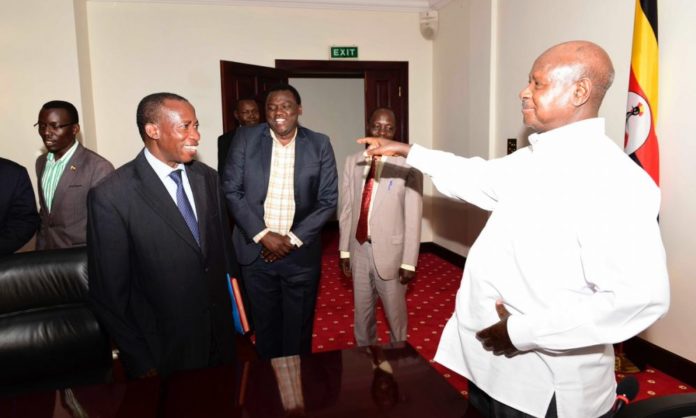
And today President Yoweri Museveni, his biggest political opponent Dr Kizza Besigye and a host of seasoned politicians have paid tribute to the deceased DP stalwart, who passed on Saturday at the Case Clinic after suffering a stroke.
President Museveni described Nsubuga as an ‘open, tolerant politician who believed in dialogue’.
“Learnt of the untimely death of Hon Mathias Nsubuga. He was an open, tolerant politician who believed in dialogue. The country will miss him,” Mr Museveni tweeted.
MOURNED DECEASED: FDC presidential candidate Dr Kizza Besigye
Besigye, a former FDC presidential candidate in the 2016 elections, tweeted: ‘Our heartfelt condolences. Our best promise and contribution to him can be to complete what he has died trying to achieve. “He was a very friendly and fair minded person who has passed on fighting for a free and fair country.”
Prime Minister Dr Ruhakana Rugunda described the late Mathias Nsubuga as a patriot and a man of peace.
Prime Minister Dr Ruhakana Rugunda has described the late Mathias Nsubuga as a patriot and a man of peace. “I join the family and country in mourning the death of DP Secretary General, Hon Mathias Nsubuga. He has been a patriot and a man of peace. RIP comrade.”
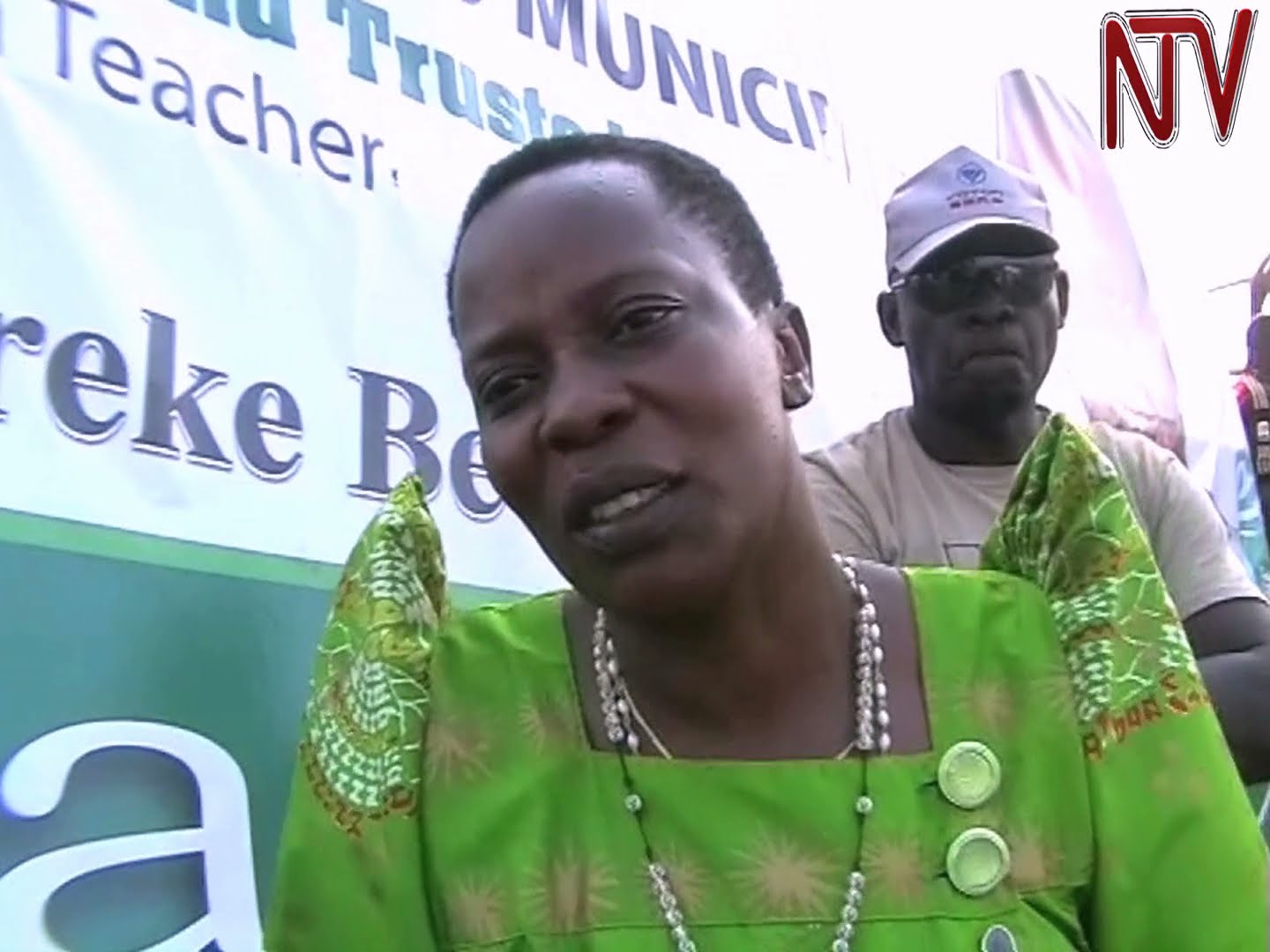
DP senior member and Mukono Municipality MP, Betty Nambooze described the late as the ‘Democratic Party’s bridge’.
Mukono Municipality MP Betty Nambooze Bakireke of the Democratic Party (DP).
“The DP bridge has collapsed…Hon Nsubuga has been the bridge between all groups, all generations in the party. Even in the hardest of all times, amidst all controversies Nsubuga could get in touch with everybody. We shall miss you my Mwami of all times. FAREWELL MATHIAS,” she wrote on social media.
Deputy government spokesperson, Colonel Shaban Bantariza described the fallen politician as ‘respectable leader, a parent, good Christian, and a nationalistic gentleman’.
Former DP Member of Parliament Dr. Lulume Bayigga.
Former Buikwe South MP, Bayigga Lulume said: “I will fondly miss him as a resourceful leader in the party, a reconciler and a man impassioned by the value of inclusiveness. Rest in Peace my elder brother.”
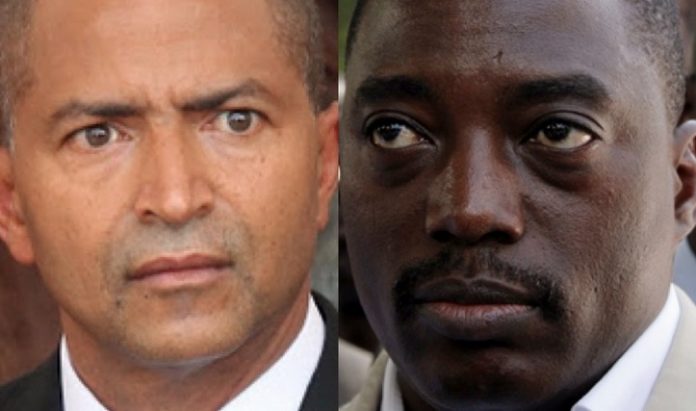
DRC President Joseph Kabila (R) with his challenger for presidency Moise Katumbi (L).
Moise Katumbi, the most popular politician in the Democratic Republic of the Congo according to recent polls, has made a dramatic intervention in the ongoing crisis in the vast central African state, calling on the president, Joseph Kabila, to stand down within 24 hours to avoid chaos and bloodshed.
The DRC is bracing for violent protests and riots when the mandate of Kabila, whom critics accuse of seeking to hold on to power indefinitely, expires tonight.
Opposition officials have spoken of a ‘trial of strength on the streets’ in coming days.
Hundreds of armed police have set up checkpoints around Kinshasa the capital, while soldiers in armoured vehicles have been deployed to strategic points in the sprawling city of 12 million.
Observers fear the chronically poor and unstable state, which has never known a peaceful transfer of power since gaining independence from Belgium in 1960, could plunge into a prolonged period of damaging, and possibly very violent, instability.
Katumbi, the former governor of the southern province of Katanga, is seen as the only serious opposition candidate for the presidency. He said Kabila, who has been in power since 2001, should step down before becoming an illegitimate ruler.
“I am advising him it is still possible to leave a legacy. It is very important … At midnight on [Monday] he will no longer be a legitimate president,” Katumbi told the Guardian in a telephone interview on Sunday night.
The crisis has been building for several months. Both negotiations and protests have intensified as the end of Kabila’s mandate approaches.
Katumbi, 51, who has been in exile since being convicted on a minor fraud that supporters say was politically motivated, called on ‘all the soldiers, the police, everyone, not to shoot on the people’.
“The military are of the people of Congo. They do not work for one person. Their suffering is the suffering of the people,” Katumbi said.
In September, more than 60 people died when security forces opened fire on an opposition march calling for Kabila to step down. At least four policemen were lynched. Opposition leaders in the DRC have said they would not call for mass demonstrations on Monday, but would let ‘the people express their anger’ instead.
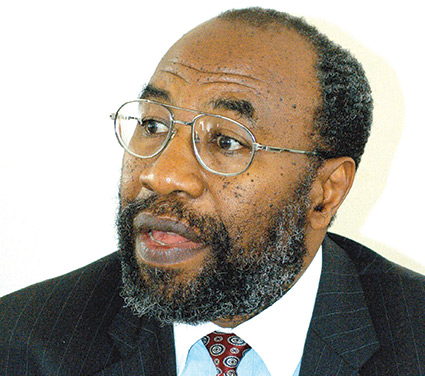
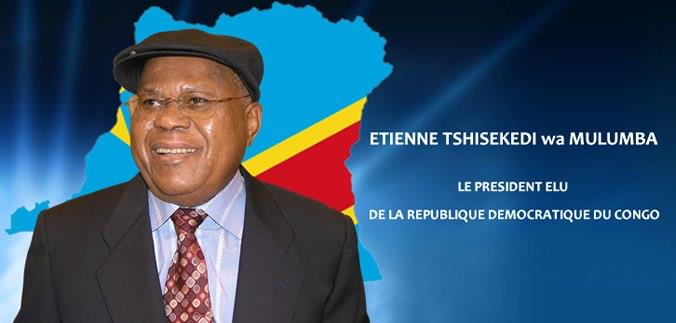
DRC OPPOSITION GURU: Perennial politician Etienne Tshisekedi wa Mulumba
“There will be lots of deaths. We will never know their number, because we never do around here but there will be many, sadly,” Valentin Mubake, political adviser to the DRC’s main opposition leader, Etienne Tshisekedi, said on Sunday.
Last-minute talks brokered by the Catholic church between government representatives and a coalition of opposition groups failed to reach agreement on Saturday, but are scheduled to start again this week after bishops visited Rome, where they will see Pope Francis.
Government officials blame the opposition for the lack of progress in reaching a settlement, and accuse western powers, which have tried to pressure Kabila to make concessions by imposing sanctions on key members of his entourage, of “a neo-colonial mindset”.
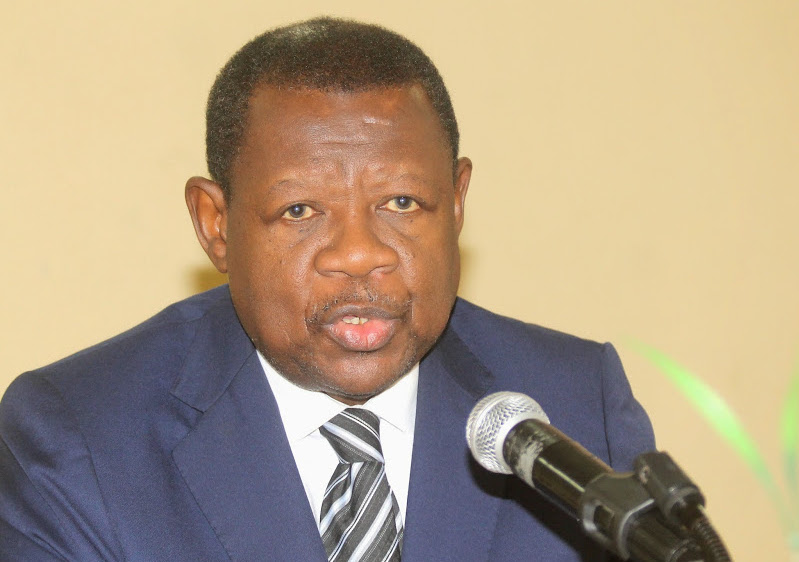
DRC Information Minister Lambert Mende.
“The US and the Europeans shouldn’t try and force us. It’s a pretty clumsy approach to take. It is lucky that the president is a very calm man,” said Lambert Mende, minister of information and a close confidante of Kabila.
Large groups of young men gathered on Sunday outside the offices of Kabila’s party and coalition allies.
A key question now is if opposition parties can channel widespread popular discontent – or are seen as part of the problem rather than a potential solution by ordinary people.
High inflation, the devaluation of the local currency and flagging investment is causing deep economic hardship throughout the country, where two-thirds of the estimated 70 million population live on less than US$2 a day.
Many observers believe Katumbi, who also owns one of Africa’s most successful football clubs, could unify the fragmented opposition and present a more credible alternative to Kabila than Tshisekedi, the 84-year-old former prime minister who is currently its most senior figure.
However, Katumbi, who has spent recent weeks travelling between western capitals to rally support, said he did not want to cause bloodshed by returning too soon.
In 2006, Kabila oversaw the first free vote in decades, ushering in a period of relative stability and economic growth as mining firms invested billions of dollars.
The reclusive former guerrilla leader won a second, contested election in 2011.
But many observers now fear a return to the brutal civil wars that killed an estimated 5 million people in the DRC between 1997, when the dictator Mobutu Sese Seko was ousted after a 32-year rule, and 2003.
“It is the balance of power on the ground which counts … The balance of power will now be worked out on the streets and then we will talk again. But in the long run, whether it’s around a table or in the streets, Kabila will lose,” said Mubake, the opposition adviser.
The burial programme for the fallen Democratic Party (DP) Secretary General Mathias Nsubuga has been released.
According to the party, today, there will be a requiem mass at 5pm at the home of the deceased at Nalumunye.
DEAD: Former DP Secretary General Mathias Nsubuga.
Thereafter the body will be taken to Parliament tomorrow for the MPs and other members of the public to pay their last respects. On Wednesday, there will be another requiem mass at Lubaga Cathedral at 9am after which the body will leave for Kiwangala-Masaka, where the deceased will be laid to rest on Thursday.
The former Bukoto South MP died Sunday evening just a day after he suffered a stroke on Friday and was admitted to Case Clinic, where he had been receiving treatment.
“With deep sorrow I announce the death of Hon. Mathias Nsubuga, Secretary General of the Democratic Party. We have lost a most clean hearted man. RIP,” DP President Norbert Mao broke the sad news to the world on social media.
Mao said Nsubuga had suffered the stroke on Friday at Mukono Bookshop in Kampala before he was rushed to Case Clinic.
Journalist tie their mouth with black cloth staging a demonstration in front of Guwahati Press Club, protesting against police atrocities on a woman reporter and a Video journalist of Guwahati-based television news channel (Dy 365) at Latasil police station.
The number of journalists killed in the line of duty is on track to decline in 2016 from recent record levels as fewer journalists were targeted for murder and war became the deadliest beat, the Committee to Protect Journalists (CPJ) found in its annual analysis. Deaths in combat or crossfire ticked to their highest number since 2013 as conflicts in the Middle East dragged on.
At least 48 journalists were killed in relation to their work between January 1 and December 15, 2016, compared with 72 in the previous calendar year. CPJ is investigating the deaths of at least 27more journalists during the year to determine whether they were work-related. CPJ’s data is researched and vetted according to strict journalistic criteria.
More than half of the journalists killed in the year died in combat or crossfire, making up the highest proportion of killings since CPJ began keeping records. Syria was the most deadly country for journalists for the fifth year in a row. At least 14 journalists were killed in Syria in 2016, the same number as in 2015, bringing the total number killed there in the line of duty since conflict broke out to at least 107.
“It is undeniably good news that fewer journalists are being murdered, and the decline shows the critical importance of the fight to end impunity,” said CPJ Executive Director Joel Simon, adding: “However, journalists covering war continue to be killed at an extraordinarily high rate, a reflection of the brutality and unpredictability of modern conflict.”
Historically, around two-thirds of journalists killed are singled out for murder in retaliation for their coverage, compared with about one-third in 2016. CPJ identified 18 journalists murdered this year, the lowest number on record since 2002. The reason for the drop is unclear, and could be the result of a combination of several factors detailed in the report.
War was the most dangerous beat for journalists this year, covered by 75 percent of victims. Political groups, including Islamist militant organizations, were responsible for more than half of the killings of journalists. In response to the high level of conflict-related killings in recent years, CPJ has established an Emergencies Response Team and is planning to publish a report on safety in 2017.
CPJ began compiling detailed records on all journalist deaths in 1992. CPJ considers a case work-related only when its staff is reasonably certain that a journalist was killed in direct reprisal for his or her work; in combat-related crossfire; or while carrying out a dangerous assignment. CPJ’s list does not include journalists who died of illness or were killed in car or plane accidents
POURED COLD WATER ON TERM LIMITS DEBATE: The Deputy Speaker of Parliament, Rt. Hon. Jacob Oulanyah, at the meeting of European, Caribbean and African Members of Parliament in Nairobi, Kenya.
The Deputy Speaker of Parliament, Rt. Hon. Jacob Oulanyah, has told a meeting of European, Caribbean and African Members of Parliament that no one will pass resolutions that impose presidential term limits on Uganda.
He said Uganda’s Constitution has mechanisms through which political power can change hands and that the Constitution was the ultimate will of the people of Uganda which non-Ugandans should not undermine.
Oulanyah made the remarks as the Committee on Political Affairs resumed consideration of a motion on a resolution on constitutional limits for presidential terms on Friday, 16th December 2016 in Nairobi Kenya.
The Committee is part of the African, Caribbean and Pacific (ACP) Parliamentary Assembly.
The proposals for presidential terms limits are being advocated by Members of the European Parliament with support from some Members from the ACP.
Oulanyah advocated for the dropping of the whole motion on term limits following concerns that these were being dictated by the European Parliament.
He added that despite the fact that the Motion was agreed on by the ACP in its earlier stages, it was possible to have it dropped all together at this point.
“A thinking human being has a right to change his mind. We are not bound by any precedent. We can’t sit here and do what is not right for us,” Oulanyah stated.
There was a heated debate in the Committee with several delegations wondering why there was a call for withdraw of the Motion at a stage when they were considering amendments to it.
The Deputy Speaker however, stated that there was no precedence set that can stop the retraction of the motion adding that the decision to support it is undermining the will of the people who vote for them.
“What is not prohibited in law is allowed. I have never seen anywhere in the world where a motion cannot be withdrawn. This is a question of sovereignty and the will of the people,” he added.
A delegate from Rwanda, Hon. Evariste Kalisa, supported the Deputy Speaker’s position arguing that the citizens of the ACP and EU can decide on presidential term limits but not through motions passed by a few representatives.
“Our European counterparts pointed out that they don’t have term limits because it is the will of the people. We cannot vote for what is not good for our people,” he said.
On the withdrawal of the Motion, Kalisa added that, “I cannot be embarrassed if I discovered that I made a mistake in the first place.”
The argument for withdraw of the motion was received with serious resentment from MPs from Mali and Nigeria who noted that re-instating presidential term limits would eliminate dictators especially on the African continent.
The two delegations then stated their position that they would vote with the European representatives when the matter is put to vote.
The final vote on the motion on term limits will be taken when the ACP and the EU representatives meet in a joint assembly on Wednesday, 21st December 2016.
The joint meeting of the two Committees on Political Affairs will however, meet before the vote is taken.
In the same meeting, the ACP Committee on Political Affairs called on President Yahya Jammeh of Gambia to respect the outcome of the recent elections and hand over power.
The Ugandan delegation in Nairobi included MPs Cecilia Ogwal (Dokolo), Juliet Kinyamatama (Rakai), Jack Wamanga-Wamai (Mbale Municipality) and William Nokrach (PWDs).
END GENDER VIOLENCE: The Speaker of Parliament Rebecca Kadaga addressed the Triennial Commonwealth Women Conference, part of the 62nd Commonwealth Parliamentary Conference in London.
The Speaker of Parliament, Rt. Hon. Rebecca Kadaga, has urged women Parliamentarians to end violence targeted at women during elections.
She said there are many incidents of women being victims of election related violence compared to men, which indicates that women are often targeted not necessarily because of their political actions or affiliations, but simply because they are women.
Kadaga, who is also the Chairperson of the Commonwealth Women Parliamentarians, was addressing close to 150 women across the Commonwealth countries during a two-day Triennial Conference in London, United Kingdom on Friday, 16th December 2016 under the theme ‘Political Violence Against Women’.
The Triennial Commonwealth Women Conference is part of the 62nd Commonwealth Parliamentary Conference taking place from 11th to 18th December 2016.
Kadaga informed the meeting that for every public violent incident known and recorded, there are more incidents happening behind closed doors and in private, with scanty documentation and, worse, without adequate services to respond to survivors’ needs and due process for perpetrators.
“These private and public incidents, no doubt discourage and prevent women from participating in the electoral process,” she said.
Kadaga appealed to electoral commissions, as national institutions, to ensure that electoral procedures safeguard women’s rights to inclusive electoral processes. She urged lawmakers to consider making laws to address harassment of women politicians and establish mechanisms to end impunity of such crimes.
Hon. Shirley Osborne from the Caribbean region observed that civil society organisations were doing commendable work to address the problem but that there was need for advocacy and a platform to address the issue.
While women parliamentarians from the Pacific region were in agreement that participation in elections was an important political process, they noted that the direct physical violence meted on women at home and in public greatly affected women’s ability to participate in the electoral processes.
The Secretary-General of the Commonwealth Parliamentary Association, Mr Akbar Khan, informed women Commonwealth Parliamentarians that he was committed to seeing that the CPA embodies diversity but also shares values of democracy, rule of law and human rights.
The 62nd Commonwealth Parliamentary Conference brought together Speakers and Members of Parliament representing the nine regions of the CPA, namely, Africa, Asia, Australia, British Islands and Mediterranean, Canada, Caribbean, Americas and Atlantic; India, Pacific and South East Asia.
The Commonwealth Parliamentary Association provides a unique platform for inter-parliamentary dialogue to take place and given its diverse nature of membership, the Association is in a unique position to offer a comprehensive perspective on how to strengthen parliamentary democracy among member states.
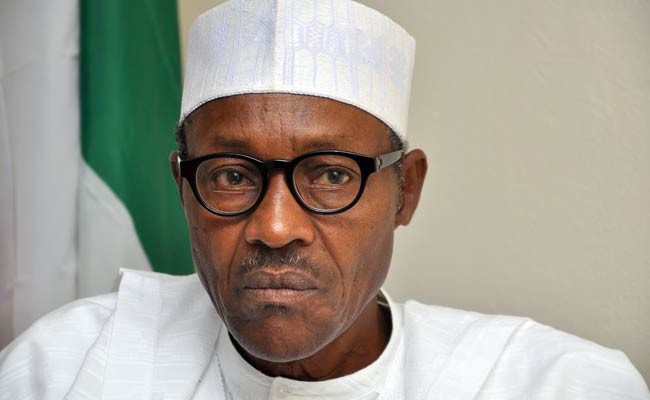
QUESTIONS ON HEALTH STATUS: Nigerian President Muhammadu Buhari, one of the leading voices against Yahya Jammeh's clinging on to power.
Fourteen West African leaders have announced they will travel to the Gambia in January for the inauguration of Adama Barrow despite the incumbent president Yahya Jammeh trying to cling to power.
The regional West African bloc also agreed to take ‘all necessary actions’ to uphold Barrow’s victory, leaving the door open for military intervention, as it met to discuss Jammeh’s refusal to accept the election result
A delegation of four African presidents from members of the Economic Community of West African States (Ecowas) had flown to the Gambia capital, , Banjul, last week but failed to convince the country’s autocratic leader to change his mind.
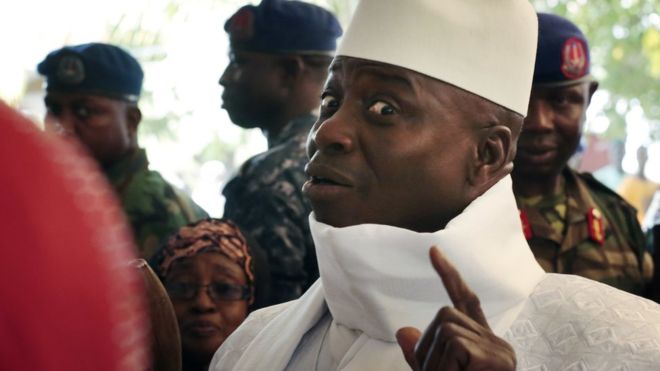
WARNED: Yahya Jammeh has been warned by ECOWAS that he stands to face resistance if he clings on to power in The Gambia, where he has been President for 22 years.
It came as a surprise to many Gambians when Jammeh conceded defeat on television after the 1 December election after ruling the tiny west African nation for 22 years. A week later, however, he took to the airwaves again and reversed his position, saying that the electoral commission, handpicked by him, was not independent.
Ecowas has no standing army, but could ask member states to send in troops, as it did in Guinea-Bissau in May 2012 after there was a military coup. Marcel de Souza, the head of the Ecowas commission, has said sending in troops was “a possible solution”.
Macky Sall, president of the Gambia’s only contiguous neighbour, Senegal, told French television that the use of force should be a “last resort”.
“There were certainly crimes. But if we engage in a showdown, it is clear that the consequences will be much more dramatic,” Sall said. “If it is necessary to dialogue and find a way out for Jammeh to be protected, why not? I am for dialogue and allowing him to leave quietly.”
Jammeh is becoming more isolated not just from other countries in the region but within the Gambia, as unions and civil society organisations have demanded he respect the vote and leave.
The bar association said that his volte-face was “tantamount to treason”, the teachers’ union said it was “a recipe for chaos and disorder which undoubtedly endangers the lives of all Gambians particularly our children”, and the press union, the medical association and the university added their voices to the clamour of condemnation.
On Sunday, the Supreme Islamic Council, formerly a strong ally of Jammeh’s, came out in favour of Barrow after meeting the president-elect, saying they were ready to work with him.
This was a significant departure for a president who last year declared his country an Islamic republic: now, it appears that only his ministers and the military remain on Jammeh’s side.
The head of the armed forces, Ousman Badjie, last week told the Guardian that Jammeh paid his salary and was the commander-in-chief and so he answered to him. It was not clear where his loyalty would lie after 19 January, when Barrow is sworn in as the new president. In the past two weeks, more soldiers have been posted to the streets of Banjul, rigging up camouflage shelters and balancing machine guns on sandbags.
Concerns remain over Barrow’s safety after Jammeh’s government put pressure on him to get rid of the Senegalese private security firm he had hired to protect him, and one of the main points on the Ecowas statement was an exhortation to guarantee his safety. It also called for support from the African Union and the United Nations, including “technical assistance”.
A Billboard announcing Wizkid's performance at the concert that was scheduled in Uganda on December 3, last year.
Renowned Nigerian entertainer Ayodeji Ibrahim Balogun aka Wizkid has had a bad year that began with his being relieved of an award during a ceremony in Rotterdam, The Netherlands.
And today Face TV through its lawyer Fred Muwema of Muwema and Company Advocates has obtained a warrant of arrest for the singer, who allegedly failed to honour a US$60, 000 contractual obligations to perform at a concert in Uganda on December 3.
The warrant, issued by the Buganda Road Court, has directed the International Police (Interpol) and Uganda Police to arrest Wizkid, the ‘Ojuelegba’ hitmaker.
“To: Any police officer, Uganda police force/international police (Interpol). Whereas Sunday of Lagos Nigeria. Stands charged with the offence of; C1: Obtaining money by false pretence contrary to section 305 of the penal code act. C11: cheating contrary to section 307 of the penal code act.
You are hereby directed to arrest the said Sunday Are and produce him before me on or before the 16th day of January 2017.” The order has been issued today by Magistrate Baligeya Moses Mufumbiro.
According to Muwema, Wizkid’s manager Sunday Are was paid the full performance fee of US$60,000, a brokerage fee of $5,000 and $3,000 as per diem for the days Wizkid’s group was going to stay in Uganda.
“Our client then incurred substantial expenses in booking and re-booking flights, hotel, venue, advertising and promotions for the concert, which expenses grossed over $300,000. In the meantime, more than 25,000 Ugandans paid for tickets in advance in anticipation of the Concert.
“To our client’s dismay and utter shock, Wizkid and his troupe did not show up for the Concert despite assurances were made up to the very last minute. This misconduct by the accused has not only damaged the name and reputation of our client.”
In response, the court issued the arrest warrant against both Wizkid and his manager Are.