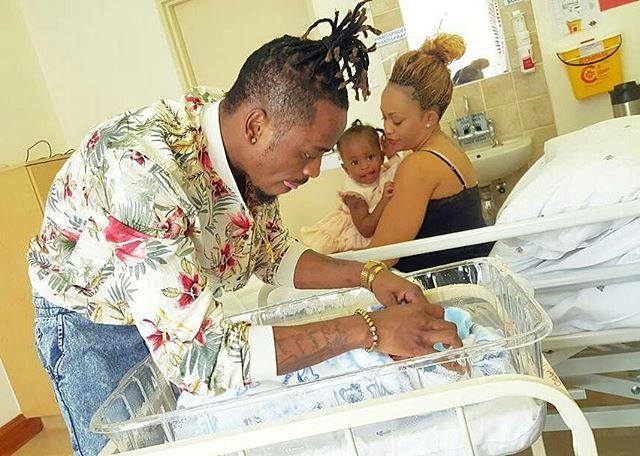
Renowned entertainer Wizkid of Nigeria has been relieved of an award that was erroneously given to him.
Instead the award has been given to the Sony Music Entertainment Africa-signed artiste out of East Africa and Tanzania – Alikiba.
The award that was subject to public voters became a subject of discussion after votes showed Alikiba was leading but the organisers gave Wizkid the award during the ceremony held in Rotterdam, Netherlands.
‘MTV congratulates Alikiba who has won Best African Act at the 2016 MTV EMAs. The news was revealed November 10 after the incorrect results for Best African Act were posted late Sunday night November 6 due to an error,’ MTV EMA wrote in an official statement.
Six Worldwide Act winners, including Wizkid, were selected by an international committee of MTV executives to recognize current artistes who are rising to have a wider geographic appeal beyond their local region.
The winners were chosen based off a range of criteria including international MTV video play, radio airplay, streams and sales across multiple territories and regions.
The winner of Best African Act was selected by fans via votes on MTVEMA.com, and an MTV spokesperson commented: “Both Wizkid and Alikiba are great artists and deserving winners at the MTV EMAS and we congratulate them wholeheartedly on their achievements.
The spokesperson added: ‘We apologise for any confusion we have caused but we are pleased to recognize the achievements of both these artistes on this global platform’.
In appreciation Alikiba said: “Thanks to MTV for this huge honour. It’s very exciting to be recognized at the MTV EMAs and I am delighted to bring home the award to my fans in Tanzania and East Africa. Thank you to my family and management.”
The news of an Alikiba win sent Tanzanian fans into overdrive, prompting them to make comments on social media.
Meanwhile, Wizkid has since deleted all posts on social media regarding him as winner of the award.
ASSAULTED: The Daily Monitor journalist Shamim Jjingo Nakawooya.
Former NRM parliamentary contestant for Bukoto Mid-West Eddie Ssansa Luwaga, has been convicted and given a 12-month non-custodial sentence for assaulting journalist Shamim Jjinjo Nakawooya.
Appearing before court, the Masaka-based businessman was also fined UgShs 2.5 million, to be paid the Nakawooya, a reporter with the Daily Monitor, whose phone was also damaged by the assailant.
Last year in October Nakawooya sued Mr Luwaga for assault and the destruction of her gadget as she carried out interviews at the Masaka District Regional Criminal Investigation Directorate office, in a case that has taken one year to get disposed of.
The news about the judgment was broken by the National Coordinator of the Human Rights Network for Journalist (HRNJ) Uganda Robert Sempala on his Facebook page.
The ruling was applauded by several members of the Fourth Estate.
HONOURED: The Ganda Boys with UN High Commissioner for Refugees Felipe Grandi
As expected, the US election left the country divided with anti-Trump protests breaking out shortly after the Republican candidate Donald Trump was declared winner.
Uganda’s singing duo, the Ganda Boys (formerly Da Twinz) had anticipated this to happen and they set out to plan what to do to unite the country in the aftermath of the election.
Through their tour dubbed ‘Day of Healing and Reconciliation’, the musicians and refugee activists have organised a series of music shows on the East Coast of the United States.
Their first show was held yesterday at the United Nation Headquarters, General Assembly Hall in New York and among those in attendance was the High Commissioner for Refugees, Filippo Grandi, who honoured the Ganda Boys’ work in the field of refugees and social activism.
“Our message has always been one of peace, goodwill, unity, cooperation and a heartfelt vision for a better world.”
Their second show is scheduled for tomorrow at the Lincoln Center, Manhattan, where the Big International Awards are set to take place.
Their song, ‘The Forgotten People’ is nominated in the category of Best Social Action. Here, they will share the stage with luminaries such as Marianne Williamson, Jonath Smith, Seth Glier and Sofia Rei amongst.
UNCOMFORTABLE WITH BIAs: KNUT Secretary General Wilson Sossion
The Kenya National Teachers Union (KNUT) has once again called for the closure of the over 400 Bridge International Academies (BIAs) in the country.
In January this year KNUT Secretary General Wilson Sossion said the schools, numbering about 405, flout education standards in the country and should be closed, a demand that has now been revived. According to KNUT, among other irregularities, the teachers in BIA schools reportedly undergo only three months of training before they start teaching.
However, in May this year, the Managing Director of BIAs in East Africa Mr Andrew Okwara reiterated the BIAs cooperation with Kenya’s Ministry of Education, dismissing plans of any impending closure of the schools that reportedly provide low-cost education to children from less privileged backgrounds.
“For the last eight years Bridge has worked in close partnership with the Ministry of Education in Kenya to see that every child, regardless of the location of their birth or income of their parents, has access to a high-quality education,” says Mr Okwara, said.
BIA BACKER: Billionaire philanthropist Henry Bill Gates IIIBillionaire Mark Zuckerberg also support the BIAs.
Founded in 2008, the BIAs, backed by billionaires Bill Gates of Microsoft and Mark Zuckerberg of Facebook, have come under fire in the East African region for allegedly operating in contravention of the educational standards of the respective countries.
In Uganda, last week, Justice Patricia Wasswa Basaza of the High Court ordered for the closure of 63 BIAs in the country.
ORDERED BIAs CLOSURE: Education Minister Janet Museveni
The order was in respect to an appeal filed by the BIA following a directive by the education minister Janet Museveni, to have the schools closed for ‘poor sanitation’, having unqualified teachers and improper licensing.
The BIAs provide subsidized education, with pupils paying about US$28 (UgShs 65,000) per term.
According to Bridge International Academies, it is the 21st largest employer in Uganda, ‘with close to 800 Ugandan individuals employed and has already invested UgShs10 billion in the Ugandan economy, with plans to invest another UgShs25 billion in the coming years’.
SHOWCASING: A model shows off the attire at Xenson's show.
Graft designer Samson Ssenkaaba aka Xenson has unveiled his latest fashion collection.
Exhibited under the theme of ‘Baroque Afrique’, Village Mall in Bugolobi was yesterday a beehive of activity when he showcased his products to hundreds of spectators including celebrities Denzel of Urban TV, Gaetano Kagwa and Ronnie Nsubuga, the CEO of Crystal Models among many other city socialites. And at exactly 9pm, the models walked to a band number showcasing clothes made out of tyres.
HERE I COME: A model shows off her attire
“As opposed to the traditional fashion shows, Xenson shows are an exhibition of style, the Xenson style. Xenson presentations will always be incredibly curated shows, major fashion events and extravaganzas. His shows combine his extraordinary award winning artistry, visual aesthetic to offer an unmatched memorable fashion experience,” a fashion enthusiast said of the designer.
DOING MY THING: A model struts the walkway at the show.
The show was also graced by other fashion designers like Liz Kagwa with her latest collection and Brenda Maraka, with Black and White under the theme of ‘love and mathematics’ and both ladies did not disappoint.
Sandra Suubi treated attendees to her latest single, “Singa tabadde gwe”, a gospel song which served her well with her awesome vocals that left both men and women baffled.
Who is Xenson?
Samson Ssenkaaba aka Xenson, is a Ugandan Artist, fashion designer and poet at the vanguard of a ‘youthful African art renaissance that refuses to be pigeonholed into a singular Artistic expression’.
He is a solitary dreamer greatly influenced by the grandeur of African cultures, vitality of African dance and performance, and hip-hop as a free expressive art form.
Ssenkaaba traded his engineering studies to join the Margaret Trowel School of Industrial and Fine Arts, Makerere University, Kampala where he graduated with a 1st class honors degree. Since then, intermittent appearances of his Art works, Films and fashions have been shown in numerous exhibitions and shows in Uganda and abroad.
He is a well collected artist in Germany, Scotland, United Kingdom, Netherlands, Brazil, Argentina, France, USA, Canada, Niger, Burkina Faso, Kenya, Tanzania, Rwanda and Uganda where he has held successful Exhibitions and Fashion shows.
Xenson says he enjoys giving back to the Ugandan community through his Art-Club by promoting and teaching art to students and persons with or with no artistic background.
The Russian government was in touch with members of President-elect Donald Trump’s political team during the U.S. election campaign and knows most of his entourage, one of Russia’s most senior diplomats told the Interfax news agency on Thursday.
Accused by defeated Democratic contender Hillary Clinton of being a puppet of President Vladimir Putin after praising the Russian leader, Trump has dismissed suggestions he had anything to do with the Russian government during the campaign.
But in comments that could prove politically awkward for the president-elect, Russian Deputy Foreign Minister Sergei Ryabkov said there had indeed been some communications.
FBI INQUIRY
The Federal Bureau of Investigation opened a preliminary inquiry in recent months into allegations that Trump or his associates might have had questionable dealings with Russian people or businesses, but found no evidence to warrant opening a full investigation, according to sources familiar with the matter. The agency has not publicly discussed the probe.
The U.S. government has blamed Russia for cyber attacks on Democratic Party organizations.
Trump, who has spoken of his desire to improve tattered U.S.-Russia ties, has said he might meet Putin before his inauguration, but Putin’s spokesman has said there are currently no plans for such a meeting.
Interfax reported on Wednesday that Dmitry Peskov, Putin’s spokesman, would be in New York this week for a chess tournament, a few blocks from Trump Tower, where the president-elect has his office.
But it cited Peskov as saying he did not plan to pass any message to Trump from Putin.
The Russian parliament erupted in applause on Wednesday when it heard that Trump had been elected and Putin told foreign ambassadors he was ready to fully restore ties with Washington.
Ryabkov was more circumspect though, saying the Russian Foreign Ministry felt no euphoria about the Republican’s win despite wanting to normalise relations with Washington.
Moscow and Washington are at odds over Syria, Ukraine and NATO.
Ryabkov said Trump’s allies had made some tough statements about Russia during the campaign and that his ministry was therefore not harbouring any “rose-tinted” hopes.
“We are not expecting anything in particular from the new U.S. administration,” Interfax cited Ryabkov as saying.
Moving is a hassle. Possessions are packed into bulging boxes, which are then loaded onto trailers full of other bulging boxes, each one labeled with its content. Plastic totes are filled to the brim. Backs ache at the strain. Yes, moving is a hassle.
But not for Elvis Karegeya, 24, a theatre major at Middle Tennessee State University. He has few possessions and those he has mean little to him.
People? Now they’re a different story.
“I used to miss the superficial stuff, but people have become more of me,” Karegeya said.
“Every time you throw me somewhere, I’d rather get attached to people than things and places and minuscule things I can’t really take with me.”
His philosophical outlook comes from living the life of a man without a country, trapped in limbo by United States immigration law for 63 months. Karegeya (pronounced care-ruh-GAY-yuh) isn’t interested in taking things with him. Living out of a suitcase for so long makes him wish he could bring the people he has met along with him … wherever he’s going.
Karegeya and his mother and siblings have been in the United States since he was 18. They have been fighting for political asylum in the United States since 2011.
It’s a long way from Africa to Murfreesboro, thousands of miles that Karegeya may never travel again.
Born in Uganda, the MTSU student lived there until he was 3. The family moved to neighboring Rwanda, where his father, Patrick Karegeya, was appointed an officer in the new government set up after the country’s bloody civil war. The strife resulted in mass genocide that left more than 800,000 people dead. At that time, his father, a colonel, became part of the liberation army that set up a new government in Rwanda, so they moved. Fighting had plagued Rwanda for many years as rival clans, the Tutsis and Hutus, clashed. The Tutsi-led rebels eventually came into power under the Rwandan Patriotic Front-led government. Col. Karegeya was chief of external intelligence in this new government led by Paul Kagame.
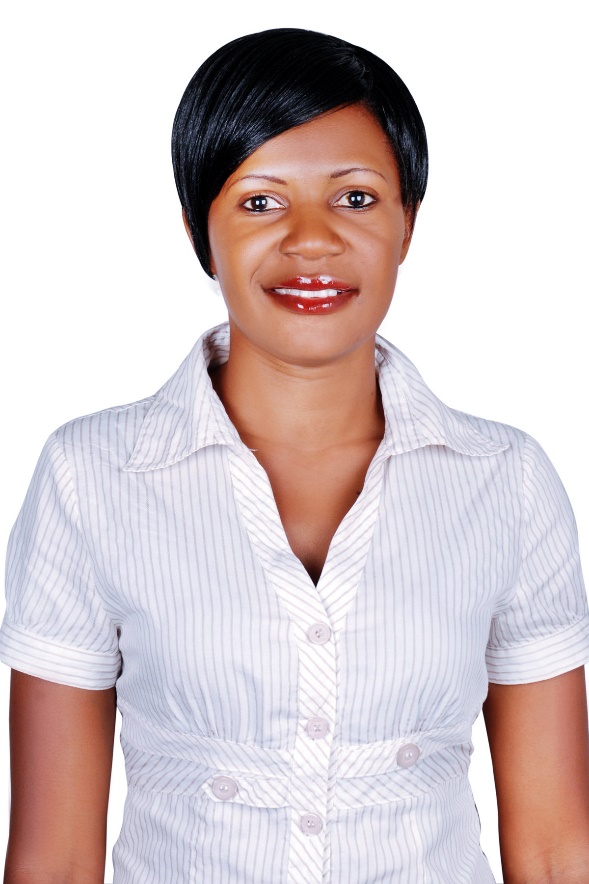
Ms. Portia Mbabazi Karegeya, daughter to late Patrick Karegeya.
However, the elder Karegeya and the president had a falling out. The Karegeyas left Rwanda in 2007 after Col. Karegeya was released from prison, settling as a family in South Africa in 2008. After an assassination attempt on an uncle in 2011, also an official in the government, who was shot, the elder Karegeya decided their home was no longer safe for Elvis and his siblings.
The preconceived notions most Americans hold about Africa — people living in grass huts in the jungle — puzzled the young Karegeya early in his arrival in the United States.
“I had a gate,” he said of his modern home in Rwanda.
Elvis’ family came from one of the wealthier families in his community. The area was urban, and he attended Green Hills Academy in central Rwanda. He went away to boarding school in eighth grade in South Africa. He wore school uniforms and learned English.
Elvis used to take offense to the ignorance of his culture and lifestyle in Africa, but he has learned people can’t be blamed for not knowing. He tries not to get upset about it now.
Elvis had a formal relationship with his father. It was loving but within the bounds of strict African family dynamics.
“We didn’t have that chummy father son relationship, but he was my dad,” Elvis says. “I loved him, and I knew he loved me. It was more than a lot of my friends had with their dads.”
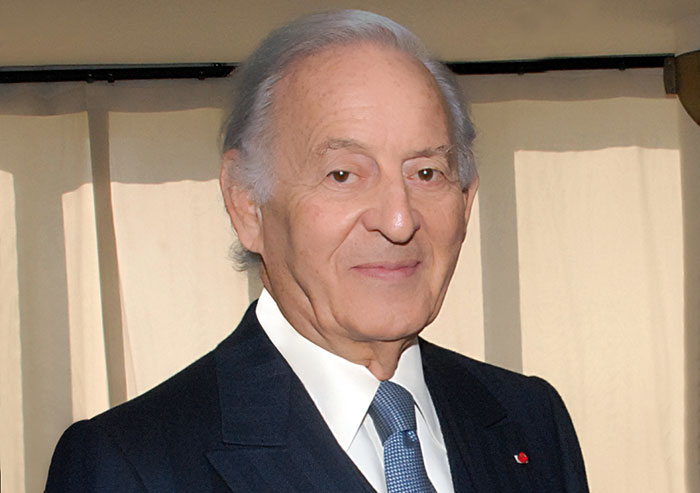
Late Patrick Karegeya who was strangled in a South African Hotel.
His father stayed in South Africa while Elvis and his mother came to America. An older sister, Portia, left from Uganda earlier and moved to Canada. A younger brother, Richard, came to America after Elvis and his mother when he was 15.
According to U.S. immigration laws, to gain asylum, a refugee must face persecution based on race, nationality, religion, political opinion or social group. The refugee can either declare on arrival or after having been in America if circumstances in his or her home country have changed while in the United States. Once asylum is declared, a 26-page document must be filed: 14 pages of instructions and 12 pages of information to fill out. The application asks questions such as: “Are you afraid of being subjected to torture in your home country or any other country you may be returned?” This must be filed with the Immigration Office.
Of all petitions filed, only about 29% of applicants are granted asylum. The alternative is deportation.
“The problem is, we’re in limbo,” Elvis says with a shrug. “I’m no longer a citizen of Rwanda, but I’m also not a citizen of the United States either.”
Elvis is easily angered when he hears someone speaking negatively of refugees. After all, he understands their plight. He doesn’t understand racism or xenophobia.
“People are not running across the border for fun,” Elvis says. “What do you think these people are running from? If these people had a great life, they wouldn’t come here.”
Patrick Karegeya texted his son around 3 p.m. Central Time on New Year’s Eve almost two years ago. His message: “Happy New Year. I love you.”
Elvis had to work at a call center in Knoxville while his mother and brother traveled to Maryland for a holiday visit with friends.
“I decided to wait until midnight to text him,” Elvis says.
Before the New Year came in, his brother asked if he had heard from their father. He told him about the text from the previous day. Later, Elvis noticed he had several missed calls from his mother and brother. He called his brother back on a work break.
Richard asked if he was sitting down.
“Dad is dead,” Richard said.
“Him dying didn’t cross my mind,” Elvis said of his father. “I didn’t really cry.”
After his dad’s falling out with President Kagame, a series of events that involved accusations of insubordination, the elder Karegeya was given an 18-month imprisonment that ended in 2007. Upon release, he fled to South Africa where he helped to start the Rwandan National Congress, an anti-Kagame organization.
The colonel was critical of President Kagame and the Rwandan government after fleeing. According to a BBC report in March 2014, he had meetings with intelligence officials in South Africa and Tanzania before troops from those two countries began sending troops into the Democratic Republic of Congo. They were battling the M23 rebel group, which the BBC said was receiving funds from Rwanda. Kagame’s administration denied the allegation.
On January 1, 2014, Patrick Karegeya’s nephew found him strangled in a Johannesburg hotel room. There was evidence of a struggle, but nothing missing from the room.
“We know who did this,” Elvis says. “It was the Rwandan government that killed my father.”
If his family were deported back to Rwanda, he fears the same fate would await them.
Elvis knows what people think of his name, but he assures them he’s not named for Elvis Presley.
“My cousins named me,” Elvis says. “One of my cousin’s names is Elvin, so it’s just kind of a variation.”
Although, Elvis does know his mother was reading Shakespeare’s Merchant of Venice when she named her daughter Portia.
Elvis stands at just over six-feet-tall. His dark eyes match his dark skin and light up when he laughs, a high, lilting laugh. His accent is the only thing that would reveal he is from Rwanda.
Elvis recently starred in MTSU Theater’s production of Uncle Vanya. He played a quirky character named Waffles and even learned how to play guitar for the role.
“It was fun,” Elvis says. “My first show at MTSU was great. I loved working with the director, Helena.”
In the spring, he portrayed a “Shark Boy” in West Side Story.
This semester, he’s cast in Kafka’s Metamorphosis. The show runs this coming February in MTSU’s Tucker Theater.
As his life and education in Murfreesboro rolls forward, Elvis waits to hear the fate of his citizenship from an immigration judge in Memphis.
His family’s appeal for asylum has already been denied once.
After their father was assassinated, immigration officials said the surviving Karegeyas were no longer in danger. An offer of a status known as “Withholding of Removal,” was offered. However, this alternative to asylum does not grant green cards, naturalization, international travel and can be terminated at any time should conditions in one’s home country change. The Karegeyas declined this, as asylum would give them permanent residency and the opportunity to apply for citizenship within a few years, safeties Withholding of Removal does not offer. Elvis is stuck in a cycle without permanent residence and no ability to travel outside of the United States.
Elvis and his family had their second hearing for asylum on December 7 in Memphis. They were again offered Withholding of Removal and again denied. They want to become citizens, not stuck in limbo renewing licenses and work orders every year.
“My attorney said, ‘maybe you’ll get married. That could help,’” Elvis said with a laugh.
On Feb. 22, Elvis and his family were again denied asylum in the United States. The family has appealed, but the appeal process to the Immigration Board takes years to complete. With no guarantee of asylum after appeal, Elvis is left in limbo yet again, renewing his license and work permit every year.
Time passes without his father.
“To this day I don’t think I’ve really dealt with it,” Elvis says of his father’s murder. “It’s just some type of unbelievable movie script type situation.” Elvis says he cannot really believe it’s real. He can’t really grieve because he hasn’t been able to.
“I think if the president [of Rwanda] is gone, I’ll know what you were fighting for is done and I think that’s when I’ll actually fully grieve but I don’t think I’ve lost my dad yet.”
Gaining asylum could be a step to healing this wound. One less “thing” to carry with him to a new place, with new faces.
The ruling National Resistance Movement (NRM) has received over Shs2 billion as its share of monies allocated to parties with a representation in Parliament, and are also members of the Inter-party Organisation for Dialogue (IPOD).
According to the Electoral Commission (EC) spokesperson Jotham Taremwa, the money, Shs3 billion which is allocated according to strength of parties in parliament (party representation), was recently wired by the finance ministry to the parties’ respective accounts.
Currently, the parties represented in Parliament include the NRM, which has 289 members; the Forum for Democratic Change (FDC) with 36 members; the Democratic Party (DP) with 15 members and the Uganda Peoples Congress (UPC) with six members.
Sources imitated that the FDC got about Shs300 million, while the DP and UPC with a collective representation of 21 members will share about Shs150 millions.
Currently, the Parliament of Uganda has over 430 MPs, among them 57 Independents and 10 UPDF representatives.
GUILTY: The three public service ministry officials leave court after being found guilty of causing financial loss and abuse of office.
Anti-corruption Court judge Lawrence Gidudu has found former Permanent Secretary Jimmy Lwamafa, Principal Accountant Christopher Obey and the Commissioner for Compensation Stephen Kunsa Kiwanuka, guilty of causing financial loss of over 88 billion and for abuse of office.
Former Public Service PS Jimmy Lwamafa (middle in blue suit) leaves court with his co-accused.
The three public service ministry officials, who have been on remand in Luzira Prisons, had been accused of paying the money, allegedly belonging to the National Social Security Fund (NSSF), to ghost pensioners. Available information indicates the three carried out the illegality over two financial years, 2010/11 and 2011/12.
However, in September this year two court assessors, Vincent Okech and Stanley Kurong, had advised Justice Gidudu to acquit the trio of all 10 charges preferred against them.
CONTROVERSIAL: City lawyer Andrew Karamagi says President Museveni has no powers to close any public university.
Controversial city lawyer Andrew Karamagi, who rose to fame after accosting Attorney General Peter Nyombi at the beginning of the Annual Law Year in 2014, has turned his barrel to President Yoweri Museveni, shooting from the hip and telling that the President that he has no powers to close a public university.
Appearing on NBS talkshow ‘Morning Breeze’, Karamagi said the President erred when he justified his directive to close the university under the Universities and Other Tertiary Institutions Act 2001.
“I Yoweri Kaguta Museveni, President of the Republic of Uganda has this 1st day of November 2016, pursuant to the powers vested in me by the Constitution and Section 26(2) of the Universities and Other Tertiary Institutions Act 2001 as amended, decided to close Makerere University with immediate effect,” the President wrote early last week.
But according to Karamagi, Mr Museveni was wrong: the law only gives the President, who is also the Visitor, supervisory powers, he said.
‘President Museveni has no powers to close a public university. That law only gives him supervisory powers’, Mr Karamagi said, adding that the President does not trust anyone in the education chain, in respect to Makerere university.
‘Mr Museveni doesn’t trust the administration at Makerere. He doesn’t trust the education minister who happens to be his wife,’ the vitriolic lawyer said, adding that the closure of Makerere is a ‘national crisis’.
He also said Makerere had been ‘reduced’ to three camps; the protagonists and antagonists of Mr Museveni and the neutral ones.
And, as if in support of student demos, Mr Karamagi said: ‘For Makerere, there’s no solution from those in charge. Those affected by the situation there should take action’.
He also said Uganda is a ‘failed state’. ‘Doctors are complaining, police is asking citizens for fuel… Makerere is one of the symptoms of a failed state; how much more are we waiting to see before concluding we have a failed state?’ the lawyer posed.
In February 2014 Karamagi attracted public attention when he grabbed a speech from the Attorney General Peter Nyombi who, at the time, was at loggerheads with the Uganda Law Society for reportedly misadvising the President Museveni ‘on a number of controversial issues, including the re-appointment of retired Justice Benjamin Odoki as Chief Justice and the appointment of Gen Aronda Nyakairima (RIP), a serving army officer, as Internal Affairs minister, before resigning from the army.