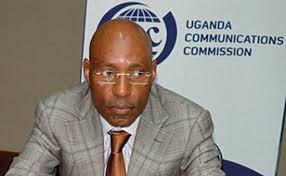
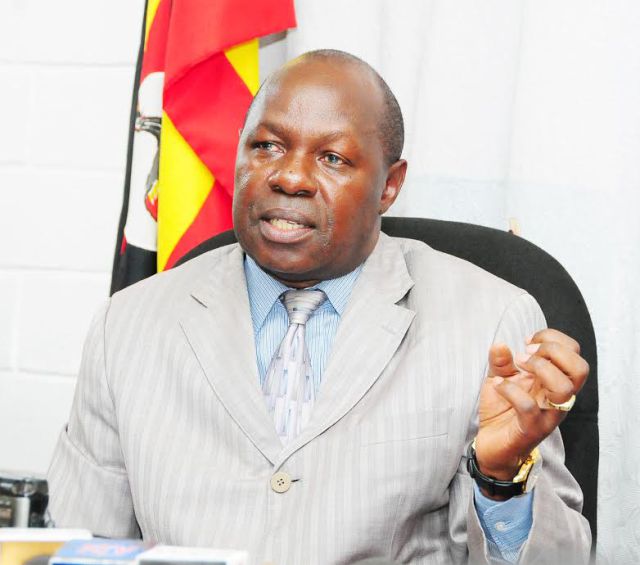
UCC boss Geoffrey Mutabazi, the man at the centre of the controversial letter asking editors to be sacked.
The Uganda Communications Commission (UCC) has ordered broadcast media in Uganda to stop airing programmes about incidents that happened in Kasese, resulting in the killing of 62 people and the arrest of the Rwenzururu King Charles Wesley Mumbere.
According to the UCC, the Kasese matter is before court and any reporting about it is sub judice.
BLOCK: The document stopping the broadcast of Kasese incidents
‘Any broadcast of matters in courts of law must be done in such a way not to prejudice the rights of the suspects and victims or otherwise compromise the court processes,’ the UCC statement dubbed ‘Public Notice’ reads in part.
‘This is therefore, to direct all broadcasters to observe the minimum broadcasting standards and the law to ensure that to forthwith refrain from further airing any programs regarding the Kasese incident and/or the prosecution of Charles Wesley Mumbere,’ the statement adds.
South Sudan Information Minister Michael Makuei Lueth
An American freelance journalist working for the US-based Associated Press (AP) has been forced to leave the country by South Sudan’s National Security’s agents.
Justin Lynch, who has been working in South Sudan since July this year, was picked up by people who identified themselves as ‘agents’ and they reportedly took him to Juba International Airport and placed him on a plane destined for Ugandan capital, Kampala.
The South Sudan News Agency has been told that Lynch’s ‘deportation’ is a result of his numerous reports which include recent documented ethnically targeted killings in and around Equatoria region and other part of the country.
South Sudanese Minister of Information Michael Makuei Lueth told the Associated Press that he has no knowledge of Lynch’s deportation.
South Sudan’s government has a history of arresting and torturing journalists, closing newspapers and other human rights violations, the media says.
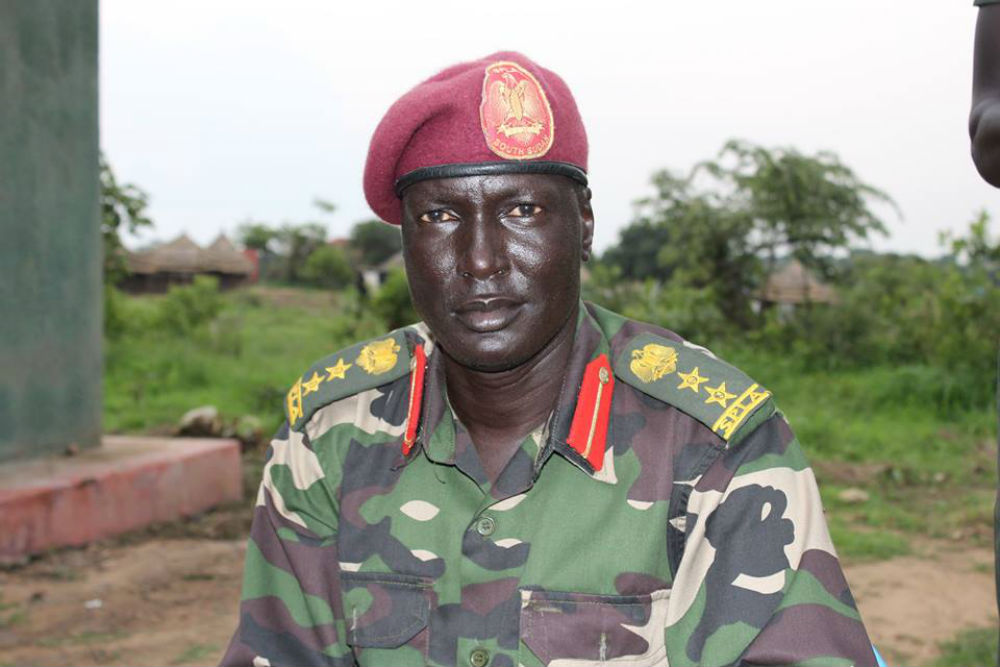
SPLA-IO Spokesman Col. William Gatjiath.
Meanwhile, the Sudan People’s Liberation Army-In Opposition (SPLA-IO) has refuted claims by South Sudan national army (SPLA) spokesman Lul Ruai Koang on social media that the rebel forces who captured Juluce Tabule, the Commissioner of Kangapo County of Yei River State over the weekend, now demand that the government pays a US$2.5 million ransom in exchange for the detained commissioner.
‘This is to inform the people of South Sudan, region and the international community that armed terrorists affiliated to Warmonger Riek Mach[ar] have demanded $2.5 million in order to release Mr. Julius-Tabule Commissioner of Kangapo- County in Yei River State whom they abducted over the weekends with his three bodyguards’, Koang wrote on his Facebook page today.
In response, the SPLA-IO blasted Koang for calling the armed opposition ‘terrorists’, adding that the claim of the ransom is part of ‘government outrageous propaganda it has been feeding the people of South Sudan and the international community for years’.
In the statement, the SPLA-IO says South Sudanese and the international community should know that the armed opposition is fighting for a cause and that the claim of ransom is false, adding that Tabule is being treated like any other prisoners in Upper Nile, Jonglei, and Unity States.
“We refute these unfounded allegations, we have never asked for any ransom since the war broke out, we are fighting for a cause, and we will never ask for a ransom,” the senior rebel officer said.
“This is just one of government dirty propagandas. The people of South Sudan and the world know exactly how Juba talks,” he asserted.
The armed opposition calls the accusations ‘misleading’ and warned that the detained government official would soon declare his defection to the SPLM/A-IO.
“The claim by the government of South Sudan is a misleading nature or propaganda and we would like to inform the general public that the captive is in a good care, healthy and being kept in safe-conduct by the administration of the SPLA/IO. It would be his decision to join the SPLA/IO and announce his defection to the people movement in the coming few days,” the statement added.
The office of the rebel military spokesperson described Mr. Koang as “somebody who can lie even if he knows what he is saying is a pure lie.”
TOUGH GUYS: Parliament of Uganda and Parliament of Kenya in action. Uganda scored a slim 1-0 victory over Parliament of Kenya with Arinaitwe Brian notching the all-important goal
Football defending champions, EALA have sent the strongest signals yet of retaining the Inter-Parliamentary Games Tournament, after the team beat the Parliament of Burundi 2-1 in an entertaining Group B match played at the Mbaraki Sports Ground in Mombasa as the tournament entered Day Two.
Dependable striker, Ibrahim Jamal scored the first goal in the second minute following good inter-change of passes in the midfield. Jamal was on the mark again fifteen minutes later to open the gap.
Captain of EALA, Hon Straton Ndikuryayo (back against camera) controls the ball as a Parliament of Burundi opponent approaches.
Wycliffe Ketto picked up a loose ball in the midfield dribbled past two defenders to set Jamal to score for EALA to lead 1-0.
Julius Maganda of Uganda missed a golden chance to double the lead on 25 minutes when he failed to connect a pass from Hon Bernard Mulengani.
In the second half, Parliament of Burundi made serious raids often catching EALA off guard. EALA defender handled the ball in the box but Burundi’s Hon Jean Marie Niyonkuru, failed to convert the resultant penalty kick.
Hon Dennis Karera then latched on to a loose ball and fired past the EALA goalkeeper to reduce the deficit.
In the first match of the Day, Parliament of Uganda beat Parliament of Kenya 1-0 in a fast paced Group A match. The match was a balanced affair in both halves. Parliament of Kenya strikers missed numerous scoring chances with Hon Augustine Neto and Hon David Ochieng as the main culprits.
On resumption, Parliament of Uganda came back a more rejuvenated side. Kenya’s keeper, Hon Kanini Kega was twice called upon to make saves from the marauding striking force of Hon Odonga Otto, Hon Nsereko Mohammed and midfield dynamo, Hon Mugema ‘Panadol’.
A perfect combination saw the Uganda midfielders race down to the flank to set up an unmarked Arinaitwe Brian. Brian, controlled the ball, then beat the Kenyan Parliament Goalkeeper, Hon Kanini Kega on a first time shot to give his side a slim victory.
EALA players stretch before taking on Parliament of Burundi in netball. The Parliament of Burundi were more superior beating EALA 37-21
In netball, Parliament of Burundi put up a sterling performance to upset EALA 37-21 in a Group B match at the Makande Indoor Sports Gymnasium, Mombasa.
Parliament of Burundi who were featuring a netball side for the first time since the Tournament commenced a couple of years ago, were clearly the better side, showing intent from the very beginning of the game.
Goal Attacker, Hon Sintozuma Jacqueline opened the flood gates as Burundi took a 15-13 lead at end of the second quarter. On resumption, it was one-way traffic for the victors. Hon Mboneko Sauda and Hon Ndayizeye Gloriose were a constant thorn in the flesh of the EALA Netball team.
Speaker of Kenya National Assembly, Rt Hon Justin Muturi shakes hands with Hon Khatibu Mwashetani, player of Bunge FC, Kenya. Kenya lost 0-1 to Parliament of Uganda. All photos/Courtesy/EAC
In the first match of the day, Parliament of Uganda were awarded the match versus Parliament of Kenya on a 60-0 walk-over in Group A match at the Makande Indoors Sports Gym, following the Parliament of Kenya’s unavailability to raise a team in accordance with the rules governing the tournament. At the moment, the rules stipulate that only Members of Parliament can feature in the tournament.
In group A of men’s Volleyball, Parliament of Uganda won Parliament of Tanzania 2 sets to 0 in an interesting encounter. Parliament of Uganda beat Parliament of Tanzania 25-12 in the first set. They won the same amount of points in the second set.
In Group B, Rwanda was awarded 2 sets to 0 (25-0 and 25-0) over Parliament of Burundi who did not field a team.
In women’s volleyball, EALA were awarded 2 sets to 0 victory following the failure of Burundi to field a team.
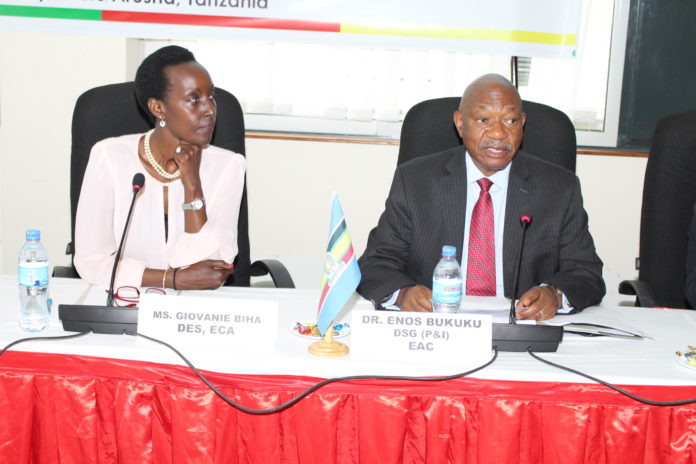
The EAC Deputy Secretary General in charge of Planning and Infrastructure, Dr. Enos Bukuku, addressing delegates when he officially opened the SRCM for Eastern and Southern Africa at the EAC Headquarters in Arusha, Tanzania. With him is Ms. Giovanie Biha, the UNECA Deputy Executive Secretary.
The ongoing migration of people to Europe is evidence that African countries have failed to implement policies that could yield benefits to their citizens.
The East African Community (EAC) Deputy Secretary General (DSG) in charge of Infrastructure and Planning, Dr. Enos Bukuku, said that poverty-stricken refugees were willing to risk their precious lives to cross the Mediterranean and face other risks knowing they could get a better life in Europe.
Dr. Bukuku said the migration provides an opportunity for African leaders, elites and governments to ask themselves pertinent questions on why the continent continues to score poorly on all development indicators.
The DSG said it was ironical that many African countries were at the same level of economic growth with most economies in South East Asia in the 1960s yet the latter had become part of the 20 largest economies in the world even as their African counterparts continue to lag behind in development.
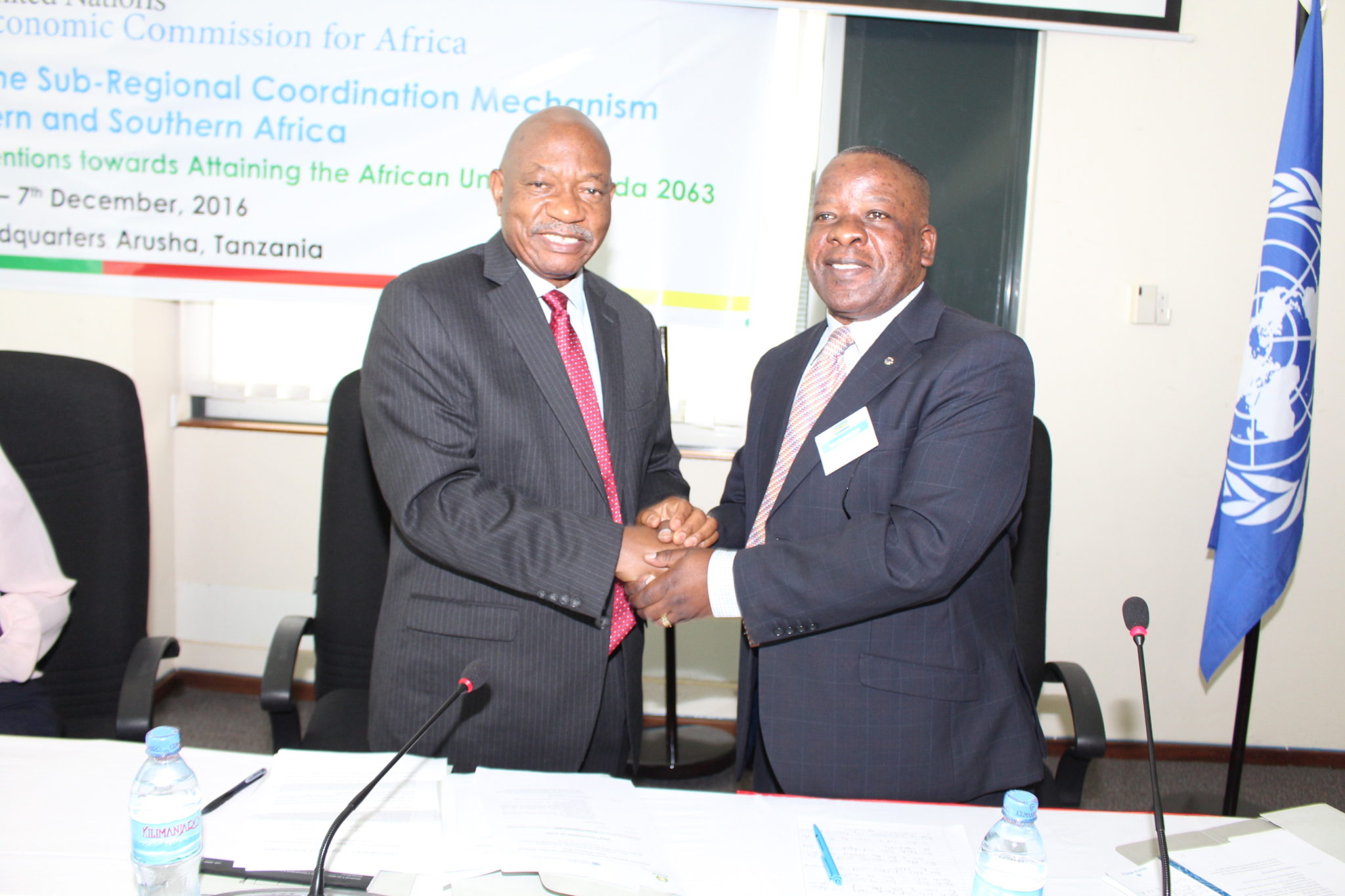
Dr. Bukuku was speaking when he presided over the official opening of the 3rd Stakeholders Meeting on the Sub-Regional Coordination Mechanism (SRCM) for Eastern and Southern Africa at the EAC Headquarters in Arusha, Tanzania.
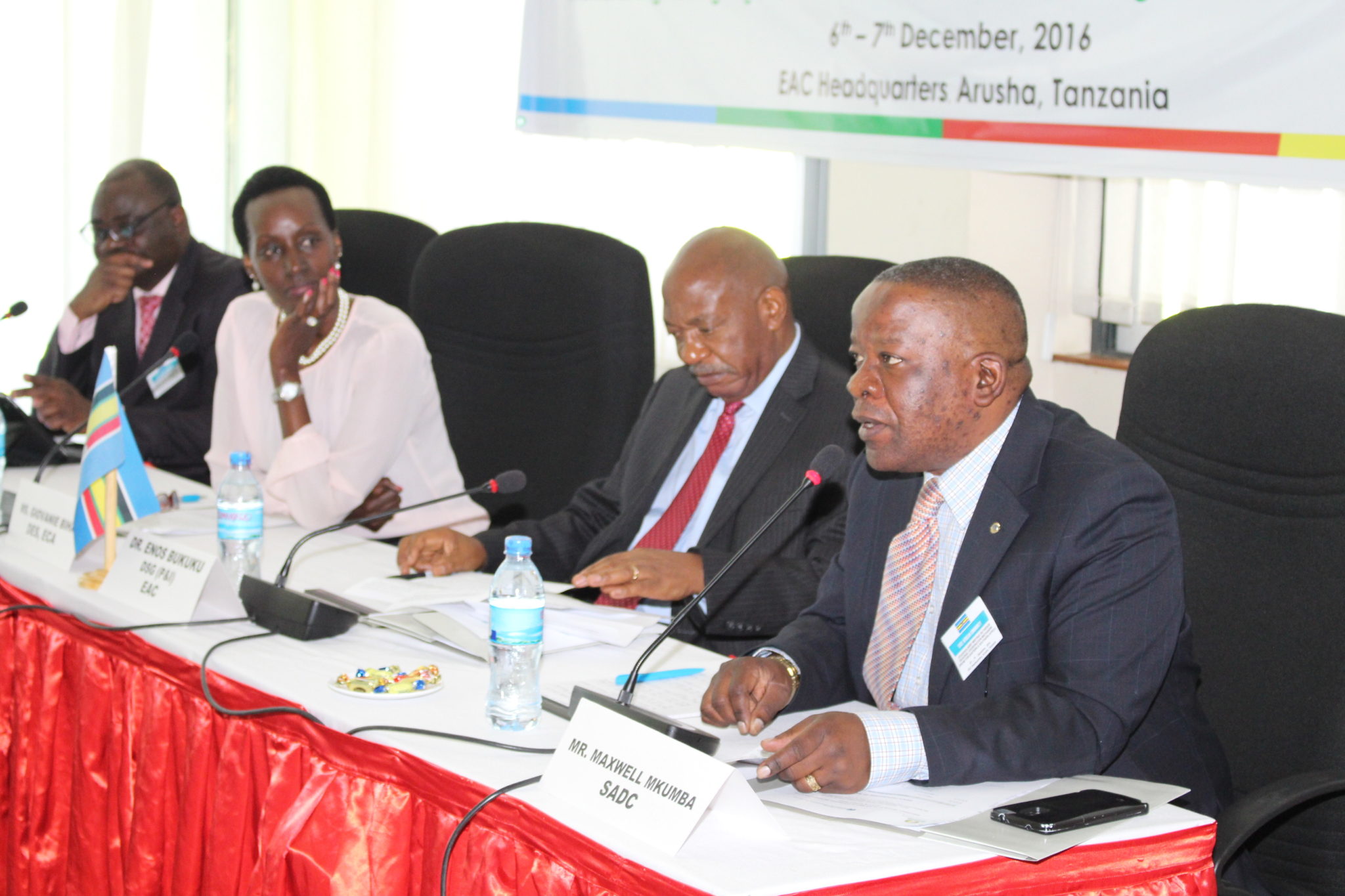
SADC Senior Policy and Technical Coordinator Maxwell Mkumba makes his remarks during the official opening of the Sub-Regional Coordination Mechanism Meeting for Eastern and Southern Africa. With him are (L-R) Prof. Said Ademujobi (UNECA Sub-Regional Office for Southern Africa), Ms. Giovanie Biha (UNECA Deputy Executive Secretary) and Dr. Enos Bukuku (EAC Deputy Secretary General in charge of Planning and Infrastructure).
The main aim of the two-day SRCM is to bring together UN Economic Commission for Africa (UNECA) Sub-Regional Offices, Regional Economic Communities (RECs), Inter-Governmental Organisations (IGOs) and UN agencies in order to identify opportunities for joint planning and programme implementation at the sub-regional level and thereby effectively support the work and priorities of the RECs and IGOs in the regions.
Among the RECs and IGOs represented at the meeting are the EAC, Southern African Development Community (SADC) and the Indian Ocean Commission. Other organizations with representatives at the meeting are the African Union, United Nations Development Programme, International Labour Organisation, International Organization for Migration, NEPAD, and the Port Management Association for Eastern and Southern Africa.
SADC Senior Policy and Technical Coordinator Maxwell Mkumba (right) officially hands over the SRCM Chair to Dr. Enos Bukuku, the EAC Deputy Secretary General in charge of Planning and Infrastructure.
Speaking at the forum, Mr. Maxwell Mkumba, the SADC Senior Policy Director and Technical Coordinator, on behalf of the SADC Executive Secretary and SRCM outgoing Chair, Dr. Stergomena L. Tax, emphasized the importance of aligning RECs and IGOs key flagship initiatives with the AU Agenda 2063 and the 2030 Agenda for Sustainable Development.
“We also need to discuss and agree on effective instruments to strengthen our collaboration, synergies and coherence that are necessary to ensure AU Agenda and the UN Sustainable Development Goals (SDGs) are effectively mainstreamed into the regional and national development plans,” said Mr. Mkumba.
Mr. Mkumba said that the SRCM had recorded significant achievements over the past one year when SADC held the position of Chair and cited the development of the Draft Addendum to the Business Plan and the study on the mapping of the SRCM stakeholders.
“However, we can do better than this if we are able to improve on our joint programming processes, allow for more regular interactions and effective information sharing and communication, as well as well as urgently deal with challenges around resourcing of programme implementation,” he said.
“Peoples of the regions we represent are looking up to initiatives like the SRCM to address development challenges, including poverty eradication. The SRCM should serve as the excellent mechanism for achieving sustainable development,” he added.
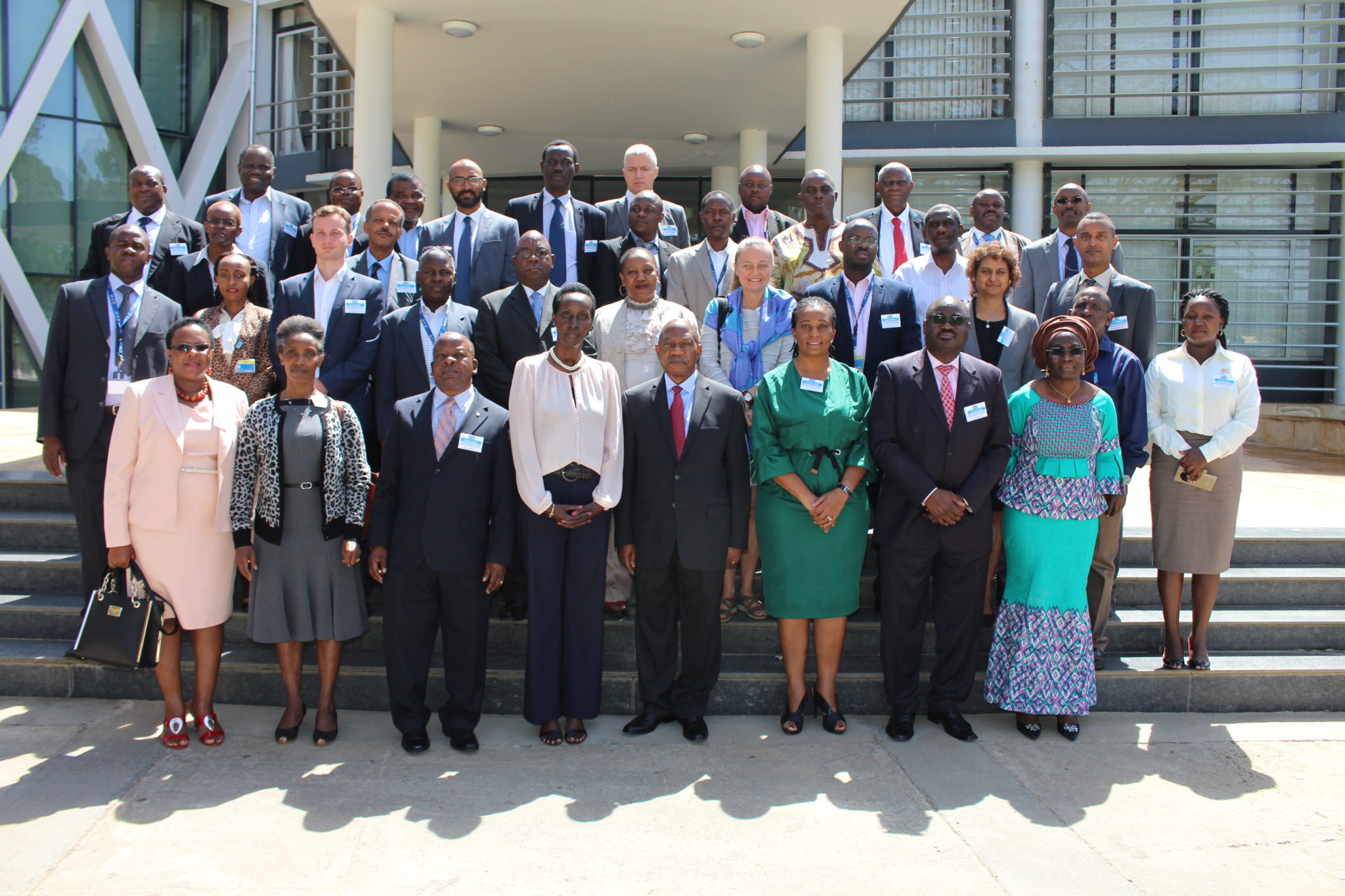
The EAC Deputy Secretary General in charge of Planning and Infrastructure, Dr. Enos Bukuku and Ms. Giovanie Biha, the UNECA Deputy Executive Secretary (front row, middle) in a group photo with other delegates at the SRCM meeting outside the EAC Headquarters in Arusha.
In her remarks, the UNECA Deputy Executive Secretary, Ms. Gionvanie Biha, said the SRCM was a relatively new and evolving mechanism that needs to be embraced and nurtured by all stakeholders, most of whom were still on a learning mode.
Ms. Biha urged UN agencies to use the SRCM as a platform for sharing information and knowledge and building on synergies and complementarities to support regional priorities, adding that leadership by RECs was key to the success of the mechanism.
EALA Speaker, Daniel F. Kidega (centre), Chairman of the Bunge Sports Club, Hon Wafula Wamunyinyi (right) and the Mombasa County Senator Hassan Omar at the flag-off of the 7th Inter-Parliamentary Relations seminar
Several Ugandan Members of Parliament including former 1500 metres Junior World Champion Julius Acon and compatriots Maureen Osoro and Anne Adeke got off to a good start the 7th East African Inter- Parliamentary Games tournament.
Starring in the ladies track and field events, MP Osoro won both the 400 m and 800m races ahead of compatriot Christine Ayo (400m) and Tanzania’s Esther Matiko, who came in third in the 400m race. In the 800m race MP Osoro beat Tanzanian Matiko to second place, while youth MP Anne Adeke came in third.
In the Men’s category, Parliament of Kenya’s Wesley Korir, a former Boston Marathon Champion, got his name on the medal chart, crossing the line ahead of former athlete Julius Acon of Uganda and Kisoi Munyao of Kenya.
Korir also hit the finish in the 400 metres dash beating Parliament of Uganda’s Gota to second place while compatriot, Dr Victor Munyaka scooped third place.
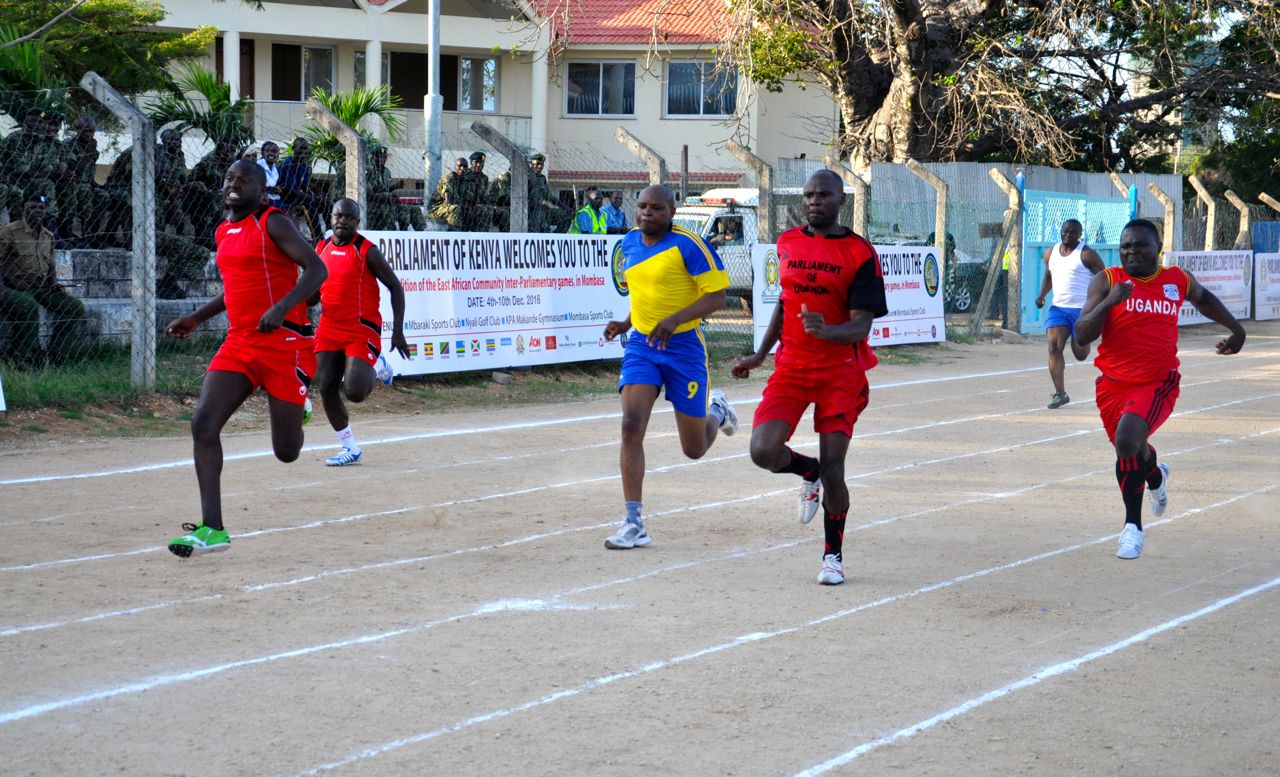
Senator Isaac Melly of Parliament of Kenya dashes to the finish line in the 400×1 Men finals. Kenya won that particular race.
Team Kenya also did well scooping the 400 x 1 relay with MPs Dan Wanyama, Kanini Kega, David Ochieng and Senator Isaac Melly starring in the race. The walking race was also won by Kenya’s Korir.
In men’s tug of war, Parliament of Uganda were declared champions after beating Kenya 2-1 in a pulsating final. Parliament of Uganda started off well beating Kenya 2 pulls -1 pull and Tanzania 2 pulls to zero to book a date yet with Parliament of Kenya. Parliament of Kenya on its part were the stronger side beating Parliament of Tanzania, 2 pulls to zero.
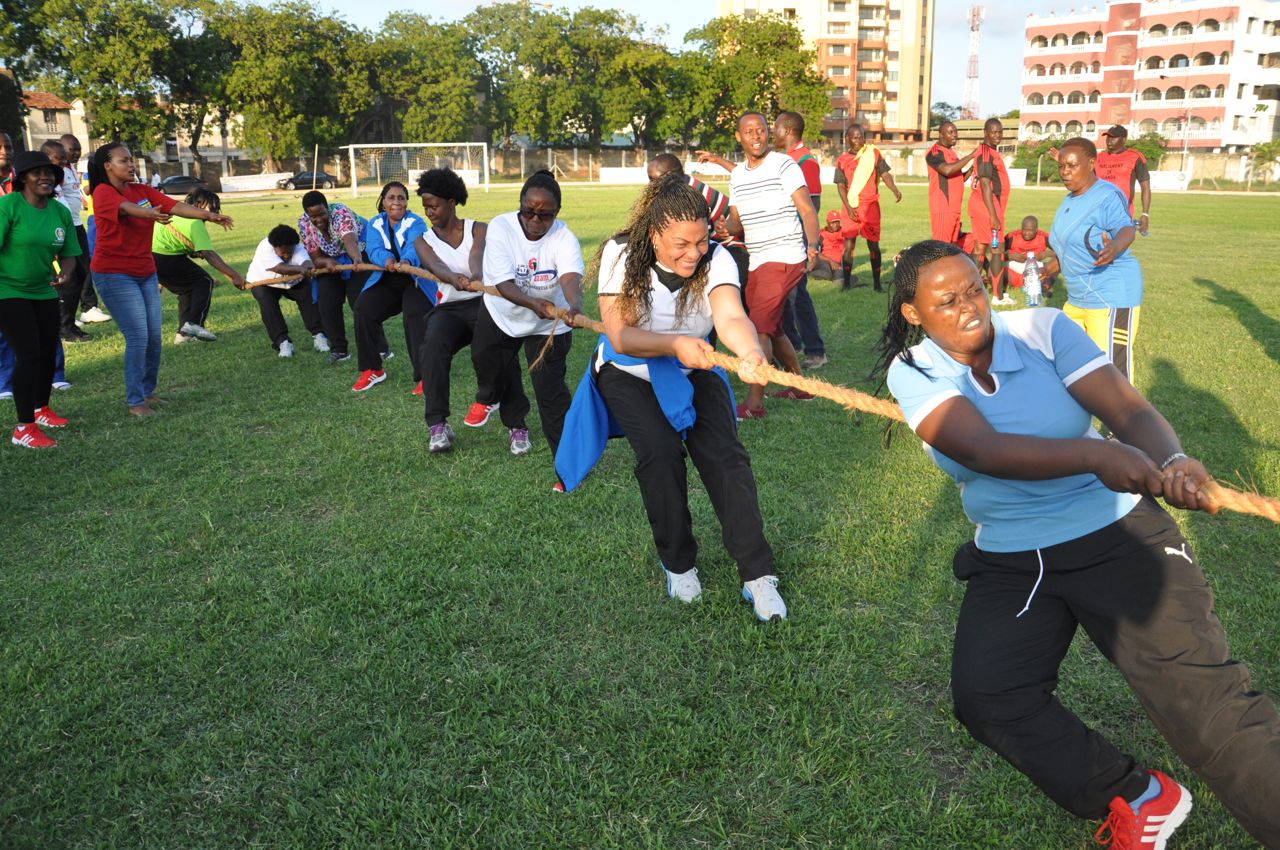
A section of EALA Legislators during the Women’s Tug of war competition. Six sports disciplines are been played in the week-long tournament.
In the women’s category, Parliament of Kenya proved to be superior beating Tanzania 2 pulls to zero. However, in the second match, Tanzania beat EALA by two pulls to zero.
Earlier on, the week-long extravaganza was preceded by a Pre-Tournament Conference opened by the Speaker of EALA, Rt Hon Daniel F. Kidega. The Speaker reiterated the importance of the Games saying it enhanced inclusiveness and bonding.
“Beyond interface as Parliaments, the Inter-Parliamentary Games further enhance interaction with the citizenry of the Partner States and act as a mode of sensitization by popularizing the Integration process. Sports is key for the integration of the region as enshrined in Article 119 which anticipates the promotion and enhancement of diverse sports activities”,Speaker Kidega noted.
Sport, he remarked, similarly plays a vital role in building social inclusion in the region, as an engine of shared experience and empowering citizens to develop friendships. Sporting activities create greater sense of belonging, increase in confidence levels and strengthening of Community capacity.
The Speaker called on the Partner States to promote sports tourism by investing in more budgets. The theme of the Pre-Tournament Conference: ‘Uniting East Africans, One People, One Destiny’, was called to enhance bonding ahead of the Games.
Mombasa Senator Hassan Omar said sports was key in integration. He said there was need for common identities, justice and common standards including adherence to human rights. He said the integration pillars would only be realized if there was total commitment from all Partner States.
The Governor of Mombasa, Hassan Ali Joho, said there were clear values stipulated in the Treaty for the Establishment of the EAC on the reasons for coming together. He said the integration systems needs to be anchored on economic, social and cultural values as well.
“Let us ensure the Community is people-centred and private sector driven”,Governor Joho said, and called for the fast uptake of Kiswahili as the official language of the Community.
The Chair of the EAC Joint Planning Committee Saoli Ole Nkanae also addressed the Conference. Another key presentation was made by the Senior Monitoring Evaluation Officer, Julius Burungi who said significant progress had been made at the EAC, the challenges notwithstanding.
The presenter said all stakeholders need to be involved in the integration of the region. He cited lack of awareness and funding as some of the challenges the Community is facing.
LED UGANDA DELEGATION: Minister of State for Sports Charles Bakkabulindi
Leaders of the delegations, Uganda’s Minister of State for Sports Charles Bakabulindi, William Ngeleja (Parliament of Tanzania), Hon Evariste Kalisa (Parliament of Rwanda) and Dennis Karera (Burundi National Assembly) addressed the Pre-Tournament Conference.
EALA Member, Hon Abubakar Zein called on the legislators to embrace fair play and discipline as the games proceed. He maintained that there was need for etiquette and adherence to decorum, rules of conduct and courtesy as the games proceed. Hon Zein said fair play as well as sportsmanship/sportswomanship were key attributes in the entire tournament.
In attendance also were representatives of the Kenya Ports Authority and the Aga Khan University.
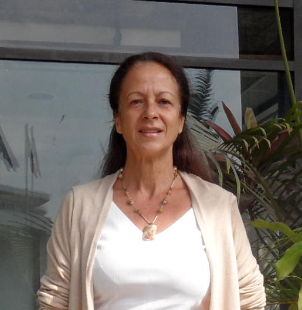
The French Ambassador to Tanzania and the East African Community Malika Berak has called on all parties in the Inter-Burundi Dialogue to engage constructively and consensually in the forthcoming consultations to be held in Bujumbura, Burundi.
In a press statement also copied to the EAC Secretariat, Amb. Berak said that only a political solution would enable Burundi to achieve a peaceful exit from the crisis.
“We reiterate our full support for the continuation of sessions on Inter-Burundi Dialogue, within the framework of the mandate given to it by the East African Community,” said the envoy.
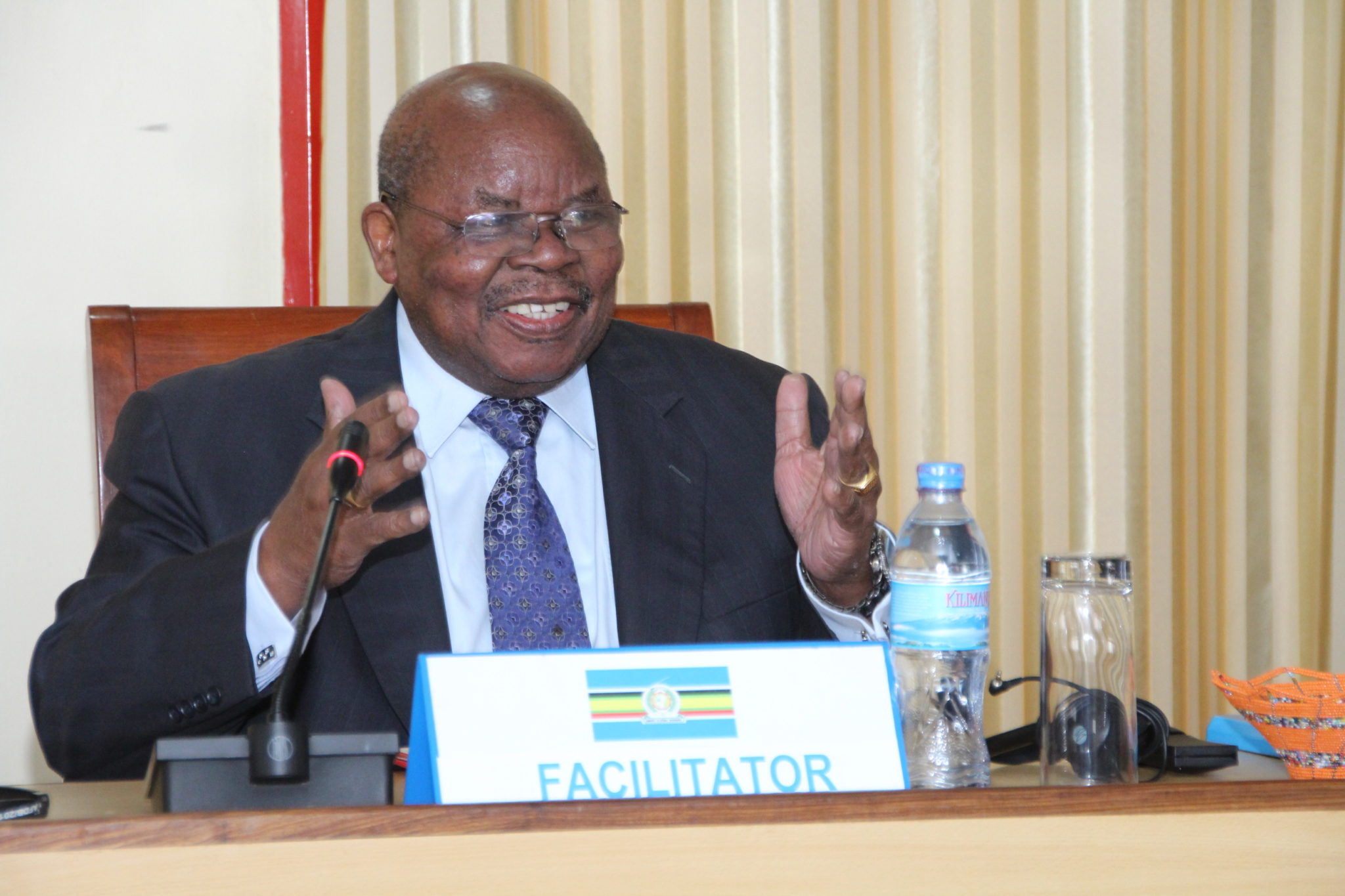
Inter-Burundi Facilitator, former Tanzanian president Benjamin Mkapa.
Amb. Berak further hailed the determination and commitment of the former Tanzania President Benjamin William Mkapa, who is also the Facilitator of the Inter-Burundi Dialogue.
Meanwhile, in a press statement on December 1, Mkapa disclosed that a roadmap for the Burundi Dialogue process was developed and presented to the Mediator, President Yoweri Museveni of Uganda on November 2nd, 2016. The roadmap provides for a series of engagements between December 2016 and June 2017 that will culminate in an agreement.
Mkapa said that in implementing the roadmap, he will in due course be visiting the Republic of Burundi to confer with President Pierre Nkurunziza and also consult with other political players, adding that this would lay the ground for a series of both formal and informal engagements with and among various stakeholders, in and outside Burundi and also with international actors.
The Facilitator observed that since his appeal in May 2016 to Parties to the Conflict to desist from violent acts and give dialogue a chance, there has been a noticeable improvement on the security situation in Burundi.
“It is important that as this process proceeds, and for which the Barundi and the EAC citizens will continue to be briefed on the progress, all parties should strive to avoid actions and utterances that are not helpful to the healing process and remain seized of the commitment to a political process,” Mkapa said.
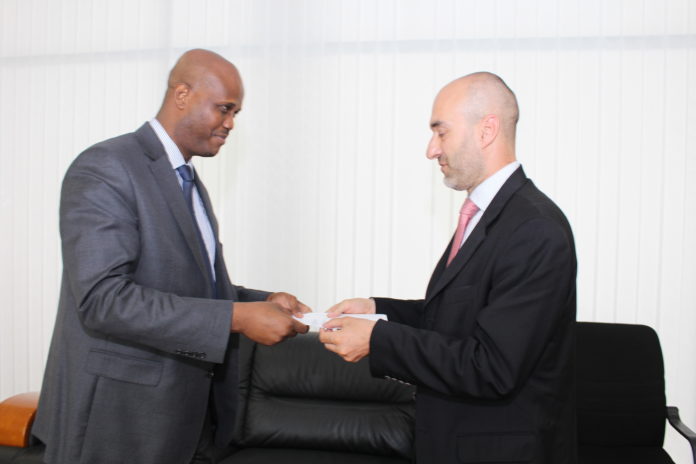
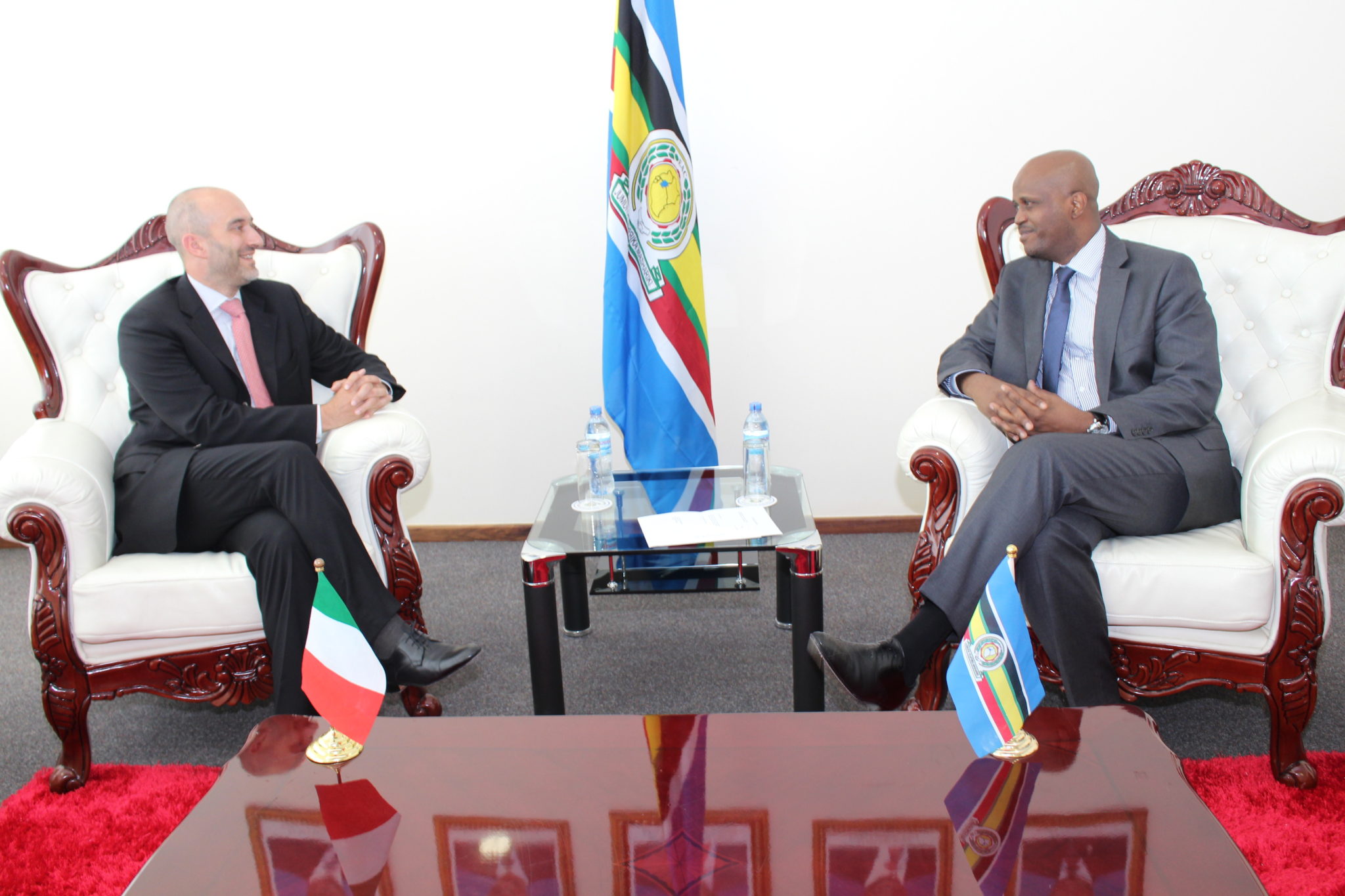
Italian Counsellor, Roberto Mengoni(R), presents his letter of accreditation to EAC Secretary General, Amb. Liberat Mfumukeko.
The Italian government has appointed Counsellor Roberto Mengoni as Italy’s Permanent Representative to the East African Community.
Ambassador Mengoni, who is also accredited to Tanzania, presented his letter of accreditation signed by the Italian Minister for Foreign Affairs and International Cooperation Paolo Gentiloni, to the EAC Secretary General, Amb. Liberat Mfumukeko, at a function at the EAC Headquarters in Arusha, Tanzania.
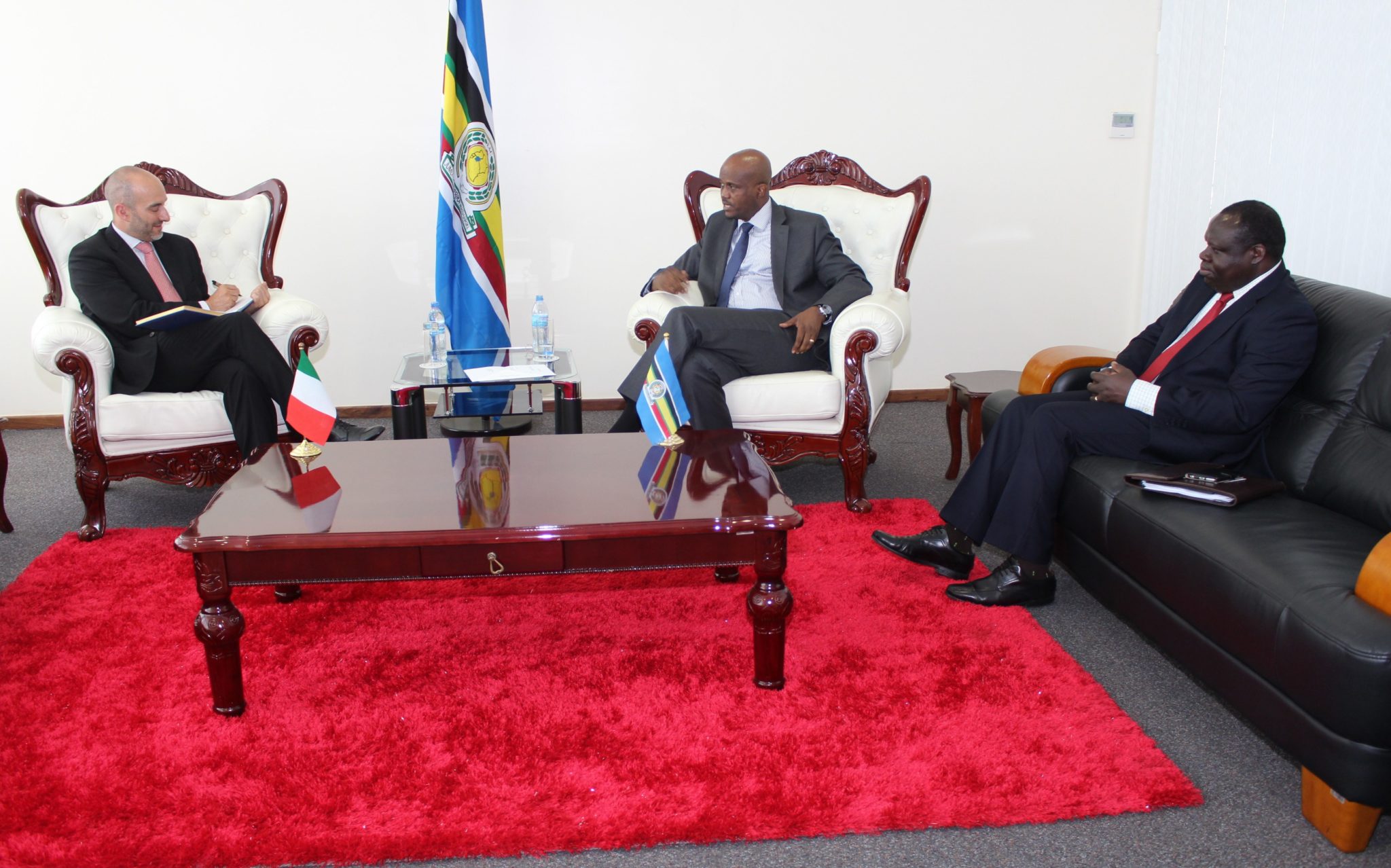
EAC Secretary General Amb. Liberat Mfumukeko in discussion with the Amb Roberto Mengoni.
The Secretary General commended the Italian Government and briefed the Envoy on the milestones recorded in the integration process. He also pledged to link up the envoy with the East African Business Council through which Italian investors could explore available opportunities.
On his part, Amb. Mengoni commended the EAC Secretariat for spearheading the integration agenda and highlighted a few areas that the Italian Government was interested in supporting the EAC, especially the Renewable Energy sector. He disclosed that his government was pushing for a policy change on Africa that will see a more robust engagement with the continent and the EAC.
The two officials also discussed also the status of negotiations of the EAC-EU Economic Partnership Agreement and the Inter-Burundi dialogue.
Speaking about the Inter-Burundi Dialogue, Amb. Mengoni hailed the efforts of the Facilitator, former Tanzanian President Benjamin Mkapa, and the EAC Secretariat in spearheading the process and called upon all the parties and stakeholders to give peace a chance in Burundi.
Amb. Mfumukeko, Amb Roberto Mengoni and EAC Deputy Secretary General in charge of Productive and Social Sector, Hon. Christophe Bazivamo during the acrreditatioion ceremony.
Also present at the ceremony was the EAC Deputy Secretary General in charge of Productive and Social Sectors, Christophe Bazivamo.
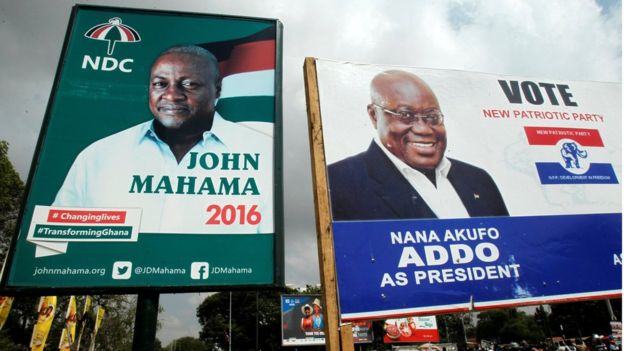
TOP CONTENDERS: Poster of Ghana's presidential candidates incumbent John Mahama and Nana Akufo-Addo
Polls have opened in Ghana’s presidential election, after all seven candidates aligned behind a pledge to keep the process peaceful.
The leading candidates are incumbent President John Mahama and former foreign minister Nana Akufo-Addo.
After polls close on Wednesday evening, official results are expected within three days.
The candidates signed a pact last week vowing to follow electoral rules and keep the peace.
But clashes broke out on Monday in Chereponi, a small northern town on the border with Togo, and six people are said to be in a critical condition as a result.
The campaign has been dominated by the faltering state of Ghana’s economy and the issue of corruption.
Mr Akufo-Addo is hoping it will be third time lucky for him and the centre-right New Patriotic Party, after two failed attempts in running for the country’s top job.
President Mahama of the National Democratic Congress won in 2012, but he had already been sitting president for several months following the death of his predecessor, John Atta Mills.
MADE CHANGES: Commander in Chief of armed forces. Gen. Yoweri Museveni.
President Yoweri Museveni who is also the Commander-in-Chief of armed forces on Monday issued a stern warning to UPDF soldiers over corruption.
According to military sources, Gen. Museveni told the Uganda Peoples Defence Forces High Command meeting that took place at State House in Entebbe that corruption is “ravaging” the army again.
Museveni said he would not allow UPDF, which has been credited for peace support operations in the region, to be tainted by some corrupt army officers.
His remarks come at time a Shs2 billion fake arms deal that reportedly involves some senior officers and other army officers. The army officers are allegedly to have conned a Polish company of the said billions after disguising as the Ministry of Defence Procurement Committee that sought supplier of arms.
Some of the implicated officers who recently went to Poland to meet the directors of the company and settle the issue were shocked to learn that the Inspector General of Police General Kale Kayihura and External Security Organisation boss, Ambassador Julius Ocwet, had met the directors of the company and compiled a report.
However, as of now there is no concrete evidence pinning any senior official in the fake arms deal.
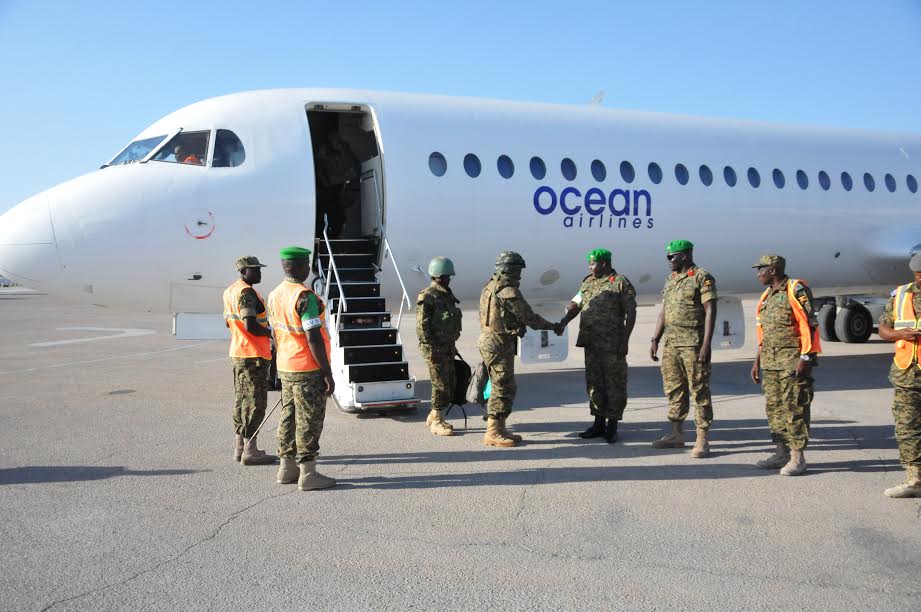
Uganda Contingent commander Brig. Sam Okiding flanked by UGABAG XVII commander Col. BP Ogik receives the rotating in troops of battle group XX at Adan Abdulle International Airport in Mogadishu on Monday 5th December 2016.
The first flight of UGABAG XX comprising of eighty soldiers has safely landed in Mugadishu.
The Boeing 737 from Ocean Air Lines Company touched the ground at Adan Abdulle International Airport at about 0730Hrs East African standard time.
On the Airport to receive the troops was the outgoing Uganda contingent commander Brig. Sam Okiding together with outgoing UGABAG XVII commander Col. Bob Priscily Ojik.
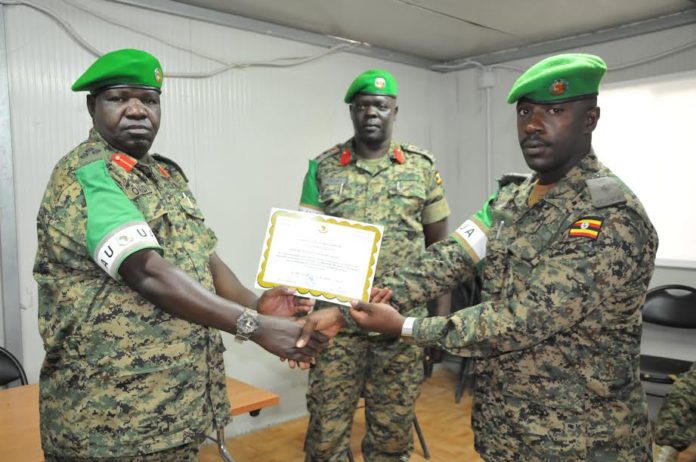
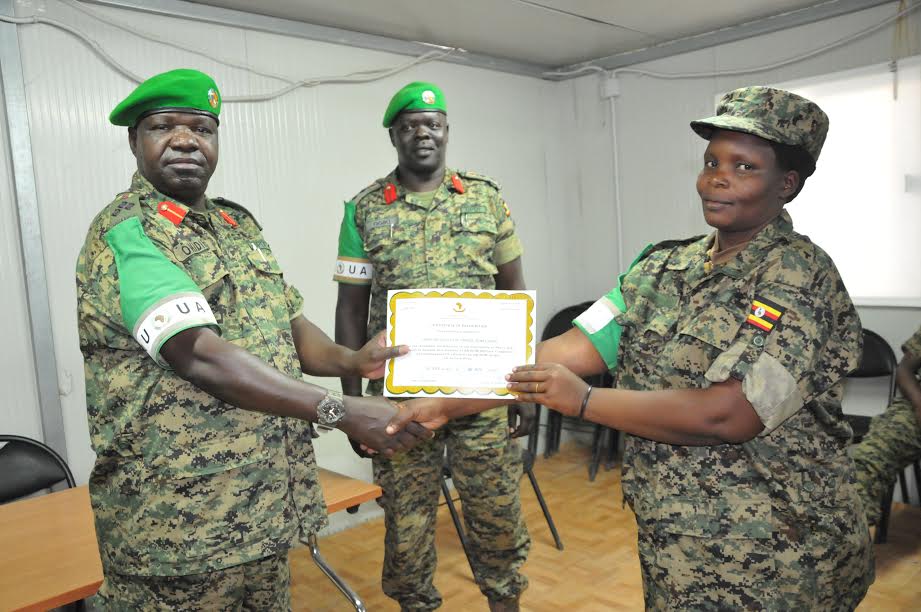
Lt. Col. Charles Monday, the specialist in Air defence and field Artillery rotating out with UGABAG XVII (right) receives certificate of recognition from the outgoing Uganda contingent commander Brig. Sam Okiding (left) as Outgoing UGABAG XVII commander (centre) looks on.
The plane brought back an equivalent number of rotating out peacekeepers of UGABAG XVII.
Before boarding, the rotating out troops received a briefing from Uganda contingent commander Brig. Okiding who congratulated the Battle Group for the job well done and urged them to maintain the discipline and patience which they have exhibited during the hard times.
The outgoing head of EOD/IED teams for Uganda contingent under Battle Group XVII Lt. Iyan Nuwe Agaba recieves a certificate. EOD/IED team credited as a force multiplier for enhancing mobility along the AMISOM main supply route for survivability and sustainability of troops in the mission in the face of Al-Shabaab terrorists.
Rotating out peacekeepers received certificates of recognition from the Uganda contingent commander who was franked by the Battle Group XVII commander thanking them for the invaluable contribution to the restoration of peace and stability in Somalia as members of the AMISOM military component service for a period of one year.