Stanbic Bank
Stanbic Bank
21 C
Kampala
Stanbic Bank
Stanbic Bank
Home Blog Page 2011

KASESE VIOLENCE: MPs want commanders of raid on Rwenzururu palace suspended

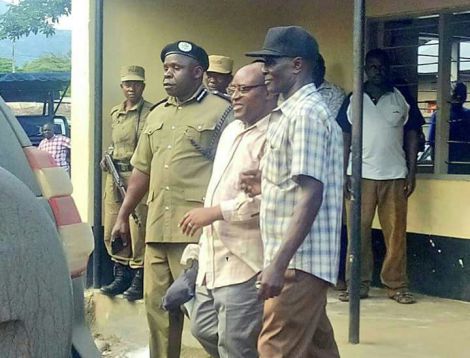
Rwenzururu king Wesley Mumbere being arrested before being taken to Nalufenya Police Station in Jinja.

Members of Parliament from Kasese and the general public is yet to get over the shock from the weekend killings in Kasese that saw over 80 dead and hundreds arrested.

According to MPs from Kasese, they want compensation for the damage and all the security officers who commanded the raid on the palace to step aside for investigation. The commanders included among others that of UPDF Div 2 Brigadier peter Elwelu and Police’s Director of Operations Asuman Mugenyi.

“The commanders both Police and UPDF who were on ground should be step aside and be investigated. The People of Kasese will seek justice. Goverment is not willing to accept where they have failed,” Kasese Municipality MP Robert Centenary, said.

He was reacting to Internal Affairs Minister Jeje Odong’s statement to Parliament in respect to the deaths that followed the attack on the Palace of Rwenzururu Kingdom by the UPDF and Police. According to General Odong, the security operatives were acting in self defence after they were attacked by a militia group called the ‘Kirumira Mutima’.

The Minister said the attacks followed a regional security meeting which had been convened at Kabarole Local Government Headquarters. The meeting, attended by RDCs, District Chairpersons and security leader from the seven district of Rwenzori had resolved that all camps which had been established by “Kirumira Mutima” be dismantled by security forces.
“On the 21st of Nov 2016, on learning about these impending operations, the cultural guards started attacking police stations and police posts. These attacks were carried out in a similar manner across the district where 16 policemen were killed and 6 guns stolen. In all these incidents, the attackers used assault rifles, petrol bombs, grenades, machetes, spears and daggers,” he said.

Apparently, it is at that moment when the palace was stormed on Saturday because sections of the ‘Kirumira Mutima’ group disappeared into the palace with their guns.

“Unfortunately, 46 cultural guards lost their lives, while 146 have been arrested…” he said.

However, the Kasese Municipality MP Centenary dismissed Odongo’s account as false.

Speaking on the floor of Parliament in reaction to the minister’s statement, Centenary said that by the time of the attack, the Rwenzururu King Charles Wesley Mumbere had agreed to surrender the guards as requested by the authorities.

“I bleed in tears, when I see MPs clap at the Minister’s statement which is a false account of what happened,” he said.

“The minister’s statement on the Kasese Killings is false… allow us to give our side of the story,” he added.

According to the legislator, the palace was sealed off at about midnight of Saturday after the Omusinga received a phone call from the President asking him to surrender his guards.

“We requested MP Katusabe to go and negotiate with the King. It was agreed that the royal guards be handed over. As MP (Bukonzo West MP Godfrey Atkins) Katusabe was informing the CDF, Gen Katumba Wamala of the King’s acceptance, he was told to leave the palace,” MP Centenary said.

It was at that moment that security started bombing and shooting those that were found in the palace, he said.

“As we reached Kasese town, we were informed that the palace was bombed,” Centenary said and added: “The security forces of Government destroyed the Palace and Omusinga offices. As people of Kasese, we demand that the king be released.”


Stories Continues after ad

Gov’t statement on Kasese violence

Foreign Affairs Minister, Gen. Jeje Odongo.

29th November, 2016

PRESS RELEASE

GOVERNMENT STATEMENT ON THE SECURITY SITUATION IN THE RWENZORI REGION

INTRODUCTION

As you may be aware by now, His Highness Charles Wesley Mumbere, the Omusinga of Rwenzururu was arrested from his palace on 27th November 2016 by the police in a joint security operation. This was as a result of the attacks conducted by cultural guards “Kirumira Mutima” who are said to be his creation and under his command.  On the 26th of November 2016, these cultural guards of Obusinga Bwa Rwenzururu attacked the joint security patrol team in Kasese town with a petrol bomb, stabbed and injured a soldier. This was immediately followed by simultaneous attacks in Ihandiro Sub County, at Kagando hospital in Kisunga sub county, Bwesumbu, Kyabarungira, Mubuku in Maliba Sub County and Ibanda in Bugoyi Sub County. In all 16 policemen lost their lives and 6 guns were taken by the attackers. This is the reason I came to brief you.

BACKGROUND

The Rwenzururu agitations started way back before Uganda got independence in 1962. First, were the struggles between the Bakonzo and the Batooro around 1900s when the colonial agreements failed to recognize the Bakonzo as an independent ethnic group and instead placed them under the Toro Kingdom? This was under the wider district of Toro which was formed in 1910.These struggles are well documented. The agitation for autonomy by the Bakonzo continued to become a concern for the colonial government and this history is well stipulated in Sessional Paper No1 of 1963.

In 1974 two districts of Rwenzori and Semuliki were created. In 1979 Semliki was renamed Bundibugyo and Rwenzori became Kasese district. The two districts were created for purposes of enabling devolution of power and resources between the local communities of the region; a response to the long standing agitation and demands.

In 1982 the Obote government reached a political deal with the Rwenzururu Movement in which the current king, Iremangoma Mumbure agreed to lay down arms in return for development funds for social welfare, education as well as material incentives plus government scholarships.

However, the disgruntled faction led by Richard Kinyamusithu, the movement’s former Chief of Staff formed the Rwenzururu Freedom Movement which culminated into National Liberation of Uganda (NALU) of Amon Bazira.

When the NRM allowed for the restoration of Cultural and Traditional Institutions in 1992, the matter was later constitutionalized in the 1995 Uganda constitution.

Building on the political movement of the Rwenzururu, the Bakonzo continued to agitate for the recognition of the Rwenzururu Kingdom which in 2009 was granted by government.

The on-going situation in the Rwenzori region is therefore an off shoot of a long history and not the creation of the NRM government.

LIKELY CAUSES OF THE CONFLICTS

The conflicts in the Rwenzori region may be attributed to some of the following general causes.

Political Causes.  The talk of cessation and creation of the Bakonzo state of Yiira has been in the public domain for quite some time now. Government has been clear that this dream is an impossibility in the present times. This factor will be investigated to ascertain whether it is one of the drivers behind the behavior of violent actions of OBR.

Tensions between OBR and Obudingiya Bwa Bwamba (OBB). The creation of Obusinga Bwa Rwenzururu (OBR) and later Obudingiya Bwa Bwamba (OBB) cultural institutions was hinged on achieving political and social harmony. However, this created jurisdictional and control tensions between the two cultural institutions. Government continues to investigate this factor with a view of resolving the enduring tensions.

Land factor. Claims and counter claims over land rights between the Bakonzo and other communities is alleged to be one other cause of the conflict. Indeed, the Kajura Commission of Inquiry report strongly recommended government intervention on the matter.  This factor will further be investigated in order to provide lasting solutions to the land problem.

Economic factors. Many of the local communities, especially those in the hard to reach mountainous areas are prone to exploitation, and misguidance by influential and powerful individuals to further their selfish and divisive political interests. Most of the youths participating in attacks are being assured of false promises of economic emancipation by these individual.

It should be noted that the current security situation has no connection to claims of political persecution by some area leaders. The government lost elections in several areas in the country and there has been no such occurrences in those areas. In any case the attacks in Rwenzori region occurred in 2012 and 2014 yet there were no elections in those years. The occurrences are a matter of security and criminality to which some individuals have to take responsibility.

THE PERIOD BETWEEN 2014 – 2016

In July 2014, there were attacks occasioned by cultural guards of Obusinga Bwa Rwenzururu (OBR) across the Rwenzori region against security installations as follows;

  • In Kasese, the cultural guards attacked the police at the Weigh Bridge along Kasese Mbarara highway, two police officers were killed and their guns taken.
  • In Bigando sub-county, 11 people including a UPDF soldier, his wife and a child were killed.
  • In Kibuku Ntoroko district, they ambushed a UPDF patrol truck and cut a soldier on the headed. They also they attacked the main police station in Ntoroko and took 3 guns.
  • In Bundibugyo they attacked a Uganda Wildlife Authority post and took 2 guns. They went ahead and attacked the Central Police station, killed four police officers including the OC station and made away with 6 rifles
  • At Kanyamwirima UPDF Barracks they killed 4 soldiers and injured one. Here they also took one a Rocket Propelled Grenade (RPG).

While in 2014 the attacks were conducted by “Isyomango Syo Businga”, (Youth of the Kingdom), in the recent wave of violence the attackers have graduated into a militia which is trained, uniformed, armed, camped, and under a command and control structure. This new structure is composed of “Kilhumira Mutima” (the strong hearted and keepers of a secret) who have occasioned the most recent attacks.

It should be recalled that in 2014 a total of 68 attackers lost their lives in the violence. Additionally, 23 civilians died and 10 members of the security forces. Those who were arrested and prosecuted totaled to 179. Of these 155 suspects were leniently pardoned by government. Over 500 others who had fled after the attacks benefitted from the government amnesty—returned and were rehabilitated and re-integrated into the community. Note that among them were two ministers of Obusinga Bwa Rwenzururu In the year 2016 alone, many civilian killings were noted to have been conducted by the same criminal groups.

  • Fifteen people died in Bundibugyo after the Feb 2016 election, 139 houses were also set ablaze in a period of 04 days.
  • As the Bundibugyo clashes subsided, a similar situation developed in Kasese district following the Local Council III Election in Hima Town Council. On the night of 10th March 2016, in Hima Town Council, a group of 30 people armed with machetes, knives and clubs injured 04 UPDF soldiers.
  • On 11th March 2016, the attackers critically injured 02 police officers and grabbed a gun from one of them.
  • On the evening of 15th March 2016, the GISO of Kyabarungira sub county and his brother were attacked and stabbed in Kasese town, by suspected OBR Youths leaving them seriously injured.
  • On the morning of 23rd March 2016, clashes in Ntotoro sub county of Bundibugyo left 20 people killed, sparking a fresh wave of IDPs, approximately 5000 who sought refuge in Bubukwanga Camp.
  • On 23 Mar 16, a gang of criminals associated to OBR cultural guards, armed with pangas, attacked Kidodo Police post in Kasese Municipality, leaving 01 police man killed and 01 gun taken.
  • These were many including an incident where they critically injured a Commissioner of Police in Buhuhira Sub County in Kasese.

INTERVENTIONS AND ENGAGEMENTS

Following the various incidents and attacks, several political initiatives and security engagements were undertaken and were still on going. These included;

  • The Rt Hon Kajura Commission of Inquiry report of 2005 set up by Government brought to light useful insights to the situation in the Rwenzori region. Among the recommendations was the need for government to recognize the kingdom of Rwenzururu as a cultural institution. This wish was granted by an endorsement of cabinet on 17th Mar 2008. Subsequently, His Highness was coronated in 2009.
  • Meetings by Senior Security officials with His Highness the Omusinga and OBR Officials.
  • Meetings by the Defence and Internal Affairs Committee of Parliament with the Omusinga and OBR officials
  • Meetings by the Defence and Internal Affairs Committee of Parliament with the Omusinga and OBR officials
  • In several high level meetings with the Omusinga, it was agreed that the cultural guards should be disbanded and the UPDF and police should provide security to the Omusinga in the palace and other areas, like is the case with other cultural leaders.

CURRENT SITUATION

On the 21st of Nov 2016, a regional security meeting was convened at Kabarole District Local Government Headquarter which was attended by RDCs, District Chairpersons and security leader from the seven district of Rwenzori. The meeting resolved that all camps which had been established by Kilhumira Mutima in Kamabale village of Nyabiswa subcounty in Kabarole, Ihandiro subcounty in Kasese, Kakibuta and Kakimiara both in Hima Division of Kasese be dismantled by security forces.

On learning about these impending operations, the cultural guards started attacking police stations and police posts. These attacks were carried out in a similar manner across the district where 16 policemen were killed and 6 guns stolen. (names of the deceased are attached).

They also ambushed and burnt a police patrol vehicle which had gone to Kiburara to reinforce the unit there. In all these incidents, the attackers used assault rifles, petrol bombs, grenades, machetes, spears and daggers. In response to these attacks unfortunately, 46 cultural guards have lost their lives while 149 have been arrested. Most of the attackers “Kilhumira Mutima” retreated into the palace with their weapons.

This led to the negotiations with His Highness by both security and political leaders for the attackers to surrender and handover the weapons. In this operation, an assortment of weapons were recovered from the palace, including, 07 (seven) Sub-Machine Guns (SMGs), pistols, ammunition, machetes, spears Improvised Explosive Devices (IEDs), and 16 petrol bombs.

It should be noted that the security forces ensured the safety of His Highness, the Omusinga. The King was arrested and is in safe custody at Nalufenya police station.  It is expected that His Highness will cooperate with the Police and help in explaining his role in these criminal attacks.

The joint security forces are continuing with investigations in this matter. Appropriate legal action will be taken on all those who have been apprehended. We want to thank the people of Kasese for continuing to cooperate with the investigators.

CONCLUSION

We condemn in the strongest terms possible all those who promote the ideology of extremism and violence. The UPDF and the Uganda police have a constitutional mandate to protect all Ugandans, their life and property. Anybody who takes armed action to destabilize the security of Uganda will be dealt with in accordance with the law of the land.

The joint security forces have taken control of the situation and people in the region have gone back to their business in peace. The joint security forces continue to monitor the situation and we would like to thank the people of the region for their support to the joint security forces.

We appeal to the public to remain calm, vigilant and to continue to cooperate with the security forces in ensuring sustainable peace for the region.

Hon. Jeje Odongo

MINISTER OF INTERNAL AFFAIRS

NAMES OF THE DECESEAD POLICEMEN

Sgt Joseph Kule

Detective Cpl Richard Elai

Cpl Patrick Anywar

Cpl Kasim Kaluba

PC Thomas Malinga

PC Robert Baluku

PC Gaetano Awachi

PC Edward Periyo

PC Henry Oyuci


Stories Continues after ad

Ministry releases new Aids treatment guidelines

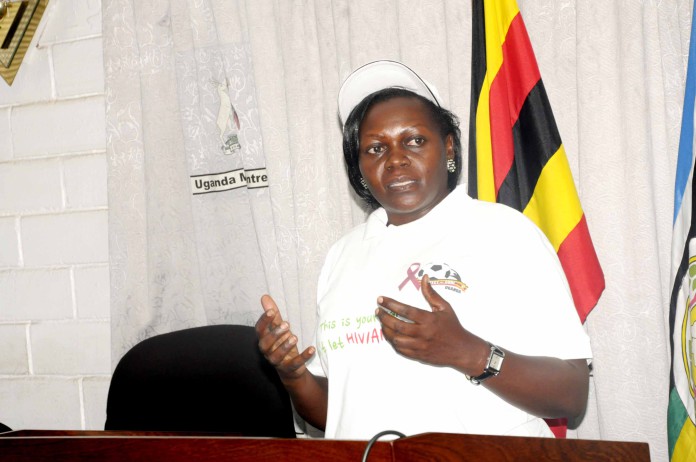
SPIRITED EFFORTS AGAINST PATIENT RIGHTS BILL: State-Minister-for-Health-Sarah-Opendi.

The State Minister for Health in charge of General Duties Sarah Achieng Opendi, has today launched the consolidated guidelines for the prevention and treatment of HIV/Aids in Uganda.

Speaking at the function at the headquarters of the ministry of Health in Kampala, minister Opendi said project will reduce substantial AIDS-related deaths and new infections by 2030.

She said the ministry is releasing a new circular to all health facilities to ensure a smooth roll out of the new guidelines. The new guidelines replace those released in 2013, where only those infected with HIV with advanced opportunistic diseases were eligible for antiretroviral treatment.

The only exception under the 2013 guidelines were children under age of 15, lactating mothers, TB/HIV and HIV/HBV co-infected individuals, HIV-infected individuals in sore-discordant relationships and HIV infected individuals that were among key populations.

“This will require all facility staff to acquire training in the new guidelines and also ensure that they are supported with requisition of adequate stock of antiretroviral drugs to meet the slightly added demand for ARVs,” the minister said, before blaming some medical practitioners for administering wrong medical prescriptions to AIDS patient on ARV treatment.

Speaking at the same function the UNAIDS regional director for eastern and southern Africa professor Sheila Tlou noted that new infections among young children and adolescent girls had decreased significantly.

She noted that in order to achieve the SDG target of ending AIDS as a public health threat by 2030, there was need to address gender inequality, gender based violence with includes sexual violence and sexual exploitation “which are all core to young woman’s vulnerability.”

She noted that the HIV/Aids most-at-risk groups include among others fishermen and women, long distance truck drivers, female sex workers and drug users.

“Short of an HIV vaccine or cure, test and treat is one of the critical tools we need to create an Aids-free generation,” Dr Tlou said, adding that expanding access to treatment is at the Heart of the UNAIDS ‘Fast-Track’ approach to achieve the 90-90-90 targets set for 2020 with the aim of ending the AIDS Epidemic by 2030.

“These targets include 90% of people living with HIV knowing their HIV status; 90% of those receiving ARV treatment, and 90% of people on ART having no detectable virus in their blood,” she said.

Meanwhile, Minister Opendi announced that this year’s World Aids Day commemoration on December 1 will take place on Kalangala Islands, with President Yoweri Museveni expected to be the chief guest.


Stories Continues after ad
Zuma survives latest internal ANC putsch

WANTS EXPANDED POWERS: Embattled South Africa president Jacob Zuma

South African President Jacob Zuma survived a rebellion in his own African National Congress, his spokesman said Tuesday, after discussions over his future in the party’s top decision-making panel dragged on for three days.

“He is the president, yes. Of both the ANC and the country,” said Mr. Zuma’s spokesman Bongani Ngqulunga. The three-day meeting of the ANC’s National Executive Committee presented the biggest challenge yet to Mr. Zuma’s seven-year presidency. Tweets by participants in the meeting, which ended late Monday, and local media reports suggested members of the 86-person NEC were taking turns speaking out in favor or against the president staying in office.

Several newspapers reported that at least three members of Mr. Zuma’s cabinet had supported holding a no-confidence motion against him. Spokesmen for the ministers either declined to comment or couldn’t be reached.

The ANC has said that it will hold a news conference later Tuesday, which is expected to chart out the way forward for the president and the party ahead of 2019 general elections.

The ANC is scheduled to hold its main congress in late 2017, which would be a natural moment for slotting in not only a new party leader but also a new president ahead of the national vote. One option would be to bring forward those deliberations.

Some analysts speculated that the failed insurgency against Mr. Zuma could herald a shake-up in South Africa’s cabinet, with those who spoke out against the president being replaced by loyalists.

“It is possible that the President will consider a cabinet reshuffle, or even that ministers will resign en masse,” South Africa’s Rand Merchant Bank said in a research note.

The focus here will be on Finance Minister Pravin Gordhan, who is seen as one of the of the voices most critical of the president—although he wasn’t reported to be one of the ministers to have actively pushed for Mr. Zuma’s ouster at the NEC meeting. Both Messrs. Gordhan and Zuma have said they are working together to improve South Africa’s economy.

Other commentators said they expected that Mr. Zuma’s weakened state would require him to keep opponents on board.

Ratings agency Standard & Poor’s is expected to release its review of South Africa’s credit worthiness Friday. The agency, which has South Africa just one notch above junk with a negative outlook, has previously warned about the risks to the economy from the political turmoil.

The 74-year-old Mr. Zuma, who was on his way Tuesday to attend the funeral of Fidel Castro in Cuba, has been met by an accelerating onslaught of corruption allegations, along with criticism of his handling of the economy and the ANC’s poor performance in August’s local elections.

In March, South Africa’s highest court found he had violated the Constitution by refusing to repay taxpayer money used to remodel his private home. Mr. Zuma has since repaid some of the funds.

A month later, another court ruled that a 2009 decision to drop corruption charges against Mr. Zuma was ‘irrational’ and should be reviewed. The president has denied any wrongdoing.

The biggest setback for Mr. Zuma came this month, when an official report from the country’s top corruption watchdog said there were ‘worrying’ indications that he allowed a family of rich businessmen to direct cabinet appointments and gain overly generous state contracts.

Mr. Zuma on Friday said he would go to court to challenge the report.


Stories Continues after ad
Renowned SA fashion designer Tlale to showcase at the ASFAs

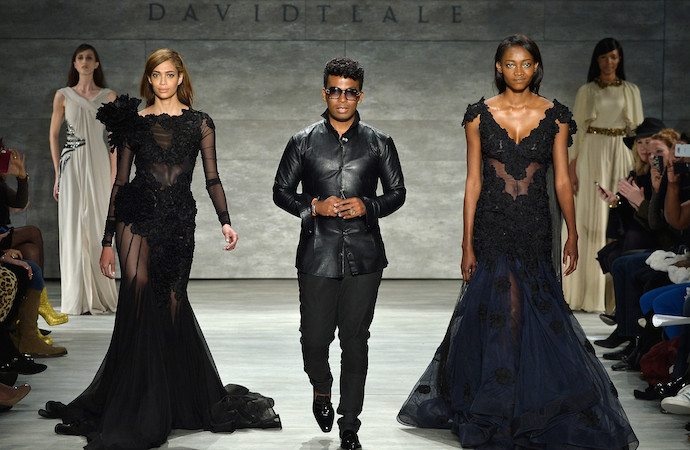
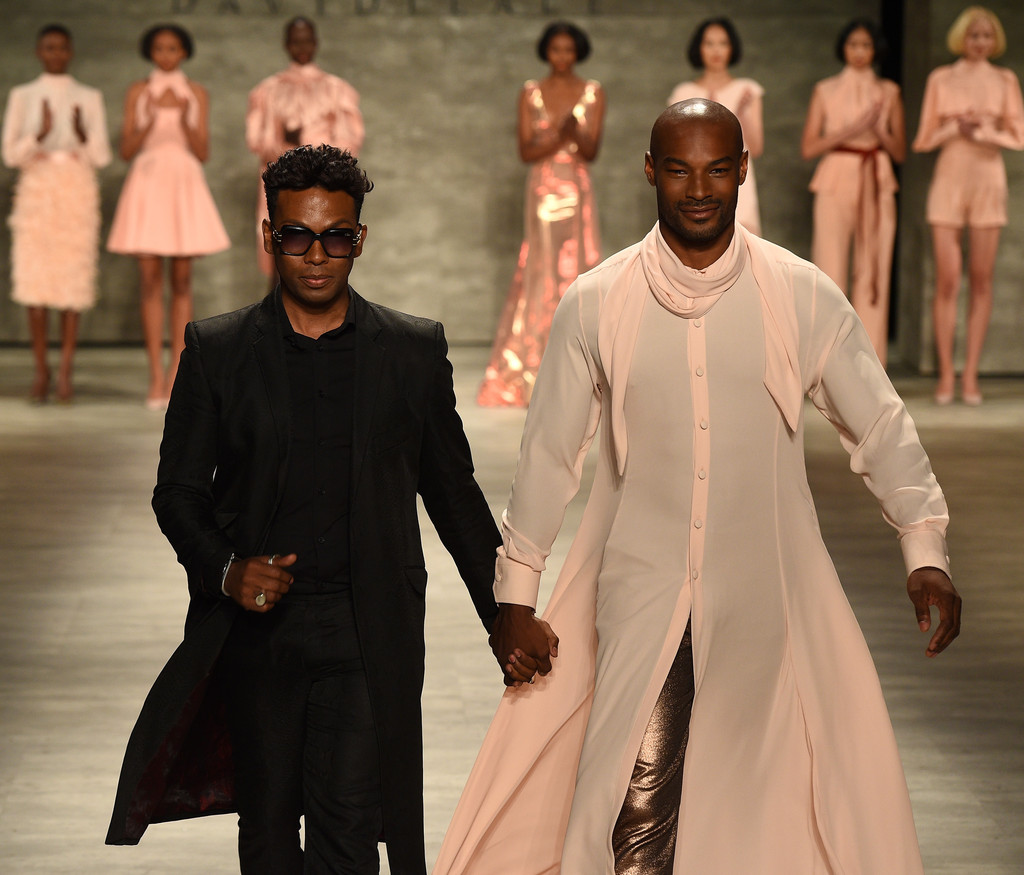
A model walks the runway at the David Tlale fashion show during Mercedes-Benz Fashion Week Fall 2014 at The Pavilion at Lincoln Center on February 9, 2014 in New York City.

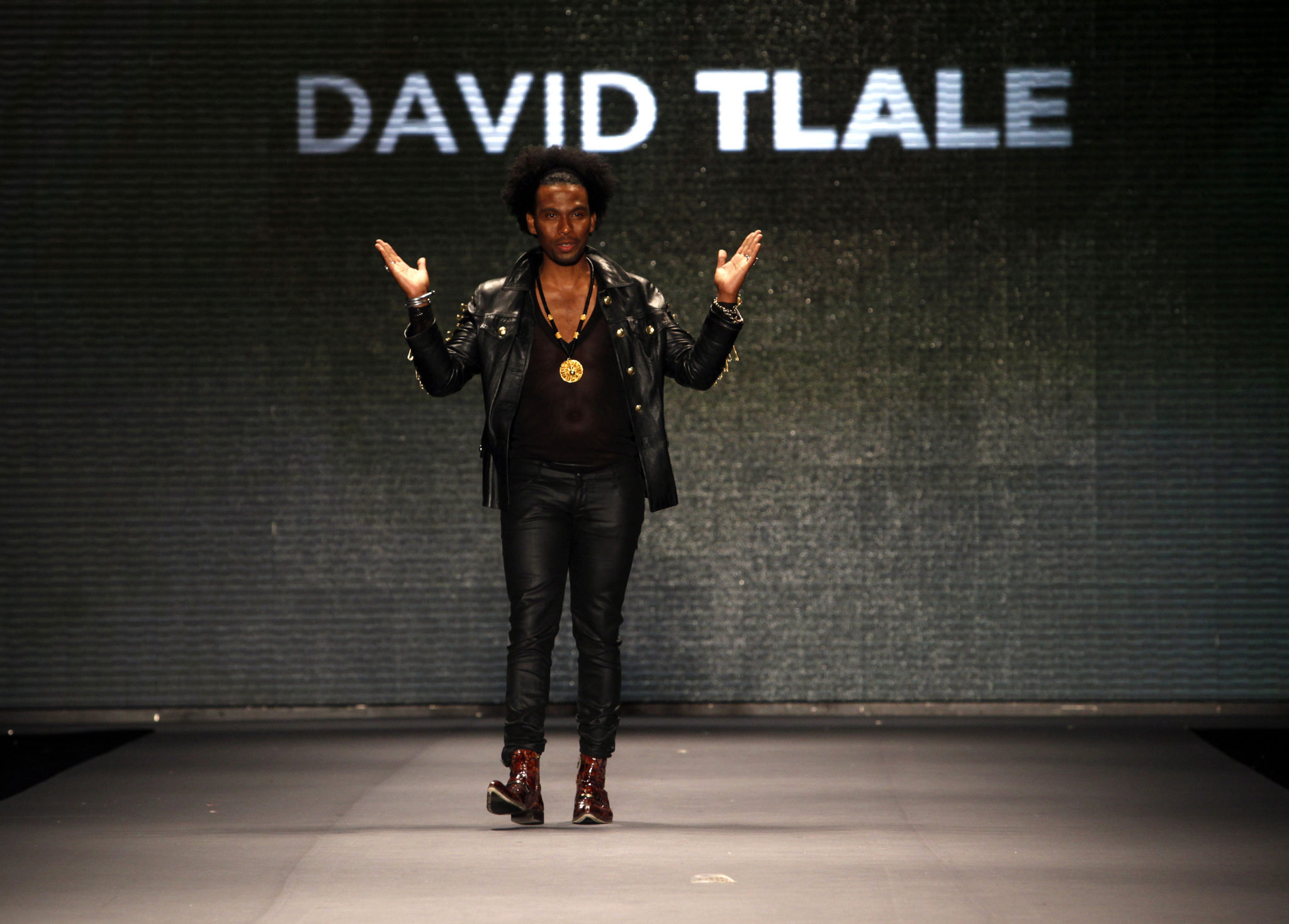
Renowned South African designer David Tlale will headline a fashion showcase at the annual Abryanz Style and Fashion Awards.

Tlale, a Ciroc brand ambassador for South Africa will be in good company as ASFA organiser Brian Ahumuza was recently named Ciroc brand ambassador for Uganda.

Designer David Tlale with male supermodel Tyson Beckford.

Tlale’s rise to the top begun in 2002, when he was a semi-finalist at the South African Fashion Week Elle New Talent Show Competition.

Designer David Tlale walks the runway during the Arise: African Promise Collective Spring 2010 show during New York Fashion Week, September 11, 2009. REUTERS/Eric Thayer (UNITED STATES FASHION) - RTR27QES
Designer David Tlale walks the runway during the Arise: African Promise Collective Spring 2010 show during New York Fashion Week, September 11, 2009. REUTERS/Eric Thayer (UNITED STATES FASHION) – RTR27QES

In 2003, he went on to launch his label. In 2007, Tlale was one of four young South African Fashion designers selected to present a showcase his Collection during/around Paris Couture week.

The Fashion magnet was also afforded an opportunity to design and produce South African Express Airline’s uniform.

In 2009, Tlale won ‘Designer of the Year” for his debut spring/summer 2010 Ready-to-Wear Collection at the Africa Fashion Week awards hosted by international super model Alek Week.

The African Fashion International award afforded Tlale the opportunity to debut his label at Mercedes-Benz Fashion Week New York Spring / Summer 2010, along with three other African designers.

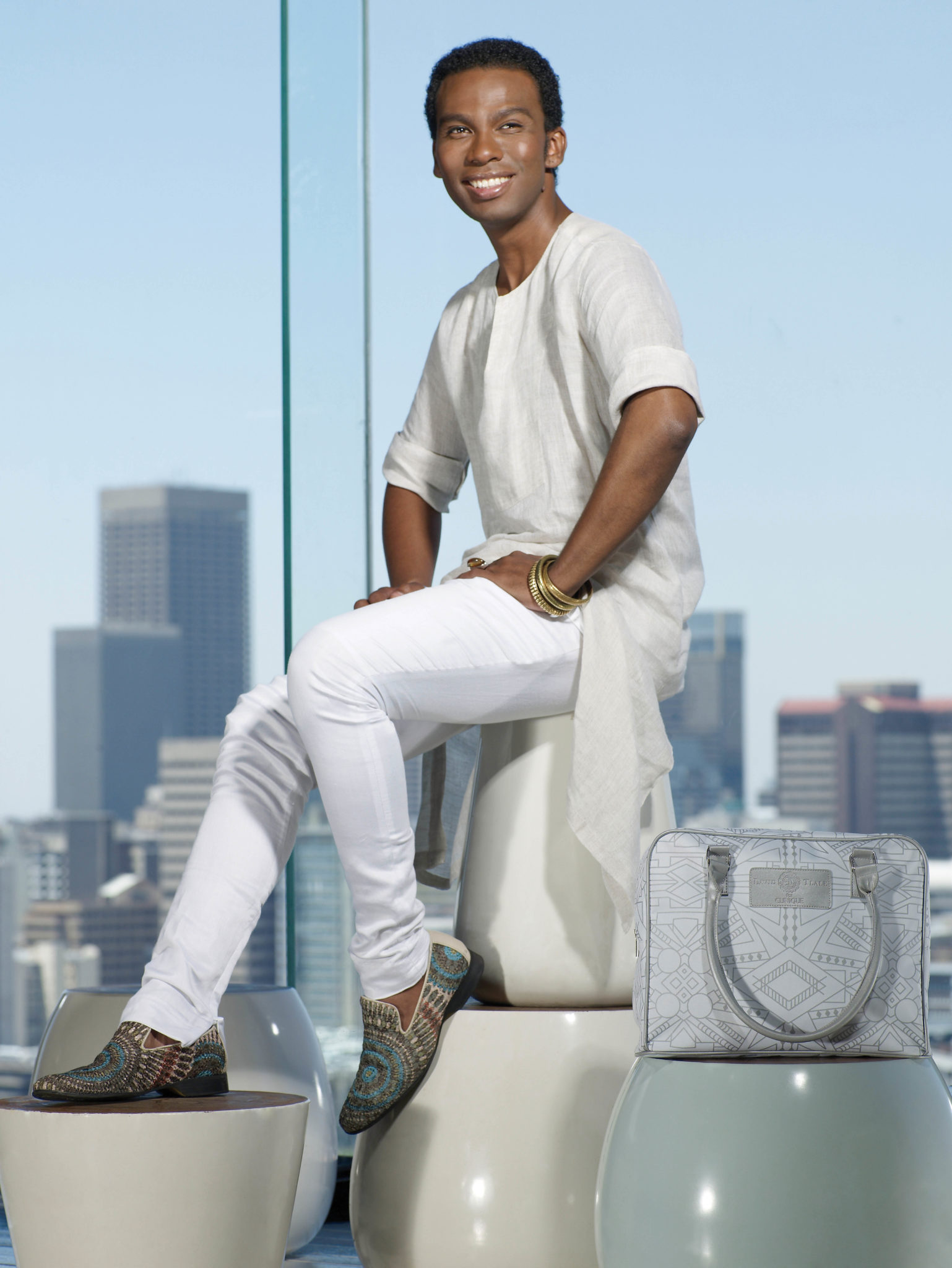
South African fashion icon David Tlale

He also showcased during the FIFA World Cup tournament at Africa Fashion Week 2010, earning him the title ‘King of Fashion in SA’ by the South African press.

In 2011, he closed the iconic ‘Nelson Mandela Bridge’ in Johannesburg presenting a showcase the featured 92 models including popular South African celebrities, sports personalities and musicians walking this remarkable runway to celebrate Mandela’s 92nd birthday.

David Tlale will be the headline Fashion Designer, at the Ciroc sponsored ASFAs on December 9, at the Kampala Serena Hotel.


Stories Continues after ad
South Sudan endorses deployment of regional protection force

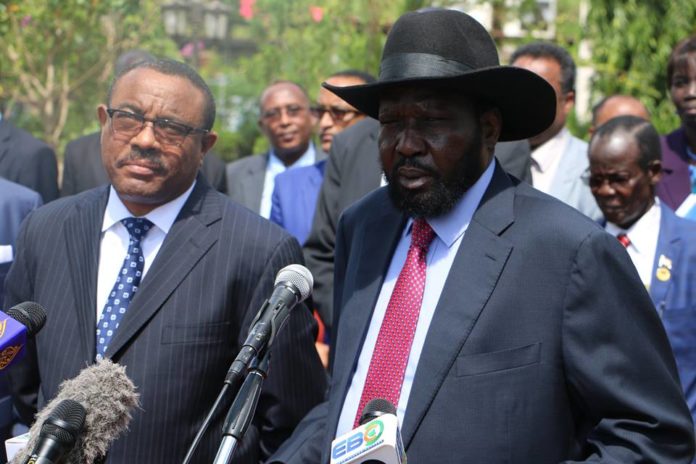
AGREED OF FORCE DEPLOYMENT: South Sudan President Salva Kiir Mayardit and Hailemariam Desalegn, the Prime Minister of Ethiopia.

South Sudan President Salva Kiir Monday said he accepted the deployment of the regional protection force because he has received numerous assurances of support and cooperation from the United Nations and regional leaders.

The president also disclosed he received assurances from regional leaders that the force would never take unilateral decisions.

“Many leaders from the region have been calling and asked me to accept on behalf of the people of South Sudan the deployment of the regional protection force. I told them this is not a personal thing for me to just decide. I said I will consult with the people. And so we did this with the stakeholders,” Kiir said.

He added that his first deputy Taban Deng Gai who leads a splinter faction of the SPLM-IO and his team consulted among themselves and they agreed that this should be taken to the cabinet where a formal decision was taken to accept the 4000 strong force on Friday.

The head of state was speaking to some members of the Dinka Council of Elders who visited him at his residence to congratulate him on the acceptance of the deployment of the regional protection force and for a successful foreign trip to Equatorial Guinea for Arab- Africa summit.

President Kiir, according to one of his top aides, also requested them to campaign for peace and reconciliation in the country, saying war does not resolve differences. He further declared his personal commitment to end the conflict.

“We have accepted the deployment of the regional protection force because of peace. We need our people to return to their homes and resume their normal lives. If this force will play a positive role, then let them come,” said president Kiir according to one of his top aides.

The South Sudanese government initially rejected the deployment of troops from countries sharing immediate borders with the young nation saying “they have interests in the country.”

But after a visit of the Ethiopian Prime Hailemariam Desalegn, at the end of October 2016, Juba said it accepts the participation of the Ethiopian troops in the regional force and said they signed a security agreement to stop hosting armed opposition groups in their respective countries.


Stories Continues after ad

Somalia presidential elections to be postponed again

UN Special Representative to Somalia Michael Keating


Presidential elections in Somalia are expected to be postponed to December following the failure to meet deadlines for the Lower House elections in regional states.

According to Michael Keating, the UN Special Representative to Somalia,  the presidential elections earlier scheduled for tomorrow, November 30, could be postponed to next month, as the parliamentary elections are still in progress in various regions in Somalia.
He added the elected lawmakers could then vote for the new Somali President mid next month.
About 50-percent of the parliamentary elections are complete, whereas country’s electoral and dispute bodies said they will carry out investigations into allegations of corruption, irregularities and intimidation that could result in the nullification of results of seats won in rigged elections.
This is the fourth time the election is being delayed, as the Somali leader’s term ended on September 10.

In the past the International community has urged Somali leaders to implement the electoral process.


Stories Continues after ad
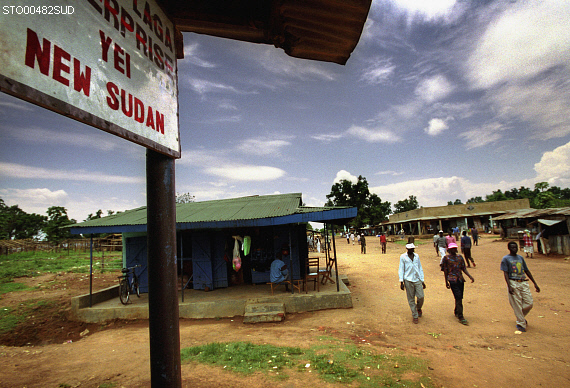
South Sudan authorities block monitoring team from accessing Yei

DANGEROUS? Yei Town in South Sudan

South Sudanese authorities Monday barred the ceasefire monitoring team from reaching Yei to assess the security situation in the troubled Central Equatoria region .

In a statement, the Ceasefire and Transitional Security Arrangements Monitoring Mechanism (CTSAMM) said one of its teams was ‘denied freedom of movement while trying to reach Yei to conduct an assessment of the area and carry out its mandated activities’.

The ceasefire monitoring mechanism said they got the green light from all the concerned authorities including the Joint Military Ceasefire Commission since early this month.

“However when the MVT began their journey from Juba this morning they were stopped at a check point on the outskirts of the city and told they would not be allowed pass beyond that point,” said the statement.

The ceasefire mechanism called on the Transitional Government of National Unity to intervene to ensure that its teams can visit Yei.

” The CTSAMM would like to reiterate that it has a legal right to be present in South Sudan as stipulated in Chapter II of the ARCSS, and condemns, in the strongest terms, the denial of freedom of movement for the CTSAMM MVTs,” said the statement.

In line with the peace agreement, the CTSAMM is tasked with the monitoring of the implementation of the Permanent Ceasefire and Transitional Security Arrangements (PCTSA).

Since last summer, different reports emerged from areas in Yei speaking about attacks by armed opposition elements in the area who are described as ‘terrorists’ or ‘anti-peace elements’ by the local authorities. Other reports also cited violent counterinsurgency operations by the government army in the area.

On November 12, Adama Dieng, UN special adviser on prevention of genocide, called to probe the human rights violations in Yei, stressing the gravity of the situation there ‘merits immediate intervention – a full scale fact-finding investigation and enhanced humanitarian support’.

Also, Dieng mentioned reports about the expulsion of farmers from their agricultural plots into Yei town.

“These farmers have lost their homes and belongings, livestock and land. Property has been looted and villages have been burned,” he said.


Stories Continues after ad

Amama Mbabazi’s In-law to Museveni: Seek Asylum In South Africa

DEFIANT: President Museveni's critic Alice Ruhindi, who is also an in-law to former Prime Minister and presidential candidate John Patrick Amama Mbabazi.

President Yoweri Museveni has left the country for South Africa for a two-day working visit, where is set to meet his counterpart Jacob Zuma.

“I have left for South Africa on a two-day working visit. I will hold bilateral talks with His Excellency Jacob Zuma @SAPresident,” the President tweeted Monday.

The President’s visit comes in the wake of chaos that has engulfed Kasese town over the last few days, leaving over 60 people dead and the King of the Rwenzururu Kingdom Charles Wesley Mumbere arrested.

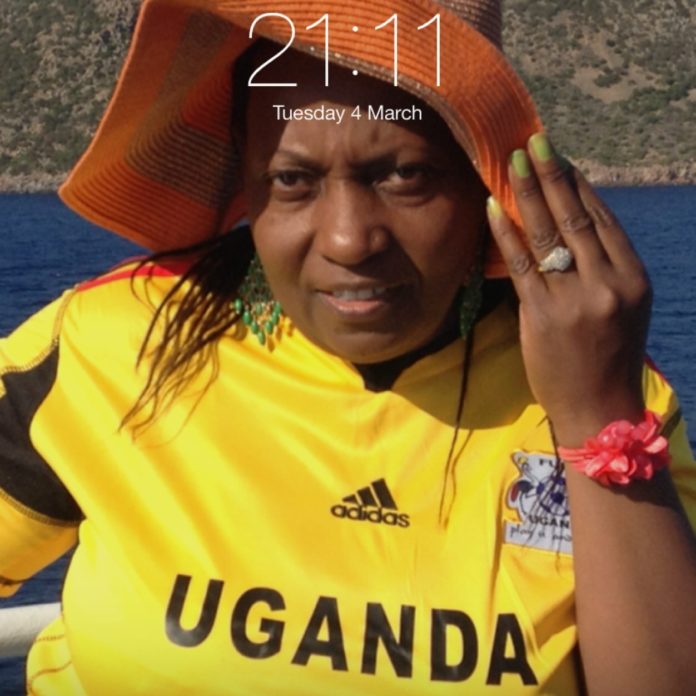
The President’s tweet elicited some negative comments, and one of the people to respond to it is Alice Ruhindi, an in-law to the former Prime Minister and presidential candidate, John Patrick Amama Mbabazi.

In her ‘response’, Ms Ruhindi a younger sister to Mbabazi’s wife, and National Resistance Movement (NRM) government critic, advised the President not to return to Uganda but instead seek asylum in South Africa.
‘Please don’t come back. Seek asylum in SA,’ Ms Ruhindi, a known critic of the President ever since he fell out with her in-law, wrote.
Meanwhile, Ms Ruhindi is not the only person to have had such a response. There are others with similar responses on their social media platforms.

Rasta Magt Afidhu …People of Kasese need your presence in the country and you are busy moving around!! There is nothing productive in those “BILATERAL TALKS” even if you secure some deal, your greedy corrupt MPs will swindle every deal in their favour. So come back and settle your people first.


Stories Continues after ad

Kasese Violence: KTN journalist Joy Doreen Biira charged with terrorism

'DROP TERRORISM CHARGES CPJ IMPLORES UGANDA GOVERNMENT': Renowned TV Anchor Joy Doreen Biira who was arrested by police yesterday.

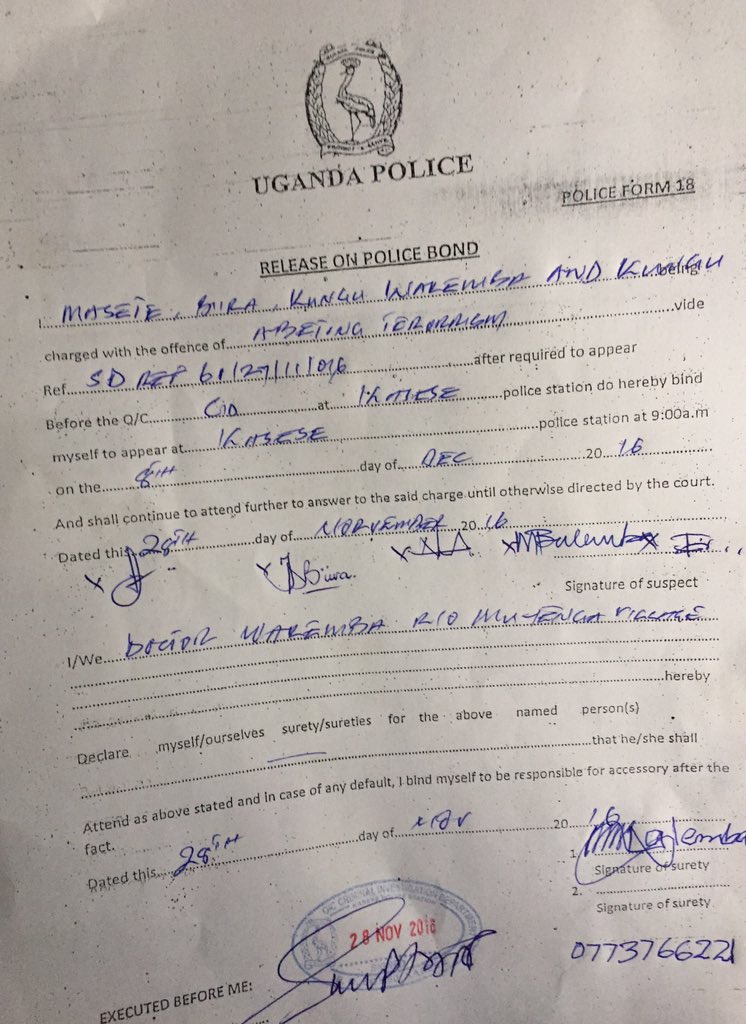
Journalist Joy Doreen Biira has been charged with abetting terrorism.

However, after being charged and she has been released with four others on police bond.

Earlier, KTN Television, current employers, of Joy Doreen Biira and one of the biggest stations in Kenya has vowed to fight what it has called violations of journalists’ rights.

“We must stand up against dictatorship and journalists’ violation #FreeJoyDoreen,” the station tweeted today.

“It’s so sad what I’ve witnessed today with my own eyes — part of the palace of the kingdom I’m from, the Rwenzururu Kingdom, burning down. It felt like watching your heritage deplete before my eyes…..” KTN journalist, Doreen Biira wrote on Facebook yesterday, reacting to the invasion of the Rwenzururu palace that left over 60 dead. Ms Biira posted and it is what has earned her to coolers curtsey of both Uganda police and the army.

Charge sheet
Charge sheet

In addition to the post, she shared with her followers photographs of some of what she had seen and this brought her on collision with security.

Stories Continues after ad