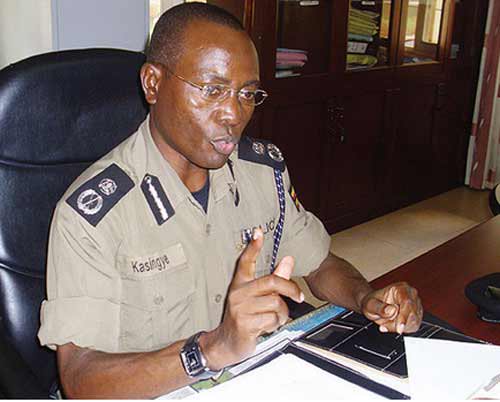
NO SUMMONS FOR ANITE: Police Spokesperson AIGP Asan Kasingye.
Police has recovered a stolen car that was destined for the Democratic Republic of Congo (DRC).
Writing on his Twitter account, the Police Director of Interpol and International Relations Assistant Inspector General of Police Asan Kasingye asked the owner of the car, a blue Toyota RAV4 Reg No UAL 643G, to contact the Interpol offices on Mabua Road in Kololo, for further details.
He however, did not give details Reports indicate a number of cars are being stolen from innocent Ugandans, most of them special hire drivers.
In June 2015, Interpol Uganda working with its counterparts from 24 other eastern and southern African countries, launched an operation against transnational crimes dubbed ‘Usalama One’, to crack down on among other crimes, motor vehicle theft. In Uganda, seven vehicles were held in the swoop.
In May this year the Commandant of the Police Flying Squad Herbert Muhangi, announced they had impounded stolen 15 vehicles.
In a related development, in March this year the Uganda Revenue Authority (URA) handed over 24 posh sports Utility Vehicles (SUVs) and sedans stolen from the United Kingdom and smuggled into Uganda to the British High Commissioner Ms Alison Blackburn.
Interpol officials inspect one of the cars stolen from London at the URA offices in Kampala
The SUVs including Range Rovers, Audis, Toyotas and BMWs were estimated at about 1 million Pound Sterling.
He’s probably used to hanging around football stadiums than attending entertainment events.
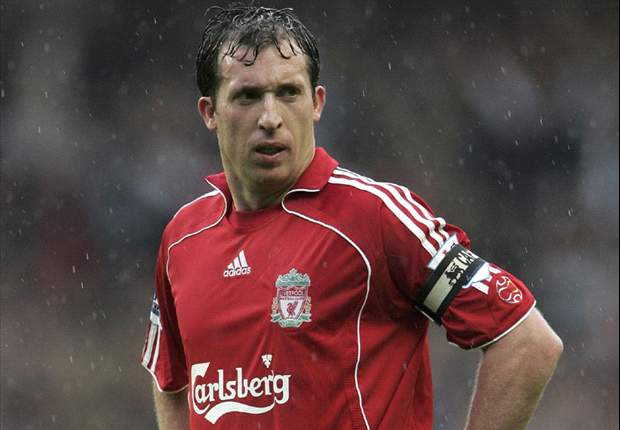
But former England international Robbie Fowler is among a slew of star guests set to grace next week’s Uganda Entertainment Awards (UEA).
The 41-year-old Liverpool FC legend is expected to jet into the country early next week on invitation from Pemba Sports Africa (PSA), the organisation that’s bankrolling this year’s UEA.
Organizers say Fowler has already confirmed his attendance at the Aug 19 do due to hold at Serena Hotel in Kampala.
It’s the first time the former Leeds United and Manchester City man is visiting Uganda, and we can reveal he will be working on a number of charity projects with PSA and the Sickle Cell Association of Uganda (SCAU).
Fowler is most remembered for his goal scoring prowess in an illustrious career that lasted over two decades in the English premiership. He was also considered one of the richest sportsmen in the world during his heydays.
The Sky Sports commentator will most likely be drawn to the Best Male and Best Female Sports Personality categories at the awards where Denis Onyango and Peace Proscovia are tipped as frontrunners.
A total of 47 awards will be given out at this year’s ceremony with Eddy Kenzo and Sheebah Karungi leading the nomination pack with six and five nods, respectively.
The pair will go neck and neck in Artiste of the Year and Video of the Year categories.
Nigerian songstress Yemi Alade of the Johnny fame, Tanzania’s Ali Kiba and South African TV host Bonang Matheba are some of the other international celebrities expected to grace the red carpet fete.
Matheba will host the red carpet show for E! in the second only African show to be televised by the American TV giant after the South African Saftas in March.
Tickets to the event are selling at Shs 50,000 and Shs 100,000 for ordinary and VIP seats, respectively. Corporate tables go for Shs 3m each. You can now buy your ticket online at jumia.com or easyticket.co.ug as well as Serena Hotel.
The defiance exhibited by supporters of Inspector General of Police, General Kale Kayihura this morning at a Kampala Court is an indicator that the IGP has finally joined the ranks of Dr. Kizza Besigye in pursuit of individual rights.
Gen. Kayihura was supposed to appear before the Makindye Magistrate’s Court to answer criminal summons in relation to the brutal beating of opposition supporters and innocent citizens who had lined up Gayaza-Kasangati road to welcome back Besigye from two months detention at Luzira over treason allegations.
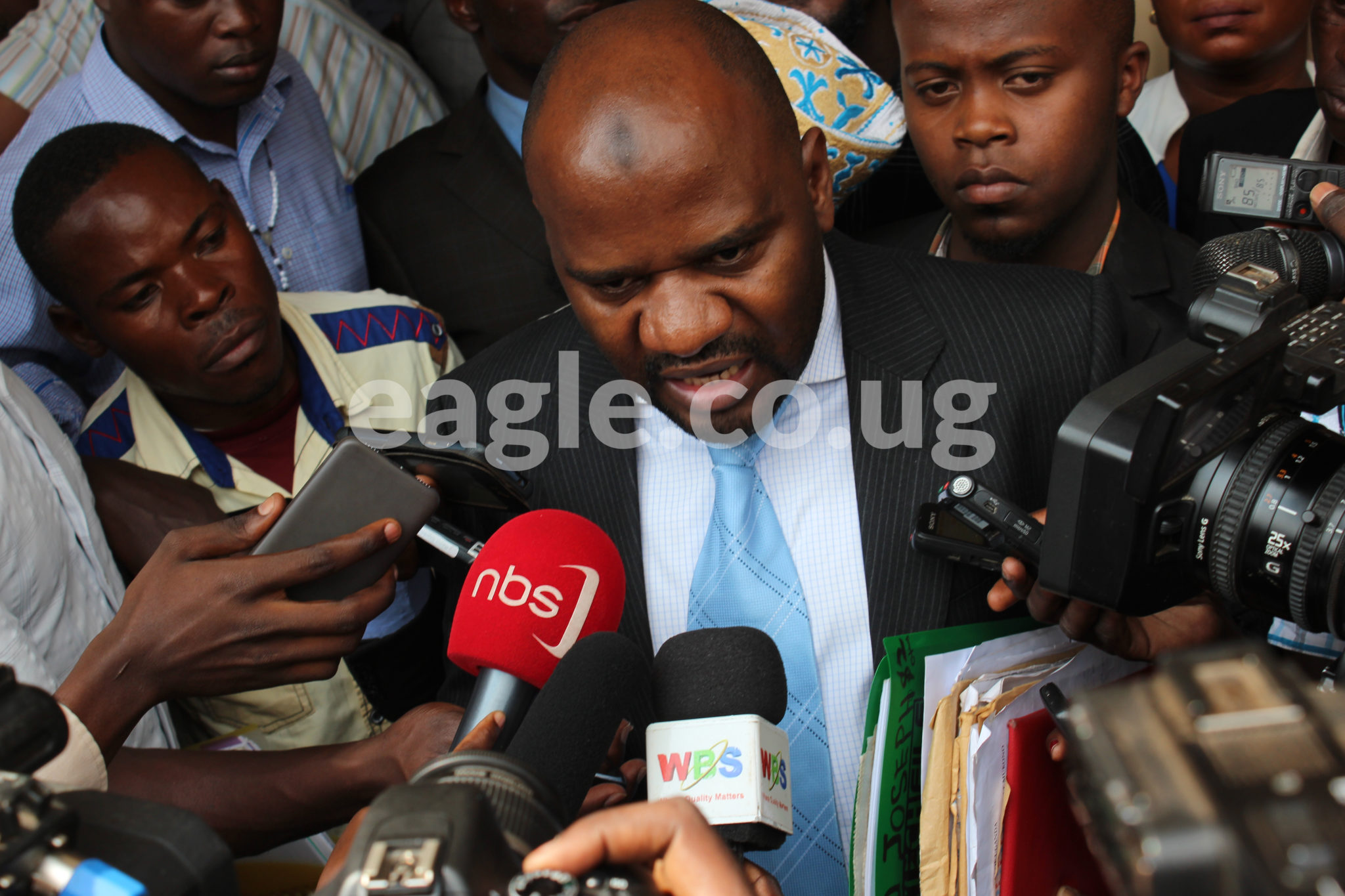
SUED GEN. KAYIHURA: City lawyer Abdullah Kiwanuka of Lukwago and Company Advocates. Photo credit/Pius Enywaru/eagleonline.co.ug
However, Gen. Kayihura didn’t show-up but a statement was made by his supporters when they took-over court, making business at the ever calm court premises nightmarish.
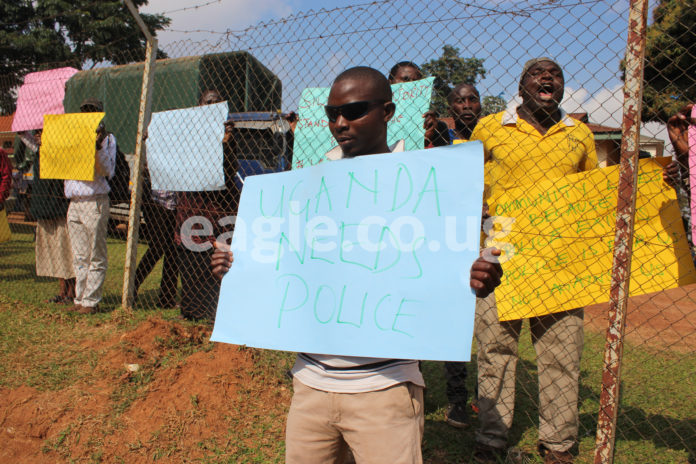
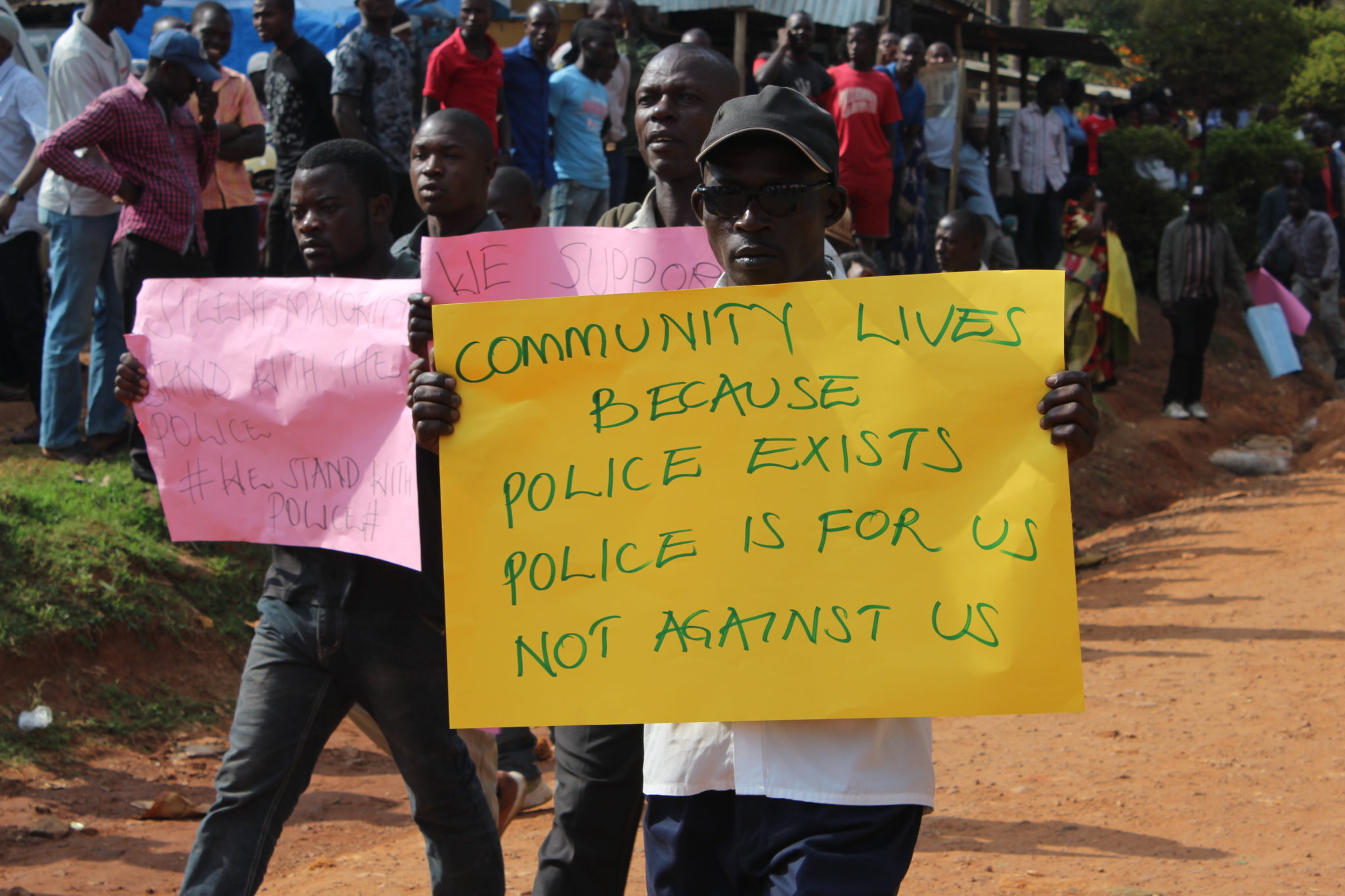
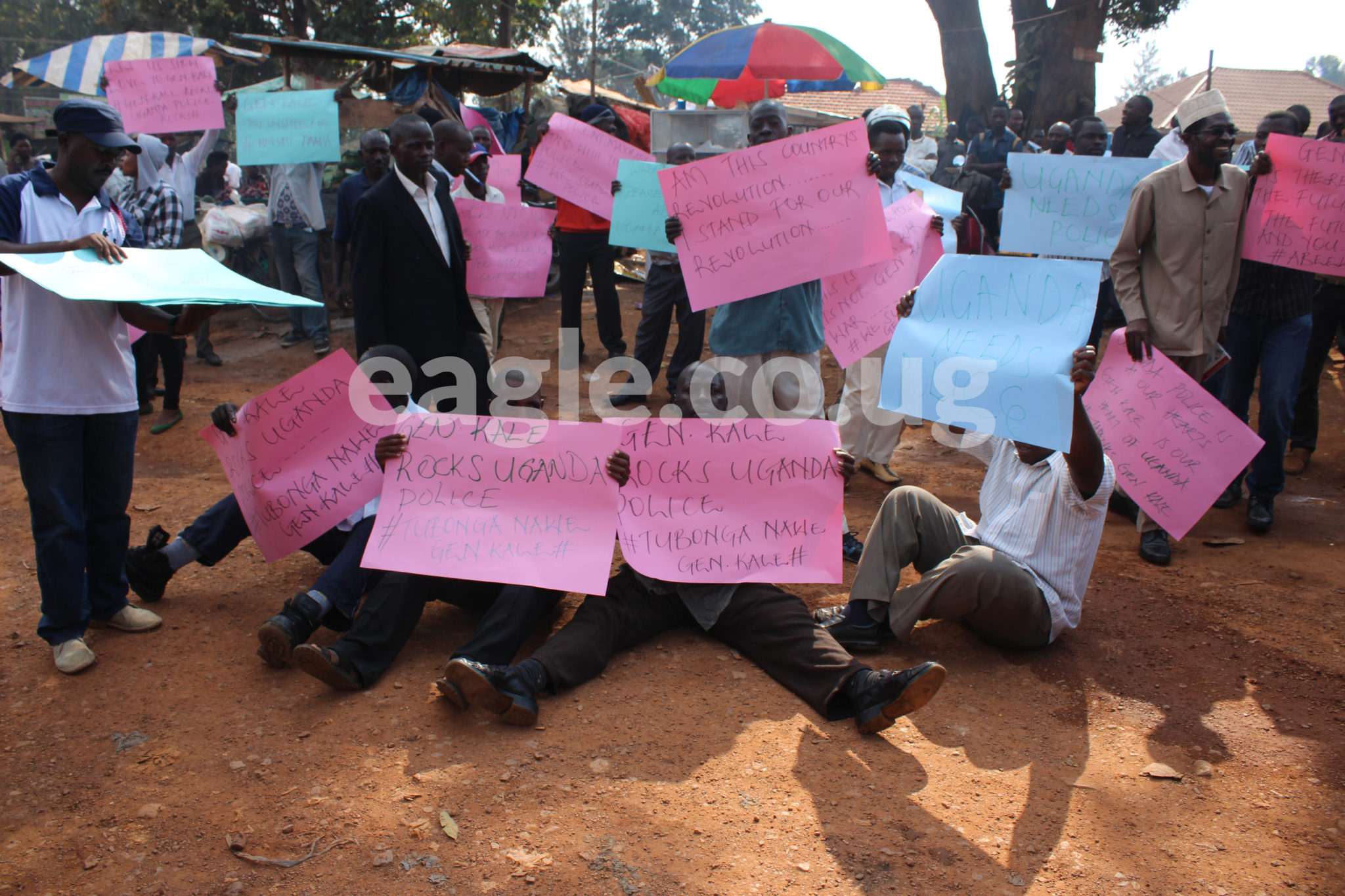
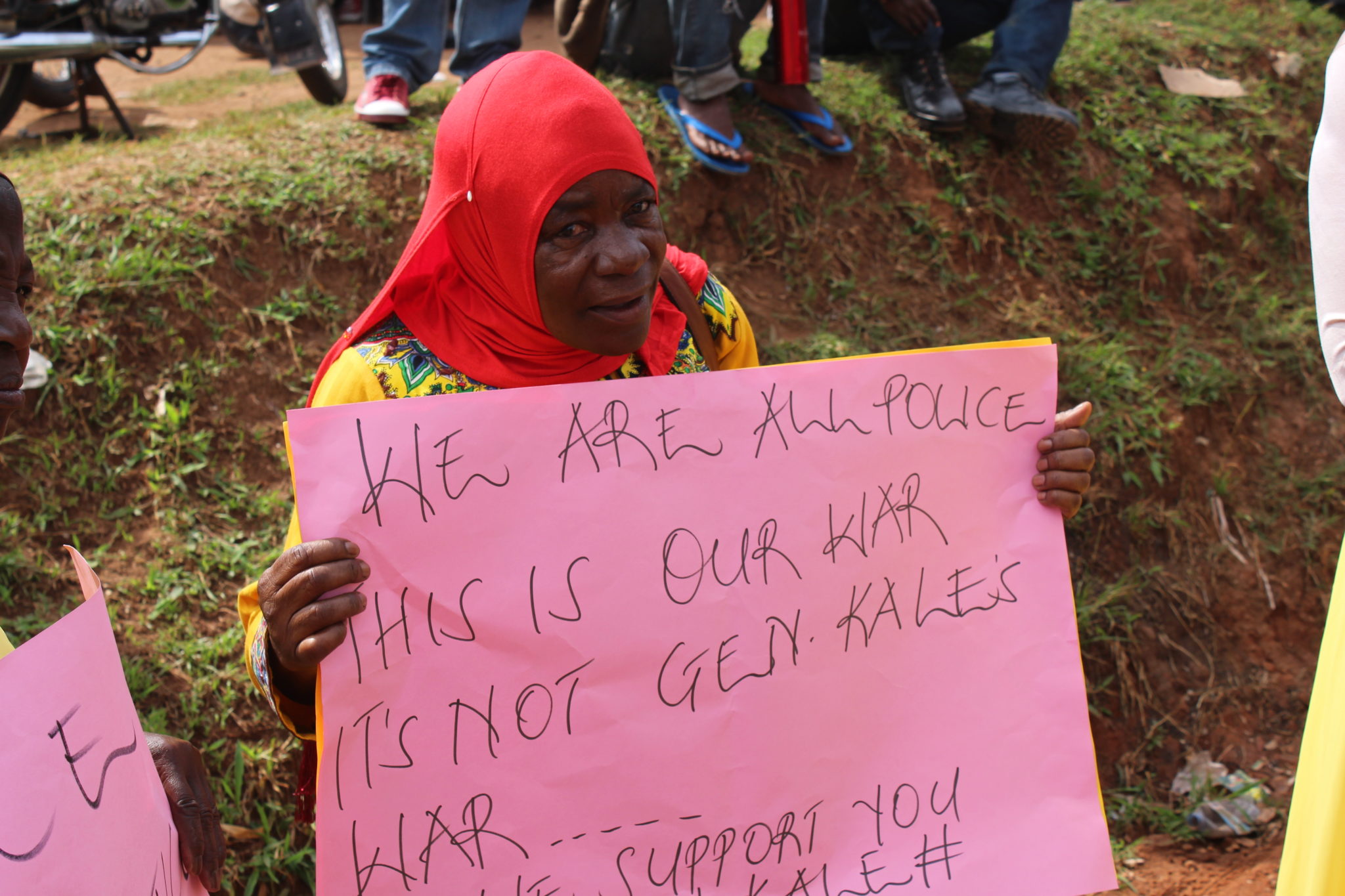
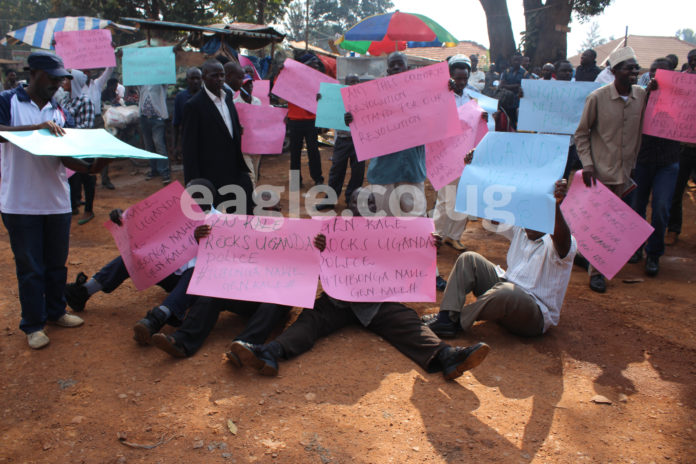
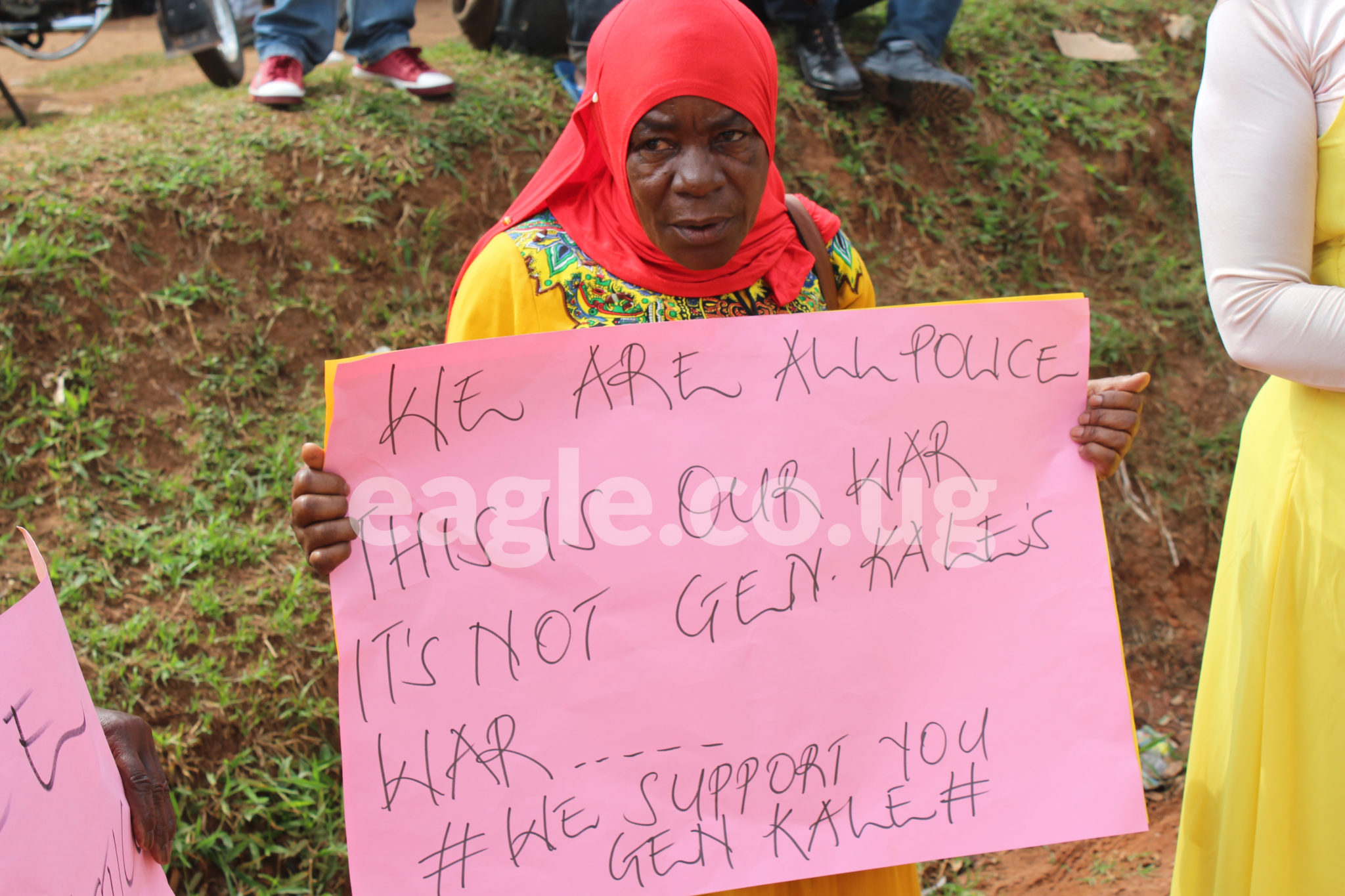
It all started when the men and women invaded court with placards denouncing the prosecution of the police boss, stating that those against the IGP are not after him as an individual but rather want him off the helm of the Uganda Police.
In the usual Ugandan style, had the demonstrations at court been carried out by non-supporters of the IGP (or the regime), it would have been considered ‘defiance and organized outside their mandate’ as the demonstrators didn’t seek police permission to organise, such ‘illegal assemblies’ that are prohibited under the Public Order Management Act (POMA).
IN SUPPORT OF IGP: Supporters of IGP Kale Kayihura hold placards with messages praising police. Photo credit Pius Enywaru/eagleonline.co.ug
Contrary to the known norms, most Ugandans have come to terms with today’s siege by the ‘friends of Mr Kayihura’ at Makindye but at a cost: however much Gen. Kayihura and his juniors keep on condemning the Forum for Democratic Change (FDC) kingpin Besigye, all isn’t lost as the General also believes that for someone to be accepted or to have justice, one has to defy the status quo.
With happened in Makindye Court today, it is evident that Kayihura has finally accepted to join Kizza Besigye in the ‘defiance’ campaign if he is to get justice and therefore, those that see defiance as a useless method to advocate for rightfulness have to rethink, since the man who was until yesterday criminalizing defiance, is a Saul turned Paul. It is the written word of the Lord, check Acts 9.
IN SUPPORT OF IGP: Supporters of IGP Kale Kayihura hold placards with messages praising police. Photo credit Pius Enywaru/eagleonline.co.ug
Witnessing the fracas at court today reminds one of the stories of ‘bad regimes’ of Idi Amin and Milton Obote and how bad they were. Nevertheless, one would imagine that Gen. Kayihura, a lawyer, should have used the chance availed to him by court in regard to the allegations brought against him and his juniors, to prove a point that he appears and indeed that indeed the National Resistance Movement (NRM) party fought for the restoration of rule of law and ‘that is why I have appeared before court and subjected myself to the due process of the law’. And had the IGP done so, it would dispel the theories that ‘some people are more equal than others’ and also the trending allegations that indeed the police is a brutal force.
Back to Makindye, the rowdy Boda Boda cyclists reportedly mobilized by a one Abdul Kitata, whose ascendance into the ‘rank and file of police’ is only known to himself, was at it again when he over powered police led Kampala Metropolitan Commander who looked on helpless as the ‘friends of Kayihura’ made it unruly for court business, and for business in the neighboring areas!
Placard holding supporters of police IGP General Kayihura
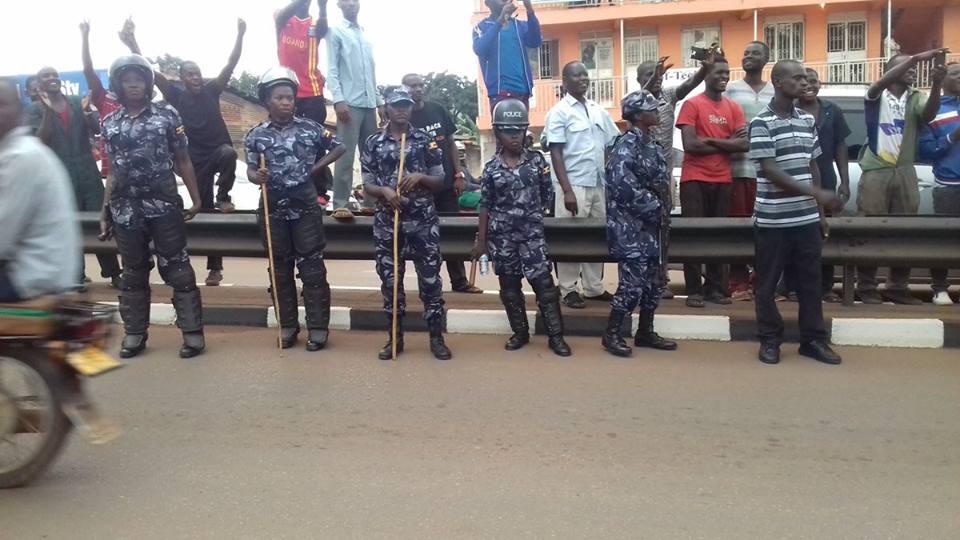
The boda boda fellows, who outnumbered the police and who had a clear access to the court, made it rough for traffic flow and other people who were at court but perceived to be anti-Kayihura.
For example they stormed one office and assured lawyers for the plaintiff that they are marked people and would face revenge for having accepted to prosecute ‘their man’, Gen. Kayihura.
“You will leave to regret and we know where you stay and your movements, we will work on you,” one man holding a placard reading ‘Kayihura is hero’ said to Kampala Lord Mayor Erias Lukwago and city lawyer Nicholas Opiyo.
However, instead of police intervening to separate the two sides, they instead ordered the lawyers to vacate the courtyard and in the process, the lawyers hit back saying “Takeaway your goons who want to beat us.” Not a rosy affair, if you ask!
Intriguingly, the boda boda guys evoked the name of Jennifer Musisi, asking why no Ugandan had sought the prosecution of the KCCA Executive Director, who they claimed, should also have been prosecuted, ostensibly for the death of two-year old Ryan Semaganda in November 2014 and the wanton beatings of street vendors in the city by KCCA law enforcement officers.
In so doing the boda boda fellows sought to relate Musisi’s ‘failure to supervise her subordinates’ including that of the driver of the KCCA vehicle and the KCCA enforcement officers, to the charges related to police brutality Gen Kayihura is currently facing.
Anyhow, as the situation continued to degenerate, KMP Commander Frank Mwesigwa intervened to calm the situation, promising the rioting ‘friends of Kayihura’ that the plaintiffs’ lawyers would vacate the court premises and that allegations against KCCA Executive Director Jennifer Musisi ‘would be investigated’.
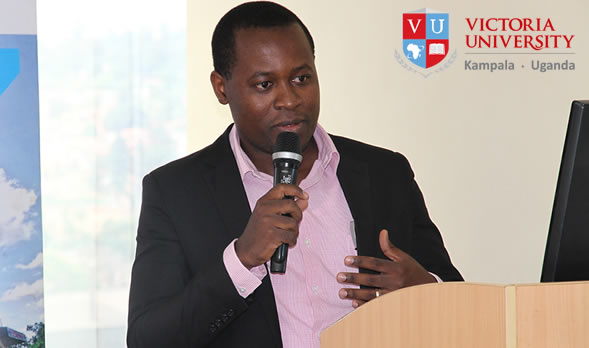
THE JOURNALIST INTERVIEWED THE DEAN OF SCIENCE AND TECH. MAXIMUS BYAMUKAMA
ICT ROLE IN THE JOB MARKET: UNIQUENESS OF VICTORIA UNIVERSITY OFFERING
What are the ICT-related courses offered at Victoria University?
The faculty of science and technology at Victoria University houses 3 courses. The Bachelor’s degree in Computer Science, The bachelor’s degree in Information Technology and the degree in Business Information Systems. We also have Ordinary Diplomas in IT and Business Information Systems.
Why should students study these courses from Victoria University and not anywhere else?
Our ICT courses at Victoria University are developed by well refined experts in the field, with a battery of experience both in academia and industry. These courses are IEEE compliant. For example, our Computer Science curriculum is based on the 2013 Curriculum Guidelines for Undergraduate Degree Programs in Computer Science by The Joint Task Force on Computing Curricula, which is part of the Association for Computing Machinery (ACM) in the IEEE Computer Society. As such, our students are well placed when searching for employment opportunities in IT-driven organizations and are guaranteed of being considered for graduate studies in the world’s leading universities.
Our courses have also core modules in other crucial areas such as business management, ethics and critical thinking. We groom the whole individual and deliver to the nation a well formed professional and not just a computer expert.
We also have very well qualified staff in the faculty, with international academic exposure and relevant work experience.
How is IT integrated into your education techniques at VU?
Not only do we have a well-stocked computer laboratory with hassle-free internet but also teach using interactive smart boards. All our students have laptops given by the university so it is easy for some lecturers to conduct wireless lectures if need be.
And to make all this easy for all students, we have a compulsory introduction to ICT course in the first semester of first year. All students, regardless of the course they enrolled for, have to study this course. We also encourage lecturers to handle assignments electronically and minimize paperwork.
Are there any IT innovations that VU has developed?
Because we practice what we teach, you will find that some of the software we use at VU to manage organizational processes has been entirely developed in house! For example, our student’s results management system has been entirely developed by us. We want to make it a culture that students’ projects in class relate directly to the needs of the organization and its affiliates, as well as other businesses. That way the university and the student both benefit.
What are the requirements for a student to join your faculty?
If you would like to study computer science, we look for good grades in mathematics or any of the physical sciences at advanced level. For information technology and business information systems, we are open to students who have studied arts at advanced level but we still need good scores in mathematics at O Level. We could also admit you if you have an ordinary level certificate with good grades in a diploma in an ICT related field.
The beauty with applying to VU is that if you meet the minimum requirements, we handle you individually and can even ask you to come in for an interview to assess where we can best place you.
How do you prepare your students for the job market out there?
That is a very good question. We are actually the only university that looks for internship positions for its students while they are still with us. Our faculty, through the university, has MoUs with many institutions where to send our students for internship. Not only do they get real life experience but also make develop networks with people already working in ICT related jobs.
How practical are your courses?
Very practical! In fact, some of our modules are almost 100% practical. This doesn’t mean that theory is not important. It is, since it is the basis for the practical components of our courses. It is irrelevant if it’s not backed up by a hands-on approach. For example, in our computer programming lectures, students always use the lab and study by writing real computer programs. This is also made easy by the fact that our student to computer ratio is, at any one time, one to one (1:1). In our computer networking classes, the VU computer network is used as a case study and students get to see all the components and how they interact.
What new things do you have planned for your faculty?
We have started plans to start some good short courses in the near future including general literacy courses which should prepare people for accredited certifications like ICDL (International Computer Drivers License) and also specific certifications like the Certified Forensic Computer Examiner Program (CFCE). We want our faculty to be a one-stop point not only for students seeking quality education in computing but also for organizations looking to snatch well cultivated and professional IT scholars.
TOP 10 REASONS to Join Victoria University
Location, Convenience and Accessibility
Market driven programmes
Self-Employment programmes
Research excellence
State of the Art Facilities
State of the art clinical skills lab and simulation centre
IN FIGHT WITH EU OVER AMISOM WAGES: Burundi President Pierre Nkurunziza.
Police in Burundi has said it closed 15 foreign-exchange offices and arrested 12 money-changers as the East African country, struck by more than a year of unrest, struggles with a dollar shortage.
The actions were taken against speculators who committed ‘economic crime’ by not complying with the official exchange rate, police spokesman Pierre Nkurikiye wrote on his Twitter account.
An inadequate supply of dollars from Burundi’s central bank has forced companies into the black market, where the cost of greenbacks has surged. The central bank this year ordered banks, non-government organizations and embassies to open accounts with it to regulate foreign-exchange supplies.
The landlocked, coffee-exporting nation has a gross domestic product of about $3.1 billion. It has been rocked by violence that’s killed more than 470 people since April 2015, when President Pierre Nkurunziza decided to stand for re-election; a move his opponents said was unconstitutional.
Meanwhile, traders and growers of fruit and vegetable crops in Cibitoke province, 70km northwest of the Burundian capital Bujumbura, are complaining about the ban on export of food items to Rwanda.
In Cibitoke, the measure taken by the Burundian government last week, affects sellers and growers of several fruit and vegetable crops, including tomatoes, onions and eggplants “I grow and sell tomatoes, onions and other vegetables in Rwanda. My tomatoes are getting rotten in fields because we are not allowed to sell any food items in Rwanda,” said Generose Nisabwe. “The government (of Burundi) should suspend this measure because most of people living near the border with Rwanda sell their food products in Rwanda,” added Nisabwe.
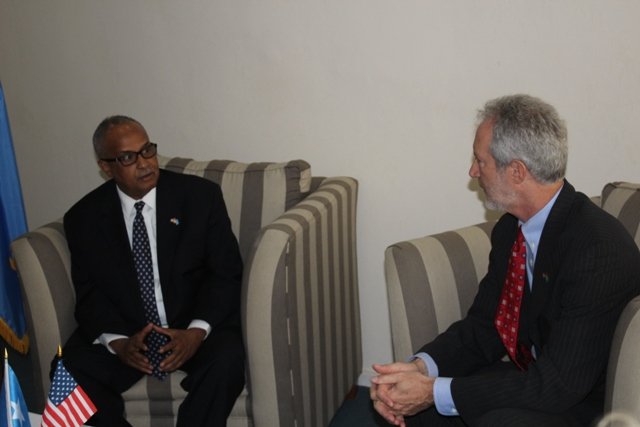
U.S. Ambassador Stephen Schwartz presents his credentials to Abdisalam Omer Hadliye, Somalia's minister of foreign affairs.
The first US ambassador to Somalia in 25 years has arrived in Mogadishu and presented his credentials to the Somali government.
Ambassador Stephen Schwartz, who met with Foreign Affairs Minister Abdusalam Omar Hadliye, is tasked with helping Somali officials stabilize the country after decades of civil war and the al-Shabab insurgency.
“The appointment of an ambassador to Somalia is a sign of the strong bonds between the two countries,” Schwartz said after the meeting.
“… I am pleased to have this opportunity to help the people of Somalia build a peaceful nation with a stable democratic government,” he added.
Somali foreign affairs minister Abdusalam Omar Hadliye holds talks with US Ambassador Stephen Schwartz
Schwartz praised Somalia’s progress over the last eight years and urged the leaders to deepen their commitment to improving the lives of Somali people, including women and youth, according to a statement from the Somali Foreign Ministry.
State collapse is the main reason for the long US diplomatic absence from Somalia. In 1991, the US embassy in Mogadishu closed after the regime of Mohamed Said Barre was overthrown and violence erupted between warring clan militias.
In late 1992, President George HW Bush deployed US troops to Somalia to support a UN aid mission aimed at relieving mass starvation. But 10 months later, 18 American soldiers were killed in Mogadishu by rebels who shot down two US helicopters, in the ‘Black Hawk Down’ incident. The United States withdrew its troops the next year.
After two decades of war and chaos, it was only in 2012 that Somalia achieved some measure of stability with the creation of an internationally-backed government.
But security remains a problem, as the militant group al-Shabaab continues to launch attacks in Mogadishu and elsewhere, a situation noted by the new envoy.
On Tuesday, Somali leaders ended a meeting in Mogadishu aimed at making final preparations for the upcoming elections.
Leaders endorsed a new timetable announced by the Somali Federal Electoral Implementation Team (FEIT) that sets October 30 as the date for presidential election.
Lawmakers will elect the president, after officials agreed it was not possible to hold one-person one-vote elections across the still-volatile country. President Hassan Mohamud has said he will seek re-election.
IN SUPPORT OF IGP: Supporters of IGP Kale Kayihura hold placards with messages praising police. Photo credit Pius Enywaru/eagleonline.co.ug
The Makindye Magistrate’s court has allowed the Directorate of Public Prosecutions (DPP) to formally file application for consideration in the case against the Inspector General of Police General Kale Kayihura, who is accused of allegedly failing to superintend his subordinates who were involved in beating the opposition Dr Besigye’s supporters and bystanders, on July 12 and 13.
This was after lawyers seeking the prosecution of Gen Kayihura faulted the Makindye Resident State Attorney for arrogating himself powers to take over IGP’s prosecution.
SUED GEN. KAYIHURA: City lawyer Abdullah Kiwanuka of Lukwago and Company Advocates. Photo credit/Pius Enywaru/eagleonline.co.ug
The IGP was dragged to court by a group of 20 lawyers, led by Abdullah Kiwanuka of Lukwago and Company Advocates, who today tasked court to explain why Gen Kayihura and his co-accused, all senior police officers above the rank of Superintendent, did not turn up in court.
But magistrate Richard Mafabi saved the day, asking the DPP to instead file the formal application, before he adjourned the hearing to August 29.
Meanwhile, scuffles ensued between rival supporters of Gen Kayihura and those of his pursuers including Lord Mayor Erias Lukwago and city lawyer and President of opoosition JEEMA party Asuman Basalirwa after the magistrate announcing the adjournment.
Placard holding supporters of police IGP General Kayihura. Photo credit/Pius Enywaru/eagleonline.co.ug
Intriguingly, some people carrying placards in support of the IGP were overheard asking why no Ugandan had sought the prosecution of KCCA Executive Director Jennifer Musisi, who they claimed, should also have been prosecuted, ostensibly for the death of two-year old Ryan Semaganda in November 2014 and the wanton beatings of street vendors in the city by KCCA law enforcement officers. They related Musisi’s ‘failure to supervise her subordinates’ including that of the driver of the KCCA vehicle and the enforcement officers, to charges Gen Kayihura is currently facing.
Baby Semaganda was crashed by a KCCA car in the precincts of the City Hall where his mother Mariam Namutebi, a street vendor, had earlier been arraigned before the city court for illegally hawking merchandise in the city.
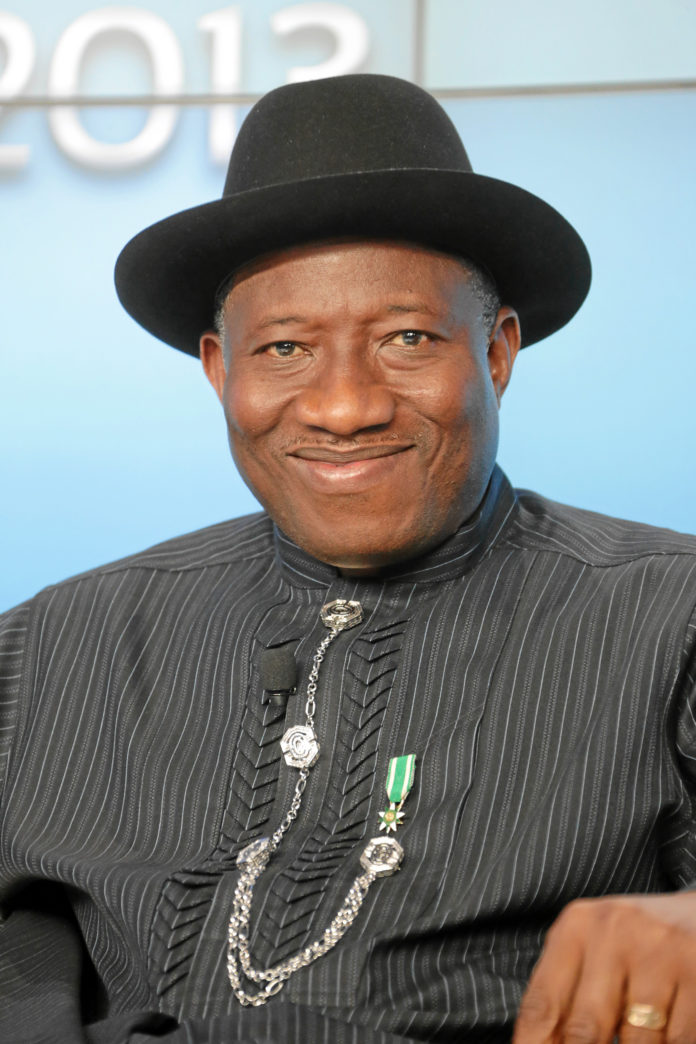
ACCUSED OF SUPPORTING MILITANTS: Former president Goodluck Ebele Jonathan.
Former Nigerian President Goodluck Jonathan has rejected reports that he is sponsoring a militant group destroying oil pipelines in the Niger Delta region.
Jonathan, who was defeated by incumbent President Muhammadu Buhari in elections in March 2015, had been named as a sponsor of the Niger Delta Avengers (NDA) by a purported faction of the group.
The NDA has launched a campaign of attacks on the country’s oil infrastructure in 2016, dramatically cutting Nigeria’s oil production. The group is demanding a greater share of the country’s oil wealth for residents of the Delta, an impoverished but resource-rich part of southern Nigeria.
In a statement issued through his media assistant Ikechukwu Eze, Jonathan said that claims he was backing the group were ‘idiotic’ and that the former president was committed to ‘peace, non-violence and better human community’.
Jonathan’s statement added that another group of militants in the southern swamplands—known as the Movement for the Emancipation of the Niger Delta (MEND)—had previously attempted to assassinate him and was still intent on this goal. MEND led an insurgency in the Niger Delta in the mid-2000s, kidnapping oil workers and blowing up pipelines before a presidential amnesty deal was struck in 2009.
The former Nigerian leader claimed that the group had made several attempts on his life before and during his presidential tenure, which ran from 2010 to 2015.
“We, therefore, have no doubt in our mind that MEND, as a group contracted to go after Jonathan with the mind of assassinating him, is yet to abandon this criminal and ignominious craving,” said the statement.
Jonathan has a strong support base in the Niger Delta and in the south of the country in general, with key oil-producing areas including Rivers state voting for the ex-president’s People’s Democratic Party in the 2015 general election.
The NDA itself has claimed that reports of separate factions within the group are unfounded. “The public and all sane minds should know that the entire household of the Niger Delta Avengers remain[s] intact,” said a statement posted on the group’s website Saturday.
Buhari’s administration has claimed on several occasions to be engaged in dialogue with militant groups in the Niger Delta, including the NDA, but the group itself has said such claims are untrue. The NDA has also disavowed links with MEND; the latter group has publicly stated that it is working with the government to bring the renewed attacks to an end and has branded the NDA as ‘criminals’.
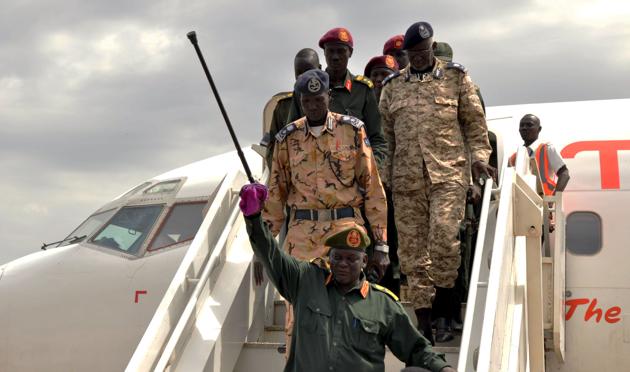
SPLM-IO Chief of Staff Gen Gatwech on return to Juba. Photo credit/finance.yahoo.com
South Sudanese rival forces have clashed around a strategic town, Yei, which is about 160 km south of the national capital, Juba, and towards the Ugandan border.
This is after the opposition forces of the Sudan People’s Liberation Army (SPLA-IO) in Opposition under the leadership of the former first vice president, Riek Machar, captured Lasu County, southwest of Yei.
Officials of the opposition faction confirmed that fighting erupted around Yei town, the capital of the newly formed Yei River State, when their forces came under attack from forces loyal to President Salva Kiir.
“Our forces of the SPLA (IO) came under attack today, when forces loyal to President Salva Kiir moved out of Yei town and attacked them. They were attacked in their defensive position some kilometers away north of Yei town,” James Gatdet Dak, spokesperson for Machar, leader of the country’s main opposition faction, said.
“However, our forces fought back in self-defence and chased the attacking forces back into the town. They did not follow them to capture the town,” he added.
Dak also revealed that their forces on Monday captured a strategic county of Lasu, which is south of Yei town, towards Kaya at the border with Uganda.
He also said another force from Juba was defeated on Tuesday between Juba and Lainya County when it attempted to attack the SPLA-IO forces on Juba-Yei road, which he claimed to have been closed by the opposition forces.
He further claimed that like Juba, Yei has also been besieged by the opposition forces.
The opposition leader’s spokesman also said fighting was going on around Renk, in the furthest north of the country, near Sudan’s border. Also there has been fighting in Nasir and Maban areas in Upper Nile state, he added.
There are also reports of fighting around Raga in Western Bahr el Ghazal state, west of the country.
Fighting erupted in Juba on July 8 between bodyguards of the two rival leaders, Kiir and Machar, and spread throughout the town, forcing Machar and his small number of troops to leave Juba and relocate into the bushes around the capital.
Opposition officials accused President Kiir’s forces of starting the fighting at the palace in an attempt to kill their leader, an accusation which President Kiir’s officials have denied.
President Kiir went ahead by replacing Machar, saying he had stopped communicating with him and called on him to return to the capital. Machar said he would only return to Juba once a third party force is deployed to separate the rival forces and guarantee his safety.
He also said his replacement was ‘illegal’ and a violation of the Article 6.5 of the Agreement on the Resolutions of the Conflict in South Sudan (ARCISS).
The East African regional bloc, IGAD, in their communiqué released on Friday called on Machar to return to Juba and assume his position as first vice president, calling on the newly appointed replacement, Taban Deng Gai, to step aside.
Meanwhile, as fighting continues around Juba, the two sides have called for reinforcements from different locations and fighting has been intensifying in the bushes around the capital and in other areas in the country.
United Nations Security Council (UNSC) is expected to discuss and pass a resolution on Friday for deployment of a third party force in Juba to take charge of its security, including protecting the leadership, civilians and key government installations.
A participant announcing the upcoming conference. Courtesy Photo.
Uganda will this year play host to the fourth edition of the East Africa International Arbitration Conference (EAIAC), an authoritative platform that is promoting the region’s legal capacity and highlighting arbitration as an alternative investment dispute mechanism.
THE EAIAC logo
According to a release by the Africa Press Organisation (APO) on behalf of GBS Africa, the EAIAC 2016 will highlight the importance of international arbitration as a tool for promoting foreign investment on the continent, look at arbitration case studies from Uganda and the region focusing on infrastructure, natural resources and Energy projects.
Uganda’s is increasingly gaining recognition as a leading Infrastructure and natural resource player in the Eastern African market, and the organizing committee considers Kampala as a natural choice for hosting EAIAC 2016.
EAIAC 2016 will take place on the September 8-9 at the Serena Kampala and will be addressed by Ministers from the region, international arbitration professionals and investment experts.
Organised by GBS Africa, the conference is supported by regional law societies, private sector bodies, development agencies, regional governments and investment community with an interest in East Africa.
The platform brings stakeholders together to share best practices, network and chart the way forward for East Africa’s Arbitration practice.
EAIAC Kampala 2016 will build on the success of the previous conferences held in Addis Ababa (2013), Nairobi (2014) and Dar –es Salaam (2015).