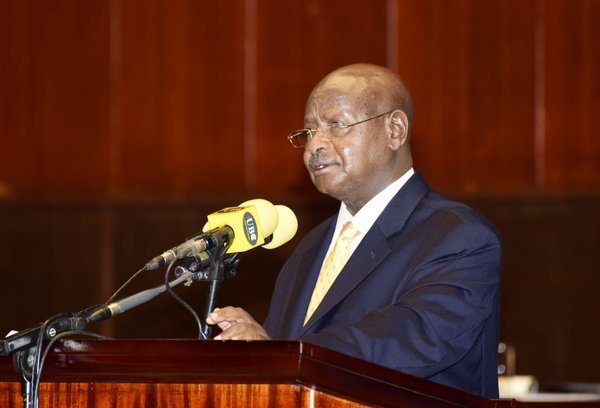
President Museveni is not a happy man despite expressing optimism at the current economic and political gains the country has made since the National Resistance Movement (NRM) government came to power in 1986.
Making the State of the Nation Address (SONA) this afternoon at the Serena International Conference Centre hall, Museveni revealed that Uganda is annually contributing US$3.2 billion to the developed economies including China with US$875million, India US$1.154b; to UAE ─US$406m; the EU ─ US$637m; to USA ─ US$89m and South Africa ─US$257m, through imports. He, however, said government was focusing on improving export earnings and added that the issue trade imbalance was being addressed through the establishment of institutions to add value to local products.
‘We were not yet able to end this haemorrhage because we lacked the basics; the crucial basics lacking were electricity, low transport costs and easy transport means. The big deficit of infrastructure could not be tackled through the traditional foreign aid,’ Mr Museveni noted in the one and half hour speech. Speaking about the democratic gains registered since 1986, Mr Museveni said Uganda had advanced tremendously in that arena.
‘Having followed closely world and historical events for the last 50 years, I am not aware of any society anywhere in the world that is more democratic than Uganda as far as the forms and structures of democracy are concerned’ he noted, before detailing the representation of special interest groups in Parliament as one of the milestones of the NRM government.
‘How many other countries in the world have special representation for the women, for the youth, the disabled, the workers or the soldiers? Mr Museveni asked.
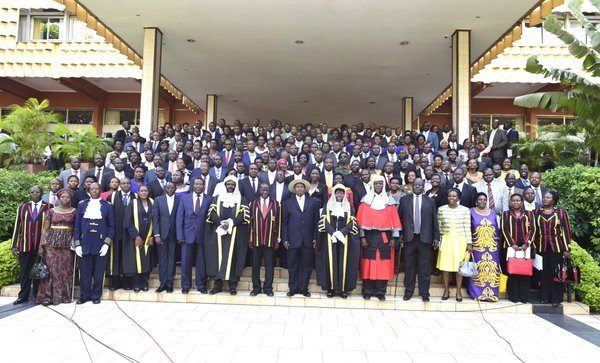
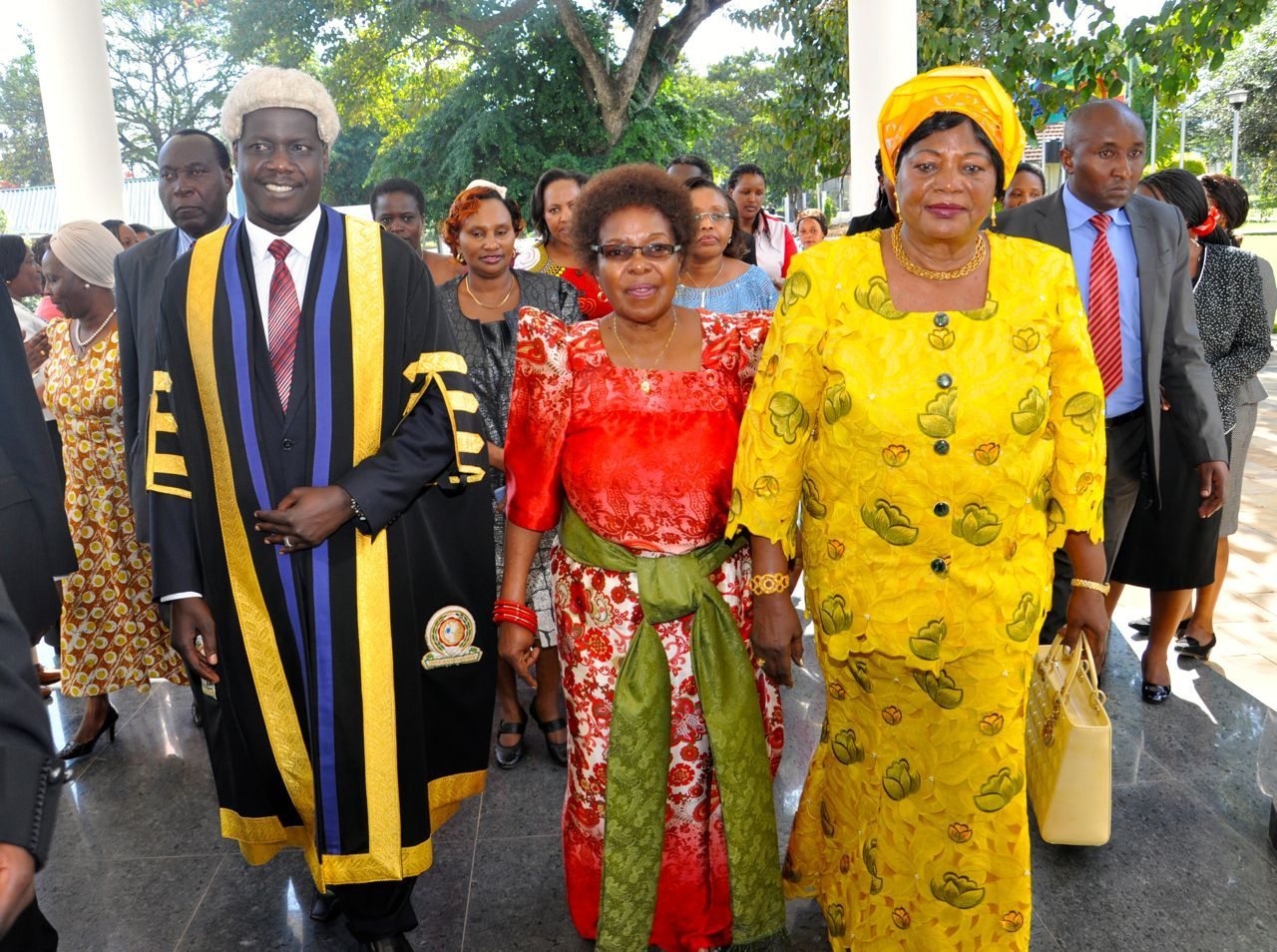
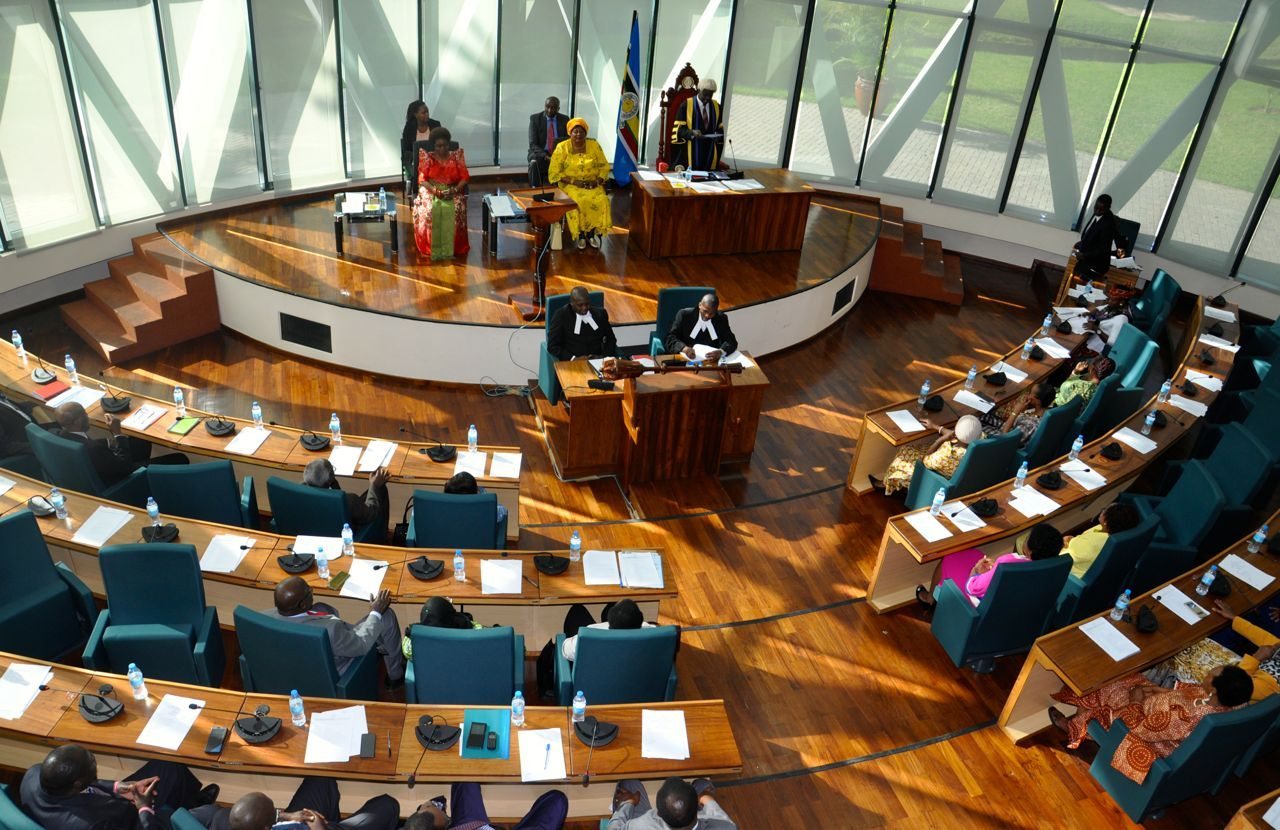
Earlier, the Speaker of Parliament Rebecca Kadaga had welcomed the President and delivered the introductory speech, giving an outline of the function before a fully packed audience including the newly-elected Members of Parliament.
https://www.youtube.com/watch?v=yAoharjUkYM&feature=youtu.be
The 2016 State of the Nation Address via NBS TV
State of the Nation Address
by
H.E. Yoweri Kaguta Museveni
PRESIDENT OF THE REPUBLIC OF UGANDA
at the
Uganda International Conference Centre,
Serena, Kampala
31st May, 2016
His Excellency the Vice President,
Rt. Hon. Speaker of Parliament,
His Lordship the Chief Justice,
Rt. Hon. Speaker of EALA,
Rt. Hon. Speakers of Kenya (Senate and National Assembly),
Rt. Hon. Speaker of South Sudan
Rt. Hon. Prime Minister,
Rt. Hon. Deputy Prime Ministers,
Rt. Hon. Leader of the Opposition,
Hon. Ministers,
Hon. Members of Parliament,
Hon. Members of EALA,
Members of the Diplomatic Corps,
Distinguished Guests,
Ladies and Gentlemen.
Madam Speaker,
In fulfillment of the Constitutional requirement under Article 101 (1) of the Constitution of the Republic of Uganda, I am here to deliver the State of the Nation Address, 2016.
First of all, I congratulate all the Ugandans on the recently held elections, the swearing-in of the President, Members of Parliament and Local Government leaders.
Madam Speaker, since my last Address, the Nation has lost a number of important personalities from different walks of life. Parliament has lost the following members:
- Late Hon. Gen. Aronda Nyakairima, former Minister of Internal Affairs;
- Late Hon. James Mutende, former Minister of State for Industry and Technology;
- Late Hon. Omwonya Stanley, Member of Parliament Okoro County – Zombo District;
- Late Hon. Susan Namaganda, Woman Representative – Bukomansimbi District.
Madam Speaker, I request that we all stand up and observe a moment of silence in memory of the departed persons. May the Almighty God rest their souls in eternal peace.
I have been hearing some circles talking of “political reforms”. Modesty is not always a virtue. The fact of the matter is that Uganda has already carried out the “most advanced political reforms”. Having followed closely world and historical events for the last 50 years, I am not aware of any society anywhere in the world that is more democratic than Uganda as far as the forms and structures of democracy are concerned. This is because the architecture of this democracy was put in place by, mainly, we, the freedom fighters, working along with the other delegates of the Constituent Assembly (CA), who had been fighting for democracy for a long time both here and in other parts of Africa. How many other countries in the world have special representation for the women, for the youth, the disabled, the workers or the soldiers? We have also done away with the sub-colonialism of the colonial and the time following the end of colonialism, before the advent of the NRM leadership. This is, for instance, the first time we have a Member of Parliament representing the IK people who had been described as the “vanishing tribe of Africa” by one writer in the 1960s.
We have, also for the first time, an MP for Tepeth. We have, for long now, had MPs representing the Ssesse Islands and Buvuma Island.
I do not know why I forgot the people of Kome Island whom I intend to visit in the near future. The people of Sigulu Island already have an MP. Our democratic structure is comprehensive, thorough and massive. It is not easily rivaled. The only pollution to this glorious and massive Liberation Movement has been the mistake of the careerists introducing the use of money in electioneering. We shall also struggle against that. Therefore, democracy is one area where we do not need aid because that is what we fought for here and in the rest of Africa for many decades.
The story of Uganda and the NRM is a long one. We went through the decades of resistance and liberation (1971 to 1986) and we have been through 3 decades of recovery. The size of our GDP in shillings was 6 trillion in 1986 and was Shillings 74 trillion by 2014. In US dollars it was 4 billion in 1986 and was US$ 27 billion by 2014. The size of the GDP of Uganda would be and will be much bigger if we were to export and when we export more products. If, for instance, the shilling appreciates to Uganda shillings 2,000 per one dollar, the GDP would be US$42 billion today.
We would, then, already be a middle-income country. The shilling depreciates because we import too much and we export little and, mainly, of low value. We still export quite a bit of unprocessed raw-materials.
We are donating US$875million to China each year in imports. We are donating to India US$1.154 billion each year in the form of imports; to UAE ─US$406 million; to EU ─ US$637 million; to USA ─ US$89 million; to South Africa ─US$257 million, etc. Yet our own exports to these countries are as follows: India ─ US$24.8 million; to UAE ─ US$.62.6 million; to EU ─ US$433 million; to USA ─ US$27.2 million; to South Africa ─ US$4.7million; to China ─ US$54.7 million. While the economy of Uganda recovered, as pointed out above, we were not yet able to end this haemorrhage because we lacked the basics. The crucial basics lacking were electricity, low transport costs and easy transport means. The big deficit of infrastructure could not be tackled through the traditional foreign aid. That effort was miniscule and of little impact. That is why, in 2006, the NRM decided to set up the Energy Fund and increase, massively, allocations to the Road Fund.
I gave the details of these in the campaign period. I do not have to repeat them here. That far sighted decision, has created the necessary base we needed for takeoff.
We now have 5200kms of tarmac roads compared to the 1200kms of 1986 that, moreover, needed urgent repair. We now have 850mgws of electricity compared to the 60mgws of 1986. We are in the process of adding an extra 1000mgws in the next five years by working on Karuma, Isimba, the mini-hydros, the geo-thermal in Lake Katwe, the gas-powered stations and those using HFO (Heavy Fuel Oil). We already have a surplus of 100mgws during even the peak hours in the evening (6:00p.m to 10:00p.m). At night only 350mgws is consumed. During the off-peak hours of the day, 500mgws are consumed. Therefore, during the night hours after 10:00 p.m., the surplus is 500mgws. That is why I would encourage some factories to work at night. The only problem we have are the high prices of electricity caused by the expensive money the Bujagali developers used. We shall get a solution for it. As I have said before, the power from Nalubaale is at 1.04 US cents per unit. That from Bujagali, on the other hand, is at 11US cents per unit. By a combination of measures, we shall resolve this handicap in a win-win way. The future electricity stations, especially, the big ones, will never be expensive in the same way.
With this better base of electricity and the improved roads, we are now, for the first time, in a position to decisively tackle the haemorrhage by attracting and incentivizing investors that will save the huge money in dollars that we are currently donating to India, China, UAE, Japan, EU, USA, etc. ─ a total of US$5.528 billion per year. This huge amount of money goes for textiles (US$888million), leather goods (US$0.22million), fruit products (US$20.2million), second hand cars (US$568.7million), carpets, etc. etc. All these can now be made here. Fortunately, the investors are there. They just need a good atmosphere for investing. What is the good atmosphere needed? First of all, now that the electricity is abundant, we need to ensure that it is cheap for, at least, manufacturing ─ not more than 5 US cents per unit. This, we have started implementing.
Secondly, the Government institutions, without exception, must buy locally made products provided they are of good quality and comparable price. That, however, should not be an excuse for continuing to import what can be made here. If the quality is not yet perfect, discuss with the manufacturers how that can be improved. All the uniforms for the Army, the Police Force, the Prisons Service, the Uganda Wildlife Authority (UWA), the Medical services, etc., must be bought locally. So should the boots, the belts, the head-dress, the jackets, etc., etc.
Thirdly, we are discussing with the other EAC members about stopping this haemorrhage of our resources. One sector, for instance, is assembling cars rather than importing the already assembled cars. When a car is imported in knockdown state and is assembled here, it is about 25% cheaper because it is cheaper to transport car parts on ships and trains than importing assembled cars. When a car is already assembled, it occupies more space on the ship and on train flat-bed wagons. Hence, it is more costly.
All this is not just about stopping the haemorrhage of our money to the outside and paying more than we should pay. It is also about jobs for our children. By importing so much from outside, we are creating jobs for the children of the Chinese, the Indians, the Japanese, the Europeans, the Americans and the Middle Easterners and forgetting about our own children. This must stop. If all the textiles that are used in Uganda are made here, we shall save US$888 million, annually and create about 45,000 direct manufacturing jobs. By insisting on only allowing vehicles that are assembled in-country (lorries, buses, mini-buses, pick-ups and piki-pikis) to be sold in the Ethiopian market, they have created 160,000 jobs. You can check that easily.
I have talked to our importers. These policy changes or evolutions should not take one year. We can phase them; but they must be triggered. Otherwise, we shall be slaves. We shall continue to run a supermarket for foreign products but which we call country.
The NRM has created the base for our country to graduate from being a supermarket for foreign products to becoming a manufacturing centre for goods, in which we have got comparative advantage. It is not just the availability of cheap electricity, low transport costs, the availability of the ICT backbone and piped water in the country. Those utilities must be in well organized industrial parks so that investors do not have to drain swamps, make roads, bring electricity, waste time begging bureaucrats who do not know what building a country means. Since the idea of industrial parks has been talked about for ages, I have now directed the Engineering Brigade of the UPDF to build these parks, starting with the one of Nakasongola. Investors should only come to build factories and not to be swamp-drainers and land surveyors.
The fourth factor that is crucial that we must expunge is corruption among the political leaders and the public servants.
I have quite a bit of information about leaders who ask for bribes from foreigners and locals who invest here. During the campaign, I compared these to rats who eat stored millet. These rats must be exterminated. They damage our future.
In the NRM caucus, we shall discuss more. However, in this term, the corrupt are going to see how a Muyekera (Omuhekyera, resistance fighter) looks like. We are going to stamp out corruption as we stamped out indiscipline in the army. It is a shame for a minister or a government official to ask for favours from, especially, foreigners. “I have failed to finish my hotel or house”, “I have failed to pay school fees for my child”, etc. If you need help, talk to your Party, to your relatives, to your colleagues but not foreigners or business people. That is nauseating corruption. Struggle to live within your means. Corruption should and will be stamped out. You saw the Commission of Inquiry (mismanagement of UNRA) report which pointed out that the Ushs. 9 trillion we have spent in the last 7 years could have built 5000 kms of roads instead of the 1000kms we built. That is why I set up that Commission of Inquiry to expose all that and more. The thieves should remember a Runyankore saying: “Akabikirwe ekaramu tikajunda” ─ “something written down in ink (or by pen) never rots”. Therefore, the thieves are an endangered species. When we were fighting Idi Amin, we would decry the presence of the illiterate Amin soldiers in Government. We would blame them for all the mistakes. It is, therefore, a big disappointment that educated people can be part of the corruption. NRM has never failed to confront any battle. We shall similarly win this one.
Fifth, do not delay any project. A request for investment should not take more than two days. Why should it? The investor has already made his or her calculation. It is his or her money. Why the delay? The excuses about the environment are, also, not valid. Many of the manufacturing processes are well known. Their best practices are known. If it is an abattoir, it needs this and that, if it is a milk factory, it needs such and such, if it is a stone quarry, it needs this and that. I will simply not tolerate any delay of more than two days. Recently, for instance, we got offers of people who want to start an airline in Uganda who will, apparently, save us the US$420 million per annum that we are losing every year. If somebody has no ulterior motives, it is easy to quickly decide on what to do in such a matter. No delays in investment decisions.
I have spent alot of time talking about manufacturing. This is, however, not to forget about services (tourism, banking, hospitality, education, health services, professional services, etc). These have no reason not to move well. The country is peaceful and it will remain so. The infrastructure elements required (roads, the railway, electricity, the ICT backbone, the undersea cable, etc.), are either in place or are being worked on. The government, however, will intensify the efforts to capitalize Uganda Development Bank (UDB) because it is erroneous to think that you can modernize agriculture and industrialize the country using Commercial Banks.
This is a mistake. Uganda Development Bank will be capitalized so that it gives low-interest loans to agriculture and industry (manufacturing). The services sector is already employing about 430,000 people. We shall work with our partners abroad to increase the number of tourists to, at least, four million per annum instead of the present 1.3 million tourists per annum. Again, on the issue of financing, the NRM had the foresight to leave UDB out of the privatization.
I wanted to see whether the involvement of the private sector in Banks, would lower the interest rates because of “competition” and the “efficiency” of private actors. Well, the facts show that it has not. Even when the inflation rate is 5%, the Banks lend at 23.5% as of now. It is these Commercial Banks that are fuelling the craze of importing by giving endless loans to importers (abagula). Abakola ebintu (manufacturers) and the abatunda (those who sell) do not feature much in the lending scheme of these Commercial Banks. 22% of their lending is to importing. Should we say that the commercial banks are part of the haemorrhage? Fortunately, we have the option of UDB that will come to our rescue. There are, however, short-term issues that must also be addressed in addition to capitalizing UDB. There is the problem of Government not paying arrears of private companies that supplied to Government. I have already directed Government to resolve this issue. In any case, the Banks should not use this excuse to grab people’s properties as long as there is evidence that those companies are owed money by the Government.
Secondly, there are companies that supplied to the Government of South Sudan but were not paid on account of the crisis that was going on there. I have already directed government to help these companies.
In the oil sector, there are companies that borrowed money in order to, for instance, buy drilling rigs. Hence, on account of delays in the oil programmes, these companies’ loans have attracted huge interest and yet they are not yet working. These companies will get support from the Government to negotiate with the Banks for reasonable treatment.
Fourthly, the Government is going to bring legislation to deal with consumer protection. Some of the Commercial Banks and money lenders, apparently use unethical methods to steal the property of Ugandans. I have, for instance, heard of money-lenders presenting money-lending as a sale and using any default by the borrower to grab people’s properties.
Ugandan companies should also be more careful in dealing with these Banks because some of them use their ignorance. The Government is now fully aware and will take all the legal and appropriate counter-measures. Islamic Banking which we have legalized will also bring in a new philosophy to the chagrin of these sharks.
When it comes to agriculture, there will, initially, be two major efforts. Number one, continue to battle with the 68% of the homesteads that are still in subsistence farming. I have talked about this alot in the past. This time, however, the difference is that I have given written orders to OWC to stop “trying to be everywhere and end up being nowhere”. I have directed them to, initially, concentrate on three cash crops: coffee, fruits (meaning oranges, mangoes and pineapples) and tea. According to the planned allocation for the coming financial year, I am sure, using one acre of seedlings per homestead, will cover about 2 million homesteads in one financial year out of the 7.3 million homesteads that live in the whole of Uganda. That will not be a bad effort when they are added to the 270,000 homesteads already served with perennial cash-crops by OWC in the last 2 years. I have told OWC of Mao Tse Tung’s exhortation that “it is better to cut off completely one finger of the enemy so that he remains with only nine than to injure all the ten” which then may recover so that the enemy remains intact. In fighting, we always strive for the battles of annihilating the enemy rather than merely routing the enemy.
This struggle is about pulling the 68% of the subsistence farmers into the money economy and avoiding any further land fragmentation. There are, however, many Ugandans that are already involved in plantation agriculture (e.g. sugar and tea estates), there are large scale farmers like myself and there are quite a number of medium and small scale commercial farmers. All these are part of the 32% of the homesteads that are already part of the money economy.
The plantation owners are fully capable of sustaining themselves and developing their businesses. The only support they need from Government is policy support. Take the example of new sugar factories poaching sugarcane of the older ones. This must stop. The policy of no new sugar factory in the radius of 50 kms must be implemented. Otherwise, we shall have the phenomenon of suicidal “cannibalism” by these factories. The tea growers need fertilizers. The big ranchers need machinery for bush clearing etc. The ranchers and the country will be well served by the State helping to buy and concentrate young bulls for fattening (kugomora) so as to feed the new abattoirs that have been built in the country. One abattoir needs 400 cows per day. I am one of the big farmers.
However, I currently sell only 1,000 cows per year. There is a clear need here to re-organize the agro-industrial sector. By establishing feed lots, I can rear for you 100,000 cattle for slaughter per annum. However, in the short run, the quick solution is for the Government, through its agencies, to buy young bulls from farmers, fatten them and maintain a ready supply to the abattoirs as the farmers are assisted to industrialize their farming and move away from relying only on free-range farming (ente kusetuka). Otherwise, with a national herd of 14 million cattle today, it is not a problem supplying a number of abattoirs each requiring about 146,000 cattle per year. It is simply the organization. This is where Government actions are required.
Later on, all the farmers will need support for micro-irrigation using solar-powered water pumps. I have told Makerere University to develop these solar-powered water pumps. We are also working with some investors to see how to tackle the problem of low use of fertilizers in Uganda. In the USA, they use 132kgs, per hectare, of fertilizers. In Uganda, we only use 2.5kgs per hectare.
There is the minerals sector. Minerals, like agriculture, produce raw-materials for industry (for factories). We are, accordingly, moving on that front. The Chinese company in Sukuru hills, near Tororo, is working on producing phosphate fertilizers, sulphuric acid and steel. That facility, once fully developed, will generate annual income of the magnitude of US$306 million and create 1,800 jobs. Similar operations will be done at Kilembe, Butogota in Kanungu, Muko in Kabale, Namekhera in Bugisu. We must build a gold refinery in the region. The only gold refineries are, apparently, in Dubai and in South Africa.
Hence, the whole of this area (Uganda, Tanzania, Congo, South Sudan) exports unpurified gold for which we get US$970 per ounce. Yet an ounce of purified pure gold, goes for US$ 1,212 per ounce. This is not correct. Therefore, the artisanal mining needs to be monitored and guided so that they do not become part of the haemorrhage. As long as you are only collecting the bukunkumukira (fragments, particles) of gold, in the form of alluvial gold, the State should ignore you. However, these artisanal miners should be regulated and what they are harvesting should be known and recorded. At the same time, three things should be happening. One, exploration by licensed people should continue. Nobody should stop properly equipped scientific exploration to continue.
Secondly, the Minerals Department should have a fully-equipped laboratory that should conclusively analyse the samples so as to determine the exact content of the minerals. Thirdly, once the rock of the gold or diamonds or whatever from which the bukunkumukira are coming from is located, capable large scale investors should come in so that they directly mine and process as well as buying from the regulated and licensed artisanal miners. The two can work together but in an organized and coordinated way.
Therefore, the four must be coordinated and legalized: artisanal mining, exploration, industrial mining and processing as well as refining. Otherwise, unregulated and illegal artisanal mining will be part of the haemorrhage and will block great opportunities: industrial mining, processing and refining which bring in much more money, transfer of technology and create more jobs.
What is true of gold and diamonds is also true of other minerals e.g. coltan (columbite tantalite), tin, wolfram etc. All this should be discussed with our artisanal miners like the ones I saw at Kamusenene in Bukuya. I do not want high-handed actions by corrupt and selfish officials roughing up our people. All Ugandans are intelligent. They are able to tell what is good and what is bad when you show it to them clearly and patiently.
Above, I have only talked about gold (alluvial or from the hard rock). I have not talked about jewellery. Our gold must be converted into jewellery so that we get more money from our gold, create more businesses from that gold and create more jobs. The artisanal miners should, therefore, get organized so that we can assist them to make jewellery from our gold. However, you cannot make, jewellery unless you purify the gold which takes us back to the issue of the Gold Refinery.
Then there is the shame of illegal fishing. In 1986, there was not a single fish-processing factory on Lake Victoria or anywhere in Uganda.
I built the first one with Italian support at Masese. By 1995, about 17 fish factories had sprung up employing over 1.3 million people in the value chain; by 2005, we were exporting 36,615 tonnes valued at US$ 143.6 million per annum. Once it was realized that there was money in fishing, all parasites descended on our Lakes and started fishing out all the young fish. The fish in the Lakes is now depleted. The anti-illegal fishing officers became the fish poachers.
The consequence is that the fish stocks are very low in the Lakes. Out of the 21 fish processing factories, 12 have closed. The others are limping on, operating at less than 30% capacity and only earning US$ 96 million per annum. This shame will not be allowed to continue. First of all, I am going to cause the registration of all the fishermen on the Lakes so that we know who is who. Anybody with a criminal record will not be allowed on those Lakes. Secondly, I will buy surface radars that can watch the Lake surface all the way to the international borders with Tanzania, Kenya and the Democratic Republic of Congo. No illegal boats will operate on those Lakes.
Thirdly, we shall encourage the acquisition of ships and steamers that will transport people to and from the islands so that the illegal fishermen will not hide behind the cover of being canoe-transporters. I have put a number of ministers in that sector to no avail. This is a big shame. No boat will be allowed in the fish breeding areas. If the Anti-illegal Fishing Law is not strong enough, then the Ministry must bring a stronger one. Anybody engaged in illegal fishing, transporting young fish, buying or selling them, must go to jail for, at least, five years. These are enemies of our future and our prosperity and must be treated as such. We shall also set up an interest-free revolving fund for the fishermen to buy the proper fishnets and ban all the bad fishnets.
Therefore, Honourable Members of the 10th Parliament, I stand before you today as a proud Jajja (grandfather) that has been engaged continuously for the last fifty years in the struggle for the liberation of our people, the recovery of our economy and its growth and expansion as well as the socio-economic transformation of our country. Using that historical vantage point, I am able to confidently say that Uganda is now on the point of take-off for the reasons I have enumerated above and take off it will, obstacles and problems notwithstanding.
I cannot, however, conclude my address without touching on these two points: Petroleum and the East African integration. The 6.5 billion barrels of proven oil reserves, now that we have solved the issues of the refinery and the pipeline, will help us to more easily fund the roads, the railway, electricity, irrigation, some aspects of education and health as well as the innovations of our long suppressed scientists. Prof. Isharaza died recently without realizing his dream of industrializing the production of the powerful Muhoko (luwoko) products. The poor language of the scientists calls Omuhoko “phytolacca dodecandra”.
With our oil money, all the economically viable products of our scientists will be funded ─ the electric car (Kiira), the bus (Kayoola), the muhoko and ekiboombo products of the Late Dr. Isharaza, the banana starch, eshande (banana) juice etc., etc.
The final one is East African integration, leading to a political federation. In the last 50 years, this has been our aim, following in the footsteps of Mzee Mwalimu Nyerere, that great African leader. Information from Arusha indicates that there is now a good level of convergence on this issue among the East African States. Economic integration is moving well. Political integration is also a sine qua non of guaranteeing our sovereignty. I salute the Ugandans for supporting political integration unreservedly. The political and economic integration of East Africa is not just for sentimental reasons. It is in order to ensure our prosperity. Our brothers and sisters in
Ethiopia, whom I salute, are effectively using their market of 90 million people to attract investments by giving local investors protection. The size of the market is not just for sentiments. The 160 million people East African market should be used to pull in investments for the prosperity of our people.
In the coming session of Parliament, the Government will present to you for consideration, the following bills:
- Agriculture Extension Bill
- Amendment of the NAADS Act 2001
- Amendment of the Universities and other Tertiary Institution Act (2011)
- Fisheries (Amendment) Bill
- National Coffee Bill
- Uganda Construction Industry Commission (UCICO) Bill
- The Engineers Registration Act (Amendment) Bill
- The Roads Act (Amendment) Bill
- Foreign Service Bill
- Uganda Institute of Diplomacy and International Affairs Bill
- Overseas Properties and Immunities Bill, 2010
- Constitution (Amendment) Bill, 2016
- Administration of the Judiciary Bill, 2016
- Geneva Conventions (Amendment) Bill, 2016
- The National Legal Aid Bill, 2015
- Uganda Wildlife 2015 Amendment Bill
- Uganda Land Commission Bill
- Landlord-Tenant Bill
- NEMA Act (Amendment) Bill
- The Climate Change Bill
- Water Act (Amendment) Bill
- Consumer Protection Bill
- Cooperatives Societies (Amendment) Bill
- New Sugar Bill
- Data Protection and Communications Technology Bill
- Uganda Communication Act (Amendment) Bill, 2015
- National Curriculum Development Centre (NCDC) Amendment Bill
- Physical Activity and Sports (PAS) Bill
- Uganda National Examination Board (UNEB) Amendment Bill
I, therefore, have the pleasure to declare the 10th Parliament open.
I salute all of you. May God bless Uganda.
31st May, 2016 – UICC, Serena
Stories Continues after ad