Stanbic Bank
Stanbic Bank
27.2 C
Kampala
Stanbic Bank
Stanbic Bank
Home Blog Page 2190

Zuma ‘successor names’ emerge

WANTS EXPANDED POWERS: Embattled South Africa president Jacob Zuma

Embattled South African President Jacob Zuma may not live out his second five-year term, and already people in the country are floating names of a possible successor.

Writing in Business Day Columnist Allister Sparks named Vice President Cyril Ramaphosa and Zuma’s former wife, the current Africa Union Chairperson Dlamini Nkosana-Zuma, as being among the people favoured to succeed Zuma should the president be impeached.

According to Mr Sparks, former President Kgalema Motlanthe’s name as possible successor to Zuma has also surfaced, ostensibly backed by the Gauteng branch of the ruling party, the Africa National Congress (ANC).

The 73-year old Jacob Zuma has not had a very smooth presidency, beginning with a scandal involving his private Nkandla home where millions of dollars of taxpayers’ money were reportedly spent on its upgrade. Also, he was recently in the news for hiring and firing two finance ministers in just under a week, triggering off a volley of accusations of incompetence, some made by top ANC officials, and calls for him to step down.

The developments come in the wake of the Speaker of National Assembly Baleka Mbete warning of ‘chaos and instability in the country if President Jacob Zuma were to be removed from power.’

Reportedly a close confidant of President Zuma, Ms Mbete, who was also a Vice President under Dr Kgalema, said she would not support ‘chaos and disruption unless I know what you are talking about and I agree with it’.

Jacob Zuma was first elected South African president in 2009 and was re-elected in 2014 to serve his second and last term that is supposed to end in 2019.

Should Zuma be edged out before the expiry of his term, he will become the second South African president after Thabo Mbeki, to be impeached.


Stories Continues after ad

Sacked Editor Sues Daily Monitor owners For Millions

Kenya’s top paper fired managing editor Denis Galava, they said he had failed to follow procedure.

Since 2013 several seasoned journalists of Namuwongo based Daily Monitor were fired or have left in an unannounced retrenchment saga. But this time the ball has shifted to the Nairobi-based head office, and the latest  is a former Nation Media Group editor who was sacked for allegedly flouting procedure in the publication of an editorial in the New Year has sued for KSh250 million.

Daily Nation, Kenya’s most sold daily, fired Denis Galava who authored the editorial, ‘Mr President, get your act together this year’ says he was unprocedurally terminated without a benefit package despite being a permanent and pensionable employee. “The termination letter to the claimant dated January 20, 2016 purporting to terminate his employment disingenuously misrepresents that he was on contract,” Galava’s memorandum of claim reads.

“The implication of the immediate termination was that I would receive no benefits or severance pay,” Galava himself states in his verifying affidavit.

Galava who says he received a salary of KSh800,000 per month at the time of his termination and therefore wants the court to award him three months pay in lieu of notice, the equivalent of one year’s pay for wrongful dismissal, a month’s salary for each year of service, pay for 24.5 days of leave earned, his accrued employer pension contributions, pay for the 19 years he would have worked before retiring at 60, “adjusting for promotion and annual increment,” as well as compensation for lost pension earnings.

To receive, which he would require a finding and declaration of the court that he was, “wrongfully, maliciously and unfairly terminated.”

“The termination of the claimant’s employment in such an acrimonious manner has exposed him to infinite prejudice and is unlikely to be gainfully employed in the only profession that he has trained for and made a career out of,” his memorandum filed by Kemboy and Company Advocates reads.

He has also sued NMG CEO Joe Muganda based in Nairobi for defamation for comparing him with “a bank teller who steals cash” in an interview with the BBC after his suspension over the editorial caused an uproar on social media and called into question the independence of the group.

He claims NMG Editor-in-Chief Tom Mshindi used the opportunity to settle a personal score in retaliation for his refusal to play ball in “insidious power games.”

Source: CapitalFMKenya

Stories Continues after ad

Colonialism fragmented the African market

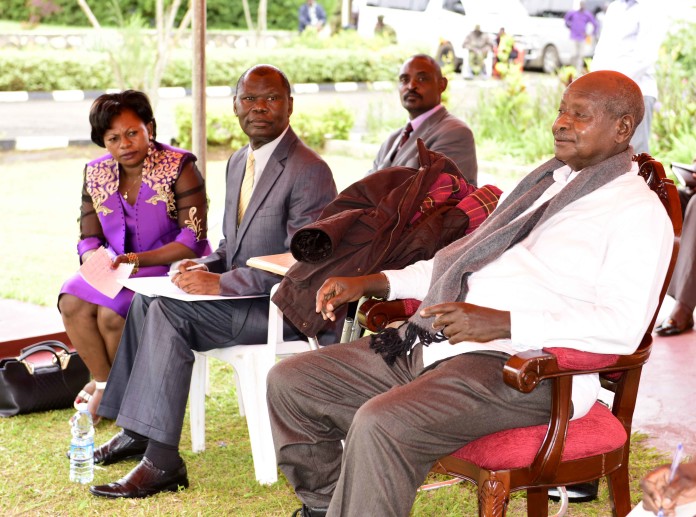
President Museveni

Principle number two of the NRM is Pan-Africanism.  Like all the other three principles of the NRM, Pan-Africanism is for the benefit of the Ugandan people as well as our brothers and sisters in Africa. Pan-Africanism, in particular, addresses two needs of our people, first and foremost.  These are: prosperity of our people in a modern context and strategic security against all potential imperialists.

Prosperity, in a modern context revolves around the production of goods and services in order to earn incomes create jobs for our people and expand the tax base.

In order to expand production, demand is very decisive.  The more buyers that buy what you produce, the more prosperous your business and the whole country will become.  When somebody buys what you produce, he is supporting your prosperity ─ your income, jobs for your people and he is helping you to expand your tax base so that you support the welfare of your people better (schools, health services, infrastructure, pensions, etc).

Colonialism fragmented the African market. Prior to colonialism, there was a market of this area stretching all the way from Zanzibar to the River Congo at Nyangwe and up to Juba (Gondokoro).  It was not a common market because some of the chiefs were quite extortionist.  Others like Rumanyika of Karagwe were very benevolent and were assistive to the traders.  The market, therefore, was not common but it was a market.

Colonialism, however, totally fragmented this market. Congo went to the Belgians as did Rwanda and Burundi.  South Sudan went to the Arabs.  We only remained with Kenya, Tanganyika and Zanzibar.  Since Independence, we have been re-assembling the market.  Under COMESA, I am happy to report, the old East African market is not only re-assembled but it is now a Common Market (no taxes in it or reducing them) and also expanded.  The members of COMESA are: Burundi, Comoros, DR Congo, Djibouti, Egypt, Eritrea, Ethiopia, Kenya, Libya, Madagascar, Malawi, Mauritius, Rwanda, Seychelles, Sudan, Swaziland, Uganda, Zambia and Zimbabwe.

These countries have got a combined population of 470 million of people.  This is a good destination for our goods and services.  It is already saving some industries that could not survive and grow without this market.  I can give two examples:  Maize and milk.  By 1986, we were producing only 200,000 tonnes of maize per annum.  We are now producing 4 million tonnes of maize per annum but only consuming 1 million.  The surplus 3 million tonnes are absorbed by the EAC and COMESA.  The same story with milk.  By 1986, we were producing only 200 million litres of milk per annum.  We are now producing 2 billion litres of milk per annum but Uganda only consumes 800 million litres per annum.  Where does the rest go?  It is absorbed by COMESA, by the EAC and the rest of the world.  Otherwise, we would, by now, have suffered from over production of these products and the prices would have collapsed.  This market is now being expanded to include SADC (Southern Africa) under the tripartite arrangement involving EAC, COMESA and SADC.  This will have a combined population of about 632 million people and a GDP of US$ 1.3 trillion.

The pulling of our markets does not only provide us with a bigger market for our goods and services.  It also enables us to better negotiate for market access to other foreign markets e.g. USA, EU, China, India, Japan, Russia, the Gulf, etc.  This is where the future of our prosperity lies.  I normally tell you of the Runyankore proverb that applies to this case. It says: “Ija turye kumwe, biri aine eki akurebireho” ─ “The one who invites you for a meal expects something in return”.  The foreign countries will allow us to access their markets sustainably because they see that we have our own big market to offer them in return.  Our own big market enables us to negotiate for other big markets.  Therefore, regional and continental integration is necessary for our Prosperity.

Apart from Prosperity, regional integration, especially for the EAC, is crucial because of our strategic security and survival as a free people.  During the school debate in which I participated with the other presidential candidates on the 13th of February, 2016, I pointed out how the Americans are “aiming at what they call four dimensional superiority” whereby they will be superior on land, in the air (air-force), at sea (the navy) and in space (satellites and rockets).  The question is: “How do we guard ourselves against such hegemonism?” Can Uganda, alone, even if we become a First World country by 2050, guard herself against such hegemonism? In the Second World War, some of the developed countries such as France, Holland, Belgium, Denmark or Norway were the first victims of German aggression. Apart from economic integration, we, therefore, need to have political integration wherever possible. Political integration is possible where the populations are similar, linked or compatible.  Where there is incompatibility, political integration should not be attempted. We believe and know that the East African Federation is possible and it would create a centre of gravity for the Black race.  Who is the guarantor of the freedom of the Black race currently?  I cannot see anybody today.  That is why Africa is being tossed around by some actors.  EAC, in its present state, is about the size of India in land area with a population of 160 million people.  This is a good nucleus for a very powerful, in global terms, African State that would be the centre of gravity of the African people’s destiny as free peoples.

The conflicts that went on in Uganda, Congo-Kinshasa, South Sudan, Rwanda, Burundi etc., although not planned, ended up getting rid of the quisling of foreign interests and creating conditions for Afro-centred thinking in these countries in addition to the original EAC states of Tanzania and Kenya.  It is a great opportunity for the African people to have this phenomenon.

Therefore, the geo-politics of this area revolves around the three elements:  prosperity for our people, strategic security for our people and enhanced international credibility for the African peoples.  There are, however, some diversionary issues being pushed by people that need more information.  You hear of the problems of landlocked countries or the problem of the Nile River waters.  These are non-issues.  The Coastal States benefit as much as the hinterland States by operating efficient Ports. Goods that come through the Ports create wealth for the coastal States as much as they are the wealth of the hinterland States.  The threat to the Nile waters is lack of electricity in the Tropics and lack of industrialization.  It is the lack of these two phenomena that causes the populations in the Tropics to cut forests for fire wood and invade forests and wetlands looking for more agricultural land to under-utilize using primitive agriculture.  Electrification and industrialization in the Tropics would enhance the waters of the Nile rather than diminish that precious resource.  In any case, the 85 billion cubic metres of the Nile water per annum is nothing to speak about compared to the 3000 billion Cubic metres of water of the Congo River.  If this area is saved from the fratricidal conflicts in the Sudan and the Congo, the peoples of this area could have a rational discussion about the future of our dear continent including the optimal use of these natural and human resources.  Human resources are, sometimes, more important than natural resources.  The big population of Egypt (88.8 million) and Ethiopia (101 million) is very beneficial for the whole of Africa as consumers and producers, including being producers of the products of the intellect (engineering, manufacturing, etc.).  There is a lot of potential complementarily between the products of a developed Tropics and North Africa (food, textiles, leather, forest products, steel, electrical equipment, engineering products, etc.), on the one hand and products of the intellect on the other hand.

Some of the most prosperous countries in the world, do not have natural resources ─ China, Japan, South Korea, etc.  The human resource is itself a great resource (as consumers and producers).  Africa is lucky to have both the human and the natural resources.  Let us know how to use them optimally.

I thank you.

15th March, 2016  

Kyankwanzi


Stories Continues after ad

Uganda Cranes could be disqualified from AFCON

When the draws for Afcon 2017 were made in 2015 several commentators labeled the group in which Uganda was included as the “weakest”. Others went over board to celebrate that this was the year in which the 38 year jinx was going to be broken.

I recall vividly that I, together with my brother Apollo and Taban laboured so much to explain that the past failures had nothing to do with the “hard’ or “easy” group but had more to do with what goes on off the pitch.

When you critically look at the 8-point program of Moses Magogo the issues he raised that would enable Uganda to qualify for a major tournament like Afcon 2017, are all off the field.

Indeed countries that qualify for major tournaments like these year- in- year- out do not do so because of their inclusion in “easy” groups but rather because they have mastered off the field preparations.

mAGOGO

Today as I write FUFA has conceded defeat ! The possibility of failing to fly the National team the Cranes to Burkinafaso has become a REALITY. There is no hiding about that.

In fact those people who are thinking about the return game on 29th March had better be warned because there is 99.99 chance of that game not being played . Why?

The return fixture on the 29th-March is inconsequential if at all the first fixture on the 26th March in Burkinafaso has not be honored. Technically speaking by the 29th March Uganda will have been disqualified from the Tournament for its failure to honor the fixture.

But why would this happen??

With the exception of the First world, no single Federation in the Third World can charter a plane across borders without the support of government. It is impossible !! FUFA find themselves in a similar scenario. They need to charter a plane from Uganda to Burkinafaso. The federation does not have the funds to do that.

So even if you have a fully fit Onyango, a blistering Miya Farouk, a Marauding Mawejje, the off field conditions are just enough to pull their ambitions down and the collective objective of the team.

The win against Comoros and Togo away was not because Uganda was more talented but rather because the off-field preparations had been thorough with government support.

The fact that Moses Magogo was able to dine, play, serve, joke with the team while in Camp in Njeru in the run up to the Comoros game perhaps explains why perfect preparations manifest themselves on the pitch.

This is in total contrast today. The FUFA president is running up and down while the clock is ticking. With each passing day his hopes fade. He has been seen picking up the towel and heading to the dustbin. Its game down!!

Every Ugandan Football fan where ever you are this is the time to pick up that phone and call your brother or sister in government and remind them that the responsibility of the national team is theirs.

I repeat without government support forget about AFCON 2017!!

By disqualifying Uganda from Afcon 2017 due to lack of government support, government will have ruthlessly crashed the wishes and aspirations of sports fans.


Opinion by Timothy Katende


Stories Continues after ad

Museveni defends Electoral Commission

As Uganda went to the polls on Febraury 18th,  voting across most of Kampala and Wakiso districts started as late as 3pm as voting materials arrived way later than the scheduled opening of polling at 7am, forcing the Electoral Commission [EC] to extend the deadline from 4pm to 7pm.

Across polling stations in Kampala and Wakiso, voters started queuing as early as 6am, heeding to advice by the electoral body and Opposition politicians to flock to polling stations promptly and beat the 4pm deadline.

Fast forward to the presidential election petition, President Museveni’s lawyers have defended the Independent Electoral Commission during the morning session of day three saying  there’s no single piece of evidence suggesting that any voter didn’t vote because of delay of voting materials.

NRM lawyer Kiryowa Kiwanuka in his presentation said that the EC started distribution of voting materials with the farthest points according to the schedule but insisted it was not a  trick or favour for a particular candidate.  “It’s true there was late delivery of voting materials in Wakiso, Kampala but not true to say it was intended to benefit any candidate,” he reasoned while responding to evidence and submissions of Amama Mbabazi’s lawyers.

The first respondent’s (Museveni) lead lawyer led Didas Nkurunziza also told court that the petitioner didn’t have any evidence to show that their client candidate Yoweri Museveni had solicited for votes by giving out money and hoes.

“There is no evidence that 1st respondent, as candidate, gave out hoes. Therefore, allegation is not proved,” Nkurunziza said. In his affidavit, my client Museveni vowed that he didn’t personally give out UGX250,000 per village with intent to induce voters to vote for him but instead the money was for party activities as no political party can survive without financing officials.”


Stories Continues after ad

Museveni team begins response to petition

Chief Justice Bart Magunda Katureebe

Lawyers representing President Yoweri Museveni in a petition challenging the results in which he was declared winner of the 2016 presidential elections have today started their defence.

The lawyers among them Kiwanuka Kiryowa and Didas Nkurunziza are responding to a raft of issues tabled before the Supreme Court by lawyers for petitioner John Patrick Amama Mbabazi.

The issues include allegations of voter bribery and other electoral malpractices, and the petitioner wants court to annul the announced results of the Feb 18 elections.

Museveni, the 1st Respondent, is jointly sued with the Independent Electoral Commission, (IEC), whose chairperson Eng Badru Kiggundu was subjected to cross-examination by Muhammad Mbabazi, the lead counsel for the petitioner on Monday.

And today, while responding to allegations that the respondent bribed voters by paying out Shs250.000, counsel Nkurunziza said ‘suspicion is not sufficient to accuse one of bribery and the claim of someone claiming to have been bribed is not enough’.

Tabling an affidavit sworn by National Resistance Movement (NRM) Secretary General Justine Kasule Lumumba, counsel Nkurunziza argued that the said money was for facilitation of the activities of the NRM in the villages.

“The money was for party activities; no political party can survive without facilitation of party activities,” he told the nine-panel bench led by Chief Justice Bart Magunda Katureebe.

He also challenged allegations that the 1st Respondent, Yoweri Museveni gave out hoes to the people of West Nile as an inducement for them to vote for him.

Further, according to Nkurunziza, the petitioners did not adduce any affidavit evidence to support the allegation of hoes being given out as bribery.

“There was no evidence from Amama that candidate gave out hoes to influence voting and therefore allegation is false,” Mr Nkurunziza said.

Nkurunziza further submitted that the said hand hoes were given to the people of West Nile as part of a government programme, and then tabled an Office of the Prime Minister (OPM) policy statement of 2013 to support his argument.

Proceedings continue…

Stories Continues after ad

Singer Chameleone, family visit AK47 one year after his death

We’re now at the one year anniversary of Emmanuel Mayanja Hummertone popularly known as AK47’s death (March 16), and it’s only natural for family members, fans, and friends alike to feel nostalgic regarding the late musician.
The Mayanja family (singers Joseph Mayanja aka Jose Chameleone, Pius Mayanja aka Pallaso and Douglas Mayanja aka Weasle) have quite many reasons to be in a state of reflection: the budding dancehall artiste was their family’s last born and equally loved by the public.
According to a close source, the Mayanjas on Monday traveled to Kalangalo village, in Mityana District, where the fallen artiste was buried last year to pay their respects, ‘Okulima e Bijja’ in Luganda.
AK-47 left behind three children. His fiancé Nnalongo Margaret Kiweesi said the deceased was not settled, days to the fateful night when he met his death. He had just started constructing a house for his young family.
AK-47 died at Dejavu Bar in Kansanga, a Kampala suburb, under unclear circumstances.
 
Stories Continues after ad

Okhuti delights in KCCA brace

Samson Ceasar Okhuti scored a brace, his first goals for the club since the January mid-season transfer from rivals Express.

Kampala Capital City Authority (KCCA) goal-hero Ceasar Okhuti felt hard work paid off after he fired a brace to ensure his side beat Soana FC 2-0 on Tuesday evening in the Azam Uganda Premier League at Nakivubo stadium.

Okhuti scored his first for the club just after 4 minutes of play as he cleared the ball into the box from a mess created by Didi Muhammad in the dangerous area. He pounced again in the second half from an uncleared corner kick to seal the three points for the league leaders.

KCCA coach Mike Mutebi felt the two strikes were lucky and could probably be repeated, nevertheless man of the match Okhuti was delighted.

“It’s a blessing to play such a big game and score such wonderful goals but if you work hard and believe in yourself, such things happen,” he told EagleOnline after the game.

“We still go and fight and the big man Mutebi (head coach) keeps pushing us every day. All we need is one chance. Mike wasn’t panicking at all at half-time. He just told us to keep working hard.

“We need to concentrate considering our position on the table. We need these chances, and if we utilise them, surely we would win the league.”

KCCA F.C now maintains the leadership grip at the summit of the league with close rivals, Vipers not in action.

Express F.C fell 2-0 away in Jinja at the Kakindu stadium to JMC Hippos.

Team captain Richard Wandyaka and Musa Walangilira scored for the Hippos.

At Mutesa II stadium, Wankulukuku, URA F.C was held to a one all draw by Lweza.

Defender Allan Munaaba scored an own goal to put give Lweza the advantage towards the end of the first half before Elukana Nkugwa equalized three minutes into the second half second.

The Saints F.C lost their great run since the second round start when they lost at home 1-0 to visiting Sadolin Paints.

Bright Stars played to a none scoring draw with BUL F.C at the Champions stadium.

Stories Continues after ad

Kasese GISO alive – Police

Fred Enanga, police Spokesperson.

James Mulhumbira, the Gombolola Internal Security Officer (GISO) of Kasese who had been reported dead is still alive, police has said.

According to police spokesperson Fred Enanga, Mr Mulhumbira is in critical condition at Kilembe Mines Hospital, where he has already undergone surgery.

Police says the GISO was attacked by a gang last night at a bar that sells local brew called Malwa.

Anonymous sources were quoted as saying the attackers are linked to the Rwenzururu kingdom, but the realm has denied any association with them.

Stories Continues after ad

Police, army were strained in Kasese- Kiyonga

DEFENCE Minister Crispus Kiyonga

Defence Minister Crispus Kiyonga has said security forces acted with restraint during last week clashes between civilians, army and police in Kasese.

“What happened in Hima and Buhuhira has the same pattern as the attacks of 5/7/2014. The government acted with great restraint following those attacks and forgave some of the people that were involved in the crimes,” he said in a statement signed by the army Spokesperson, Lt Col Paddy Ankunda.

Dr Kiyonga who is currently outside the country appealed to the people of Kasese to not to join the those who have been attacking “police and the army positions

Stories Continues after ad