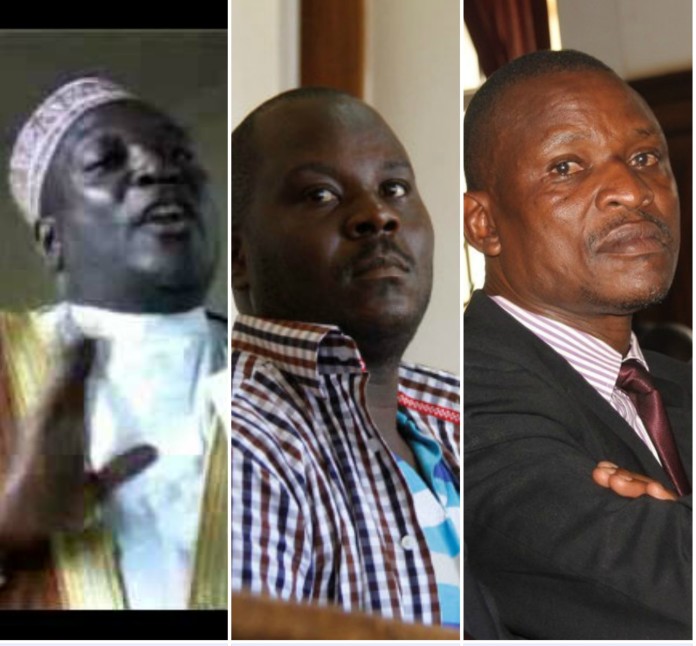
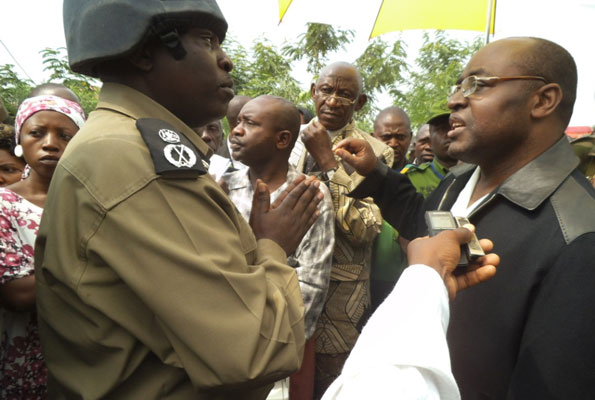
Controversial public pair Director Dawa Sheikh Nuhu Muzaata Batte and Joseph Tamale Mirundi a senior presidential advisor on media affairs, two of the three sureties paraded by murder suspect Muhammad Ssebuufu could not get him bond.
Ssebuufu the managing director of Pine Car Depot and his three aides were last year charged with two counts of murder and aggravated robbery.
The incarcerated car dealer has on Monday been denied bond by High Court Magistrate Flavia Nabakooza dismissed the bail application considering the gravity of the matter which attracts a defence sentence upon conviction.
She also that the applicant is accused with four other people, who were all committed to High Court for trial; and that granting one person bail and leaving his co-accused in prison would appear unfair.
Ssebuufu who claims to be in an unsound health condition thus returns to Luzira Prison where he is presently on remand.
Prosecution alleges that accused persons and others still at large on October 21, 2015 at Pine Car Bond located on Lumumba Avenue in Kampala allegedly killed a one Dona Betty Katusabe.
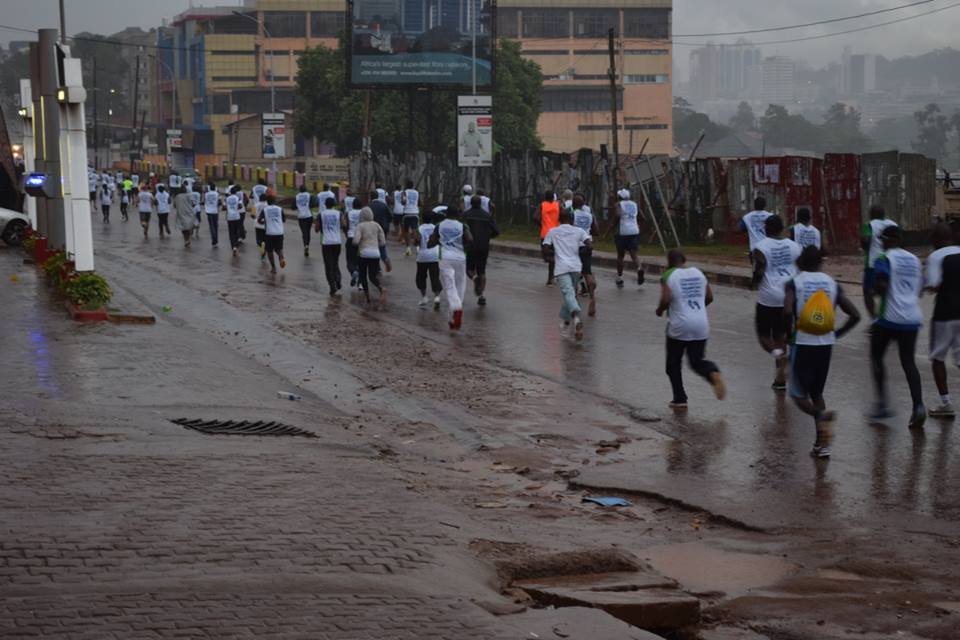
More than 300 people yesterday took part in the inaugural NSSF Kampala Hash Sevens Run , which is intended to raise Shs240 million to rehabilitate selected schools managed by the Kampala Capital City Authority.
The run started and ended at Pearl Africa Primary School Nsambya, on the outskirts of Kampala city.
Mr Richard Byarugaba, the NSSF Managing Director, promised to extend the sponsorship to the event next year. The Run was also attended by the KCCA Executive Director Jennifer Musisi.
“The NSSF Kampala 7 Hills Run is a vehicle through which we will progressively raise funds to contribute to the improvement of learning conditions in Kampala schools, mainly improving sanitation facilities and renovations. NSSF pledges to sponsor the run next year,” he said.
On average, 57% of the Government Grant Aided Primary Schools don’t meet the required standards, according to records from KCCA.
The funds will benefit over 40 primary schools over the next 3 years.
KCCA Executive Director Jennifer Musisi thanked the participants for braving the morning chill to take part in the run whose intent is for a good cause.
“I would like to applaud all of you; individuals and companies who have taken part in this Run today. Our partnership with NSSF and Kampala Hash Harriers will become a beacon of hope for children in Kampala schools,” she said.
According to KCCA records, only 43% of KCCA schools meet the recommended pupil – toilet stance ration.
The run was a fun, non-competitive event that covered the historical 7 hills of Kampala; hence the 7 hills run moniker. Participants ran 21km and traversed the seven hills of Kampala i.e. Nakasero, Kibuli, Old Kampala, Namirembe, Rubaga, Lubiri and Nsambya.
They just won a very serious gong at the Social Media Awards 2016, now Campus Bee news website is going to receive gushing tributes for Uganda’s first ever online campus bazaar; dubbed bazaar.campusbee.ug.
The young, dynamic and vibrant youths have today launched the local university bazaar where sellers and buyers converge in a small place to carry out transactions; the Campus Bee Bazaar is not any different.
According to Boses Musiime, the Chief Technology Officer at Campus Bee, their latest product is an online marketplace for University students to sell and buy items from fellow students and well accredited sellers who are within the university’s jurisdiction.
“Anyone can post an item for sale and potential buyers can contact the seller and purchase the item directly- without the hustle of a middleman. Students can also search for cheap or good deals on items and services that are offered around campus,” Musiima reveals.
“We shall have dedicated staff to filter and moderate listings to ensure that our site is credible and not filled with spam,” he adds.
“We live in a world where technology simplifies the simplest of things. We felt inspired to work on a service which simplifies the life of students since studying isn’t simple. The days of sticking posters to walls using porridge and glue are long gone because we are modern and cool.
At the turn of the decade, Uganda had lost nearly a third of its forests and could lose most of its tree cover in about 30 years unless measures are quickly taken to reverse the situation, environmentalists said but there is hope.
Environmentalists now reveal that great strides have been achieved in reviving Uganda’s forest cover despites massive illegal activities that destroy forests. According to Onesmus Mugyenyi, deputy Executive Director Advocates Coalition for Development and Environment, the situation is not as bad as it was due to certain interventions like increased tree planting speared headed by government ad individuals.
“When you look at the trends now you realise that there is some kind of recovery. There is increased afforestation although the rate of deforestation is still higher as compared to the number of trees being planted,” Mugyenyi says.
Mr. Mugyenyi adds that introduction of the Environment Protection Police which arrests those destroying the environment is a move in the right direction. He says there is need to concerns that include encroachment on forest illegal logging and corruption in the sector.
“There are still a number of challenges that have to be addressed in overlap terms of mandate. You have different institutions and the mandates overlap, there are gaps in condition so you find that different institutions within the environment and natural resources sector are not moving together which is a problem.
Uganda had more than five million hectares of forest in 1990, but only 3.5 million hectares remained by 2005. “If deforestation continues at the present rate, Uganda will have lost all its forested land by 2050,” Mugyengi warns however.
“Climate change does not happen in isolation. It interacts with existing problems and challenges – notably deforestation, soil degradation, declining food security, declining fish stocks – and makes them worse.
Only 10 percent of Uganda’s population has access to electricity, while the rest use biomass as a source of energy, especially firewood for cooking. Areas around Kampala have lost more than 78% of forest land since 1990.
“Because 84 percent of rural Ugandans rely on burning firewood for cooking, deforestation is occurring at an alarming rate,” he said.
A huge leak of documents that implicate government heads in the setting up of “shell” companies to harbor billions of dollars is set to cause upheaval on offshore hubs and shake up global political governance.
A team of journalists from around the world published what they called the “Panama Papers” on Sunday—more than 11.5 million encrypted internal documents from Mossack Fonseca, a Panamanian law firm.
An anonymous source began supplying the documents— dated from the 1970s to 2016—to German newspaper Süddeutsche Zeitung (SZ) a year ago. SZ assembled a group of media organizations, including the International Consortium of Investigative Journalists (ICIJ), The Guardian, the BBC and Le Monde, to analyze the data, before simultaneously releasing their findings.
Calling the leak “the biggest that journalists had ever worked with,” SZ said the documents revealed numerous shadowy financial transactions via offshore companies created by Mossack Fonseca.
The law firm, who has more than 40 offices worldwide, specialized in the sale of anonymous offshore companies, known as shell firms.
According to SZ’s findings, 12 current and former heads of state, 200 other politicians, as well as members of various Mafia organizations, plus football stars, 350 major banks, and hundreds of thousands of regular citizens were among Mossack Fonseca’s clients.
It is important to note that owning an offshore company is not illegal in itself, but SZ alleged that concealing the identities of the true company owners was the law firm’s primary aim in the bulk of cases.
While people often legitimately move funds to countries outside their national boundaries to access more relaxed financial regulations, offshore companies are also commonly associated with tax evasion as well as serious illicit activities such as money laundering.
We have not been able to independently verify the allegations made by media outlets that studied the documents.
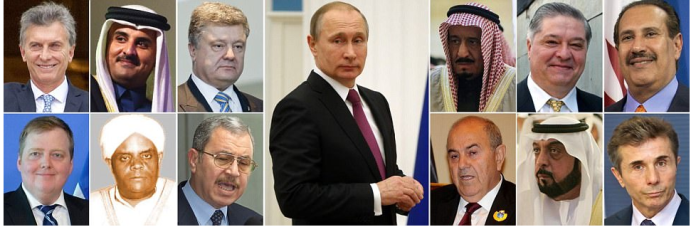
Argentine President Mauricio Macri, Iceland’s Prime Minister Sigmundur Davíð Gunnlaugsson, Saudi Arabia’s King Salman, U.A.E President Sheikh Khalifa and Ukrainian President Petro Poroshenko are among those named in the documents as having set up shell companies, according to SZ.
Relatives and associates of other leaders, including Russia’s Vladimir Putin, China’s Xi Jinping, Syria’s Bashar Assad and Britain’s David Cameron, were also identified by the team of reporters that examined the documents.
Other prominent Asian officials named in the reports included Anuraj Kerjiwal, the former head of Indian political party Lok Sattam, as well as Cambodia’s Minister of Justice.
Ramon Fonseca, the director of Mossack Fonseca, told Reuters that the firm was not responsible for the activities of the companies it incorporated.
“We’re dedicated to making legal structures which we sell to intermediaries such as banks, lawyers, accountants and trusts, and they have their end-customers that we don’t know,” Fonseca said.
But revelations have caused a global uproar, with pundits warning of dire financial and political consequences to come.
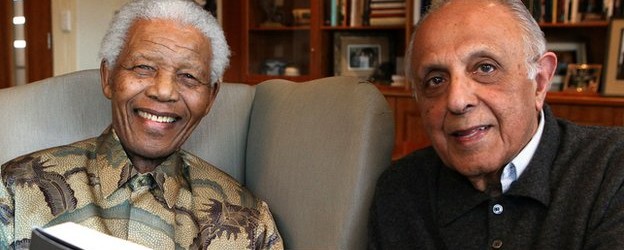
A South African anti-apartheid veteran has called on President Jacob Zuma to resign following a scandal over improper spending at his private home.
Ahmed Kathrada, who was jailed alongside Nelson Mandela, said that Mr Zuma’s resignation would end a “crisis of confidence” in the government.
Mr Zuma said on Friday he would repay the money but would remain in his post.
He has faced widespread calls for his resignation from South Africa’s opposition.
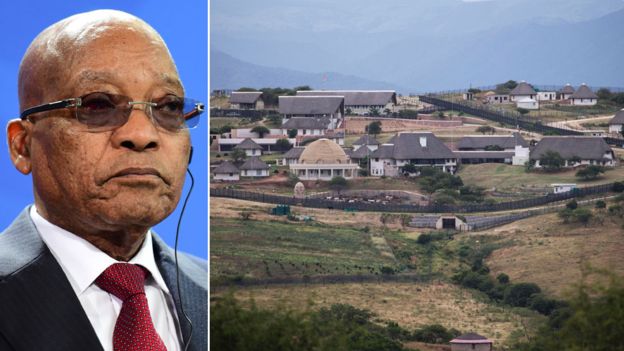
South Africa’s highest court ruled that Mr Zuma had failed to uphold the constitution by ignoring instructions to repay some of the $16m in state funds spent on renovations at his private residence.
In a televised address on Friday, Mr Zuma made no reference to the calls for his resignation.
The leadership of Mr Zuma’s party, the African National Congress, said it was united behind its leader, but the intervention of 86-year-old Mr Kathrada, a party veteran, may carry weight.
Along with Mr Mandela, Mr Kathrada was among eight ANC activists sentenced to life imprisonment after being convicted of trying to overthrow the apartheid government during the 1963-1964 Rivonia Trial.
In an open letter published in South African media, Mr Kathrada said: “In the face of such persistently widespread criticism, condemnation and demand, is it asking too much to express the hope that you will choose the correct way that is gaining momentum, to consider stepping down?
“I know that if I were in the president’s shoes, I would step down with immediate effect.”
The scandal is arguably the biggest yet to hit Mr Zuma, who has fended off accusations of corruption and cronyism since before he took office in 2009.
The public protector, an anti-corruption body, ruled in 2014 that $23m of public money had been improperly spent on Mr Zuma’s rural home in Nkandla in KwaZulu-Natal province, and ordered him to reimburse part of the expense.
In this photo, Ahmed Kathrada and the late ANC hero Nelson Mandale enjoyed close ties. Kathrada has added his voice to numerous calls for President Jacob Zuma to resign from office.
South African media reacts – BBC Monitoring
South African papers are abuzz with reactions to President Jacob Zuma’s apology for improper spending on his rural home, and speculation about what he will do next.
The Johannesburg Star‘s Janet Smith says Mr Zuma must be observing events in Brazil, where there are growing calls for the resignation of President Dilma Rousseff over corruption charges.
The Sowetan‘s report about Mr Zuma’s apology is overshadowed by the ongoing saga involving the president and the Indian-born Gupta family, which has allegedly been allowed undue influence. The paper’s front-page comment yesterday was headlined “It’s official: he’s a failed president”
In the Mail and Guardian, Carien du Plessis foresees difficulties for the ruling ANC if Mr Zuma were to resign, saying: “In a party split down the middle in more or less equal factions… things are more likely to fall apart.”
Business Day‘s reports about the apology includes opposition Democratic Alliance leader Mmusi Maimane’s description of it as an insult, and ANC secretary general Gwede Mantashe’s efforts to discourage calls for the president to step down.
The president claimed he had acted “in good faith” and “never knowingly and deliberately set out to violate the constitution”.
“Any action that has been found not to be in keeping with the constitution happened because of a different approach and different legal advice,” he said, before issuing an apology for the “frustration” caused.
The case had been brought by two opposition parties, the Economic Freedom Fighters (EFF) and the Democratic Alliance (DA).
They have launched impeachment proceedings against Mr Zuma, but these are unlikely to be successful because of the ANC’s large majority in parliament.
Kampala-UPDF soldiers have shot dead five royal guards of King Wesley Charles Mumbere of Rwenzururu in Kasese district.
According to an eye witness, the king’s guards were attempting disarm local security guard and this alerted UPDF soldiers who intervened but later shot five dead during the scuffle.
“The guards tried to disarm a local guard but he overpowered them and made noise that attracted the army and when the soldiers came, the guards remained defiant trying to exchange fire with them but in turn, the army shot five guards dead” he said.
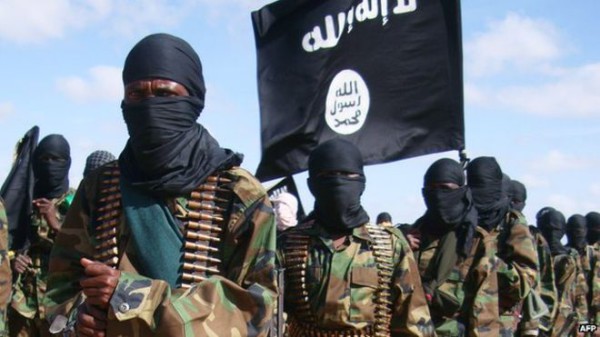
KAMPALA: Ugandan soldiers in Somalia have killed another senior Al-shabaab commander in South Western town of Leego, where he was moving with his four escorts who were also killed.
Adana Bare was killed on Saturday night by the UPDF soldiers under the command of Col Peter Omala under Sector one.
On Friday, a combined airpower by American soldiers and UPDF ground troops killed Hassan Ali Dhoore, the commander of al shabaab in Janaale.
The al shabaab tried to ambush Ugandan troops but were overpowered American drones attacked the insurgents during the battle and killed the overall Dhoore.
Janaale is where Ugandan soldiers were attacked and 19 died. Six were captured by the insurgents and have been seen.
“This group of terrorists attempted to ambush and disrupt UPDF patrol operations but was unsuccessful,” UPDF statement says.
“Removing Dhoore from the battlefield would be a significant blow to al-Shabaab’s operational planning and ability to conduct attacks against the government of the Federal Republic of Somalia, its citizens, US partners in the region and against Americans abroad,” said Peter Cook, the Pentagon press secretary.
City advocate, Francis Kimara has been elected new president of Uganda Law Society replacing Ruth Sebatindira.
Gimara holds an LLM from Cambridge University, a Bachelor of Laws degree from Makerere University and a Diploma in Legal Practice from the Law Development Centre. And is a Co Managing Partner at M B Gimara Advocates.
Former Lord Councilor for Kawempe and ex- contestant in the 2016 general elections for Kampala woman Member of Parliament Shifrah Lukwago is the new Secretary to the society.
Gender , Labour and Social Development PS Pius Bigirimana
The Permanent Secretary in the Ministry of Gender, Labour and Social Development, Pius Bigirimana last Friday launched two new books titled; ‘From tears to cheers’ and the ‘Youth Livelihood Model’.
During the launch at Sheraton Hotel in Kampala, Mr Bigirimana decried the deteriorating civil service and vowed to retire after writing down material that many after him will read.
“My next book will be focusing on the civil service, answering what happened to the civil service. I joined as a young man, the selflessness and integrity,” Bigirimana said, adding: “Deterioration for government civil servants will be the subject.”
Bigirimana, who formerly was the PS in the Office of the Prime Minister, said that civil servants must acquire skills and also develop a reading and writing culture.
“When we do not write, someone else will do it for us, let no one else write our story of what we did or how we did it.” He warned.
Bigirimana lauded
The Prime Minister, Dr .Ruhakana Rugunda, who was the Chief Guest at the book launch said Bigirimana is a valuable asset to the government.
“It is rare to find public servants who are authors because they spend most of their time writing volumes and volumes of reports. Pius (Bigirimana) has challenged many of us, and he remains a truly valuable asset to the government.” Rugunda said.
Wilson Mukasa Muruuli, the Minister Gender, Labour and Social Development, who also doubles as Bigirimana’s political supervisor at the ministry, said the books had been written by a man who has been at the centre of what they depict.
“Pius is an epitome of a very good and wonderful civil servant, his books are not memoirs, they are not just a historical account or policy statements, but they touch on history, policy and his experience in his career as a civil servant.”Muruuli said.
The former premier, Prof Apollo Nsibambi was impressed with the topics Bigirimana chose to write about in his different books.
“The topics he has covered are very crucial; for example corruption in one of his books. I want to encourage public servants to write books because information can easily be distorted if you do not write,” Nsibambi said.
Mr Nsibambi also praised Bigirimana for his assiduous attempt to cultivate the culture of writing in the civil service.
The two books launched on Friday bring to four written the number of books written by Bigirimana.
The other two are titled “Corruption: A tale of a wolf in a sheep skin’ and ‘Abundance Mentality’.
The new books
The first book entitled, “From Tears to Cheers,” which also has a foreword by the First Lady, Janet Kataaha Museveni, is a brief analysis of the reconstruction in Northern Uganda and the Karamoja Region between 2007 to 2012. The book documents the conceptual as well as implementation processes for the recovery of Northern Uganda from the socio-economic destructive upheavals of the Lord’s Resistance Army war. The narrative constructs a chronological presentation of the breakout of the war through the various development frameworks targeted at bringing the Acholi-Lango region, Karamoja and Teso regions to par with the rest of the country.
The second book titled ‘Youth Livelihood’ is a model for empowering youth in the developing world. The book outlines steps to undertake when implementing a nationwide fund programme to finance self-empowerment entrepreneurship by youth under the auspices of a national framework by the Government, a donor agency or any other stakeholder.