Stanbic Bank
Stanbic Bank
18.1 C
Kampala
Stanbic Bank
Stanbic Bank
Home Blog Page 2210

Sudan orders re-opening of crucial river with South

Sudan President Omar Bashir

Sudan’s President Omar Hassan al-Bashir has announced the resumption of river transport with the landlocked South Sudan ending a four-year halt decided by Khartoum over security concerns and accusations of support to rebel groups .

In a speech delivered in the capital of White Nile state, Rabak, al-Bashir announced the resumption of transport by river between Kosti and Juba.

The river transport was very active between North Sudan and South Sudan before and after the secession, and goods were transported by river barges to Juba or shipped by barge from Juba to Mongalla, Bor, Adok, Shambe, Malakal and Renk.

Bashir’s decision on Thursday follows an earlier one to open the border and review oil transportation fees. It also comes after statements by South Sudan President President Salva Kiir, vowing to improve ties with Khartoum and increasing bilateral cooperation.

The Sudanese president further said that his country will remain open for the South Sudanese citizens fleeing the armed conflict in their country and seeking refuge in Sudan.

He added that they should not be mistreated or held accountable for the actions of their leaders.

The White Nile state and Khartoum state are the two regions where the majority of the South Sudanese refugees in Sudan reside.

Nearly 200.000 South Sudanese moved to Sudan since the eruption of the armed conflict between troops loyal to President Salva Kiir and defectors led by his former deputy Riek Machar in December 2013.

Bashir also inaugurated a power plant in Um Dabakir area at a capacity of 500 megawatts. He disclosed that they agreed with the Indian government which constructed the new electricity station to increase its capacity to 750 megawatts in the near future.

He further vowed to transform the White Nile state to an oil producing region and to build a new airport in the White Nile state adding it would be achieved before the new Khartoum international airport.


Stories Continues after ad

Burundi accused of hunting down refugees in Tanzania

Burundi refugees in a camp in Tanzania

Refugees from Burundi, who fled violence in their country to neighbouring Tanzania, have accused their government of sending armed men into a UN-run refugee camp to hunt down opposition supporters.

Several refugees say that they fear for their lives and that there is no adequate security in the camps in Tanzania to protect them.

“The camp is currently not safe. We live in fear of Burundian government militia [members] who are in the camp,” one refugee said in a phone interview, from a camp in north west Tanzania.

The Burundian government has denied the allegations.

More than 200,000 people have fled Burundi since the African country slipped into a violent political crisis, and half of the refugees have sought shelter in Tanzania.

Al Jazeera visited the Nduta camp, where over 40,000 refugees are currently staying.

But the team was only allowed to interview refugees who had been screened by officials from the UN refugee agency, the UNHCR. The UN said the screening was for the protection of refugees.

However, other refugees in the camp who later spoke to Al Jazeera by phone said Burundi had dispatched agents who carried out attempted killings and abductions.

One man said that he narrowly escaped an abduction.


“Some of our group were tied up. We were loaded onto a truck and driven away. My friend and I jumped off and ran away to the Tanzanian border, where we met more government militia. They killed my friend but I escaped over the border,” he said.

Several other refugees also said dozens of Burundians had left the camp in November in the belief they would join an armed rebel group back in Burundi.

The refugees said they later learned it was a trap set by government-backed armed groups, and that most members of the group were killed, according to reports from people inside Burundi.

The refugees said they reported the incidents to camp officials, but most of the government agents are still at large.

Burundi’s denial

Contesting the refugees’ accounts, Alain Nyamitwe, the Burundian foreign minister, said the allegations were baseless.

“I don’t believe that there are militia operating in Tanzania as we have heard [from] UNHCR authorities,” he said, adding: “In any case, anything beyond the borders of Burundi is not the responsibility of the government of Burundi.”

The Tanzanian government, for its part, said it was not aware of the allegations, but that it would do whatever it could to secure the camps.

“The government has been very strict, and whenever we have spotted any kind of activity that is trying to suggest there is any kind of recruitment, we have actually taken serious measures,” Harrison Mseke, Tanzanian director of refugees, said.

“Only last week some refugees were actually apprehended and they were taken before the courts and charged on issues that were associated.”

Burundi has been plunged into violence since last year, after President Pierre Nkurunziza won a controversial third term, prompting street protests, a failed coup and sectarian killings.

A leaked UN report has accused the neighbouring Rwandan government of recruiting and training Burundian refugees in a camp in Rwanda to fight against the Burundian government.

Rwanda has denied the allegations.


Stories Continues after ad
More cases of sexual violence by UN troops reported in CAR

UN Special Representative and head of the UN Multidimensional Integrated Stabilization Mission in the Central African Republic (MINUSCA) Parfait Onanga-Anyanga. Photo: MINUSCA

The United Nations Mission in the Central African Republic (MINUSCA) reported today that it has identified seven new possible victims of sexual exploitation and abuse in the town of Bambari, just days after the UN revealed which countries’ troops have been accused of abusing minors.

In a press release, MINUSCA said the cases were brought to its attention on January 21 by a team of Human Rights Watch researchers, who passed the information to the Mission in the interest of ensuring medical and psycho-social care for the victims and accountability for any alleged crimes.

Upon receipt of these allegations, MINUSCA says it dispatched a fact-finding expert from the UN Office of Internal Oversight Services (OIOS) to Bambari, near the centre of the country. OIOS found sufficient initial evidence that five of the victims were minors and had been sexually abused and that one adult had been sexually exploited.

Also, OIOS said it was unable to interview the seventh alleged victim, reportedly a minor. Finally, one of the allegations passed to MINUSCA by Human Rights Watch was previously reported and is currently under investigation.

The soldiers implicated in these cases are from the Republic of the Congo and the Democratic Republic of the Congo (DRC). The Governments of Republic of Congo and DRC have been notified of these allegations and have been asked to launch investigations. The CAR national authorities have also been informed.

“Due to the gravity of these allegations and given the information collected through the initial fact-finding, the United Nations has decided to take immediate measures, including the repatriation of the 120 Republic of Congo soldiers who were deployed to Bambari from 17 September to 14 December 2015,” the Mission announced, noting that this repatriation will occur after an investigation is carried out, and in the meantime the soldiers will be confined to barracks.

The Special Representative of the Secretary-General and head of MINUSCA, Parfait Onanga-Anyanga, today travelled to Bambari with a high level delegation. He expressed his outrage and shame, reminding the troops that “sexual abuse and exploitation is a serious breach of the UN regulations and a human rights violation; a double crime that affects the vulnerable women and children you were sent here to protect.”

He also discussed the sexual exploitation and abuse incidents with affected communities and recommended additional emergency mitigation measures.

Addressing the DRC battalion in the final weeks before its repatriation, MINUSCA’s Force Commander Major General Balla Keita urged the soldiers to “honour themselves, their country, and the UN flag by serving with the highest standards of conduct and dignity.”

Speaking with the press at the end of the visit, the Mr. Onanga-Anyanga said that MINUSCA is “in combat mode” and explained that “he will not rest until these heinous acts are uncovered, perpetrators are punished, and incidents cease.”

Finally, he thanked all partners for the important role they are playing in reporting allegations and caring for victims, adding “we will never win this fight unless we work together.”


Stories Continues after ad

Mugabe declares ‘state of emergency’ over drought

I AM STILL AROUND! Zimbabwe President Robert Mugabe


Zimbabwean President Robert Mugabe declared a state of national disaster due to the worst drought in almost two decades that’s killed cattle, withered crops and left more than a million people needing food aid.

Mugabe’s announcement on state radio came as government ministers and United Nations officials warned of an accelerating disaster caused by the El Nino weather phenomenon that’s led to drought across southern Africa.

The number of people needing emergency food assistance has risen to 2.4 million from 1.5 million in a nation of 12 million people, Local Government Minister Saviour Kasukuwere said in a statement on Friday. Crops have been affected across 95 percent of the country and more than 16,000 cattle have died, he said.

“The situation is deteriorating at an alarming rate,” Eddie Rowe, an official with the United Nations World Food Programme, said on February 2, adding: “We’re approaching an unprecedented food insecurity situation, not just in Zimbabwe, but in the southern African region.” Rowe said food aid would be needed for at least nine to 12 months.

The government has earmarked $200 million for food imports, Vice President Emmerson Mnangagwa told lawmakers in Harare.

The drought has also affected regional corn producers South Africa, Malawi and Zambia.


Stories Continues after ad
Billions spent on vehicles for LCV chairpersons

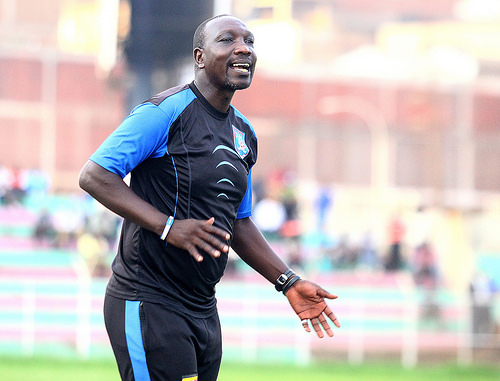
Premier Ruhakana Rugunda shakes hands with the Chairperson of the Ugnada Local Government Association (ULGA) , Jinja district boss Fred Ngobi Gume

A total of about eight billion shillings has been spent on buying 111 Mitsubishi double cabin vehicles for Local Council V chairpersons for all districts in the country.

According to the Ministry of Local Government, the heavy duty vehicles are built for tropical terrain will be used for carrying out supervision and monitoring of government programmes at district level.

“We recognized that in order to have a functioning local government, we had to do two things; provide the leaders with knowledge and skills, and also provide necessary equipment for them,” a statement signed by local government minister Adolf Mwesige, states in part.

At the handover function held at Mandela National Stadium, Prime Minister Rt Hon Ruhakana Rugunda, who was also the chief guest, warned district chairpersons to desist from misusing the vehicles.

The vehicles parked at Mandela National Stadium Namboole.


“The vehicles are for the office of the chairperson, they should not be used to serve purposes outside of what we expect them to,” the Premier said.

He also asked the handlers of the vehicles to ensure proper maintenance and utilisation.

“It is sometimes disappointing to find government vehicles parked at district headquarters because they are faulty, most cases these faults are very easy to fix,” Premier Rugunda said.

He also directed the Ministry of Finance to work together with their local government counterparts and procure the same vehicles for districts that missed this time round, and other officers like Town Clerks, Chief Executive Officers and Mayors.

The Premier also said that the government is going to give motorcycles to leaders at sub county level.


Stories Continues after ad
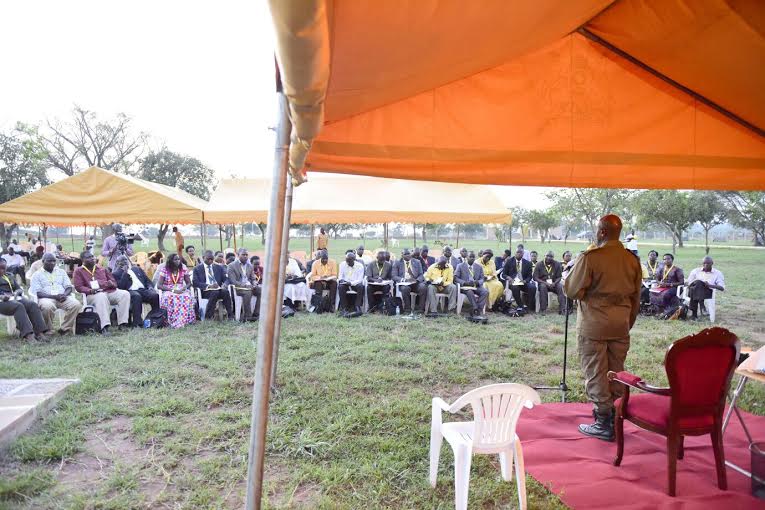
119 police officers pipped at HQs

Then SSP Sam Omala talks to Dr Besigye (inside car). Omala has been promoted to the rank of Assistant Commissioner of Police (ACP).

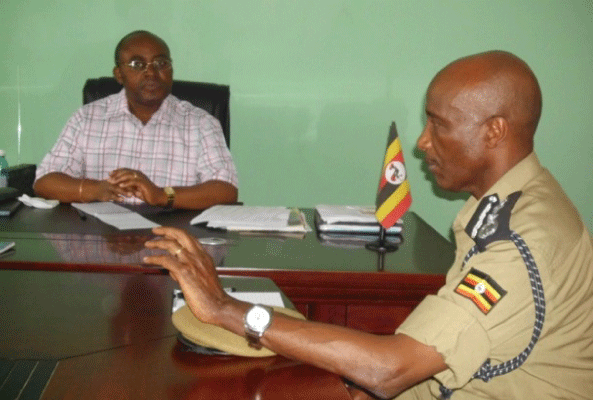
One hundred and nineteen senior police officers from the rank of Senior Superintendent of Police (SSP) to Assistant Inspector General of Police (AIGP) have today been adorned with epaulets depicting their new ranks at police headquarters in Naguru.

The officers are part of 569 newly promoted men and women police officers, the lowest being promoted from Inspector of Police (IP) to Assistant Superintendent of Police (ASP).

One Uganda Peoples Defence Forces officer, Colonel Ndahura Atwooki was one of those promoted, gaining the rank of Assistant Inspector General of Police (AIGP). Other notable names include Sam Omala, James Ruhweza, Siraj Bakaleke and Polly Namaye, all of who have been promoted from Senior Superintendent of Police (SSP) to Assistant Commissioner of Police (ACP).

ACPs Omala, Ruhweza and Bakaleke became common faces for their roles in trying to contain street protests in Kampala involving opposition figures including among others Dr Kizza Besigye of the Forum for Democratic Change (FDC) and the embattled city Lord Mayor Erias Lukwago, while ACP Namaye is Deputy Spokesperson of the Police.

Also promoted is former Sipi region commander Superintendent of Police (SP) Gerald Twishime Byensi, who now becomes SSP. He is remembered for recently ordering police officers under his command to shoot bullets and fire tear gas canisters to disperse crowds that had invited FDC flag bearer Dr Besigye to ‘witness the poor living conditions’ in which they lived in Tariet Internally Displaced Camp (IDP) in Bukwo district on January 6 this year.

Other prominent faces are SP Norman Musinga, the Commandant Highway Traffic Police, who now becomes SSP, and Muhammad kirumira, who is now Assistant Superintendent of Police (ASP).

Developing story: other emerging details following soon.


Stories Continues after ad

Sigh as civil servants get bonus payment confirmation

Zimbabwe finance minister Patrick Chinamasa

Civil servants will start receiving their 2015 bonuses this month, with members of the defence forces being the first, while the rest of Government workers will get their 13th cheques between February and May.

This was disclosed by Finance and Economic Development Minister Patrick Chinamasa , as Treasury moved in to fulfil the pledge made by President Mugabe last year that despite cash flow constraints, civil servants will get their bonuses.

Members of the defence forces — who include the Zimbabwe National Army and the Air Force of Zimbabwe — the minister said, will be paid this month, followed by the Zimbabwe Republic Police, Zimbabwe Prisons and Correctional Services and the Health sector in March.

The education sector, which has the highest number of employees in Government, will get their bonuses in April while the rest of the civil service and grant-aided institutions will be paid in May.

Minister Chinamasa said due to cash flow challenges, a once off payment was impossible hence the route to stagger the bonuses.

“To allow room to mobilise the required resources, Government will be staggering the payment of bonuses for public servants beginning this month and until May 2016.”

Anxiety had gripped Government workers who constantly demanded that Government announces the dates when the bonuses would be paid.

Minister Chinamasa said specific pay dates will be communicated upon mobilisation of the requisite resources, adding that, “Treasury sincerely regrets all the inconvenience caused.”

In previous years, Government staggered the bonuses due to cash flow challenges and some workers received their 13th cheque as late as January instead of the traditional November.

Due to tight fiscal space, Minister Chinamasa had early last year contemplated suspending payment of bonuses for 2015 and 2016 to create space for funding Zim-Asset.

The move irked civil servants and President Mugabe overturned the suspension saying “when Government bestows a benefit on civil servants, that benefit cannot be withdrawn because it has become a right.”

Last month, Government had to change pay dates for its workers with the last batch getting their salaries on January 5.

Government later met civil servants’ representatives and gave them specific pay dates when their salaries would be paid.

All workers got their salaries as announced and the employer promised constant pay dates this year.

Delays in the payment of the 2015 bonuses saw some civil servants threatening to strike not before their representatives met Reserve Bank of Zimbabwe Governor Dr John Mangudya who took them through what Government had in its coffers at that time.

This satisfied the representatives who subsequently ruled out the industrial action.

At least 83 percent of Government revenue is servicing salaries, a development that stifles economic growth.

Government has come up with a number of strategies to reduce the wage bill and is rationalising the civil service following an audit carried out last year by the Civil Service Commission.

Student teachers and trainees’ allowances have been reduced from $329 to $157, while salaries for teachers at private and trust schools have been terminated.

All vacant posts have been abolished, bus fare for civil servants has been reintroduced, under-used staff is being redeployed, funding of bridging courses has been scrapped while all members who were abusing various types of leave, tampering with pay sheets and attendance registers have been charged.

At the same time, no teacher will go on vacation leave as there is no money to pay relief teachers who will replace them for the three months they will be away.

Government has also reintroduced a 7.5 percent pension contribution, which had been shelved since 2009 when every civil servant was getting $100.


Stories Continues after ad

Zuma’s friends want to pay Nkandla bill

Embattled South Africa President Jacob Zuma

The Friends of Jacob Zuma Trust will help the president repay what he owes for his Nkandla upgrades if he approaches them, its founder has said.

“As an organisation we are virtually non-existent because we did what we had to do back then. But if he needs us individually, we will always support him, like we always did in the past,” businessman Don Mkhwanazi said.

He said Zuma had not approached the organisation for financial help, but would also not comment when asked if he would personally help Zuma out.

Recently, Zuma asked the Constitutional Court for an order that Auditor General Thembekile Kimi Makwetu and Finance Minister Pravin Gordhan determine how much he should repay for those upgrades to his private Nkandla homestead not related to security, namely the visitors’ centre, amphitheatre, cattle kraal, chicken run and swimming pool.

Mkhwanazi said Zuma’s decision should be applauded as he had done it in the country’s long-term interest.

“I believe he wants to put this matter to rest so that we can focus on more important things and so that people can stop sniping at him.”

The trust, comprising the country’s leading businessmen, helped pay Zuma’s legal bills during his fight against his corruption charges.

Zuma’s long-time friend and ally, Durban businessman Vivian Reddy, also said Zuma had not approached him for any financial help.

In 2012, Reddy that he had lent Zuma money to pay for the first phase of Nkandla and that he had repaid it, and added that Zuma took out a bond for the home.

Greytown businessman Philani Mavundla, who previously publicly said he would settle Zuma’s Nkandla bill, did not want to comment. But the construction tycoon said that Zuma’s backers had discussed his debt.

Neither Zuma’s son, Edward, nor nephew, Khulubuse, were immediately available for comment.

Trying to find out whether Zuma will be able to pay it out of his own pocket is more difficult than it seems.

As president, he is entitled to a level of privacy regarding any assets and interests he may want to dip into to settle the account.

To get a list of what he owns requires an application to the secretary of Cabinet, director general in the Presidency Cassius Lubisi.

In 2010 Zuma was forced to apologise for delays over submitting his register of interests and at the time his lawyer, Michael Hulley, said it was the size of his family that made it complicated, as well as anomalies in the Executive Ethics Code.

Although he is private about his family, it is known that Zuma has four wives and is believed to have 20 children.

He has stated that he has a bond on his home at Nkandla, KwaZulu-Natal, where he was born and brought up, but it is not known if it is paid off.

The son of a policeman and domestic worker, Zuma was not born with a silver spoon in his mouth.

And the trial in which he was acquitted of rape would have set him back millions were it not for the fund-raising efforts of the Friends of Jacob Zuma Trust.

When he became president in 2009 Zuma, whose salary is R2.7 million a year, became entitled to the use of an official house in Durban, Cape Town and Pretoria, with most costs paid for by the state.


Stories Continues after ad

EU slashes Somalia peacekeepers allowances

Members of the Uganda contingent in Somalia

The European Union has reduced the allowances for peacekeeping troops serving in Somalia under Amisom. According to the EU, each peacekeeper earns a ‘strict’ allowance of US$1028 but with the new changes the take home per month will come down to US$822.4.

The disclosure was made by the Chief of Defence Forces General Edward Katumba Wamala, who said the allowances of a peacekeeper had been slashed by 20 per cent, beginning January this year.

“I can tell you and I know you are going to turn it around, but from January (2016) the European Union started cutting down on the allowances (of the troops) by 20 per cent,” Gen Katumba Wamala, who was responding to a question over a reported seven-month salary delay for the Amisom troops, reportedly told The Observer.

According to Gen Katumba Wamala, the bureaucratic chain of disbursement also contributes to the delay in payments.

“The allowances are got from the African Union. African Union gets money from the European Union because African countries cannot raise the money to pay troops. So, the EU, which supports this mission, pays the AU and then the African Union pays the troop-contributing countries who pay the troops,” Gen Katumba said.

Uganda was the first country to deploy peacekeeping troops to war-ravaged Somalia in March 2007 and to date has the biggest contingent of over 5000.

Meanwhile, the Uganda Peoples Defence Forces celebrates 35 years of a transformational process that included its predecessor, the National Resistance Army (NRA), which was started as a rebel outfit in 1981. And tomorrow, February 6 marks the day the then rebels attacked Kabamba military barracks, where the hero of the day was General Elly Tumwine Tuhirirwe, who fired the first shot during the early morning raid on the military training installation.

As part of the celebrations, the UPDF has been carrying out a series of exercises among them cleaning of health units in different areas.


Stories Continues after ad

Controversial Buhweju RDC removed

Moses Mwebesa, the controversial Buhweju Resident District Commissioner (RDC), who banned several Catholic church activities including night prayers, has been removed.

Embattled RDC Moses Mwebesa


In a statement released by the Minister for Presidency Frank Tumwebaze, he confirmed that Mwebaze had been removed and replaced by Mbarara Deputy RDC Emmy Kateera.

“We have removed the RDC of Buhweju to investigate the allegations,” Tumwebaze wrote.

He stressed that if the embattled RDC acted irregularly, he will be punished. “But if he is being framed because of local politics on the ground we shall also know.” He cautioned.

Last week, Christians from St. Kizito, Bihanga Catholic Parish in Buhweju, and clergy at Mbarara Archdiocese petitioned Tumwebaze to reprimand Mwebesa, whom they accused of invading their church during night prayers and disorganizing the congregation.

The petition letter
The petition letter
Stories Continues after ad