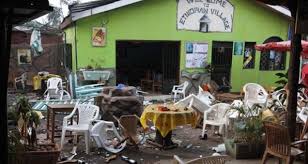
On July11, 2010, while Ugandan football fans and other revellers enjoyed the finals of the World Cup at the Kampala Rugby Grounds and the Ethiopian Restaurant in Kabalagala, two bombs went off at the different venues, killing over 70 people. In the ensuing investigations a number of suspects were rounded up and are currently facing various charges related to terrorism. Meanwhile, the Prosecution is also winding up its work and has submitted its report to court. The In series, the EagleOnline will relay the prosecution pillars on which it will rely to pin the suspects.
THE REPUBLIC OF UGANDA
IN THE HIGH COURT OF UGANDA AT KAMPALA
CRIMINAL SESSION CASE NO 001 of 2010
UGANDA versus A1. HASSAN HUSSEIN AGADE
A2. IDRIS MAGONDU
A3. ISSA AHMED LUYIMA
A4. HASSAN HARUNA LUYIMA
A5. ABUBAKARI BATEMYETO
A6. YAHYA SULEIMAN MBUTHIA
A7. HABIB SULEIMAN NJOROGE
A8. OMAR AWADH OMAR
A9. MOHAMED HAMID SULEIMAN
A10. SELEMANI HIJAR NYAMANDONDO
A11. MOHAMED ALI MOHAMED
A12. DR. ISMAIL KALULE
A13. MUZAFAR LUYIMA
FINAL SUBMISSIONS OF THE PROSECUTION
BRIEF FACTS
On the 11/7/2010, there were near simultaneous blasts at Ethiopian Village restaurant in Kabalagala [EVR] and at Kyadondo Rugby club grounds in lugogo [KRC]. The two venues had been full of revellers watching the televised world cup final match. As a result of the two blasts, over 76 people died and several others sustained serious injuries. On the 12/7/2010, an unexploded Improvised Explosive Device [IED] was discovered at Makindye House and was recovered by the bomb squad of the Uganda police. The Uganda police launched an investigation into the blasts which were extended to Kenya and Tanzania. The Uganda police force [UPF] also sought assistance from Federal Bureau of Investigations [FBI] with the investigations. The accused persons were then arrested variously in Uganda, Kenya and Tanzania in relation to the explosions and were indicted accordingly. The accused persons subsequently challenged the constitutionality of their trial in the Constitutional Court, which heard the case and directed that the accused persons be tried by this court.
OFFENCES CHARGED
Prosecution has preferred the following indictments against the accused persons.
- 3 Counts of Terrorism c/s 7(1) and (2) (a) of the Anti-terrorism Act. [Count 1-3]
- 76 Counts of murder c/s 188 and 189 of the Penal Code Act [Counts 4-79]
- 10 Counts of Attempted murder c/s 204 of the Penal Code Act [Counts 80-89]
- 2 Counts of being an accessory after the fact c/s 29 of the Anti-terrorism Act [Count 90-91]
- 1 Count of belonging to a terrorist organization c/s 11(1)(a) and (3) of the Anti-terrorism Act. [count 92]
- 1 count of Aiding and abetting terrorism c/s 8 of the Anti-terrorism Act [count 93]
The thirteen [13] accused persons are indicted as follows;-
- A1-12 are charged with three counts of terrorism[count1-3]
- A1-12 are charged with 76 counts of Murder[counts4-79]
- A1-12 are further charged with 10 counts of attempted murder [ct 80-89]
- A13 is charged alone with 2 counts of being an accessory after the fact to the offence of terrorism [ct. 90 -91]
- A1 – 12 are charged with 1 count of belonging to a terrorist organization [ct.92]
- A12 is charged alone with 1 count of aiding and abetting terrorism [ct.93]
Burden and Standard of Proof
The burden of proving the guilt of the accused and the ingredients of the offences with which the accused are charged rests on the prosecution. The accused have no burden to prove their innocence at all or even disprove the prosecution testimony. This burden does not shift to the accused at all except in a few statutory cases. Woolmington v DPP [1935] AC 462, Okethi Okale and Others v Republic[1965] E.A 555.
The standard of proof in respect of the offences preferred is proof beyond reasonable doubt. The accused should not be convicted on the weakness of their defence but on the strength of the prosecution case.
In Miller V Minister of Pensions (1947) 2 All ER 372 at page 373/4 the standard “beyond reasonable doubt” was explained by Lord Denning who stated as follows:
“The degree of beyond reasonable doubt is well settled. It need not reach certainty, but it must carry a high degree of probability. Proof beyond reasonable doubt does not mean proof beyond the shadow of a doubt. The law would fail to protect the community if it admitted fanciful possibilities to deflect the course of justice. If evidence is so strong against a man as to leave only a remote possibility in his favour which can be dismissed with a sentence, of course it is possible but not in the least probable, the case is proved beyond reasonable doubt but nothing short of that will suffice”.
- 7(1) of the Anti-Terrorism Act provides as follows;-
Subject to this Act, any person who engages in or carries out any act of terrorism commits an offence and shall, on conviction –
(a) be sentenced to death if the offence directly results in the death of any person;
(b) in any other case, be liable to suffer death.
S.7(2) of the Anti-Terrorism Act provides as follows;-
A person commits an act of terrorism who, for purposes of influencing the Government or Intimidating the public or a section of the public and for a political, religious, social or economic aim, indiscriminately without due regard to the safety of others or property, carries out all or any of the following acts:
(a) intentional and unlawful manufacture, delivery, placement, discharge or detonation of an explosive or other lethal device, whether attempted or actual, in, into or against a place of public use, a State or Government facility, a public transportation system or an infrastructure facility, with the intent to cause death or serious bodily injury, or extensive destruction likely to or actually resulting in major economic loss.
From the above provisions of the law, to prove the offence of terrorism, the prosecution has to prove beyond reasonable doubt the following ingriedents/elements;-
- Intentional and unlawful manufacture, delivery, placement, discharge or detonation of any explosive or other lethal device, indiscriminately and without due regards to safety of others or property.
- These acts must be done in a place of public use, a state or government facility, a public transportation system or an infrastructure facility.
- There should be an intention to cause death or serious bodily injury or extensive destruction likely to, or actually resulting in major economic loss.
- The acts must be done for the purpose of influencing the government or intimidating the public or a section of the public and for a political, religious, social or economic aim.
- The accused persons must have participated.
To prove the first 4 elements/ingredients of terrorism, prosecution relies on the evidence of;-
- PW1 who testified that he was part of the Al shabaab movement which he joined towards the end of 2008. He said it is a movement that fights for jihad and is fought by Muslims. It is based in Somalia.
- He explained how he joined Al Shabaab and how he eventually travelled to Somalia. He described the training that he underwent in Somalia and the battles he fought on the side of Alshabaab in places like Kismayo, Baidowa, Barawe and Mogadishu.
- He named Al Shabaab leaders like Nabahan, Jaberi, Ikrima, Amar. While in Somalia, Nabahan the Al Shabaab leader summoned him and informed him of a plan to attack Uganda and that he had been chosen to participate in that operation as one of the leaders and he was pleased. He was sent to Uganda on surveillance. While in Uganda he surveiled different places which were frequented by foreigners especially Americans and took photographs of these places which included the American embassy and Capital Pub. He later went to Kigali, Rwanda. While in Kigali, he learned that Nabahan had been killed by Americans in battle.
- He returned to Somalia and met Ikrima, Jaberi and Amar. He gave them a brief of his mission but they changed the mission to identifying other places to attack since Uganda had sent the UPDF to Somalia to fight Al shabaab under AMISOM.
- They identified him and 7 others to participate in the new mission and trained them in several areas including use of telephone and secret codes and in detonating bombs.
- He had also been trained to be a suicide bomber by Nabahan.
- The witness and his team travelled to Kenya with 4 explosive jackets/bombs and the witness continued to Kampala with the object of renting a suitable house to serve as a base to coordinate their mission.
- He identified and rented a house in Nankulabye, Kampala. This house was however later rejected by A3.
- The facilitation to rent this house was provided by the leadership of Al Shabaab in Somalia. The witness was summoned back to Kenya by Jaberi and met him with Amar and A11, and they planned how to smuggle the explosives into Uganda.
- In Nairobi, they went to a house in Kawangware and south B where he met A7 and A10. The bag containing the explosives was brought into the house, Jaberi opened the bag, removed the 4 explosive jackets and laid them on the carpet.
- These were the same jackets they had brought from Mogadishu earlier. Jaberi explained to A10 that these were the jackets they were moving to Kampala.
- The following day, the witness met with A10 who was driving a Toyota landcruiser station wagon, green in colour carrying the explosives and the two set off en route to Uganda.
- The witness was however arrested at Malaba Kenya before crossing to Uganda while A10 continued and crossed into Uganda. The witness was later handed over to Ugandan authorities where he was charged of forging a Ugandan passport and remanded to Luzira prison. It was while he was at Luzira that he heard and watched on TV that the mission had succeeded and Al shabaab claimed responsibility.
PW2 is another principal prosecution witnesses and an accomplice in the commission of the offences indicted.
- He testified about how he was recruited to support jihad and the Al Shabaab by A3. A3 first prayed in Arabic and asked for his help which he said was a religious obligation and he was obligated to respond. He stated that he accepted to help A3 because it was a religious call.
- The mission to be accomplished was to punish Uganda for taking its soldiers to Somalia to fight al shabaab under AMISOM.
- He states that he agreed to help and his role at that time was to assist identify the targets to attack. He and A3 surveilled places like Bohemian Pub in Munyonyo but A3 did not like the place because there were few people.
- He wanted a place with so many people whether Ugandans or otherwise.
- They then went to Kyadondo rugby club, they found many people and A3 was happy about it as he said this will make more impact. They and A4 also went to Ethiopian village restaurant in Kabalagala and Icelink discotheque in Makindye with the object of identifying targets.
- He testified that on 9/5/2010, A3 called him to receive some items from Nairobi. The items were received by him at his home along Busabala road in Najjanankumbi.
- The items were brought in a green Toyota land cruiser driven by A10. They were in a green heavy travel bag. After A3 and A10 checking the contents, he kept the items in one of his rooms. Thereafter, they all went and booked A10 into Niagara Hotel where he spent the night.
- In early July 2010, A3 came to collect his luggage. A3 displayed the contents of the bags and told him ‘eno ye nsonga’ meaning this is the whole issue, or the crux of the matter.
- He asked A3 what the items were and he stated these were explosives, the kind used by suicide bombers. He packed them carefully and took them on a bodaboda.
- A3 later asked him to extend his role beyond surveillance as A3 had to leave for Kenya before the mission was to be executed and he accepted.
- On 10/7/2010, A3 gave the witness and A4 final instructions and also gave them the keys to his house and he departed.
- On their way home, A4 bought 2 mobile phones from Mutaasa Kafero plaza, a Nokia 3510 and MTN Kabiriti phone. PW2 and A4 proceeded to the safe house at para zone, Namasuba. Inside they found two young men, one he described as slim, light skinned with protruding incisor teeth [Somali] and the other dark, short with a flat nose [Kenyan].
- He later came to know their names as Mursal and Kakasule respectively from A1 while in prison. They were watching a film of wars in Afghanistan with the television volume muted.
- The photographs of the heads/faces of these two individuals were identified by the witness and tendered in evidence as PE175 and PE180.
- The witness was introduced to the men by A4 as ‘a brother’ who was going to work with them in the mission.
- They then left the house and carried out further surveillance with A4 and Kakasule going to EVR via Makindye and the witness with Mursal going to KRC.
- On 11/7/2010 at around 6.30pm, he went to the safe house and found when the explosives had been assembled. A demonstration had to be made for him on how they would work. He and A4 went into a room and prayed.
- Thereafter A4 left with Kakasule to EVR and Makindye house, while the witness and Mursal went to KRC. The witness and Mursal gained entrance into the grounds. PW2 was carrying explosives in a laptop bag while Mursal was wearing a suicide vest.
- At the agreed time of 11.15pm, they detonated the explosives and the witness fled the scene on a bodaboda. [ As a result of the explosions, many people were killed and injured indiscriminately].
- Upon arrival home he twisted the phone and dropped it in the pit latrine.
- The charge and caution statement of PW2 to the police was tendered in evidence as PE97. It supports his testimony in court.
Stories Continues after ad