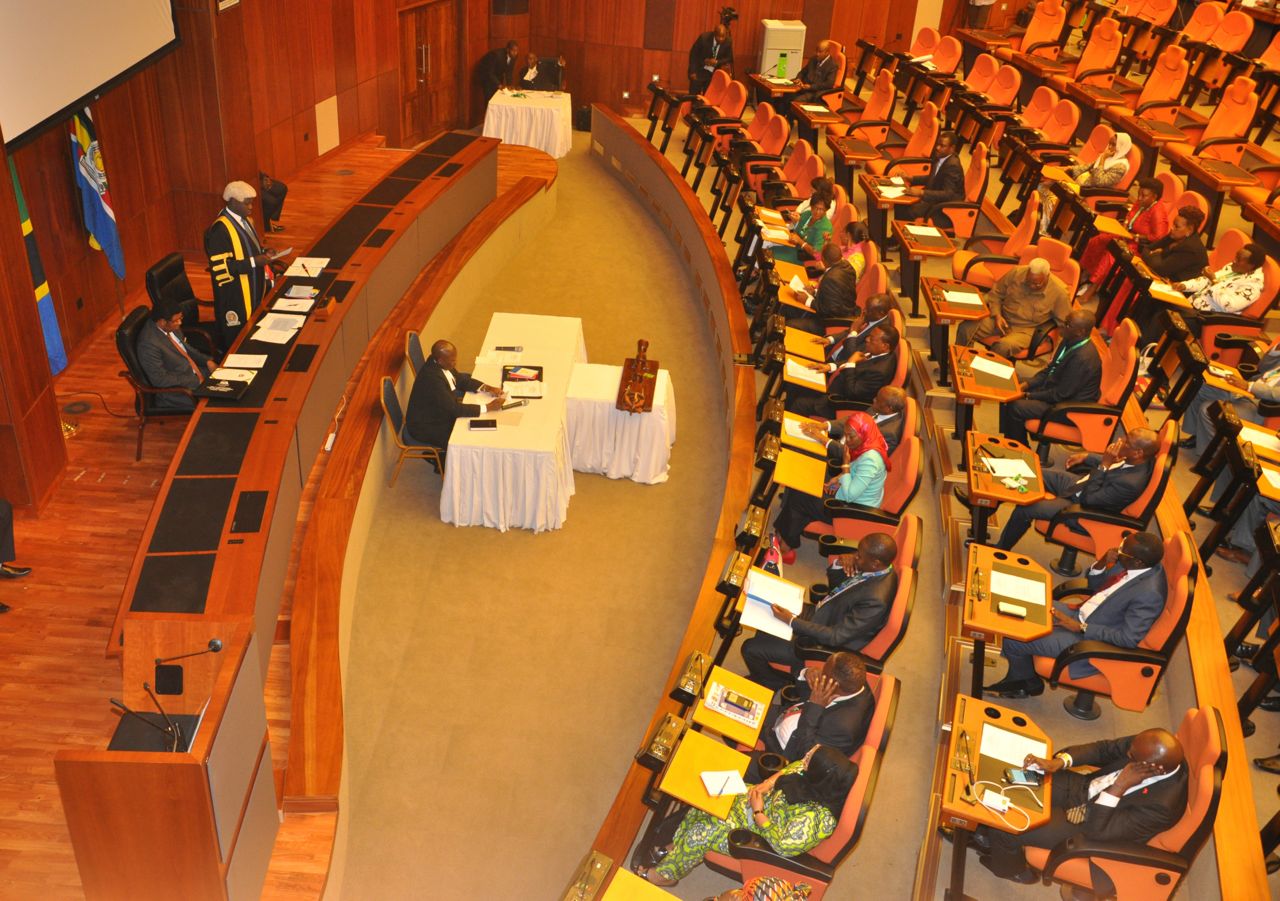
Amb Augustine Phillip Mahiga takes the Oath of Allegiance to the Assembly before the Clerk to the Assembly, Kenneth Madete. at the back is Hon Angela D. Kizigha
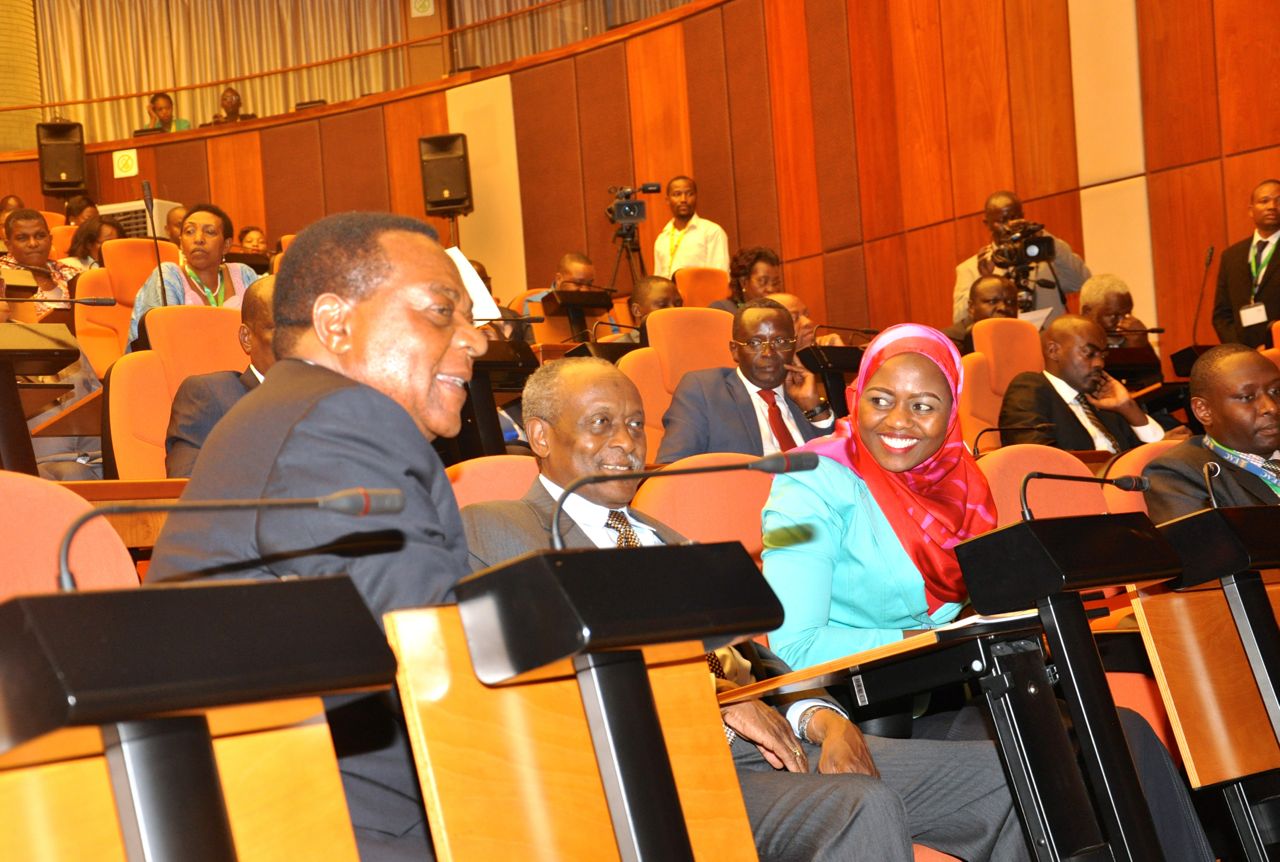
The East African Legislative Assembly (EALA) yesterday administered the Oath of Allegiance to Hon Amb Augustine Phillip Mahiga, the Minister for Foreign Affairs, East African, Regional and International Co-operation of Tanzania.
Amb Dr Mahiga is now an ex-officio Member of the Assembly after the Oath of Allegiance to the House was administered by the Clerk of EALA, before the EALA Speaker, Rt Hon Daniel F. Kidega, in accordance with Rule 5 of the Rules of Procedure of the Assembly. Under Article 48 of the EAC Treaty, ex-officio Members of EALA consist of Ministers responsible for East African Affairs from the Partner States.
And Rule 5(5) specifically states that “when a Member first attends to take his or her seat other than at the first sitting of a new House, he or she shall be brought to the table by two Members and presented by them to the Speaker who shall then administer the Oath or Affirmation of Allegiance”.
The Minister was ushered into the House by Hon Adam Kimbisa and Hon Angela Daisy Kizigha.
Amb Augustine Phillip Mahiga (left) is welcomed by his colleagues, Hon Shem Bageine, Minister for State, East African Community Affairs and the Minister for EAC, Burundi, Hon Leontine Nzeyimana
Hon Mahiga was appointed Minister by President John Pombe Magufuli in the cabinet named in December 2015 and prior to his appointment, Dr Mahiga, a diplomat, served as the Permanent Representative of Tanzania to the United Nations. He was also the UNHCR Representative to Italy, Republic of Malta and Republic of San Marino. Between the years 1994 to 1998, Ambassador Mahiga served as United Nations High Commissioner for Refugees (UNHCR) Chief of Mission in New Delhi, India. He has also served as Chief of Mission in Monrovia, Liberia.
Amb Mahiga, rose into public service from the world of academia and was appointed by the Government to the rank of Ambassador while on secondment to the UNHCR. He was once a Senior Lecturer in International Affairs and Regional Co-operation at the University of Dar es Salaam, a post he held from 1975-1977.
Amb Mahiga earned a Bachelor of Arts (Education) at the University of East Africa in Dar es Salaam, Tanzania. He earned his Master of Arts degree at the University of Toronto as well as a Ph.D. in International Relations from the same institution.
The Prime Minister of the United Republic of Tanzania, Rt. Hon Majaliwa, Kassim Majaliwa and the Speaker of EALA, Rt. Hon Daniel Fred Kidega confer
Trade between the five members of the East African Community has risen from US$2 billion in 2005 to US6 billion in 2014, the Tanzanian Prime Minister has said.
“Trade is now at 23%, over and above intra-African Trade figure of 12%. There has been a 300% increase in the value of trade from 2 billion USD in 2005 to 6 billion USD in 2014,” Rt Hon Majaliwa Kassim Majaliwa said.
Mr Majaliwa, who represented President John Joseph Pombe Magufuli, who is also the Chair of the Summit of EAC Heads of State, was delivering the State of EAC address at the commencement of the 5th Meeting of the 4th Session of the 3rd Assembly in Dar es Salaam, Tanzania.
The PM said the remarks gave a score-card on a number of areas related to the pillars of integration including the Customs Union, Intra EAC trade; Infrastructure and the Common Market.
The Speaker, Rt. Hon Daniel Kidega addresses the Plenary in Dar es Salaam
Rt Hon Majaliwa said that the Community had adopted the use of One Stop Business Posts (OSBPs) as a trade facilitation concept to minimize delays at the border posts and on the major corridors in the region. He informed the House that out of the 15 borders earmarked to operate as OSBPs, seven had been completed and 4 others were operating as OSBPs using bilateral agreements.
The seven are Gasenyi/Nemba, Ruhwa, Lunga Lunga/HoroHoro, Holili/Taveta, ISebania/Sirari, Kagitumba/Mirama Hills and Rusumo, the PM said and added intra EAC Trade was expected to register phenomenal increase in the next few years.
Rt. Hon Majaliwa also hailed the East African Business Council (EABC) for signing commitments to the ethical business standards to guide collaboration between various stakeholders in promoting trade.
He urged the region to push for total removal of Non-Tariff Barriers (NTBs).
On Infrastructure, the Prime Minister remarked that Partner States were actively engaged in the Standard Gauge Railway with Kenya having completed coverage of about 200km out of 472 km of formation as of September last year.
On the Common Market, the Prime Minister gave an account of achievements realized in the Partner States to date and noted that Republic of Burundi now recognizes the academic qualifications, experiences obtained, licenses and certifications obtained for the workers from other EAC Partner States.
Tanzania, he said, has issued a total of 3,222 simplified Certificates of Origin as at June 2015 as compared to 2,355 certificates issued in 2014. In Kenya, the Prime Minister said development of an SMS based NTBs Reporting System to facilitate reporting and subsequent elimination of NTBs had been initiated
Rwanda, the Prime Minister added, had eliminated all Non-Tariff Barriers and further harmonized demographic and social statistics for undertaking agricultural surveys and census. All the initiatives he added, were geared towards enhancing the Common Market Protocol. In Uganda, the value of goods from other Partner States accorded zero-tariff treatment grew by 9% while 360 EAC standards on traded goods had been adopted and were in application, Mr Majaliwa said.
He however lamented that the region continued to face challenges, citing delay of issuance of electronic Certificate of Origin which were yet to be adopted regionally, and the need to fast-track the completion of the Annex on Mutual Recognition of Academic and Professional Qualifications.
The Prime Minister also lauded the Speaker for EALA’s continued role in legislation, oversight and representation and urged the Assembly to double its efforts in sensitization of the publics.
In his welcoming remarks, the Speaker of the EALA, Rt Hon Daniel F Kidega remarked that EAC integration process was stronger given the commitment of various stakeholders in the process.
He however urged the EAC to instil quick interventions with regards to the Common Market Protocol, and added that there was need to ensure free movement of persons as well as the rights to residence.
The Speaker also hailed Tanzania for its commitment to harmonising work and resident permits as well as the necessary fees in line with providing preferential treatment to the citizens of the EAC Partner States. He remarked that the Republics of Rwanda, Kenya and Uganda had already abolished work permit fees and introduced inter-state passes and that the move encouraged workers to move freely in search of opportunities.
Rt. Hon Kidega hailed the Summit of the EAC Heads of State for the significant announcements made at the 17th Summit of the EAC Heads of State held last week in Arusha, Tanzania, and welcomed the entry of South Sudan to the EAC fold, adding that EALA looked forward to welcoming the new member’s legislators.
The EALA Speaker also lauded the Heads of State for launching the EAC International E-Passport. On his part the Speaker of Parliament of Tanzania Rt Hon Job Ndugai, also said the region was looking forward to inclusion of the new Legislators from South Sudan.
The Electoral Commission is today, March 9, conducting the Regional Delegates Conference in the four traditional regions of Uganda, to elect ten (10) delegates for each of the four (4) regions, who will form part of the subsequent Electoral College for the election of Members of Parliament Representing Workers. The regions are Northern Region, Arua; Eastern Region, Mbale; Central Region, Luwero; Western Region, Mbarara.
Then tomorrow the National Delegates Conference to elect Members of Parliament Representing Workers will take place at Mandela National Stadium, Namboole.
The electoral process started with the elections of delegates of the Non-unionised Workers, followed by the Sub County Delegates Conference on Saturday March 5, where ten (10) delegates, with at least three women, were elected to the District Delegates Conference on March 7.
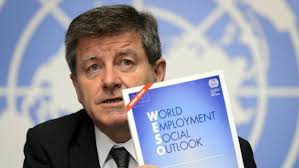
International Labour Organisation (ILO) chief Guy Ryder
As the world commemorates the Women’s Day, only ‘marginal improvements’ have been registered in the world of work in the past 20 years, according to a global study.
The International Labour Organization (ILO) said the difference in the employment rate between men and women had decreased by 0.6% since 1995.
In countries where women access work more easily, the quality of their jobs ‘remains a matter of concern’.
Launching the report, ILO chief Guy Ryder said it showed ‘the enormous challenges women continue to face in finding and keeping decent jobs’.
“Throughout their working lives, women continue to face significant obstacles in gaining access to decent jobs,” the UN agency said.
igher levels of unemployment among young women
“Only marginal improvements have been achieved since… 1995.”
The report looked at data from 178 countries and found that the rate of women’s participation in the workforce was 25.5% lower than men’s participation in 2015 – a gap only 0.6% smaller than 20 years earlier.
In many regions of the world, women were more likely to stay unemployed – 6.2% of women are jobless across the world compared to 5.5% of men – and often had to accept lower quality jobs.
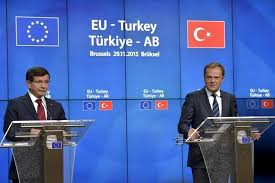
The EU and Turkey say they have agreed on the broad principles of a plan to ease the migration crisis at a summit in Brussels, but delayed a final decision.
European Council President Donald Tusk said all irregular migrants arriving in Greece from Turkey would be returned.
For each Syrian returned, Turkey wants the EU to accept a recognised Syrian refugee, and offer more funding and progress on EU integration.
Talks on the plan will continue ahead of an EU meeting on March 17-18.
Europe is facing its biggest refugee crisis since World War Two. Most migrants come via Turkey, which is already sheltering more than 2.7 million refugees from the civil war in neighbouring Syria.
Meanwhile, the EU will give Turkey €3bn it has requested to help it shelter Syrian refugees.
South Sudanese IDPs line up for relief supplies including food
The United Nations (UN) has accused South Sudan’s government as well as forces loyal to Riek Machar to have blocked trucks from delivering relief supplies in various parts of the country.
According to the UN more than one million people in South Sudan are now in dire need of food. “There is a problem of access throughout the country and by all parties”, said Ariane Quentier, UN’s spokesperson in South Sudan.
The UN said they are having difficulties transporting basic amenities such as food and clean water to those trapped in areas still under fighting. According to Quentier, those people are in desperate need of medical supplies as well. “Whatever vulnerable people need when they have been displaced – they are in need of humanitarian assistance and support,” she added.
Deputy rebel spokesman Major Dickson Gatluak denied any involvement of their troops in blocking the aid trucks. He said the government must shoulder the blame alone.
Juba: Aid blocked for ‘security’ reasons
In a rare admission the government in the capital Juba confirmed that the aid cargos have been blocked, but for security reasons. “We put our security first”, said South Sudan’s Information Minister Michael Makwei, adding: “We will not just allow any convoy to move. Last time when we apprehended a convoy which was taking relief, we apprehended arms.”
In March 2014 government troops intercepted eleven UN trucks allegedly carrying undocumented weapons. The UN’s Ghanaian contingent claimed the trucks were heading to their base in the north of the country and that the cargo was mislabeled. Juba, however, maintained that the Ghanaian troops were trying to smuggle arms to the rebels. The incident cast a shadow of doubt on the work of the UN in South Sudan and is now affecting humanitarian efforts.
Meanwhile, the blockade of aid supplies comes at a time when human rights abuses remain a major problem in South Sudan. According to a recent report from Human Rights Watch (HRW), the South Sudanese army has carried out numerous killings, enforced disappearances, rapes and abuses in the region of Western Equatoria. The report claims that government troops have attacked civilian areas, burned houses, detained critics arbitrarily and carried out summary executions.
Western Equatoria had also been cut off from aid supplies. HRW’s researchers spent a week in Western Equatoria in February. According to the rights’ group, the conflict is spreading further west to previously uncontested areas of the country.
HRW said government soldiers were also responsible for an attack against a UN camp in February 2016. Gunmen stormed and torched a camp sheltering refugees in the northeastern town of Malakal. At least 25 people were killed and 120 wounded. The UN office for the Coordination of Humanitarian Affairs said that reports of troops in government army uniforms ‘firing on civilians’ were ‘credible’. They further said that the attack could amount to a possible war crime.
After gaining independence from Sudan in 2011, South Sudan slithered back into a civil war in 2013. The conflict began as a power struggle between the South Sudan’s President Salva Kiir and his deputy Riek Machar. According to the UN, 50.000 people have died and 2.2 million people have been displaced by the armed conflict.
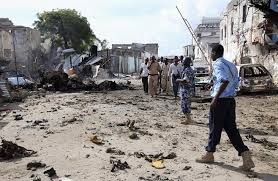
A US air strike has killed more than 150 al-Shabab militants in Somalia, the Pentagon says.
Spokesman Captain Jeff Davis said the strike hit a training camp where a ‘large-scale’ attack was being planned.
“We know they were going to be departing the camp and they posed an imminent threat to US and [African Union] forces,” Captain Davis said.
“Initial assessments are that more than 150 terrorist fighters were eliminated,” he added.
Mr Davis said the strike, by both drones and manned aircraft, took place on Saturday and targeted Raso Camp, a training facility about 120 miles (195km) north of the capital, Mogadishu.
The camp had been under surveillance for some time, according to Mr Davis. “There was a sense that the operational phase was about to happen,” he said.
He said the group had neared the completion of specialist training to conduct ‘offensive operations’, but did not give any details about the alleged plans.
Al-Shabab, an affiliate of al-Qaeda, was pushed out of Mogadishu by African Union peacekeeping forces in 2011 but has continued to launch frequent attacks in its bid to overthrow the Western-backed government.
The group has said it carried out a string of recent attacks including a twin bombing at a busy restaurant in the Somali city of Baidoa last month.
Also on Monday, the Australian navy said it had seized a huge cache of weapons on a fishing boat off the coast of Oman that was apparently heading for Somalia.
Grenade launchers, machine guns, and 2,000 assault rifles were concealed under fishing nets, a Navy spokesman said.
Crippling al-Shabab is top of a recently-announced US military strategy for Africa, which also includes addressing the situation in Libya and containing Boko Haram in West Africa. With drones from its nearby bases in neighbouring Djibouti, the US has succeeded in striking hard at the heart of al-Shabab operations, including killing Ahmed Godane, the leader of the jihadi group, in 2014.
The jihadis have since learned that they are often watched by surveillance aircraft and so they tend to meet under trees to avoid detection. This method has its limits, as this latest incident shows. They cannot train at will without being seen.
Al-Shabab maintains its determination to establish its rule over Somalia, hence its resilience and increasingly sophisticated attacks. The group is suspected to be behind an explosion at a security checkpoint at the Beledweyne airport which could have been more lethal had the explosives got aboard an airliner.
NRM-EC Chairperson Dr. Tanga Odoi and SG-Justine Kasule Lumumba are no-longer at ease.
All isn’t well at the National Resistance Movement headquarters as a section led by Dr.Tanga Odoi have written to President Museveni to intervene in the bickering between party’s Secretary General, Justine Kasule Lumumba and staff.
According to the March 1, 2016, petition to Mr Museveni who doubles as NRM Chairman, there is a lot of suffering by both technical and support staff due to the manner in which Lumumba conducts her duties.
“Congratulation indeed and long live NRM. We the undersigned all being either technical or support staff at the secretariat wish to petition you over the conduct of our boss, the Secretary General and humbly request to meet you to share with you the problems , challenges and suffering we are going through at the secretariat. Details of our issues are outlined on the next page” Dr. Odoi wrote.
Dr. Odoi says there is poor communication and flow of information between the office of the SG and staff generally. Odoi accuses Lumumba of not calling for meetings with staff even when there are problems and Lumumba isn’t there to listen to the staff. The petition is accompanied by names of staff who signed the petition
“There is discrimination of staff at NRM electoral commission which headed by Tanga Odoi, majority of who have not been paid any salary/ allowances.” He wrote
Adding “There is selective payment of salaries, constant bickering, inadequate, unequal and imbalanced salary remunerations”
Odoi says there is sidelining of staff especially those perceived as enemies and lack of accountability for the funds given to the secretariat.
“Your Excellency, there are many other grievances and problems facing your humble workers at the secretariat, we are suffering quietly yet the SG has constructively denied us audience by constantly operating from her private office which is strictly inaccessible for staff from secretariat”
“We shall be very grateful for an opportunity to meet you, your Excellency. We thank you, long live MRM, and long live President Museveni.
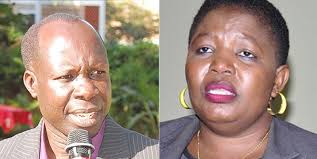
Former Makerere University Guild President, Ann Adeke Ebaju has won the national female youth slot.
According to reports coming from Homia, Adeke is reported to have beaten her close competitor, Ann Ruyonda of National Resistance Movement (NRM) party.
Lost: NRM’s Ann Ruyondo
Though, she contested as an independent, Adeke, is a Forum for Democratic Change (FDC) die-hard who won the Makerere University guild race using the party’s ticket. Adeke replaces Monica Amoding who also hails from same Teso sub-region and recently won the Kumi district Woman Member of Parliament.
The Supreme Court has adjourned to Thursday March 14, a petition filed by Go Forward candidate John Patrick Amama Mbabazi, seeking to challenge the election of President Yoweri Museveni.
On February 20 the Independent Electoral Commission (IEC) announced Mr Museveni winner of the Feb 18 presidential election with 60.8 per cent, but his fellow candidates Mbabazi and Forum for democratic Change (FDC) flag bearer Dr Warren Kizza Besigye disputed the results, prompting Mbabazi, a former Prime Minister and ruling party (NRM) Secretary General, to move to court, and sue Mr Museveni and the IEC.
And today, the Supreme Court justices led by Chief Justice Bart Magunda Katureebe heard the petition and adjourned for fresh conferencing till March 14, while also telling the petitioner’s lawyers to furnish the respondent (Museveni) with an amended petition before the close of business today.
Earlier, Mbabazi’s legal team had sought an application for amendment received at 10:15am when court was supposed to be in session. In the amendment of pleadings Amama team wants all declaration forms from 50 districts and a recount.
The judges argued that the amendments are important for the issues under consideration.
The respondent’s team also protested, saying they had been ambushed by the amendment, and that the application to amend will delay the court process and amount to abuse of court process. They challenged the petitioner’s legal team to mention the special circumstances that have prompted the amendment of the petition. According to the AG, representing the respondent, it is not necessary to amend the petition merely to bring new evidence.
‘They can do so in other affidavits,’ the AG argued.
‘We are here for conferencing but we have been served with an amendment which substantially alters the first petition,’ the respondent’s team further argued.
But the petitioner’s legal team argued that ‘there is no specific rule that bars the petitioner from making amendments’.
Meanwhile, Counsel Asuman Basalirwa had expressed concern and notified court about the reported arrests and intimidation of Amama’s would be witnesses, and asked for witness protection.
Meanwhile, the press, public and advocates have been reminded about the subjudice rule and warned against discussing the case in media. The press was also advised to set their machines and sit at the back because the ‘court room is not a theatre and should be treated with decorum’, the judges said.
The full bench of SC judges hearing the petition is led by Chief Justice Bart Katureebe, while the Museveni’s team is led by the Attorney General’s team led by Deputy AG Mwesigwa Rukutana.
The Electoral Commission has also been conjoined to the petition and is represented by lawyers Muhammad Mbabazi and Enos Tumusiime.