Stanbic Bank
Stanbic Bank
17.3 C
Kampala
Stanbic Bank
Stanbic Bank
Home Blog Page 2248

Support NRM, we value all Ugandans – Candidate Museveni


NRM Presidential flag bearer, President Yoweri Kaguta Museveni urged Ugandans to shun sectarianism and called on them to unite for Uganda’s steady progress to transformation.

The President was today speaking at his second rally held at Bobi Technical School Grounds in Tochi Constituency, Bobi County in Gulu district.

Museveni Gulu - Tochi - Bobi subcounty 03
Museveni Gulu – Tochi – Bobi subcounty 03

Museveni Gulu - Tochi - Bobi subcounty 15

“NRM does not believe in marginalization. We value everyone,” he said. Candidate Museveni also asked his supporters to vote for the NRM because it is the only party that can manage Uganda affairs.

The President said that government will support women and youth groups to acquire loans and skills to enable them create jobs and decent incomes.

Mr. Museveni said that Uganda is now economically capable and stable in terms of security and nothing will stop it from achieving development.

“We only need to take care of poverty and unemployment. We are going to support the women groups and youth to start small processing plants to add value to their products and improve their incomes,” he said.

The rally was attended by a delegation of NRM party leaders from Kinkinzi West led by Honorable Chris Baryomunsi.

Stories Continues after ad
Museveni orders for the procurement of 18m hoes

Museveni campaigning in Yumbe - Town Council - Bouma Grounds 18-2


President Yoweri Museveni has ordered for the procurement of eighteen million hoes, to cater for six million households in the country.

In a communication dated November 20, Mr Museveni, writing to the Prime Minister Dr Ruhakana Rugunda, said the issue was discussed in Cabinet last financial year but no action was seemingly taken.

‘I direct that in the next financial year, (2016/2017) you include, in the budget, the purchase of 18 (eighteen) million hoes. These hoes will be distributed to 6 (six) million households, each receiving 3 (three) hoes,’ the President wrote, adding: ‘We had discussed this issue in the Cabinet with a view of providing some hoes in the current financial year. What happened?’,  Mr Museveni queried, in a letter copied to the Vice President Edward Kiwanuka Ssekandi and the Permanent Secretary and Secretary to the Treasury, among others.

IMG_6986

In yet another communication, the President wrote to the health minister Dr Elioda Tumwesigye, directing him to pay attention to Hepatitis B in the West Nile and Northern Uganda regions, border areas where it may be difficult to contain the disease because of the constant movements.

In the letter the President urged the minister to focus on information dissemination, intervention, treatment and vaccination against the disease.

And in yet another communication, the president has directed the Micro Finance Support Centre to ease access to loans.

‘We are all aware that the Micro Finance Support Centre Ltd was incorporated by Government to allow timely and affordable financial services to low income earning Ugandans to propel household income at family level’, the president wrote to the State Minister of Finance Caroline Okao.

Stories Continues after ad
Mali hotel hostage stand-off over, US says

Some of the hostages rescued from the building had been wounded


Rescued hostage: "I heard gunshots very early in the morning"
Rescued hostage: “I heard gunshots very early in the morning”


An attack by suspected Islamist militants who took 170 people hostage at Radisson Blue Hotel in the Malian capital is over, US officials say.

The National Security Council condemned the “heinous attack”.

Malian officials earlier said militants had “no more hostages” and Special Forces were chasing them. Reports suggest at least 27 people were killed.

Al-Qaeda in the Islamic Maghreb and its offshoot al-Murabitoun said they carried out the attack.

A UN official, who spoke on condition of anonymity, said 12 bodies were found in the basement and 15 on the second floor.

It is not clear if this includes two of the attackers who are reported to have died.

One of the hostages killed was Geoffrey Dieudonne, a member of parliament in Belgium’s Wallonia region.

China’s state news agency Xinhua says three Chinese nationals are among the dead. The US state department said one US citizen was killed.

UK Foreign Secretary Philip Hammond said three Britons in the hotel were safe.

Pictures showed that some of the hostages leaving the hotel were wounded.

The US-owned hotel is popular with foreign businesses and airline crews.

Eyewitnesses said up to 13 gunmen had entered the hotel shooting and shouting “God is greatest!” in Arabic.

Analysis: BBC Security Correspondent Frank Gardner

The claim by an obscure Saharan jihadist group allied to al-Qaeda that they were behind the attack is a reminder that the country still faces an insurgency.

In 2013 French forces effected a stunningly swift reversal of al-Qaeda’s takeover of most of Mali. But Mali is a large, poor country with porous borders and large areas of ungoverned space where jihadist groups have been able to hide and plan attacks.

It has not been helped by the ease with which weapons can come across from Libya, nor by the proximity of a murderous insurgency in Nigeria where Boko Haram reportedly killed more people last year than Islamic State did in Syria and Iraq.

It is clear that Mali will continue to need international military support. But to defeat terrorism in the long term it will also need secure borders, good governance and more economic opportunities for young Malians.


Some of the hostages rescued from the building had been wounded


Why Mali is an insurgent hotspot

Profile: Al-Murabitoun

Find out about Mali

Before Special Forces stormed the building, a security source told Reuters news agency that some hostages who were able to recite verses of the Koran were being freed.

Mali’s presidency thanked the security forces and friendly countries for their support in responding to the attacks.

Off-duty US servicemen helped in the hostage rescue operation. French Special Forces were also involved.

There is as yet no established link with the attacks in Paris one week ago that killed 130 people.

In August, suspected Islamist gunmen killed 13 people, including five UN workers, during a hostage siege at a hotel in the central Malian town of Sevare.

France, the former colonial power in Mali, intervened in the country in January 2013, when al-Qaeda-linked militants threatened to march on Bamako after taking control of the north of the country.

Mali’s President Ibrahim Boubacar Keita cut short a trip to a regional summit in Chad.

The UN force in Mali took over responsibility for security in the country from French and African troops in July 2013, after the main towns in the north had been recaptured from the Islamist militants.


Militancy in Mali:

  • October 2011: Ethnic Tuaregs launch rebellion after returning with arms from Libya
  • March 2012: Army coup over government’s handling of rebellion, a month later Tuareg and al-Qaeda-linked fighters seize control of north
  • June 2012: Islamist groups capture Timbuktu, Kidal and Gao from Tuaregs, start to destroy Muslim shrines and manuscriptsand impose Sharia
  • January 2013: Islamist fighters capture a central town, raising fears they could reach Bamako. Mali requests French help
  • July 2013: UN force, now totalling about 12,000, takes over responsibility for securing the north after Islamists routed from towns
  • July 2014: France launches an operation in the Sahel to stem jihadist groups
  • Attacks continuein northern desert area, blamed on Tuareg and Islamist groups
  • 2015: Terror attacks in the capital, Bamako, and centralMali


Stories Continues after ad

Civil Society petition EALA on Burundi

The Speaker receives the petition from Pan-African Lawyers Union (PALU) Programme Officer, Evelyne Chijarira as other Officials look on.


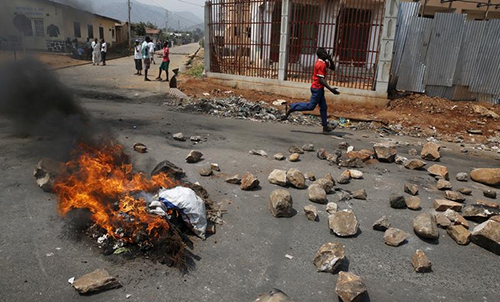
Civil Society Organisations in the EAC have petitioned the regional Assembly to urgently undertake specified number of actions within its mandate to contain the situation in the Republic of Burundi.

Representatives of the Pan African Lawyers Union (PALU) and the East African Civil Society Organisations’ Forum (EACSOF) Monday afternoon presented a petition to EALA Speaker, Rt. Hon Daniel F. Kidega at a brief ceremony at the Speaker’s Chambers in Arusha.

The Civil Society representatives are petitioning EALA among other things to make strong recommendation to the Summit of EAC Heads of State that the Republic of Burundi should not assume the rotating Chairmanship of the EAC until it resolves the political, human rights and humanitarian crisis in the country.

The petitioners further urge the House to call upon the Chair of the Assembly of Heads of State and Governments of the African Union to take concrete steps towards preventing Burundi from descending into genocide or mass atrocities.   Such measures the petition says include, enhancing the numbers and capacity of the Human Rights Monitors and Military monitors deployed to the country. They further call for the sanctions regime of the African Union to be activated.

The petition avers that EALA or a relevant committee within should immediately call for a public hearing in Arusha, Tanzania, that would welcome Burundian and East African citizens to testify to the occurrences in the country and to suggest proposals for resolution to the crises.

In addition to PALU (Principal Petitioner) and EACSOF, the Atrocities Watch Africa, Centre for Citizens’ Participation on the African Union, East Africa Law Society and the Kituo Cha Katiba append their signatures to the petition.

The petition states that there have been numerous reports of cases of assassinations, extra-judicial and arbitrary killings of over 130 persons and wants EALA to condemn what it terms arbitrary killings as well as the inordinate use of force by the police, security officials and members of a youth wing group, Imbonerakure.

The petitioners say that although the authorities in Burundi have ordered investigations into the killings, no single case has been concluded, citing the murder of the former head of intelligence Services, General Adolphe Nshimirimana.

“More recently, the arbitrary killing of the son of the eminent and award winning Human Rights Defender, Pierre Claver Mbonimpa, who is himself under recovery after been shot, for which no investigations have been done, despite statements by the Government condemning the killings”, a section of the Petition reads.


EALA Speaker,  Daniel F Kidega (2nd from right) in talks with the representatives of Pan African lawyers Union and the East African Civil Society organization Forum (EACSOF) who paid him a call earlier this week to present a petition on Burundi to the Assembly
EALA Speaker, Daniel F Kidega (2nd from right) in talks with the representatives of Pan African lawyers Union and the East African Civil Society organization Forum (EACSOF) who paid him a call earlier this week to present a petition on Burundi to the Assembly

The petitioners in addition, call on EALA to request the African Union to intervene in the political and humanitarian crisis citing its comprehensive and far reaching legal and institutional framework that includes the Constitutive Act of the African Union, 2000 and the African Charter on Human and Peoples’ Rights amongst others.

The petition acknowledges the measures taken by various organs and Institutions of the EAC since the crisis started in February this year. They include three Extra-Ordinary Summits by the EAC Heads of State held on Burundi which took place on May 13, 2015, May 31, 2015 and June 6, 2015 – the latter of, which appointed the President of the Republic of Uganda, H.E Yoweri Kaguta Museveni to mediate in the crisis.

EAC citizens, including some of the petitioners, filed a case before the East African Court of Justice, in reference No. 2 of 2015: East African Civil Society Organizations’ Forum (EACSOF) vs. The Attorney General of Burundi and 2 others.  According to the petitioners, the case requests the Court to ascertain whether the President of Burundi, could lawfully run for a third term in light of the relevant provisions of the Arusha peace and reconciliation agreement for Burundi (Arusha Accord) of 2000 and the Burundi Constitution of 2005.

The Reference No. 2 of 2015 was filed with an application for interim injunction whose citation is Application No. 5 of 2015 (arising from reference No. 2 of 2015) The East African Civil society srganizations’ forum (EACSOF) Vs the attorney general of the Republic of Burundi and 2 others. The application sought to injunct the elections of Burundi pending hearing and determination of the reference. The application was heard on 20th July, 2015 and a ruling was delivered on the same day denying the grant of an injunction.

“The East African Legislative Assembly (EALA) on its part, participated in the joint East African Community (EAC) observation mission to the Burundi elections, though it is yet to deploy its mandate and powers, under the treaty for the establishment of the East African Community, to the deepening political, human rights and humanitarian crisis in Burundi”, a section of the petition states.

The petitioners reiterate speedy responses to the situation in Burundi.

“Should the above measures not bear fruit within the next one month, the house (EALA) should call for suspension of the Burundi government from both the EAC and the AU,” the petition affirms in conclusion.

Under Rule 86 of the EALA rules of procedure, any citizen of the partner states, and nay natural or legal person residing or having its registered office in a partner state shall have the right to address, individually or in association with other citizens or persons, a petition to the assembly on a matter which comes within the community’s fields of activities and which affects him, her or it directly.


Stories Continues after ad

EALA sitting to be held in Kigali next week

RETURN OF THE HABYARIMANA GHOST: Rwandan President Paul Kagame. His country is embroiled in a conflict with France over the assasination of former President Juvenal Habyarimana.


Rwandan President Paul Kagame to preside over EALA sitting in Kigali next week.


The East African Legislative Assembly (EALA) shall hold its sitting in Kigali, Rwanda, next week.

The plenary which takes place from Monday, November 22, 2015 to Friday, December 4, 2015, is the third meeting of the fourth session of the third assembly.
The Assembly is to be presided over by the Speaker, Daniel F. Kidega. Top on the agenda during the two week period is the special sitting expected to be addressed by the President of the Republic of Rwanda, H.E. Paul Kagame.

Two key bills on the cards at the EALA meeting are the EAC disaster risk reduction bill 2013 and the EAC forestry management bill 2014.

The EAC forestry management Bill 2014 seeks to promote the development, protection, conservation, sustainable management and use of the forests in the community especially trans-boundary forests ecosystems, in the interest of present and future generations.

It further wants to espouse the scientific, cultural and socio-economic values of forests and harmonise national forest laws.

The Assembly adjourned debate on the forest management and protection bill, 2014 at its last sitting in Nairobi in October 2015.  The adjournment at committee stage followed the successful motion for the same, tabled by the chair of EAC council of ministers, Dr Harrison Mwakyembe, seeking for more time to enable the United Republic of Tanzania to make input.

Dr Mwakyembe then informed the house that the United Republic of Tanzania was expected to go to the polls in October and that it was necessary for the debate to be put on hold until such time that a new government is in place to effectively enable the Partner State to make its input.

The EAC disaster risk reduction bill 2013 on its part seeks to provide a legal framework for intervention and assistance for people affected by climate change and natural related hazards and to protect the natural environment through integration of comprehensive disaster risk reduction and management practices in the EAC.

Debate on the Bill, moved for second reading in August 2013, was halted following a request by the council of ministers to consult and consider its policy implications.  The EAC Ministers’ further called for the taking over of the Bill for appropriate amendment and re-introduction as a council of ministers’ bill.  At the same time, the move was to allow for pursuit of the ratification of the EAC protocol on peace and security which among other objectives, provides for co-operation in DRR management and crisis response.

During the plenary sittings, the house is also expected to receive and to debate on a number of reports.  They include that of the committee on accounts for the audited financial statements of EAC for the financial year ended June 30, 2014 and the committee on agriculture, tourism and natural resources report on the sensitisation workshop on standards by the African organisation of standardisation (ARSO).

The report of the committee on communication, trade and investment on the on-spot assessment of one stop border posts in the EAC is also expected to be tabled and debated.

In addition, the committee on legal, rules and privileges shall table its report on the implementation of resolutions and questions of the assembly and council commitments.

EALA sittings are held under the principle of rotation in line with article 55 of the EAC Treaty. Its last sitting took place in Nairobi, Kenya in October 2015.  EALA meets at least once in every year at its headquarter in Arusha, Tanzania


Stories Continues after ad

I am a natural producer – Brighton

producer Bright


As many of us eat and move out of hotels and eating bufundas without knowing who made the food, music lovers leave different venues without knowing the person behind the tunes they have been singing and dancing to, as Eagle Online’s Joshua Tumwesigye found out from Sound Records producer Brighton Bakabulindi aka Producer Bright.

Eagle Online: Who is producer Bright?

Brighton: I am Brighton Bakabulindi aka Producer Bright.

Eagle Online: Tell us about your education?

Brighton: I studied at Namirembe Infant School for my primary, later I joined Kasubi Secondary for O’level. I then joined Katikamu Light College for A ‘level and thereafter joined Crane Media Institute where I pursued a Diploma in Journalism and Mass Communication.

Eagle Online: Tell us about your music journey?

Brighton: I started singing in Namirembe Cathedral Church in 1996; I later joined Kampala Music School in 2000 and acquired a Diploma in Piano in 2003. In 2008 I joined production and started up my first studio at Nakulabye called Bloom Studioz.

Eagle Online:  What inspired you to join the music industry?

Brighton: I was inspired by my brother Mozart; I grew up seeing him produce music.

Eagle Online: Do you still own a studio?

Brighton: Yes, I still own a studio called Sound Records found in Kasubi.

Eagle Online: What have you achieved from music production?

Brighton: I own a studio; I look after my family since am a happily married man; I have managed to make a lot of friends and meet different people, not forgetting pursuing the Diploma out of my production work.

Eagle Online: Talk about the opposite side of the coin producer Bright?

Brighton: Like any other work I can’t escape the challenges mostly the power which is ever on and off; I have little money yet I want to set up a standard studio and I also want to be able to facilitate my movement to different places to acquire knowledge and skills about production.

Eagle Online: Talking about music production, tell us some of the producers you have mentored and the producers you have worked with so far?

Brighton:   I have mentored many producers such as Nash Wonder of Monster Studios, Producer Home Boy of Sound Records, Producer Rick Star and Producer Duncan of Sound Booklet Studios and I have managed to work with different producers including Bless, Dr Fizo, Mozart, Duncan as well as Dig Bour, with whom I co-produced a hit song “Go down low” that rocked the place.

Eagle Online: Tell us about the artists you have worked with so far, the songs you have produced, your best artiste as well as your best song?

Brighton: I have worked with a number of artistes including David Lutalo, Eddy Kenzo, Pallaso, Sheeba Karungi, King Saha, Hot Man Predator and many other artistes.

And the songs I have produced include Manya by David Lutalo, Princess by King Saha and David Lutalo, Nakutamani by Kenzo, Go down low done by Sheeba and Pallaso and many others.

Talking of my best musician I would take David Lutalo and my best song is ‘Munno gwe watoba naye’ by an upcoming artiste Hot Man Predator.

Eagle Online: What’s your comment on Uganda’s music industry today?

Brighton: Uganda’s music industry has declined a bit where most musicians have resorted to re-doing other people’s songs which could have been against the law if the Copyright Law in Uganda was endorsed and this creates laziness among the artistes in the process letting down our music industry; an example of Geo Steady.

Eagle Online: Talk about latest Uganda’s music being produced in Nigerian style and beats

Brighton: It has no problem; in fact it’s a sign of creativity among the Ugandan producers to cope up with the style of music on the African market. We as producers also move with the style and trend as is also applied in fashion; never expect someone to wear big shirts and trousers while the trending fashion is fitting.

I can give you a song like Wale Wale done my Dr J Chameleone; it included the fusion of what a good song should be made of.

Eagle Online: what type of music do you produce?

Bright: I produce all types of music; call it hip hop, raga, pop, classic, Dance hall and any other style. For example, I can mix hip hop and dancehall to make Bongo Flavor. However, we producers find a problem because we don’t exploit all our styles since most the musicians don’t like them and don’t know how to go with them.

Eagle Online: What should a producer do to get good music?

Bright: Producers should get used of listening to music, mostly western music and they should consult different people in this industry.

Eagle Online: Who is your choice producer for an award?

Bright: Without thinking any further, I wish Producer Bless would take that award.

Eagle Online: Where should we expect Producer Bright in future?

Bright: You should not say in future; wait to hear big from Producer Bright before this year ends.

Eagle Online: Your last word to your fellow producers and fans?

Bright: Thanks. I respect my fellow producers and fans; I love them and without them I can’t live. They should expect big from me.


Stories Continues after ad

Two Ugandan organisations to tussle out for US$100,000 prize

Nachilala Nkombo, Acting Africa Director at ONE.


Nachilala Nkombo, Acting Africa Director at ONE.

Two Ugandan organisations are among the four finalists for the US$100, 000 One Africa Award to be given out today in Accra, Ghana, as part of the events to mark the Mo Ibrahim Foundation Annual Governance Weekend.

Community Link and Support for Women in Agriculture and Environment (SWAGEN), will be joined in the pursuit of the prestigious prize by Africa!Ignite of South Africa and The Global Shea Alliance of Ghana, ONE Campaign announced in Johannesburg, South Africa.

The 2015 ONE Africa Award winner will be announced at the Accra International Conference Center later this evening.

For the last seven years, the ONE Campaign has recognized and promoted the innovative work of Africa-driven and Africa led advocacy efforts of those civil society organizations making on the ground progress towards the Millennium Development Goals (MDGs) with the ONE Africa Award.
The $100,000 USD annual prize awards and recognizes innovative African efforts to fight poverty and will incentivise many more of such efforts towards the attainment of the new Sustainable Development Goals (SDGs).applauded the work of the finalist organisations, and congratulated all of the 254 aspirants this year.

“As we exit the MDGs and prepare to implement the new SDG, this year’s finalists standout as examples of the effective work African organisations working tirelessly sometimes with limited resources across the continent to help their communities make progress in the fight against poverty and diseases. Be it halving extreme poverty, empowering women, or ensuring environmental sustainability.  The response rate was overwhelming. Our finalists represent some of the most innovative and results oriented development advocates in Africa, whose incredible work will no doubt contribute to the attainment of SDGs in Africa by 2030,” she said.
“At ONE Campaign we advocate for progressive policy solutions to African governments that promote economic opportunity and development, which are necessary to eradicate extreme poverty and preventable diseases in Africa. None of that would be possible without the indispensable role of indigenous African civil society organisations in accelerating the achievement of the Millennium Development Goals. We are therefore proud to support and partner with local civil society organizations, and it is for this reason that we initiated the ONE Africa Award collectively creates a better future for all Africans. Today, I am honored to recognize and announce this year’s finalists,” Nkombo

For the last seven years, the ONE Campaign has recognized and promoted the innovative work of Africa-driven and Africa led advocacy efforts of those civil society organizations making on the ground progress towards the Millennium Development Goals (MDGs) with the ONE Africa Award.
The $100,000 USD annual prize awards and recognizes innovative African efforts to fight poverty and will incentivise many more of such efforts towards the attainment of the new Sustainable Development Goals (SDGs).
Nachilala Nkombo, Acting Africa Director at ONE applauded the work of the finalist organisations, and congratulated all of the 254 aspirants this year.
“As we exit the MDGs and prepare to implement the new SDG, this year’s finalists standout as examples of the effective work African  organisations working  tirelessly  sometimes with limited resources across the continent to help their communities make progress in the fight against poverty and diseases. Be it halving extreme poverty, empowering women, or ensuring environmental sustainability.  The response rate was overwhelming. Our finalists represent some of the most innovative and results oriented development advocates in Africa, whose incredible work will no doubt contribute to the attainment of SDGs in Africa by 2030,” she said.
“At ONE Campaign we advocate for progressive policy solutions to African governments that promote economic opportunity and development, which are necessary to eradicate extreme poverty and preventable diseases in Africa. None of that would be possible without the indispensable role of indigenous African civil society organisations in accelerating the achievement of the Millennium Development Goals. We are therefore proud to support and partner with local civil society organizations, and it is for this reason that we initiated the ONE Africa Award collectively create a better future for all Africans. Today, I am honored to recognize and announce this year’s finalists,” Nkombo added.
Previous winners of this prestigious award include Friends Africa of Kenya in 2014; Agricultural Non-State Actors Forum (ANSAF) of Tanzania in 2013; Positive-Generation (PG) of Cameroon in 2012; Groupe de Réflexion et d’action, Femme Démocratie et Dévelopement (GF2D) of Togo in 2011; SEND-Ghana of Ghana in 2010; Slums Information Development and Resources Centres (SIDAREC) of Kenya in 2009; and Development Communications Network (DEVCOMS) of Nigeria in 2008.

About the 2015 ONE Africa Award Finalists

Community Link – Uganda

Community Link works toward sustainable, self-reliance livelihoods of refugees in Nakivale settlement, known as one of the oldest settlements in Uganda. One such initiative is the creation of an electricity plant that uses a maize milling machine to provide electrical power to 100 surrounding tents/homes in the settlement.

Support for Women in Agriculture and Environment – Uganda

Founded in 1992 by a group of women from the forest-dependent community in Rwoho Natural Tropical Forest, SWAGEN’s advocacy activities and negotiations resulted in the Collaborative Forest Management agreement with the Ugandan government.

Africa!Ignite – South Africa

Africa!Ignite has created a market for the work of artisans from 60 different craft groups with just over 1,000 crafters where 90% are women, to be sold to major fashion and homewares companies across the globe. Africa! Ignite has paid more than R16 million to rural entrepreneurs since 2008, and in the past two years paid R2 million to rural women crafters.

Global Shea Alliance – Ghana

The Global Shea Alliance (GSA) engages all partin 2008. By honouring the commitment and progress on the ground, we hope that new efforts can be inspired and we can

s of the shea value chain — women’s groups, small businesses, suppliers, international food and cosmetic brands, retailers, non-profit organizations, governments and consumers.

ABOUT THE ONE CAMPAIGN

ONE is a campaigning and advocacy organization of more than 3.5 million people taking action to end extreme poverty and preventable disease, particularly in Africa. Co-founded by Bono and strictly non-partisan, we raise public awareness and work with political leaders to combat AIDS and preventable diseases, increase investments in agriculture and nutrition, and demand greater transparency in poverty-fighting programs. We achieve change through advocacy. Our teams in Washington, D.C., London, Johannesburg, Brussels, Berlin, and Paris educate and lobby governments to shape policy solutions that save and improve millions of lives.


Stories Continues after ad

German foreign minister to visit Uganda


The German foreign minister Dr Frank-Walter Steinmeier will visit Uganda from Saturday 21 to Sunday 22.

According to a press  release by Sussane Pflanz, the Press and Cultural Affairs officer at the German Embassy, Mr Steinmeier, who will be accompanied by MPs and representatives of the cultural and business community, will hold talks with President Yoweri and ministers Sam Kutesa (foreign affairs); John Nasasira (Information and Communication Technology); John Byabagambi (works); Matia Kasaija (finance); Prof Ephraim Kamuntu (water) and the Minister of Energy Eng Irene Muloni.

The Foreign Minister will also meet presidential aspirants John Patrick Amama Mbabazi and Col (rtd) Dr Kizza Besigye; attend a press conference with Mr Kutesa at the foreign affairs ministry headquarters and later attend a panel discussion themed: Population Growth: Chance or Curse for Education and Economy?’ at Makerere University Main Hall.

Dr Steinmeier is on a four-day African tour that will also see him visit Mozambique, Zambia and Tanzania, the last stop of his trip.

Stories Continues after ad

South Sudan Constitution amended

South Sudan’s parliament amended the constitution to allow more regional states and give President Salva Kiir the power to appoint provincial leaders during a transitional period that seeks to end two years of civil war.
The Justice Ministry presented the bill on October 20, after Kiir’s decree earlier that month to increase the number of states to 28, from the current 10. Lawmakers in the assembly approved it on Thursday, Parliamentary speaker Manasseh Magok Rundial said in the capital, Juba.
Minority leader Adigo Onyoti Nyikwac, one of six lawmakers who walked out during the vote, said the amendment itself violated the constitution, which needs consent from two-thirds of parliament. Only 183 of a total 297 lawmakers attended the assembly, he said.
The European Union and the so-called troika, comprising the U.K., U.S. and Norway, previously urged Kiir to defer implementing the plan, saying it violates an August accord to end a conflict in which tens of thousands of people have died.
They said issues regarding the structure of the oil-producing country should be addressed during a dialogue on the constitution held by a transitional administration, set to form later this year and include members of the armed opposition.
Stories Continues after ad

Museveni to leaders – Supervise microfinance fund distribution

Museveni in Yumbe - Town Council - Bouma Grounds 12

Leaders must supervise the distribution of funds allocated under the Youth and women’s funds and the Microfinance fund to ensure that it benefits the right people and for accountability, President Yoweri Museveni has said.

The President who is also Presidential flag bearer for the National Resistance Movement (NRM) party, was today speaking at a campaign rally held at Mijali Village Boma grounds, Yumbe district town council said that the lack of supervision by Chief Administrative Officers, Permanent secretaries, Members of Parliament (MPs) and District Resident Commissioners (RDCs) was stalling the microfinance fund.

Museveni in Yumbe - Town Council - Bouma Grounds 18-2
Museveni in Yumbe – Town Council – Bouma Grounds 18-2

The President said that the money distributed under the microfinance fund is a trust loan, therefore the youth are not supposed to provide security when they want to access the money. “The money for the youth fund and microfinance is not money from the commercial banks. Loans under the youth and women fund are character loans given because of loyalty after recommendation from colleagues,” he explained.

Museveni in Yumbe - Town Council - Bouma Grounds 12
Museveni in Yumbe – Town Council – Bouma Grounds 12

Mr. Museveni also revealed that before Major Ali Bamuze’s death, the two had discussed plans to renovate Lokopyo Hill Technical School. He also promised that government would construct the Abikina power station to boost the electricity supply in the region.

Over 300 members from the Forum for Democratic Change (FDC) led by Aluma Twaha, the Chairperson FDC Yumbe Town Council pressure group crossed over to the NRM party saying that have seen good things coming from the NRM government.

Mr. Museveni called upon the residents of Yumbe district to vote for the NRM party saying that it was the only party that can run Uganda peacefully.

Stories Continues after ad