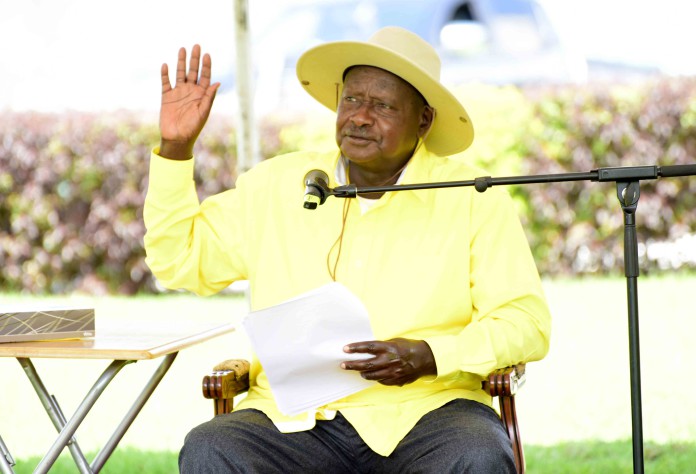
Uganda will become a middle income country in the next five years and an upper middle income country by 2040, President Yoweri Museveni has said.
In an end of year message to Ugandans, Mr Museveni said his government had prioritized six key areas which will spur development and these include defence and security; health with emphasis on immunization; universal education with skills training; roads; electricity and information communication technology (ICT).
‘The UPDF has ensured total peace in the whole country by defeating Kony, defeating ADF and disarming the Karimojong warriors. There is now total peace in the whole length and breadth of Uganda’ Mr Museveni said of defence and security.
On economic integration the President noted that through regional blocs like the EAC and COMESA had contributed to the sustained development under the NRM government since 1986, with a consumer market of 150 million and 400 million people created in the two economic blocs, respectively.
‘When we talk of prosperity, we are talking of prosperity through production and not through parasitism.
It is this realization by the NRM and its precursors that the most fundamental legitimate interest of the people is prosperity that led us to evolve the principles of patriotism and Pan-Africanism’ Mr Museveni wrote in 13-page message.
Enumerating the key developmental indices Mr Museveni said there would be a government secondary school in all the 1500 sub counties; a technical school in every constituency and professional colleges at the regional and national level.
Further, the President noted, that the literacy rate had risen from 43 per cent in 1986 to 75 per cent today, with 11 million people attending all levels of education including university education, which today has seen the emergence of 32 universities, up from only one (Makerere University) in 1986.
On roads, Mr Museveni stated that 20 major roads across all regions of the country would be tarmacked in the next five years, adding that progress has already been registered with some of the roads. He also said the Standard Gauge Railway (SGR) would be constructed to ease transportation in the EA region.
On agriculture, Mr Museveni urged Ugandans to avoid land fragmentation, and instead focus on irrigation and the use of fertilisers to boost production through both large and small scale commercial farming.
‘I, again, advise Ugandans to stop dividing the land and the wealth as a consequence of inheritance and only divide the net income from the land and the wealth (after removing costs) among the beneficiaries. As we wake up to the importance of commercial agriculture, we shall discover the need for irrigation,’ he noted.
He however, decried the low consumption and absorption levels of the products, giving an example of milk and maize. Of the two billion litres of milk produced annually in Uganda, only 800 litres are consumed, while only one million tonnes of maize, out of 4 million tonnes produced annually are absorbed in the region, he stressed.
Mr Museveni also noted that the country would soon have a cheaper and better supply of electricity to boost the much-needed industrialization drive, following the completion of the Karuma and Isimba Hydro electricity projects, which will sell a unit at US cents 5 and 4.8, respectively.
‘With increased supply of affordable electricity, we are on the verge of large-scale industrialization, starting with value addition to all our agricultural product and minerals. Our people are now educated and can run manufacturing enterprises. With the expanded Innovation Fund, we shall support as many of our groups, mainly youth or women, to process as much of our agricultural products as is necessary,’ the president underscored, and disclosed that on completion of the Ayago dam the country would produce 4356 megawatts of electricity by 2035.
Other sectors of interest that will boost development, he said, are oil and gas exploration; safe and piped water distribution; youth skilling; service delivery and tourism.
Full message below.
Fellow Ugandans,
I greet all of you and congratulate you on finishing 2015 and wish you a prosperous 2016. I extend condolences to the families who lost their dear ones in the year that is just ended.
The UPDF has ensured total peace in the whole country by defeating Kony, defeating ADF and disarming the Karimojong warriors. There is now total peace in the whole length and breadth of Uganda.
The strategic goals of the Uganda people and their African brothers and sisters should be: “prosperity and strategic security”. When we talk of prosperity, we are talking of prosperity through production and not through parasitism.
It is this realization by the NRM and its precursors that the most fundamental legitimate interest of the people is prosperity, that led us to evolve the principles of patriotism and Pan-Africanism.
In pursuit of the need for the prosperity of our people, the NRM stands for patriotism within Uganda (rejecting sectarianism of religion or tribe and gender chauvinism) and for Pan-Africanism in Africa.
With economic integration, in search of prosperity, we aim at the formation of the common market of the whole of Africa. We have already succeeded in the resurrection of the EAC and the formation of COMESA. Uganda will become a middle-income country by 2019 and an upper middle income country by 2040.
The ultimate security means the ability to guard our Sovereignty by, if necessary, defeating any aggressor on the globe. The guaranteeing of our sovereignty should not depend on anybody else except ourselves and some like-minded allies of similar interests and a common destiny, if necessary.
We always talk of transformation – Society moving towards a middle-class and skilled Working Society.
NRA has been fighting against the disorientation of failing to prioritize and trying to be everywhere and ending up being nowhere. Trying to do everything and ending up doing nothing. Where we successfully resist such disorientation, we make good progress. Since 2006, we started resisting the mistake of spending on consumption before we spend on development and wealth creation. We were also able to prioritize among priorities.
As for the roads, by combining our own funds and some limited funds from outside, I am in a happy situation to inform the Ugandans that all the major roads will be tarmacked in the next five years or less.
These are:
Moroto-Nakapiripirit; Ishaka-Kagamba; Mpigi-Kanoni; Kanoni-Sembabule-Villa-Maria; Musita-Lumino-Busia; Olwiyo-Gulu; Gulu-Acholibur; Acholibur-Musingo; Mukono-Kayunga-Njeru; Mukono-Kyetume-Katosi; Mubende-Kakumiro-Kagadi-Ndaiga; Mbarara-Kikagate; Tirinyi-Pallisa-Kumi; Hoima-Kigoroobya-Biiso-Wanseko; Masindi Port-Apac-Lira-Kitgum; Kapchorwa-Bukwo-Suam; Mbale-Maghale-Lwakhakha; Rukungiri-Kihihi-Ishasha; Atiak-Moyo; Moroto-Kotido-Kaabong; etc., etc.
Some of the above mentioned roads are already completed, some are on-going and others will be commenced on later. It is unprecedented in the history of Uganda to have so many roads being worked on at the same time and most of them being funded by the Government of Uganda.
With the railway, we are going to build a Standard Gauge Railway either with a soft loan from China or, later, using our oil money. The ICT backbone has been done with a loan from China.
On the side of human resource development, we have gone far. The immunization has stopped our children from dying young. The infant mortality rate is now 54 per 1000 live births. It used to be 156 per 1000 born alive babies in 1986.
On my advice and strong insistence, the NRM Parliamentary Caucus and Cabinet, following the Conference of Statistics House in 2006, prioritised six areas: Defence and Security; Health, especially immunization; Education, including the innovation of UPE, USE and UPET – i.e. mass education as opposed to elite education; the roads; electricity; and ICT.
Our line since 2006 was: “spend something everywhere but spend decisively in some sectors”. As a consequence of this, we boosted the budget for the roads from 398 billion shillings (2005/06) to the current level of 3,442 billion shillings (2015/16). The budget of energy from 178 billion shillings (2005/06) to 2,858 billion shillings (2015/16); the budget of Education from 634 billion shillings (2005/06) to 1,360 billion shillings; the budget of Health from 510 billion shillings (2005/06) to 1,328 billion shillings (2015/16); the budget of Defence from 350 billion shillings (2005/06) to 1,565 billion shillings, etc., etc. Yet the budget of water is still 547 billion shillings (2015/16); Agriculture and NAADS is still 815 billion shillings (2015/16); the Ministry of Gender, including the money for the Elderly, the Youth fund etc. is still 153 billion shillings; the money for restocking and cattle compensation is still 20 billion shillings (2015/16); and the money for veteran pensions is 70 billion shillings (2015/16).
On account of prioritization, we are delivering on the infrastructure. By building Karuma, Isimba and a number of small mini-hydros, our generation capacity will, by 2020, stand at 1,974 megawatts compared to the 60megawatts of 1986. With Ayago, our generation capacity will go to 4,356megawatts, by 2035.
Our petroleum plan is to build a 60,000 barrel per day, refinery, expandable to 120,000 barrels per day. Apart from getting our own petroleum, diesel and kerosene for aviation fuel, the residuals will feed the petro-chemical industries so as to produce plastics, fertilizers (again, but from another source) and pharmaceuticals.
Some of the oil will be exported through the pipeline. Even if we are to sell only 120,000 barrels per day, according to a price of US$60 per barrel, that will give Uganda an additional income of about US$ 3 billion. This money will be dedicated to infrastructure, science innovation and some of the high level science education institutions. It is considerable. We have been doing so much with so little. What will happen now that we are getting quite abit of additional money?
On the side of education, phenomenal achievements have been realized. About 11 million Ugandans are now in schools – primary, secondary, tertiary and university. The literacy rate has risen from 43% in 1986 to 75% today. We now have a total of 1,078 government secondary schools in each of the 971 sub-counties. In the next five years, we are going to have a Government secondary school in all the 1,500 sub-counties of Uganda.
However, literacy and numeracy must be accompanied by technical skills. We are, therefore, going to build a technical school per constituency in addition to some professional colleges at national and regional levels.
Pursuing mass education as opposed to elite education, we have increased classrooms in permanent materials from 40,440 in 1986 to 104,906 today; we recently repaired 648 secondary schools and built 132 brand new secondary schools; we have expanded University Education from one university in 1986 (Makerere) to 32, both government and private universities today; and we are expanding technical and vocational training.
Right from the resistance days, we realized that without the industrialization of our country, the future was bleak if not doomed. For many decades, Uganda has been losing money and jobs to the outside countries such as UK in the past and to China today.
A kilogramme of ginned cotton sells at US$.1.37. The same kilo turned into yarn sells at US$ 3. That yarn woven into fabric sells at US$5; and the final garments from the original one kilo of lint cotton, would sell at US$ 8-10. Therefore, by selling only lint cotton (i.e. after ginning), we are losing the spinning jobs, the weaving jobs, the printing jobs and the tailoring jobs, apart from getting only US$1.37 out of a total of the eventual value of US$.10. What is true of cotton is true of coffee, oil seeds, copper, gold, etc. This is the modern slavery that must be ended.
By, correctly, prioritising infrastructure, we are now able to support our manufacturers – local or foreign sourced. I am glad the power from Karuma will be 5 US cents per unit. The one from Isimba will be 4.8 US cents per unit. Unfortunately, the one from Bujagali has been 10.1 US cents per unit.
By ensuring peace and developing infrastructure, we have also laid the basis for the developing of our huge services sector. Our huge and incomparable tourism sector, starting at the very low base of 47,000 visitors in 1986 and bringing in only US$ 6.5million dollars per annum, now attracts 1.4 million visitors per annum and earns US$ 1.4 billion per annum.
I am told that there has been a slow-down of tourists because of the ignorance in the West, US and Europe, where the Ebola outbreak in West Africa scared tourists from coming to Africa. Our tourist authorities should inform all and sundry that Uganda is a World Leader in combating Ebola.
These factors should be put out clearly by those concerned. The other services such as Banking, Insurance, the Professional services, etc., are developing well. Indeed, the sector is growing at the rate of 5.3% per annum.
On the issue of ending the bottleneck of market fragmentation caused by colonialism, with the support of our brothers and sisters in the EAC and COMESA, we have created a market of 150 millions in the EAC and 400 millions in COMESA.
Indeed, the surplus of our milk production (2 billion litres while the consumption in Uganda is only 800 million litres) or maize (4 million tonnes while consumption in Uganda is only 1 million tonnes), is being absorbed in the region.
Uganda is very well endowed for agriculture. Strangely, however, many of the families in agriculture have been living in poverty, just on account of ignorance, mainly, complicated by problems of poor leadership and some parasite arrangements in some parts of the country.
I congratulate all Ugandans because when I fly over Uganda nowadays, I notice a spirit of Okusiimuka, Kuzukuka, Co (Acholi), Okwenyu (Ateso), Akenyun (Karamoja), Enga-oduasi (Lugbara), all of which mean “waking up”. What do I mean by “waking up”? The “waking up” I am talking about is more and more Ugandan families entering small scale commercial farming with “ekibaro”, “Cura”, “Otita”, “Aimar” ─ i.e. with the aim of maximizing financial returns per acre as we have been recommending to you ever since 1995.
On the issue of land fragmentation, I, again, advise Ugandans to stop dividing the land and the wealth as a consequence of inheritance and only divide the net income from the land and the wealth (after removing costs) among the beneficiaries (Abasika, abahunguzi, okakare, olewange).
As we wake up to the importance of commercial agriculture, we shall discover the need for irrigation. Where will the water for irrigation come from if we have dried the swamps? This is what we discovered in Kabale with the apple grower in Rukiga County.
The swamps can be used economically by the people that are near them but in an eco-friendly way such as fish farming which can be done on the periphery of the swamps. Fish farming is much, much more profitable than the other forms of agriculture and yet we can, then, preserve the swamp, the water, the bigugu, etc.
Value addition is very crucial as already pointed out under industrialization. Through research, we have already developed improved seeds and breeding stock.
Some Ugandan families had joined commercial coffee growing in the colonial era, different from the traditional coffee for chewing. Indeed, Uganda has been producing 4 million bags, of 60 kgs, per annum for a long time.
Out of this, Uganda earns US$ 400 million per year. The NRM is now, however, up-scaling the industry of coffee to new heights.
We have improved seeds for coffee, maize, cotton, beans, millet, etc. as well as dairy cattle, goats, pigs, poultry, etc.
We gave freedom to the private sector to operate, reinforced it by privatizing Government companies and liberalizing marketing, not to forget the return of Asian properties. The only impediment to the private sector operations is corruption by Government officials.
With increased supply of affordable electricity, we are on the verge of large-scale industrialization, starting with value addition to all our agricultural product and minerals. Our people are now educated and can run manufacturing enterprises. With the expanded Innovation Fund, we shall support as many of our groups, mainly youth or women, to process as much of our agricultural products as is necessary.
Production of maize in 1986 was 200,000 tonnes per annum. It is now 4 million tonnes. Much of this maize needs to be processed into flour for human consumption and into animal feeds (for chicken, pigs, etc., etc.). Milk production in 1986 was 200 million litres per annum. It is now 2 billion litres per annum. There is some processing capacity but we need more processors.
Industrialization will not only be based on agricultural products or minerals. It will also be based on human skills in the form of light and heavy engineering (e.g. manufacturing spare parts of automobiles and, eventually, manufacturing heavy duty equipment). Our scientists have already started with Kiira electric car as well as pick-ups and other vehicles. They are just awaiting funding from the Innovation Fund. At the small artisanal scale, I used the Najeera youth group to show what can be done in the cities for the youth.
Skilling the youth has already started. We are intensifying the effort by the plan to build a technical school in each constituency. We already have a total of 57 technical and 42 vocational schools.
Safe water for drinking now covers 73% for the urban population and 65% for the rural population. We need to cover the other 23% for the urban and 35% for the rural population. I have directed the Ministry of Water to simplify the formula for providing the drinking water to the people. Initially, it should be one borehole per village. The villages are 60,000, including the town ones. We already have 105,000 boreholes.
The towns and trading centres with piped water are 1,100 with a combined population of 8.2 million people. By this systematic method, we are going to cover everybody in Uganda by supplying them with safe-water in the next 10 years. Uganda, however, must also move from rain-fed agriculture to irrigation agriculture.
The use of fertilizers in Uganda is very low. The use of fertilizers in the USA is 132 kgs per hectare; in the EU, it is 150 kgs per ha; in India it is 157 kgs per ha; in China, it is 364 kgs per ha; in Latin America (Brazil), it is 175 kgs per ha; however, in Uganda, it is 2.5 kgs per ha.
How much more shall we achieve if fertilizers, NPK, are used? The sugarcane growers use fertilizers. We shall help the tea growers to use fertilizers in the coming financial years. Fortunately, we are building our own fertilizer industry for phosphates at Sukuru hills. Our oil and gas in Mwitanzigye will give us the Nitrogen. We only need to get the potassium from South western Uganda-Katwe area- to complete the circle of NPK (Nitrogen, phosphorous and potassium).
Conclusion
If we love one another, celebrate our diversity, resist division and stay united, we will achieve greatness. Let us all join hands and declare the Year 2016 to be our year of prosperity. The year of building on the strong foundation we have laid to secure Uganda’s future.
I wish you a happy and prosperous New Year.
Stories Continues after ad