Stanbic Bank
Stanbic Bank
26.5 C
Kampala
Stanbic Bank
Stanbic Bank
Home Blog Page 2290

Blatter, Platini suspended

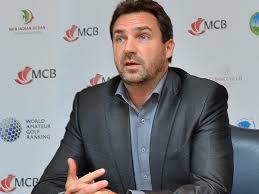
Sepp Blatter was close to tears as he urged the staff to "stay strong"

FIFA President Sepp Blatter has been suspended alongside Michel
Platini, the UEFA boss.
Both men, who were suspended for 90 days, are facing investigation by
FIFA’s independent ethics committee over the payment made to Platini
reportedly for work as Blatter’s technical advisor between 1999 and
2002.
The former FIFA boss, who is also suspected of signing a contract that
was ‘unfavourable to Fifa’ and making a ‘disloyal payment’ of US 1.5
million Platini, has temporarily been replaced by Issa Hayatou, the
Confederation of Africa Football (CAF) boss.
FIFA has come under severe criticism following reports of bribery,
with 14 of its officials being investigated by the Federal Bureau of
Investigations (FBI) and the Swiss authorities.
Recently, FIFA Secretary General Jerome Valcke was suspended, while
Austin ‘Jack’ Warner, a former FIFA Vice President and President of
CONCACAF was banned from participating in football affairs for life.
Meanwhile, the International Olympic Committee boss Thomas Bach has
also weighed in on the scandal, and asked football’s governing body to
enhance the processes of accountability and good governance.
“They must do two things immediately: they must accelerate and deepen
the reform process in order to comply with accountability,
transparency and all the principles of good governance, as expressed
in our reform programme, Olympic Agenda 2020.
They should also be open for a credible external presidential
candidate of high integrity, to accomplish the necessary reforms and
bring back stability and credibility to FIFA,” Bach’s statement reads
in part.

Stories Continues after ad

EALA swears in two

Two members of the East African Legislative Assembly have been sworn in during the 4th session sitting in the Kenyan capital, Nairobi.
Reappointed Burundi Minister for East African Affairs Leontine Nzeyimana was sworn in as an ex-officio member while Dr Francois Xavier Kalinda is a new member representing Rwanda.
The Oath of Allegiance to the House was administered by the Clerk of EALA, Kenneth Madete before the EALA Speaker, Rt Hon Daniel Kidega in accordance with Rule 5 (4) of the Rules of Procedure of the Assembly.
“No Member can sit or participate in the proceedings of the House until the Oath or Affirmation of Allegiance to the Treaty is taken,” the Rules of Procedure state in part and allow for new members to be introduced to the Assembly by two serving EALA MPs.
Nzeyimana, who was recently re-appointed Minister for EAC by President Pierre Nkurunziza following the elections in Burundi, was ushered into the House by Emerence Bucumi and Isabelle Ndahayo.  She previously served in the same position.
Dr Francois Xavier Kalinda, 53, who was elected by the Parliament of Rwanda on September 15, 2015, to replace Celestine Kabahizi who tendered in his resignation from the Assembly in June 2015, was escorted by Valerie Nyirahabineza and Dr. Odette Nyiramilimo.
Prior to his election, Dr Kalinda was the Dean of the Faculty of Law at the University of Rwanda.
A graduate of the then National University of Rwanda in 1996, Dr Kalinda pursued a Master of Law in Intellectual Property Rights at the University of Ottawa, in Canada, completing in 1999.
He also holds a Doctorate of Philosophy degree in Business Law obtained from the University of Strasbourg, France, in 2010.

Stories Continues after ad

Constituencies to get polytechincs for skilling – Museveni

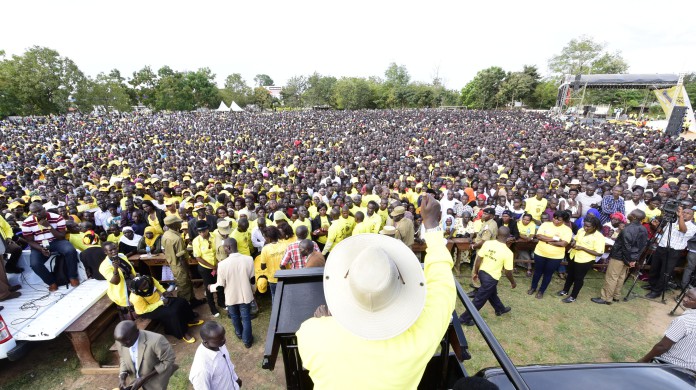
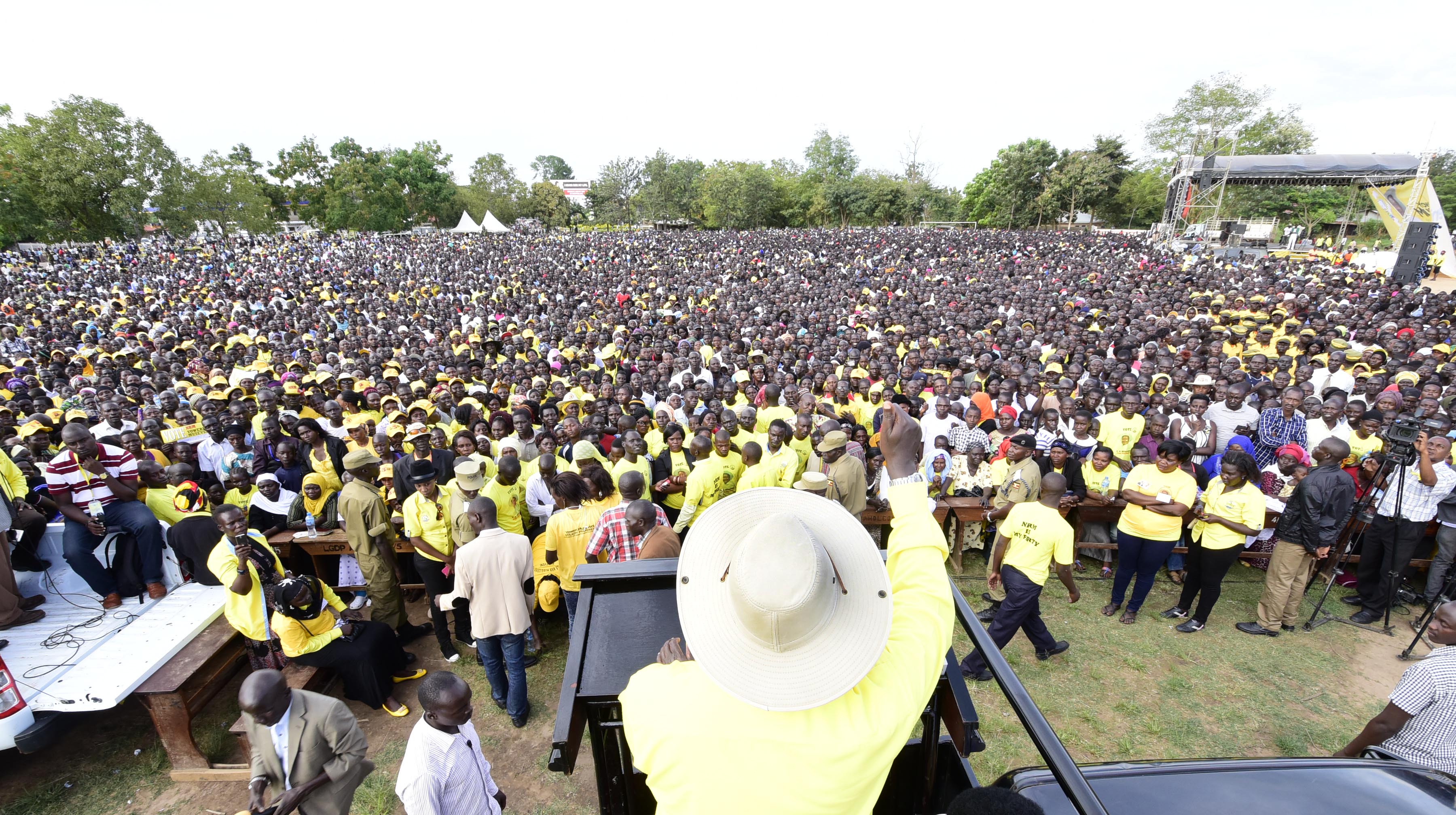
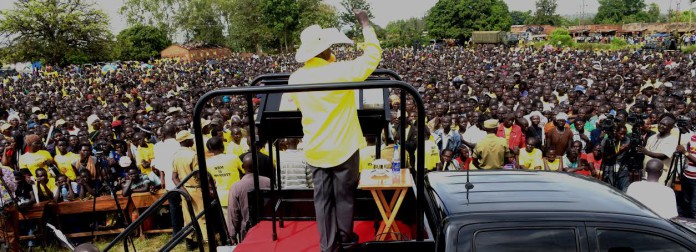
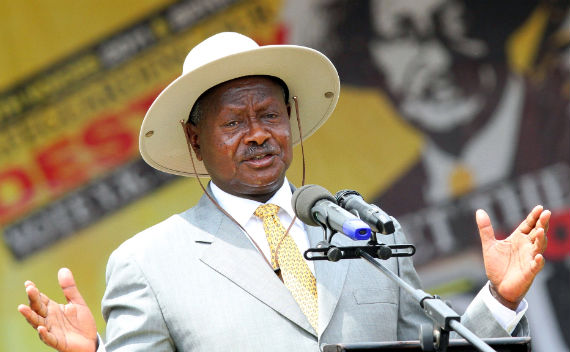
President Museveni addresses his party supporters

President Yoweri Museveni has said government will establish a
technical school in every constituency in Uganda as a means of
creating jobs for science graduates.
Speaking at the graduation ceremony of over 300 youth who completed
courses in various fields at Lutunku Community Polytechnic in
Lugusuulu sub-county, Mawogola North Constituency in Ssembabule
district, Museveni also urged the Ministry of Education, Technology,
Science and Sports to create a fund to enable graduates from
polytechnic institutions to get loans for purchasing equipment and
kick start capital.

“We have a plan to build a technical school in all constituencies. The
effort is to make our children to get skills. If you acquire skills,
there is no way you can fail to get a job. Skills can give you
wealth,” he said.
On arrival at Lutunku President Museveni toured an exhibition of the
products by the students of the school and also commissioned a
workshop at the polytechnic. He handed over tools and equipment to the
instructors for the students which he offered to them as a grant as
well as kick-start funds.

Lutunku Polytechnic, a brain child of President Museveni, offers long
and short time courses in formal and informal dairy keeping, carpentry
and joinery, brick laying and concrete practice motor-vehicle
mechanics, tailoring, catering-food preparing and processing,
electrical installation and hair dressing among others. The Head
Instructor Lutunku Community Polytechnic Mrs. Evelyne Zalwango Lubwama
commended President Museveni for supporting the Institute.
Meanwhile, responding to some of the concerns raised by the LC 1
chairman of the area Mr Seguya, President Museveni said the Ministry
of Works will construct a bridge on river Kyojja to enable the youth
from across to access training at Lutunku Polytechnic. He further
promised to solve the water problem affecting the area.
The President also pledged to build a church that was demolished
during the on-going construction of the Ssembabule to Gomba road.
The ceremony at Lutunku was attended by the Minister of Education,
Technology, Science and Sports Jessica Alupo, the Minister
of State for Housing and Urban Planning Rosemary Najjemba as well as
political and local leaders from Ssembabule and Gomba districts.

Stories Continues after ad

Spanish court closes Rwandan Generals’ case

Former Intelligence Chief Lt. Gen. Karake Karenzi.

The Spanish Supreme Court has ordered for the closure of a case the European country had slapped against 40 senior Rwanda Patriotic Army (RPA) officers including the recently-released Lieutenant General Emmanuel Karenzi Karake.

In June, Lt Gen Karake, the Director General of Rwanda’s National Security and Intelligence Services (NSIS) was arrested in London on an indictment issued in 2008 by Spanish judge Fernando Andreu Merreles, linking the General to genocide, war crimes and crimes against humanity allegedly committed during the war that brought the Rwanda

Patriotic Front government to power in 1994. Other prominent RPA officers linked to the Spanish case include Defence Minister General James Kabarebe, Brig Gen Sam Kaka Kanyemera and Col Dan Munyuza, the current Deputy Inspector General of Police.
In January this year the High Court in Spain cleared 11 of the accused and ordered for the closure of the file if no new evidence was brought against the remaining 29, some of who like Brigadier General Dan Gapfizi have since passed on.

As a result of the High Court ruling, a rights group, Association Parala Defensay Progresso de los Intereses Ciudadanos, appealed to theSpanish Supreme Court, challenging the revocation of the cases, an appeal that was thrashed on October 7, 2015 by five Supreme Court judges: Justices Anna Maria Ferrer Garcia, Miguel Colmenero, Candido Pumpido Touron, Medendenz de Luarca and Andres Palomo Del Arco.

Meanwhile, the Spanish indictment mirrors another one issued by the French against nine senior RPF/A members including Lt Col Rose Kanyange Kabuye, a former Chief of Protocol to President Paul Kagame, who was arrested in Germany in 2008 on the strength of a French indictment issued by controversial Judge Jean-Louis Bruguière in 2006, linking her to the murder of former Rwandan President Juvenal Habyarimana, whose plane was brought down by a missile on April 6, 1994 as it approached the Kanombe Airport.

Habyarimana, who was in the company of his then Burundi counterpart Cyprien Ntaryamira, was returning from Arusha, Tanzania, where the Rwanda peace talks were being held. In Rwanda Habyarimana’s death set off a killing frenzy that engulfed the country, leading to the 1994 Genocide in which about a million Tutsi and moderate Hutu were massacred by rampaging groups led by the
Interahamwe militia.

Stories Continues after ad

Kabila accused of arming ‘kiboko squad’

TOUGH ROAD AHEAD? DRC President Joseph Kabila


Democratic Republic of Congo President Joseph Kabange Kabila has been accused of arming brigades of cane-brandishing youth to disperse those opposed to his ‘third term’ bid.

According to Human Rights Watch (HRW), the youth were reportedly paid US$65 by officials of the ruling Peoples Party for Reconstruction and Democracy (PPRD) to scuttle a peaceful demonstration in the DRC capital Kinshasa.

According to reports, the plain-clothed assailants belonged to a cabal of PPRD sympathisers from the army, police, security services and youth associated with a Kinshasa-based football club, Vita.

The DRC is scheduled to hold elections on November 16 and President Kabila, who is attempting to run after serving his mandatory two five-year terms has come under heavy criticism for attempting to change the rules.

Recently, one of his PPRD close allies, Katanga Governor Moise Katumbi deserted the party and also resigned from governorship, and implored president Kabila to stand down after the expiry of his two terms.

Also, seven opposition figures who had allied with his PPRD in the pursuit of electoral reforms recently wrote to President Kabila, denouncing his third term quest and detailing their inability to continue working with him.

Stories Continues after ad

 Makerere University students strike again


Activities at Makerere University came to a standstill early today after students went on strike a day apiece, after the University Council rejected their plea to scrap the fees payment policy.

The policy dictates that students pay 100% of the tuition fees by the sixth week, and according to this semester’s academic calendar, Monday October 5 was the beginning of the 6th week, meaning that those who hadn’t paid would not access the educational services of the university.

On the same day the students had staged a strike but were restrained when their leaders promised to follow up the matter with the University Council on Tuesday. Later the two student leaders, Guild President David Bala Bwiruka and the President of Makerere University Private Students Simon Wanyera, reportedly held a closed door meeting with the Dean of Students Cypriano Kabagambe trying to strike a compromise.

The saga all started last Friday when the university management responded to the students’ guild petition over the policy, by extending the payment deadline for a month. Part of the letter signed by the Deputy Vice-Chancellor Finance and Administration, Prof Barnabas Nawangwe read:

“Management has therefore agreed to extend deadline for fees payment and registration by 01 month with effect from 5th October 2015 which is the end of the 6th week of the semester.”

But this did not soothe the students, with Wanyera saying on Monday that ‘the policy should go forever.’

At the time Mr Wanyera also expressed ignorance of any document issued by the university highlighting the extension, claiming his ‘office’ had not received it.

“This administration is making education only for the rich,” a fired up Wanyera charged.

In a related development, on Monday the students also accused the Guild President of not supporting their cause, but Bala justified his stand saying he couldn’t do ‘wrong when there is a right thing’, before telling his recalcitrant colleagues that Council would debate the fees policy issue.

Stories Continues after ad

US gives $9m to support refugees in Uganda

A man runs past a burning barricade on a rock strewn street in Bujumbura's Niyakabiga district on Presidential election day in Burundi, July 21, 2015. A policeman and an opposition official died in violence marring the start of Burundi's presidential election, already hit by opposition boycotts and protests over President Pierre Nkurunziza's decision to run for a third term. REUTERS/Mike Hutchings - RTX1L6Z1


The United Nations World Food Programme (WFP) on Tuesday received a contribution of US$9 million from the United States Agency for International Development (USAID) to provide food assistance for more than 320,000 refugees living in Uganda.

“This generous contribution has arrived just in time, as a funding shortfall was threatening to force WFP to reduce rations for refugees, including the new South Sudanese arrivals,” said acting Country Director Michael Dunford in a press release.

“Those cuts will not be necessary now, and we are extremely grateful to USAID for its lifesaving support for people fleeing conflict in neighbouring countries and seeking refuge in Uganda.”

Dunford said WFP will use the funding, received through USAID’s Office of Food for Peace, to purchase more than 13,000 metric tons of cereals and beans within Uganda for more than 300,000 refugees.

The support will also allow WFP to provide cash to 20,000 refugees in areas where markets are able to meet the demand. As well as meeting the immediate food needs of refugees, cash assistance has the added benefit of allowing some flexibility for the refugees to buy nutritious foods that may not be part of WFP’s food basket and to manage their household food resources themselves.

This contribution brings USAID’s 2015 WFP support to refugees in Uganda and extremely vulnerable populations in Karamoja to an estimated US$26 million.

Uganda currently hosts more than 490,000 refugees, mostly from the Democratic Republic of Congo (DRC), South Sudan and Burundi and roughly two-thirds of the refugees in Uganda depend on WFP to meet their basic food needs.

WFP’s assistance for refugees is closely coordinated with the Government of Uganda through the Office of the Prime Minister, the United Nations High Commissioner for Refugees (UNHCR) and stakeholder NGOs.

Stories Continues after ad

PwC global revenue hits US$35bn


PricewaterhouseCoopers International has reported global gross revenue of US$35.4 billion for the fiscal year ended on 30 June 2015, representing a 10% increase.
“The global business environment remains challenging, with a continuing patchy economic picture, geopolitical issues creating uncertainty for business and fierce competition in the professional services market.  Despite these challenges the PwC network performed exceptionally well in FY15 with growth of 10%, pushing revenues over the US$35 billion mark for the first time,” PwC Chairman Dennis M. Nally said.

He noted that over the last eight years the company had recruited good brains, enhanced services, made key acquisitions like Booz and Company and, also established new products like data analytics.
“Technology is transforming all aspects of our lives and every business, so we are working in alliances with market leaders such as Google and others, to bring the latest and best technology thinking to our clients.
“The PwC brand has been acknowledged as the strongest professional services brand in the world and this reputation is built on the energy, enthusiasm and quality of our 208,000 people and their commitment to working with all of our stakeholders to build trust and to solve important problems,” Mr Nally added.
Meanwhile, PwC enjoyed double digit growth in the Middle East and Africa with revenues up 16%.
According to Hein Boegman, CEO of PwC Africa, the global firm expects increasing growth in the emerging markets in the next few years. “We embarked upon an ambitious investment strategy in Africa in 2012 to build PwC into the leading network in Africa, which is paying dividends. We have invested substantially in the region and our people, and are firmly embedded in the local communities. Our practice in Africa with its over 10,000 staff members is a strategically important asset in the PwC Global network,” Boegman said and noted that Africa’s potential is encouraging.

“We clearly see the opportunity in Africa is huge for a number of reasons. For instance, the level of political democracy has improved significantly over the past 20 years and in the past five years we have seen the discovery of oil & gas reserves in countries such as Mozambique, Tanzania, Ghana and Angola,” he said and added: “We have great confidence in the future of Africa and are investing heavily in talent and skills development to ensure that we have the right people in the right place to continue to provide value for our clients in the years ahead.”
The South African firm recently appointed Dion Shango as the Southern Africa CEO role with effect from 1 July 2015.  Shango, a South African citizen, is the first African black to be appointed in this role within PwC. PwC South African Board Chair, Shirley Machaba, was elected to the PwC Global Board – the first female black partner to be elected to the Global Board. “This bears testimony to our commitment to diversity and inclusion, which are also key focus areas for our global firm,” adds Boegman.

Stories Continues after ad

EAC trains community radio journalists


A three-day media workshop sponsored by the East African Community (EAC)-United Nations Educational, Scientific and Cultural Organization (UNESCO) is currently underway in Arusha, Tanzania.

The workshop for community radio journalists is organised by the EAC Community Media Network (EACOMNET), and has attracted 35 participants from the five EAC Partner States of Burundi, Kenya, Rwanda, Tanzania and Uganda.

Addressing participants on the opening day Ms. Zulmira Rodrigues, the UNESCO Representative to Tanzania said her organization would support community media initiatives in the EAC region.

She noted that the UNESCO-supported community radios are the main source of wide-ranging information for rural, marginalized and indigenous communities.

“UNESCO through its support has further significantly contributed to ensuring quality broadcasting, ethical programming and inclusive content to include all groups – men, women, the youth, persons living with disabilities and persons living with albinism – to actively participate in key processes for democracy, peace and development,” said Ms. Rodrigues.

Officially opening the workshop, the EAC Deputy Secretary in charge of Finance and Administration Mr Liberat Mfumukeko, said the Community attaches great importance to the role of the media promoting awareness in the EAC integration.

“We have directed the Corporate Communications and Public Affairs Department to come up with a strategy to involve community radio stations in the Partner States in our outreach and advocacy programmes in the next Financial Year. With this strategy in place, we shall work and engage with you more closely,” said the Deputy Secretary General.

The workshop is being facilitated by community media experts from the Sarojini Naidu School of Arts and Communication, University of Hyderabad, India, led by the UNESCO Chair on Community, Professor Vinod Pavarala, assisted by Prof. Vasuki Belavadi and Dr Kanchan K. Malik.

Stories Continues after ad

Kikwete to bid EALA members ‘farewell’

Photo © Eric Miller/World Economic Forum 2006 emiller@iafrica.com Jakaya Kikwete


Tanzanian President Jakaya Kikwete will make his last address to the East Africa Legislative Assembly (EALA) 4thsession currently sitting in the Kenyan capital, Nairobi.

According to EALA Speaker Dan Fred Kidega, the outgoing President, who is also the chair of the Summit of the EAC Heads of State, will address the EALA members on October 13, about two weeks away from elections in his country to be held on October 25.

Kikwete’s mandate as President of Tanzania comes to an end this month, after he has served a two-five year term.

Meanwhile, during the two-week session, the EALA will among other assignments, debate the EAC Electronic Transactions Bill 2014; the EAC Forest Management and Protection Bill 2015 and the EAC Disaster Risk Reduction and Management Bill 2015.

“We further expect to hold consultations with a number of other stakeholders during our stay here to inform the work of the Assembly to carry on with its mandate of legislation, representation and oversight. The involvement of East Africans in the process is fundamental given the fact that integration is very much ‘a people centred process’”, Speaker Kidega said and added that since he became Speaker in 2014 the EALA has passed seven Bills and seven Resolutions, and also adopted 13 reports.
The Speaker also lauded members of the 70th United nations General Assembly (UNGA), a forum at which the newly-introduced Sustainable Development Goals (SDGs) were adopted.
‘Last month, EALA benefited from a 4 day training on the Sustainable Development Goals (SDGs) thus preparing the Assembly for the big task ahead of oversight and possible legislation around sustainable development,’ Kidega said and also hinted at polls’ process in the EAC region, where Tanzania and Uganda will hold presidential elections in 2015 and 2016, respectively.


‘Another key area we as a Parliament are keen on – concerns that of elections in the region.  The United Republic of Tanzania is headed for its polls on October 25, 2015 while Republic of Uganda is expected to hold a similar exercise in the first quarter of 2016. Our appeal to the Partner States is to ensure elections are held in a credible manner and that such processes fall within the ambits of constitutionalism and electoral laws’ he said, before imploring the media to ensure effective and objective reporting.


The Speaker also said there is need to prioritise peace and security in the EAC region, in light of the threats occasioned by the Al-Shabaab insurgents.

‘We need to fast-track the ratification of the Peace and Security Protocol in the region to anchor the architecture and also operationalize joint activities that ensure a peaceful region.  So far, Uganda, Rwanda and the United Republic of Tanzania have ratified the Protocol.  When the region has peace, then there is unrivalled development and progress,’ he added.


Earlier today Kenyan President Uhuru Kenyatta addressed the 2ndmeeting of the 3rd Assembly of EALA, whose sessions at the National Assembly in Nairobi will end on October 15.

Stories Continues after ad