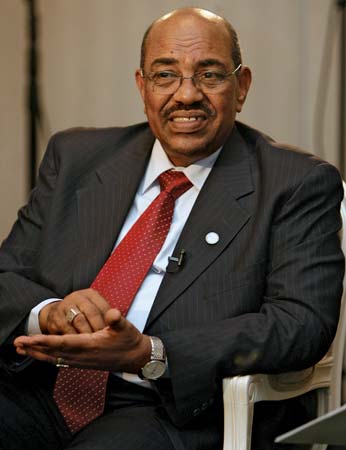
Omar Al-Bashir, failed to travel to Uganda over ICC
Sudan President Omar Al-Bashir failed to travel to Kampala for Inter-governmental Authority on Development over the International Criminal Court indictment.
Bashir who was expected to join fellow East African and Horn of Africa leaders that include Kenyan President Uhuru Kenyatta, Ethiopian Prime Minister Hailemariam Desalegn. The leaders where invited by their counterpart, President Yoweri Museveni and Bashir was due to give a report on the situation on South Sudan.
Bashir recently escaped an arrest in South Africa where Court issued an arrest warrant but South Africa’s government basing on African Union resolution down played the warrant and instead offered protection.
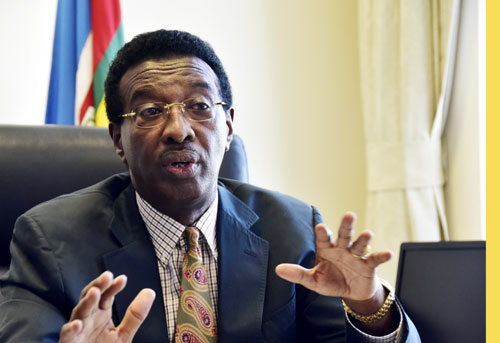
Bashir instead sent his Foreign Affairs Minister Prof. Ibrahim Ghandour with a special message for President Museveni.
The written message was delivered to Museveni by Prof. Ghandour at State House, Entebbe. Prof. Ghandour represented President Al-Bashir at the IGAD meeting at State House Entebbe.
President Kenyatta of Kenya, Ethiopian Prime Minister Hailemariam and Museveni attended the Igad meeting that focused on resolving the conflict in South Sudan.
The Uganda Parliamentary Forum on media (UPFM) has today launched a journalists’ manifesto 2016 as a reminder and commitment by journalists to act professionally come the 2016 general elections.
The six-point manifesto was launched by the Minister of Information and National Guidance, Maj .Gen. Jim Muhwezi at the Munyonyo Commonwealth Resort hotel in Kampala.
According to the manifesto, journalists are required to verify information before broadcasting, publishing or printing; properly handle opinion polls and not to have independent tally centres during vote counting.
Other points are to perform free, fair and balanced reporting, to offer a right to reply to all candidates and to avoid hate speech, inappropriate language and reference to ethnicity.
At the function several MPs and politicians cautioned journalists to desist from unprofessionalism, saying that the media risked being ostracized if they failed to respect other peoples’ rights in their reporting.
“We have a high degree of unprofessionalism in the media today …and this has failed to merge it with politicians, some of these reporters are not objective,” said Onyango Kakoba.
Kakoba, the Buikwe North MP, is himself a former journalist.
But the journalists were not cowed, and they the politicians to work hand in hand with them for the development of the country.
“The role of the media is a national role and as Members of Parliament, you have a role to play so we shall change the way we work if we complement each other,” Florence Apolot, a news producer at Urban TV, said.
Media house proprietors were not spared of criticism; with claims that they poorly remunerate their employees and that some others act unethically.
“The media appointment is poor, some people are said to be appointed on probation but after five years, they remain on probation,” said Joseph Ssewungu, the Kalungu West MP.
He said the committee has plans to name and shame media houses that underpay their workers in the bid to improve the welfare of journalists.
He argued that this is the main reason that brings about lack of professionalism in the media.
Meanwhile, in a statement signed by the UPFM chairperson Mariam Nansubuga, she reflected on the chaos that ensued after the presidential polls of Kenya in December 2007 and interlinked it with the need to have the ‘journalists manifesto’ in Uganda.
“The four reflective dialogues on this campaign and election reporting that took place in the four regions of Uganda were inspired by the events that led to the Kenyan post-election violence of 2007,” Ms Nansubuga, a media practitioner and activist, wrote.
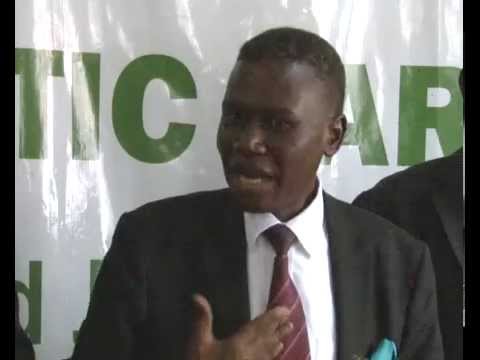
Newly re-elected Democratic Party President Norbert Mao has said that after successfully holding the delegates’ conference the party will now focus on winning The Democratic Alliance flag bearer position for the 2016 presidential elections.
Speaking to journalists at the party offices in Kampala, Mr Mao also urged all members to get back to business, saying the delegates conference held at Kingdom Hotel Katomi ended peacefully.
“The DC is now over and it is time to work, we are not idlers,” he said, in apparent reference to a splinter group led by Erias Lukwago, the embattled Lord Mayor of Kampala.
Mr Mao said the Buikwe trip he had with the area MP Dr Lulume Bayiga, his contender for the top party seat, was a success and that their unity strengthened the party.
“DP is not at the headquarters (City House); it lives in the hearts of the members,” he said adding: “You can come and sit here but you will be seen as an impostor.”
The DP president further revealed that former Buganda Premier, Mr Joseph Mulwanyamuli Ssemogerere is to convene a meeting where all members under the TDA will be invited. Mao says it’s because they ‘anticipated many conflicts’.
He noted that DP will rally behind any member chosen by TDA and advised Lukwago and his group to support him since they have no chance in being welcomed to TDA.
In a related development, the DP National Executive Committee will onAugust 28, vet those that have applied to contest on the party ticket in various constituencies.
Mao says that NEC is empowered by the party Constitution to reject any one’s application without explanation. “Nobody should say they have been locked out, they are free to contest,” he said adding: “NEC will sit and decide what to do for party members that stood as independents.”
The DP leader also warned all those using party colors to stop or face consequences.
“I asked Mr Mukasa Mbidde, the party’s Legal Advisor, to write to the Electoral Commission. The green and white are our colors, EC should inform those using them to stop,” he expressed.
Meanwhile, all newly-elected DP Executive Committee members will be sworn in on August 29 at Kaunda Grounds in Gulu.
Prime Minister Dr Ruhakana Rugunda described the late Mathias Nsubuga as a patriot and a man of peace.
PM Rugunda to lead delegation.
Ten ministers and parliamentarians led by Prime Minister Dr Ruhakana Rugunda are set to engage the Ugandan Diaspora in the United Kingdom on among other issues, citizenship and investments.
According to a release, Rugunda will be the guest of honour at the September 12 Convention where the UK Diaspora wants government to primarily address the issue of delayed implementation of dual citizenship, barriers to investments and the ban against Ugandan holders of foreign passports owning mailo/freehold land in Uganda.
According to the Uganda Citizenship and Immigration Control (Amendment) Act, ‘all Ugandans who lost their citizenship by way of obtaining citizenship of another country country can now reacquire their former Ugandan citizenship…’
It adds: ‘A citizen of Uganda of eighteen years and above who voluntarily acquires citizenship of another country may retain the citizenship of Uganda subject to the Constitution (of Uganda), the Citizenship and Immigration Act, and any law enacted by Parliament.’
Meanwhile, the Ugandan Diaspora says it remits around $800million every year, making them strategic partners in national development.
Among the sectors the Ugandan Diaspora has earmarked for investment are infrastructure development, power & energy, health-care, agri-business, real estate and financial markets.
The delegation expected to grace the 5th Uganda Convention in London includes Premier Rugunda, Energy and Minerals minister Irene Muloni, Christine Aporu, Minister for Teso Affairs, Ernest Kiiza, Minister of State for Bunyoro Affairs, Cecilia Ogwal, the Oppositional Chief Whip and Wafula Oguttu, Leader of Opposition in Parliament. Others are Barbara Nekesa Oundo, Minister of state for Karamoja Affairs, Sarah Kataike Ndoboli, Minister of State for Luwero Triangle, Mathias Kasamba, Chairperson- Parliamentary Committee on Agriculture and Rebecca Amuge Otengo, Minister of State Northern Uganda Rehabilitation.
The chief guest at the Convention will be the Nnabagereka Sylvia Nagginda and other notable attendees include Lord Verjee, Lord Popat, Lord Sheikh, Baroness Sandy Verma, Nuradin Osman (AGCO)and Ian Harrison (UKTI).
‘This roundtable discussion will be a rare opportunity to put some of the challenges that stand in the way of full Diaspora engagement to the policy makers, who it is hoped will take the views expressed back to government for discussion and where possible implementation,’ the release states in part.
The group further says that the requirement for one to have US$100.000 before accessing incentives for investors has denied the country a chance of thousands of small business start-ups by members of the Diaspora.
‘This is an amount that is beyond most Diaspora Ugandans. Furthermore it is a policy that fails to take into account that small business can be and have been started for as little as a few thousands, even a few hundreds,’ the release states.
Mid next month Prime Minister Dr Ruhakana Rugunda will lead a high-profile delegation to attend the 5thUganda UK Diaspora Convention in London.
At the roundtable event, members of the Diaspora want to share some of their experiences in foreign lands and also to explore ways of how the government of Uganda can help them in various areas of human endeavor.
Some of the areas highlighted include among others the effecting of dual citizenship, incentives as a means of attracting them to invest back home and, the easing of methods of land acquisition.
It is pertinent to note that for about ten years now, the Ugandan Diaspora is one of the leading sources of foreign exchange, repatriating about US$800 million a year. Some of this money is sent to relatives as upkeep, while a huge chunk is set aside for investment, never mind that it is not structured. And, in the process some have lost huge sums to dubious relatives who misuse the remitted funds, thereby affecting the intended life patterns of several people in the ‘dependency chain’, like school-going children and the elderly.
Such discouraging developments notwithstanding however, among the areas the Diaspora have earmarked for investment include infrastructure development, power & energy, health-care, agri-business, real estate and financial markets, all areas that are critical to national development.
For a long time now, the government of Uganda has been incentivising foreign investors with tax holidays, some stretching to ten years.
That in itself has not a bad idea but the government should now muster the courage to try out yet another scheme to benefit those Ugandans abroad who want to invest back home.
In that regard, the choice of Dr Rugunda to lead the Uganda delegation is one that is laced with potent vision; the man is an accomplished listener and diplomat who pays attention to detail.
And since as Prime Minister he is the leader of government business, Ndugu Rugunda should be able to capture the momentous occasion to assuage the fears of our brothers and sisters in the Diaspora, with a view of implementing some of their desires to the benefit of both government and other citizens, both at home and in the Diaspora.
Who knows, he can also suggest that a fully-fledged ministry is set up specifically to address development initiatives of the Ugandan Diaspora.
President Uhuru Kenyatta inspect a guard of honour mounted by the Uganda People's Defence Forces (UPDF) on arrival for a special session of the Uganda Parliament in Kampala Uganda yesterday August 10, 2015.
President Uhuru Kenyatta inspect a guard of honour mounted by the Uganda People’s Defence Forces (UPDF) on arrival for a special session of the Uganda Parliament in Kampala Uganda yesterday August 10, 2015.
President Uhuru Kenyatta was faced with an awkward moment when Uganda People’s Defence Forces’ (UPDF) band played him a song praising a party he quit more than three years ago.
It is not disputable that President Kenyatta was once a stalwart in the Kenya African National Union (Kanu). It is also not in doubt he once chaired Kenya’s independence party after President Daniel Moi retired in 2002.
On Monday though, the UPDF played the song during a party of the rituals accorded to a visiting leader on a State visit.
But as the UPDF blew away the “Kanu Yajenga Nchi” on their trumpets, the body language of President Kenyatta indicated some kind of discomfort as he inspected the guard of honour.
The song, which loosely translates to “Kanu builds the nation” was popularised during the party’s era which many Kenyans associate with brutality and dictatorship.
UHURU HANDPICKED
The party was eventually vanquished from power by the National Rainbow Coalition (Narc); a grouping of Opposition parties, in 2002.
Incidentally, part of the reason the party was defeated was the manner in which President Kenyatta was handpicked by Mr Moi to be its candidate in 2002.
Disgruntled Kanu members then jumped ship and joined the Opposition to mount one of the greatest defeats for a ruling party in Africa.
At the time, Mr Kenyatta accepted the results and moved on, Mwai Kibaki became President and Kanu became associated with Kenya’s derelict past.
Mr Kenyatta would later ditch Kanu and formed The National Alliance (TNA), which swept to power in 2013 following a coalition arrangement with United Republic Party (URP) led by Mr William Ruto, Charity Ngilu’s Narc and Najib Balala’s Republican Congress Party.
One of the key pillars the coalition proclaimed in their manifesto was openness, a principle which had almost become alien during the Kanu years.
KOT REACTIONS
But as the Kanu song played, Kenyans on Twitter (KOT) turned the incident into a butt of jokes, some even questioned its significance.
Anne Kanina-Macharia (@Anna_Kanina) wrote: “Wah! We have started the week with a KANU song played in Uganda with President Kenyatta present”, while @JosephNdwiga wrote: “Why did the Uganda military band play KANU yajenga nchi? Any significance?”
Wilfred Mutuma (@williembig) weighed in: “The Uganda forces band just played “kanu yajenga nchi” tune before our president. They need be updated!!”
Thuranira Kaugiria (@doncorleon85) tweeted: “KANU yajenga nchi. Even Uganda knows that. Let me sit here and watch #KOT behave like it’s not true,” while Betty Waitherero (@bettywaitherero) said “If you don’t get that Ugandan joke band playing Kanu song. Anyway wacha tu.”
The song may have been played out of sheer innocence and maybe because its keys are easier to master. But it also offered a lesson that a politicians’ past is indelible.
President Uhuru Kenyatta was faced with an awkward moment when Uganda People’s Defence Forces’ (UPDF) band played him a song praising a party he quit more than three years ago.
It is not disputable that President Kenyatta was once a stalwart in the Kenya African National Union (Kanu). It is also not in doubt he once chaired Kenya’s independence party after President Daniel Moi retired in 2002.
On Monday though, the UPDF played the song during a party of the rituals accorded to a visiting leader on a State visit.
But as the UPDF blew away the “Kanu Yajenga Nchi” on their trumpets, the body language of President Kenyatta indicated some kind of discomfort as he inspected the guard of honour.
The song, which loosely translates to “Kanu builds the nation” was popularised during the party’s era which many Kenyans associate with brutality and dictatorship.
UHURU HANDPICKED
The party was eventually vanquished from power by the National Rainbow Coalition (Narc); a grouping of Opposition parties, in 2002.
Incidentally, part of the reason the party was defeated was the manner in which President Kenyatta was handpicked by Mr Moi to be its candidate in 2002.
Disgruntled Kanu members then jumped ship and joined the Opposition to mount one of the greatest defeats for a ruling party in Africa.
At the time, Mr Kenyatta accepted the results and moved on, Mwai Kibaki became President and Kanu became associated with Kenya’s derelict past.
Mr Kenyatta would later ditch Kanu and formed The National Alliance (TNA), which swept to power in 2013 following a coalition arrangement with United Republic Party (URP) led by Mr William Ruto, Charity Ngilu’s Narc and Najib Balala’s Republican Congress Party.
One of the key pillars the coalition proclaimed in their manifesto was openness, a principle which had almost become alien during the Kanu years.
KOT REACTIONS
But as the Kanu song played, Kenyans on Twitter (KOT) turned the incident into a butt of jokes, some even questioned its significance.
Anne Kanina-Macharia (@Anna_Kanina) wrote: “Wah! We have started the week with a KANU song played in Uganda with President Kenyatta present”, while @JosephNdwiga wrote: “Why did the Uganda military band play KANU yajenga nchi? Any significance?”
Wilfred Mutuma (@williembig) weighed in: “The Uganda forces band just played “kanu yajenga nchi” tune before our president. They need be updated!!”
Thuranira Kaugiria (@doncorleon85) tweeted: “KANU yajenga nchi. Even Uganda knows that. Let me sit here and watch #KOT behave like it’s not true,” while Betty Waitherero (@bettywaitherero) said “If you don’t get that Ugandan joke band playing Kanu song. Anyway wacha tu.”
The song may have been played out of sheer innocence and maybe because its keys are easier to master. But it also offered a lesson that a politicians’ past is indelible.
President Yoweri Museveni has said that the National Resistance Movement is still powerful and capable party and urged its members to stay united to achieve their goals.
Museveni who is also the National Chairman of the NRM said the party is more important than individuals.
The President was yesterday speaking at a meeting held with NRM councilors and opinion leaders from Kanungu district led by Canon Josephine Kasya at State House Entebbe. The group also presented their memorandum to the President.
The President said NRM does not believe in sectarianism but instead seeks to help all Ugandans transform and become prosperous through economic production.
Museveni noted that when the NRM government was busy fighting Joseph Kony, ADF, disarming the Karamojong, Dr. Kizza Besigye was doing nothing but making noise for the President to leave. He said what Ugandans need is better infrastructure like roads and electricity, peace and security, improved education and health.
The President told the People of Kanungu that the government has already secured money for the construction of Rukungiri- Ishasha road and the construction work will begin between September and October. He told them that all the areas in Kanungu district will be connected to electricity.
The President also warned them against practicing land fragmentation and asked them to undertake commercial farming.
The Kanungu delegation thanked President Museveni for the good leadership and for supporting them.
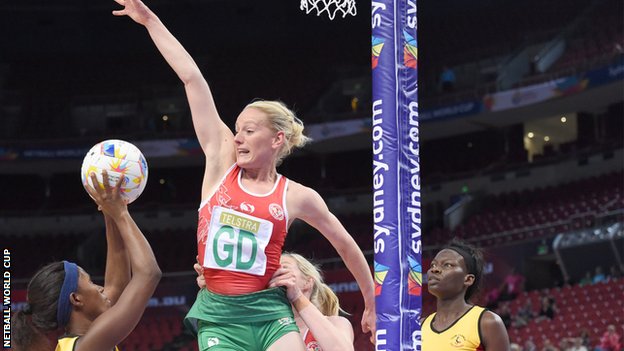
Wales produced a brilliant final quarter to edge Uganda 49-47 and finish top of Pool D with a 100% record at the Netball World Cup in Sydney.
Trish Wilcox’s side advance to a pool containing England, South Africa and holders Australia.
Wales were in front until the third quarter, when Uganda took a 39-35 lead.
But a faultless shooting display in the final period by Chelsea Lewis and Emma Thomas, who hit all 14 of her shots in the game, pushed Wales to victory.
Wales are back in action on Tuesday when they face South Africa at 03:20 BST.
Uganda also qualify as runners-up and in the next round will face New Zealand, Malawi and Jamaica, who beat Scotland 71-24 in Monday’s later game.
2015 Netball World Cup
Round two of the competition in Sydney starts on Tuesday, when the 16 nations split into four pools of four teams.
The first two pools are made up of the teams who finished in the top two of their preliminary-round groups, and a round-robin format will decide who progresses to the semi-finals.
The other two pools will filter into the play-offs for the placing matches.
Wales often found their mid-court passing disrupted by the good coverage of the Uganda players, but wing-attack Bethan Dyke and centre Kyra Jones – who sat out the third quarter – worked tirelessly to feed their shooters.
Captain Suzy Drane and vice-captain Rosie Pretorius needed treatment for leg problems during a hugely competitive match.
Wales – ranked eighth in the world – will hope the pair have suffered no lasting effects as they head into a difficult Pool F against world number one Australia, third-ranked England and South Africa, who are ranked fifth.
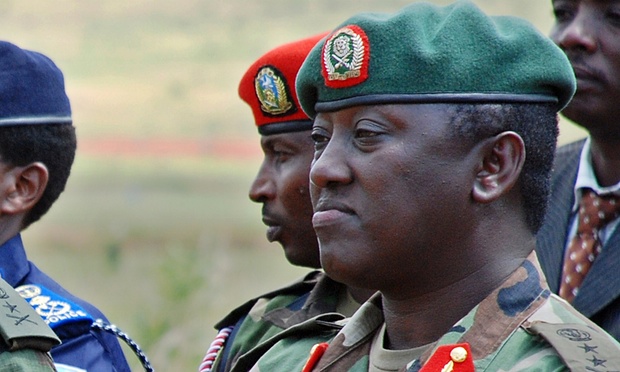
General Karenzi Karake was arrested on a warrant issued by Spain in June, angering Rwanda and African Union
A British court has dismissed an extradition case against Rwanda’s intelligence chief.
General Karenzi Karake was arrested on a warrant issued by Spain in June and released on bail. Following a hearing in London, a court official said: “The case has been discharged today.”
Under the Extradition Act, cases can be dismissed if “offences specified in the [arrest] warrant are not offences under the meaning of the [act],” the official said.
A Spanish judicial source had said Karake was accused of “crimes of terrorism” linked to the killing of nine Spanish citizens in Rwanda in the 1990s. But UK police said the 54-year-old had been arrested for alleged “war crimes against civilians”.
Rwanda reacted furiously to Karake’s arrest, with President Paul Kagame saying it showed “absolute arrogance and contempt”. The African Union called for Karake’s “unconditional and immediate” release.
Karake’s defence team included Cherie Blair, the wife of Tony Blair, who is an adviser on governance to Kagame.