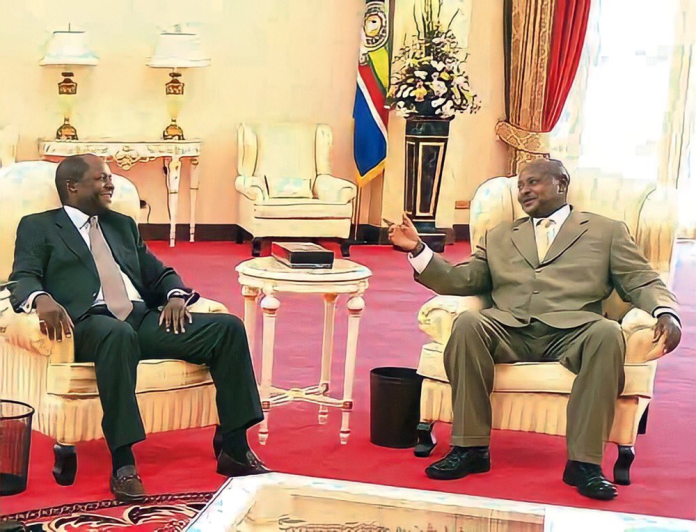
JOVIAL :Kabaka and President Museveni at a past event.
President Yoweri Museveni has called on a section of Buganda kingdom chiefs (Abataka) to refrain from causing embarrassment to Uganda by opportunistically displaying support for the Kabaka of Buganda during his medical treatment in Namibia.
This call comes in the wake of reports of indiscipline among some Ugandans concerning the Kabaka’s presence in Namibia.
In a letter addressed to the Permanent Secretary of Foreign Affairs, the Ugandan High Commissioner to South Africa and Namibia highlighted incidents involving Ugandans and the Kabaka, which only came to President Museveni’s attention on June 8, 2024, through a visit by Hon. Ssebugwawo and representatives of Abataka.
“I told them that we are not aware and nor are we involved in the issue of the HH Kabaka’s presence in Namibia,” President Museveni stated.
He clarified that the Ugandan government had no knowledge or involvement in the Kabaka’s medical trip.
The President expressed concern over the actions of some Ugandans, describing them as opportunistic attempts to demonstrate their support for the Kabaka, which have inadvertently caused embarrassment to the country and urged that only the Kabaka himself, his family, or individuals authorized by him should be involved in matters pertaining to his treatment.
“These dramas are happening away from our jurisdiction. Otherwise, we would have taken action,” Museveni noted, stressing the need for Ugandans to exercise discipline and decorum in such sensitive situations.
Museveni’s call for restraint aims to preserve the dignity of the nation and the privacy of the Kabaka during his medical treatment.
Recently the Buganda Premier, Charles Peter Mayiga noted that the kingdom administration continues to monitor the situation and urged all citizens to respect the Kabaka’s privacy and the official protocols in place.
In the same vain, a few handful Baganda in Europe demonstrated at the embassies of Namibia demanding for ‘unconditional release of the Kabaka
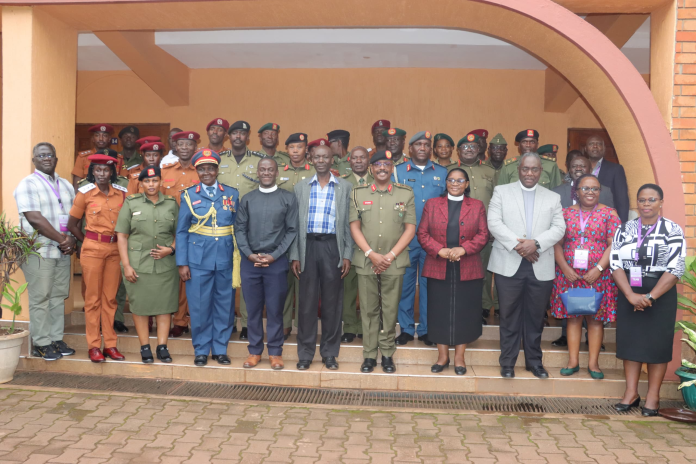
Gen.Kyanda with teams from different forces at All Saints Cathedral team.
Major General Leopold Kyanda, former UPDF Chief of Joint Staff, reminded all men and women in uniform (UPDF, Police, and Prisons Service) to maintain their spiritual connection with God for the success of their earthly missions.
He made this remark while officiating at the Armed Forces Prayer Breakfast at All-Saints Cathedral Church of the Resurrection in Bugolobi, Kampala.
Maj Gen Kyanda reiterated the message of Reverend Dr. Canon Nyegenye about the purpose of life, referencing the Old Testament’s account of Angel Michael, a spiritual warrior who fought and defeated the devil in heaven.
“The work that we do as men and women in uniform does not start today but started at that time. The purpose that they are telling us here is deeper because it was a warrior that went out and threw the devil out of heaven,” he emphasised.
He expressed remorse for the pain God endures when His children turn against Him, acknowledging the devil’s continued rebellion against God despite receiving everything. However, he noted that men and women in uniform are blessed to have a strong spiritual heritage and urged them to glorify God in their work.
“Know who you are, know your role and know your path, know what you can do. That is why you can go and defend your country no matter the place. We should remember that we still have that connection with the arch angel. This is because of the presence of the holy spirit,” Maj Gen Kyanda told the congregation.
Reverend Dr. Conon Rabecca Nyegenye, Provost of All Saints Church Cathedral Nakasero, spoke from John 10:1-11, highlighting the devil’s destructive nature and God’s restorative power.
“We are all soldiers of Christ but armed forces are soldiers of what God has called them for. You battle with people who the devil has stolen their body self and have lost purpose in life. But it doesn’t matter where one has reached, the Lord makes his people whole again,” she encouraged.
The Reverend thanked the joint forces for their presence and commended them for their work, urging them to enjoy their service with exceeding joy, like onward Christian soldiers going to war with courage and purpose.
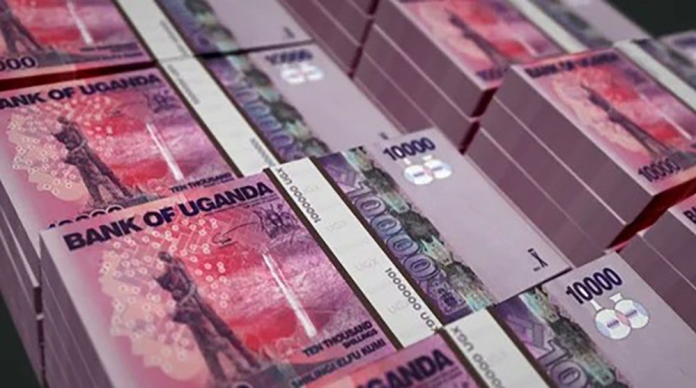
Ugandan commercial banks and other financial institutions approved only Shs3.4 trillion in loans between February 2024 and April 2024 amid fear of risks occasioned by failure to pay back.
According to the Bank of Uganda State of the Economy Report for June 2024, while Ugandan businesses and individuals applied for loans from financial institutions worth Shs5.1 trillion, only loans worth Shs3.4 trillion were approved.
As a result, annual average Private Sector Credit growth moderated to 7.8 percent in the three months to April 2024, down from 8.4 percent in the three months to January 2024.
“Both gross credit extensions and recoveries declined in the three months to April 2024, but the decline in gross extensions was faster than the decline in gross recoveries, as banks increasingly cut back on renewing credit lines for borrowers. Demand and Supply of credit remained on a downward trajectory,” the report reads in part.
The report says government intervention programmes such as the Parish Development Model (PDM), Emyooga, and fintechs have complimented the banks’ credit to the private sector.
According to the Bank of Uganda, lending rates for commercial banks rose in the three months, averaging 20.8 percent, just 20 basis points above the reading in the three months to January 2024. Similarly, the weighted average shillings and foreign currency lending rates rose in the three months to April 2024, reflecting the increase of the CBR and the associated tight liquidity and financial conditions.
The weighted average shilling lending rate reversed the downward trend observed since last year, rising to 17.7 percent in the three months to April 2024 but remains below the level for the same period last year.
The lending rate on foreign currency-denominated loans continued to rise, reaching an average of 9.1 percent about 130 basis points above the rate charged the same period a year back reflecting the tight domestic and global monetary conditions.
The rise in lending rates was most pronounced in the Agriculture, Manufacturing, Trade, and Housing sectors. A moderate decrease was observed in Personal loans, Transport and Communications. Sectors.
Overall, lending rates are expected to rise and remain elevated owing to tightening financial conditions amid the increasing government issuances of securities in the domestic market.
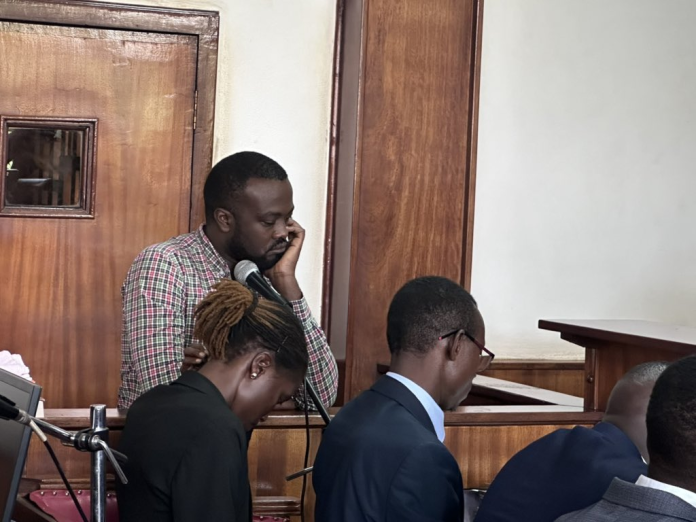
Former Rubaga RCC Herbert Anderson Burora has been further remanded to Luzira prison up to July 19, 2024 to allow the state to verify the authenticity of the documents presented by his three sureties.
Burora has been charged afresh for offences relating to hate speech and spreading malicious information against Speaker Anita Among. Buganda Road court ordered DPP to amend the charge sheet to include his contentious remarks on X.
The Prosecution says Burora called the speaker a murderer, kidnapper, torturer, and corrupt.
Burora’s remand of one week will allow the Court to make a decision on his bail application
He was picked up on July 1, 2024 by plain-clothed men from his residence in Ntinda and held in several police stations before winding up at Central Police Station, Kampala. Burora was then presented to the Buganda Road Court and remanded to Luzira.
Last week Anita Among pledged to listen to the concerns of one Fatuma Nansubuga, who was arrested in front of Parliament holding a placard written that the Speaker must resign.
Anita Among’s statement was received as a green light in Uganda’s political landscape. It suggested a potential shift towards greater openness and dialogue between the government and its citizens and it is also a sign that the voices of the people are beginning to be heard. However, the citizens also called for the release of the embattled Burora.
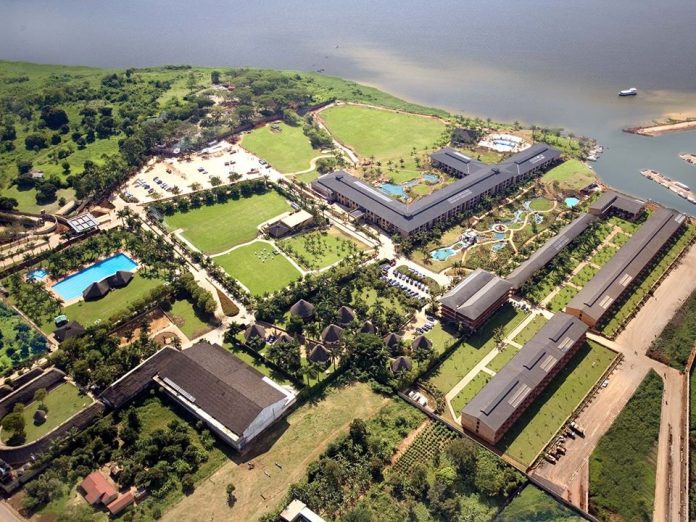
Munyonyo Commonwealth Resort is a story of nature blending with classical modernity to set base for a consummate abode in Uganda, with a tantalizing view of the marvelous Lake Victoria.
Sprawling across 90 acres, Munyonyo Commonwealth Resort boasts of world class business and conference venues; wedding, indoor and outdoor meeting venues, cuisines from all walks of life, a wellness centre that caters for kids’ activities and, a fitness centre and spa.
As testimony to the top-notch services offered at the Munyonyo Commonwealth Resort, Presidents and foreign dignitaries frequent the hotel anytime they are in town and hotel staff will talk of rubbing shoulders with the crème dela crème from the business, royalty, corporate, social and political world.
Speak Resort is affiliated to Ruparelia Group headed by Ugandan business tycoon Sudhir Ruparelia as chairman.
The hotel has been hosting many national and international conferences over the years, the latest international conferences hosted there being the Non-Aligned Movement (NAM) and G77+China summits.
The Convention Centre has a multipurpose hall, 12 high-end conference/breakaway meeting rooms and a floating restaurant that can host more than 900 guests, with an extraordinary view of Africa’s largest freshwater lake⏤ Lake Victoria. Below is the story in pictures.
President Museveni during the International Labour day celebrations.
By Ambassador Henry Mayega
As President Yoweri Museveni’s legacy continues to disconcertingly drown out Uganda’s opposition, recent Africa-wide research has declared the country number 2 on the continent in terms of democratic rankings. Simultaneously, a fete was recently organised at Kololo ceremonial grounds to honour the president’s legacy and stellar contributions to Uganda’s economic development and political stability.
The President has, over the years, assumed a string of electoral wins; right from 1996 through 2001, 2006, 2011, 2016 to 2021, he has made elections predictable and regular, a departure and norm-shattering iteration away from our checkered history devoid of democracy. Why have they continually elected him? Because citizens have prized his solid record and legacy, typified by the following:
First, rather than sit drably in the droughty corridors of power, the Yoweri Museveni administration restored Uganda to the international files of honour by reinstating peace, stability and security in a once pariah country it had become before 1986. The unseemliness of the opposition, which characteristically argues against this thesis, astounds nobody, given their finite space on Uganda’s political canvass. This administration obliterated all Uganda’s rebel groups, pacified the country, and up its sleeves, it boasts of helping with enforcing and keeping peace in the DRC, Somalia, and South Sudan, amongst others, because you can’t give what you have not.
Secondly, this administration, rather than upend the precepts of the already heated-up national political climate by 1986, choreographed and effected decentralisation in Uganda, thereby devolving power from the centre to the periphery. Thusly, new terms—decentralisation and power-sharing—were added to Uganda’s political architecture of governance, thereby mobilising citizens for development. Many responsibilities hitherto shouldered at the centre are now obligated to peripheral leadership.
Thirdly, the women who were hitherto confined to the kitchen environment have, for the first time, taken up prodigious leadership roles such as Vice President, Speaker, etc. Ugandans ought to remember this administration’s progressive policy interventions of: 1.5 marks added to females’ scores to massify admission to university; the district women MPs; the national women council; women representatives at local councils; 30% executive representation in all registered political parties, etc. Uganda’s women’s emancipation strategy did not descend from heaven; it was well calibrated, time-tested and implemented initially during the 1980–1986 bush war struggle. It got the stamp of approval and was executed once this administration took government in 1986. The conflicted opposition orbit comprised of Wine, Besigye, and Ilk will, characteristically, not agree because, to them, Yoweri Museveni is exhausting all the possible achievable national goals, leaving no gaffes for them to use against him.
Fourth, in both the health and education sectors, this administration has outperformed all its predecessors combined; it has refurbished the 5 national and 13 regional referral hospitals, built health centres: iis (3364), iiis (1570), and ivs (222), and implemented a robust immunisation programme, amongst others. Museveni’s haters may not agree, but the massification of education opportunities through UPE, USE, the higher education loan scheme, revamping TVETs, and the construction of county-based secondary schools have been the handwork of this administration to shore up access to basic services for citizens.
Fifth, in terms of development infrastructure, this administration has convincingly outmatched all previous governments put together, including our colonisers; from a paltry slightly over 1000 km (1986) to the current 7500 km (2022) Tarmacadam road network, this is an astronomical achievement in terms of revamping infrastructure. The few heretics who are crosswise with his administration have largely been shunned because of the huge political delta between what they say and what Uganda’s bombastic voter has seen this president do.
Lastly, the restoration of traditional rulers in regions that revere them, the restitution of their assets, and the passage of the law that provides for and protects them from political predators speak to this administration’s desire to put out the blazing political embers in all senses. Surprisingly, in the army council that sat in Gulu in 1988, Kiiza Besigye was one of the statistics who opposed the restoration. Relatedly, the likes of Betty Nambooze have always wanted to appear as if they love the Kabaka more than the restorer, Yoweri Museveni.
When refugees settle in a host country; they want to start a new life, be self-sufficient and contribute to their communities.
However, building a new life is filled with challenges especially if it means starting a business. They may find themselves cut off from credit and investment—and from other products and services that are so critically important, which becomes a limitation to building a better life.
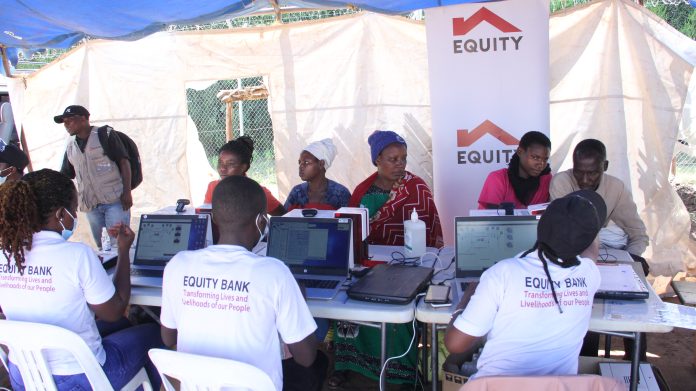
In the expansive Nakivale Refugee Settlement in South Western Uganda, Equity Bank has been experimenting with a bold approach that is charting a new course for supporting displaced people through micro-credit and micro-enterprises.
Uganda being host to more than 1.5 million refugees across both urban areas and 13 rural settlements, promoting entrepreneurship is increasingly viewed as an effective approach to overcoming the challenges of economic and social inclusion for refugees, according to the United Nations High Commissioner for Refugees’ operational data on refugee entrepreneurship in Uganda.
In 2018, Equity Bank started extending financial support to refugees through social payments and Safety Net programs, and in 2022, the Bank enlarged its purse to refugees by providing micro-credit to refugee households.
The idea was to help them to start micro-enterprises within the refugee camps. The tiny shoots planted back then have since grown, and lending has now reached over 400 refugee groups.
Working with 262 refugee agents, refugee groups have received agent loans worth Shs311 million. 3,662 individual refugees have also taken out Shs408.2 million in loans while deposits generated by refugees have crossed a Shs2 billion mark.
Besides the micro enterprises helping them achieve financial independence, the quality of their lives has improved, helping them access goods and services beyond the support they get from international agencies.
“This program is illustrative because it has helped to transition beneficiaries from systematic dependence on aid to economic stability and self-reliance,” says Elizabeth Mwerinde Kasedde, Equity Bank’s Executive Director of Public Sector and Social Investments.
Banking refugees and bringing them into the formal financial loop also dramatically expands their opportunities. Social Payments and Safety Net Programs to refugees in Nakivale, Kyakka II, Rwamwanja, Kyangwali, Imvepi, Palorinya and Rhino Camp are now channelled through agency banking.
Shs135.3 billion has so far been paid out in cash transfers across the 10 settlements where it is active. Recently, Bidibidi, Africa’s biggest refugee settlement, has been added to the loop.
In addition, 5,807 refugees have received financial literacy education with most being supported to access digital inclusion tools.
Support to refugees is and remains part of Equity Bank’s wider social protection program and capacity building to the poor, vulnerable and marginalised populations. The program has so far reached 109,887 households, impacting 230,000 beneficiaries.
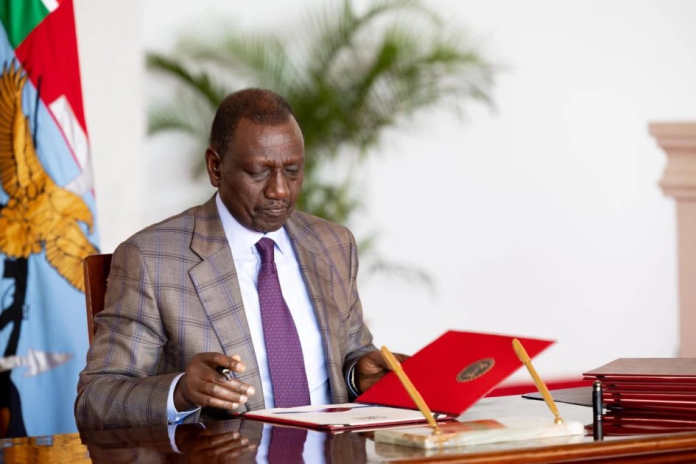
Kenya President, William Ruto has dissolved all cabinet secretaries, ministers except Prime Cabinet Secretary/Minister Musalia Mudavadi and the Cabinet Secretary for Foreign Affairs with immediate effect. His Deputy President, Rigathi Gachagua has been excused.
“I have decided to dismiss with immediate effect all cabinet secretaries and attorney generals of the Cabinet of Kenya except the Prime Cabinet Secretary and Cabinet Secretary for Foreign Affairs,” President Ruto stated in a televised address to the nation.
The President revealed that the office of the Deputy President is not affected by this decision and the Principal Secretaries will coordinate the affairs of the Ministries until a new cabinet is appointed.
President Ruto noted that he will engage in extensive consultations across different sectors, political formations, and with Kenyans from both the public and private sectors to form a broad-based government. This new government will assist him in implementing his programs, including urgent measures to address the country’s debt burden.
“I will immediately engage in extensive consultations across different sectors and political formations and other Kenyans both in public and private with the aim of setting up a broad base government that will assist me in accelerating and expediting the necessary urgent and irreversible implementation the program we have including other radical measures to deal with the burden of debt,” the President said.
The latest cabinet changes are the second since he took office in September 2022. In October 2023, barely a year ago, the President reshuffled the cabinet, making Mudavadi a CS. The other CSs, now sacked, were then reshuffled, with some getting new ministries and mandates.
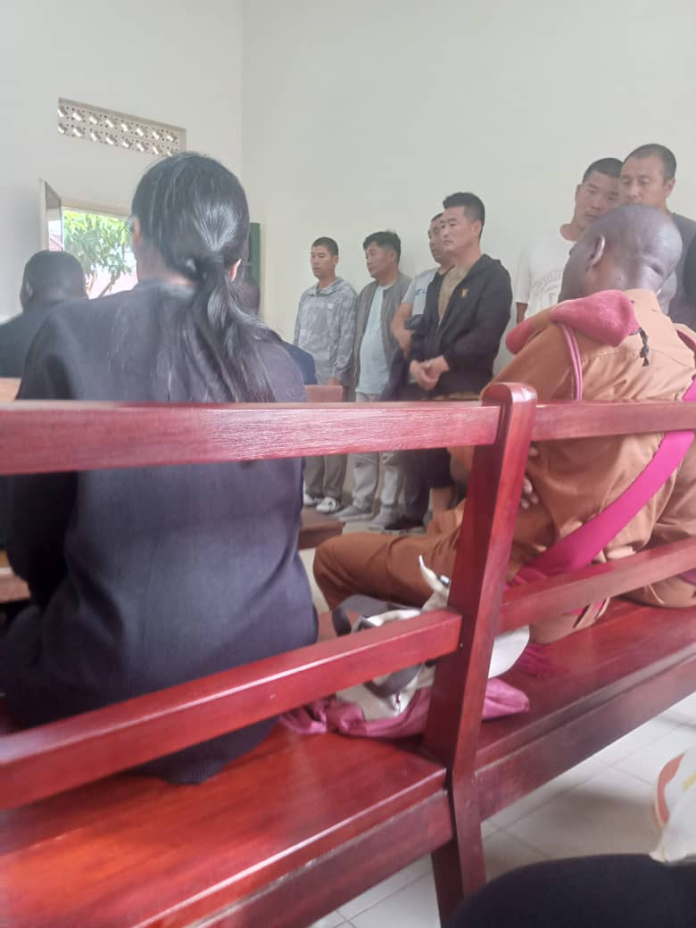
Buganda Road Chief Magistrate’s Court, Siena Owomugisha, has remanded seven Chinese nationals to Luzira prison until the July 16, 2024 on charges related to environmental destruction.
They were arrested by the National Environmental Management Authority (NEMA) at the beginning of this week for illegally mining sand in the Lwera wetland.
The suspects include: Liang Cheng Wu, Ui Wen Hu, Lian Cheng Xiang, Hu Dong Xu, Xie Gong Zuo, Ge Xing Liang and Wang Piechuan.
In a significant move to protect Uganda’s ecosystems, the National Environment Management Authority (NEMA) has launched an operation against illegal sand miners in Lwera Wetland, located in Kalungu District. The operation, which began on the night of July 9, 2024, along the Kampala-Masaka Road, resulted in the arrest of seven foreign nationals and the impoundment of 13 sinotruk lorries and four excavators, among other equipment.
NEMA halted all illegal sand mining activities in Lwera in April this year and tasked the miners to restore the degraded parts of the wetland. The restoration exercise is part of NEMA’s ongoing efforts to liberate Uganda’s wetlands and other fragile ecosystems from environmental degradation.
According to NEMA, wetland degradation is a serious crime under Section 55 of the National Environment Act, Cap 181, and is punishable with a fine not exceeding Shs600 million or imprisonment not exceeding 12 years or both.
The seven arrested foreign nationals are expected to be charged in accordance with the law, following the conclusion of investigations into the matter.
NEMA’s operation in Lwera Wetland is part of a larger campaign to protect Uganda’s environment and natural resources. The Authority has vowed to continue carrying out similar operations across the country to ensure that those who degrade the environment are held accountable.
The move has been praised by environmentalists and conservationists, who have long called for tougher action against illegal sand mining and wetland degradation.
Lwera Wetland, located in Kalungu District, is one of Uganda’s most fragile ecosystems, and is home to a variety of plant and animal species. The wetland plays a crucial role in regulating the water cycle, preventing floods and droughts, and supporting agriculture and fisheries in the surrounding areas.
The illegal sand mining activities in Lwera have been blamed for causing significant environmental damage, including the degradation of the wetland, destruction of habitats, and disruption of the water cycle.
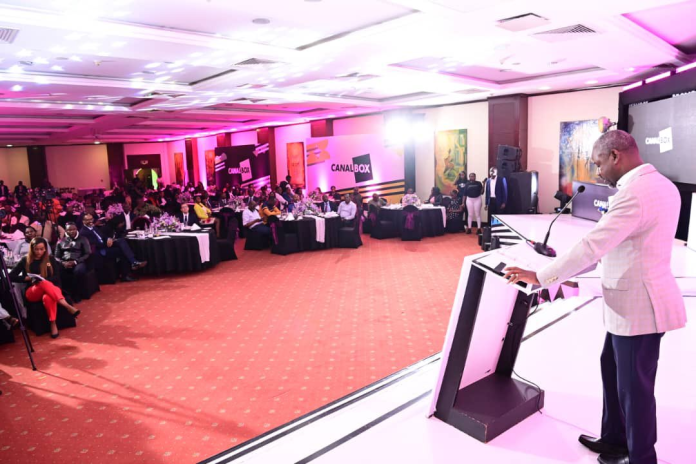
CanalBox Uganda, a new broadband internet service provider, has officially launched its services in Uganda after investing Shs50 billion in the past 11 months.
The company offers two fiber optic internet plans, Start (50 Mbps) and Premium (200 Mbps), suitable for basic and heavy internet users respectively.
Priced at Shs110, 000 and Shs200, 000 per month, CanalBox Uganda’s fiber optic internet promises to offer high speeds and reliability, making it ideal for businesses, homes, and schools that require reliable internet access for streaming, video conferencing, and other demanding applications.
Deputy Speaker Thomas Tayebwa praised the entry of CanalBox Uganda, stating, “The entry of such a giant player in Uganda is a vote of confidence in our government and its business-friendly policies, country, and people.” He commended the company’s efforts and looks forward to seeing the impact they will make in growing broadband internet prevalence in Uganda.
Tayebwa added that increasing affordability and access to the internet are crucial components in the government’s deliberate efforts to deepen connectivity in Uganda, and was glad to hear that this is also a priority for GVA’s long-term investments in fiber optic infrastructure.
“The internet has transformed societies in unprecedented ways, shaping the way we live, work, and interact with one another through communication, information dissemination, business transactions, education, and improved service delivery,” Tayebwa said.
He urged the GVA team to become the first company to zero-rate all educational websites, benefiting children in rural Wakiso and beyond.
The entry of such a giant player in Uganda is a vote of confidence in our government and its business friendly policies, country and people.
He also commended GVA for their efforts and the footprint they have made so far and looks forward to seeing the impact they make as they continue to grow the prevalence of broadband internet in Uganda, as they have done in other countries across Africa.
CanalBox Uganda’s fiber optic internet uses light pulses to transmit data, resulting in faster speeds and better reliability than traditional options. This launch is expected to increase broadband internet penetration in Uganda, supporting the country’s digital transformation and economic growth.
With its high-speed and reliable internet services, CanalBox Uganda is poised to revolutionize the internet landscape in Uganda, supporting businesses, education, and innovation.