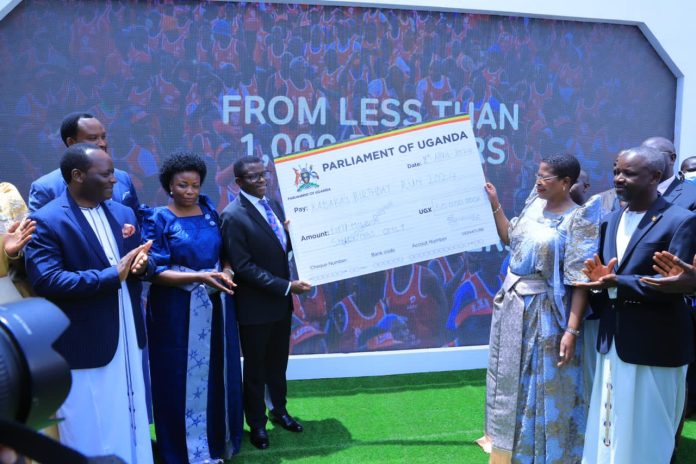
Speaker of Parliament Anita Among has led a delegation comprising of her Deputy Thomas Tayebwa and host of MPs to Bulange, Mengo to support the upcoming Kabaka birthday run.
This year’s Kabaka Birthday Run, slated for Sunday, 07 April 2024 is hinged on the fight against HIV/AIDs scourge under the theme: “Men are stars in the fight against HIV/AIDs to save the girl child.”
Speaker Among and her entourage, which included Government Chief Whip Hon Hamson Obua, the Minister of State for Disaster Preparedness Hon Lilian Aber, was welcomed to Bulange by the Katikkiro (Prime Minister) of the Kingdom of Buganda, Charles Peter Mayiga.
In his welcoming remarks, Mayiga termed the Speaker’s visit historic, adding that it marks the beginning of deeper collaboration between the Kingdom and Parliament.
“This is the first time the Speaker has been to Bulange… This is a historic visit because no Speaker of Parliament has ever been here for this purpose of participating in the run and it marks a starting point of a collaborative program with Parliament to promote the eradication of HIV/AIDs in the country,” Mayiga said.
Mayiga said for the last five years, Kabaka’s runs have been themed in the fight against HIV/AIDs and it is projected to continue following threats of withdrawal of financial support by the Joint United Nations Programme on HIV/AIDS (UNAIDS).
He called upon Parliament to prioritise the health sector in their legislative agenda, by ensuring that hospitals are spread all over the country, well equipped with medicines and equipment and also ensure that health workers are adequately paid.
He also urged politicians to find some time off politicking and attend to social needs of their constituents.
“Don’t get so consumed by politics all the time. Give special attention to some social aspects like health, sports, community development, protection of culture and heritage,” he said.
Speaker Among commended the Kabaka of Buganda, His Royal Majesty Ronald Muwenda Mutebi II for championing health needs and pledged to continue supporting the Kingdom’s humanitarian causes.
“I appreciate the Kabaka for being the champion in the fight against diseases like HIV/AIDS and others and we are here to support the kingdom in doing so. I am cognizant of the fact that HIV/AIDs has been prevalent and Buganda Kingdom has done a tremendous job…Fighting HIV/AIDs and achieving the dream by 2030 is the role of government and we thank you [Kingdom] for complementing government,” Among said.
On behalf of Parliament, Speaker Among contributed Shs50 million to support the run, while the Buganda Parliamentary Caucus bought kits for 529 MPs worth Shs10,580,000. The Speaker and MPs also gifted the Kabaka with birthday presents.
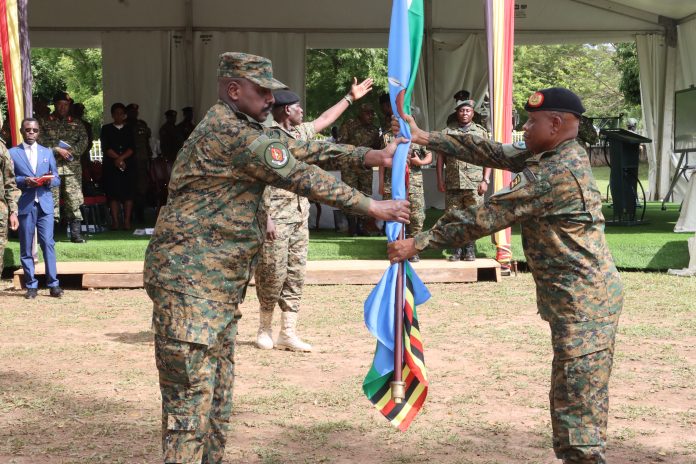
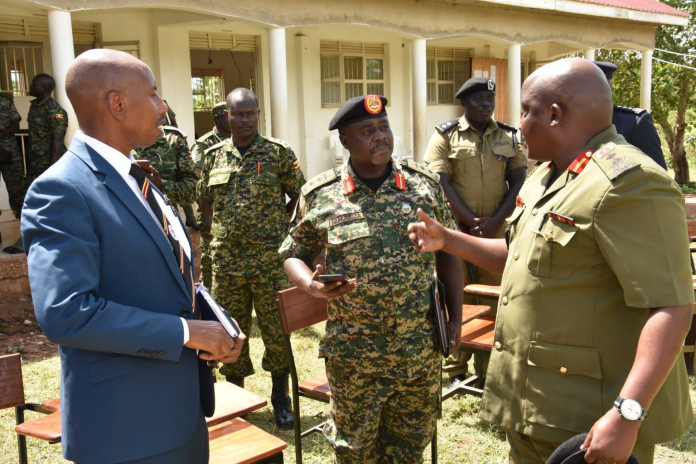
Maj. Gen. Ngendabanka receiving a report from Gen. Okidingi.
The African Union Transition Mission in Somalia (ATMIS) has applauded the outgoing Force Commander, Lt. Gen. Sam Okiding, for his exemplary leadership and steering the mission to success during his tenure.
Lt. Gen. Okiding is scheduled to depart the ATMIS mission area to take up a new position as Uganda’s Deputy Chief of Defence Forces.
At a farewell event held at the ATMIS Force Headquarters in Mogadishu, the AU chairperson’s Deputy Special Representative for Somalia, Sivuyile Bam, commended Lt. Gen. Okiding for his stewardship of the multinational African peace support operation.
“Uganda has gained from our loss. As you return to Kampala, we look forward to working with you wherever you are. And we promise that we will continue with your legacy and do the work that is expected of us,” said Bam.
The ATMIS Deputy Force Commander in Charge of Operations and Plans, Maj. Gen. Marius Ngendabanka, applauded Lt. Gen. Okiding for leading the ATMIS military component in implementing its mandate even after troop numbers were reduced and security responsibilities were transferred to the Somali Security Forces.
“We appreciate how he has commanded the military component since his arrival on the mission. We highly appreciate his leadership. He promoted teamwork among staff officers at the ATMIS Force Headquarters and across all sectors,” said Maj. Gen. Ngendabanka.
Lt. Gen. Okiding expressed confidence in the ability of the ATMIS military to successfully implement the mission’s mandate during the transition phase. He pledged that ATMIS would continue to benefit from his support when he assumes his new position as Uganda’s Deputy Chief of Defence Forces.
“My voice will now be heard about Somalia’s operations. We will fight for this operation, especially in the area of force enablers, where we are still lagging behind. And as we continue to draw down and the force shrinks, we need alternatives. So, I think I will be in a better position to advocate for our operations,” he said.
Lt. Gen. Okiding took the helm of the ATMIS military command in May 2023 and presided over the successful handover of 13 Forward Operating Bases (FOBs) and transfer of security responsibilities to the Somali Security Forces during the first and second phases of the ATMIS drawdown concluded in June and December 2023.
Maj. Gen. Ngendabanka has taken over the interim responsibilities of the ATMIS military ahead of the arrival of the substantive Force Commander.
Gen. Okiding will be replaced by Lt. Gen. Sam Kavuma at ATMIS. The has also said Gen. Kavuma will keep his seat in Parliament as UPDF representative.
“Gen. Kavuma doesn’t have to resign his seat in Parliament, it is one year and he is completing Gen. Okiding’s tour of duty. He will remain as an MP” Brig. Felix Kulayigye, Army and Defence Spokesperson told EagleOnline.
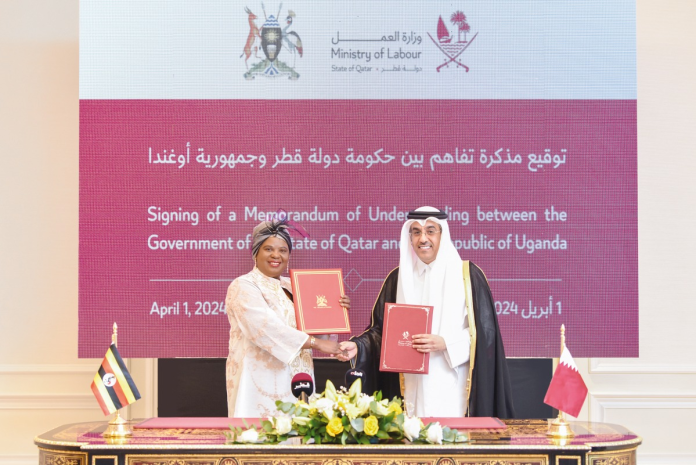
Betty Amongi, Uganda's Minister of Gender, Labour, and Social Development, and Qatar’s Minister of Labour, Dr. Ali bin Smaikh Al Marri during the labour signing ceremony.
The government of Uganda has signed a new bilateral labour agreement with Qatar, EagleOnline has learnt. The agreement was signed by Betty Amongi, the Minister of Gender, Labour, and Social Development, and Qatar’s Minister of Labour, Dr. Ali bin Smaikh Al Marri.
The agreement aims to enhance the strategy of the Ministry of Labour in attracting skilled and qualified labour, bolstering their presence in the local market, and improving the productivity of the private sector, as well as upgrading the work environment.
Under the agreement, the two parties will facilitate the procedures for recruiting skilled labour from Uganda and supply the local market with the required competencies, qualifications, experiences, and specialisations.
This also includes reviewing job opportunities available in Qatar, the skills and experiences required, and the extent to which they are available in Uganda to benefit from them.
Following the signing of the agreement, Amongi said, “I have signed the Bilateral Labour Agreement for skilled, semi-skilled, and domestic workers.” The welfare of workers, health insurance, and terms and conditions of workers are embedded in”.
The minister said a joint technical committee of the two countries will digest the agreement before the recruitment begins.
This is the second bilateral labour agreement Uganda signed after Saudi Arabia in March last year. As of June, last year, there were 235 licensed private recruitment companies. Every two years, each company pays Shs2 million in licence fees. Annually, the government collects $1.3 billion globally from labour export businesses; the Middle East alone sends in $700 million.
Last year, the Minister of Finance, Matia Kasaija, said that during the #Covid-19 pandemic, the country was surviving on remittances. The contribution of remittances amounted to $1.3 billion in 2022, compared to $1.1 billion the previous year.
The government collects $30 (Shs110,000) in job order fees for each eternalized worker. That money is wired directly to the Uganda Revenue Authority accounts. From August 2021 to August 2022, the government collected over Rs12 billion from job orders.
The Ministry of Internal Affairs says they process 10,000 passports every month, and the biggest percentage goes to individuals seeking to work in the Middle East.
According to the Ministry of Gender, Labour, and Social Development, there are over 150,000 Ugandan migrant workers in Saudi Arabia. Most Ugandans are employed in the informal sector as housemaids, gardeners, cargo handlers, and other jobs.
In 2021, Uganda externalized 89000 Ugandans, of whom 79000 went to Saudi Arabia. Of the 79000, 75000 were female. By June 2022, Uganda had externalized 50,000 nationals, and a high percentage went to Saudi Arabia.
General Muhoozi Kainerugaba fondly known as “MK” has taken over the office of the Chief of Defence Forces (CDF) and vowed to improve welfare of soldiers by fighting the evil of corruption and mismanagement of resources.
The Hand over which took place in Gulu 4th Division Headquarters was presided over by uncle and Special Presidential Advisor on Defence and Security and also Chief Coordinator of Operation Wealth Creation (OWC) Gen Caleb Akandwanabo, commonly known as Salim Saleh.
Gen Saleh congratulated both the Incoming and Outgoing CDFs upon their tour of duty and implored them to continue preserving their health.
He also urged them to cautiously uphold the first pillar of “Musevenomics”, that’s security of life and property for social economic transformation.
Gen Muhoozi replaces Gen Wilson Mbadi now appointed State Minister for Trade.
Gen Muhoozi promised that the UPDF under his charge would continue being professional, moral and tackle comprehensive national security.
The 49-year-old, who most recently served as Senior Presidential Advisor in charge of Special Operations (SPA/SO), is on a pivotal post on the path to the top spot. Gen MK current task among others is to continue battling Allied Democratic Forces (ADF) terrorists, cattle rustling in Karamoja Sub region, cyber terrorism among others.
Gen Muhoozi in his acceptance speech, expressed his profound gratitude to the President and Commander in Chief of the UPDF Gen Yoweri Kaguta Museveni for his wise stewardship that has grown UPDF to what it is today.
“UPDF continues to be the principal pillar of the Ugandan state that all Ugandans respect. UPDF is the central institution of Uganda’s nationhood because entry into it is open to all Ugandans.” He said. He added that Ugandans can disagree on anything but respect and support UPDF works.
He lauded the Outgoing CDF for a job well done in building a modern professional force and implored soldiers to avoid the spirit of “arrivism”, thinking that you have achieved all.
Gen Muhoozi further emphasized that having the best equipment, best uniforms, best education, best welfare and best accommodation, among others; can only be done by fighting corruption and mismanagement of resources.
He promised to work with every soldier to achieve what is expected of the forces.
“Continue with our role in securing the non-military aspects of security like environmental, cyber, and political security,” Gen Muhoozi cautioned troops.
The new CDF, also called upon troops to maintain their position as defenders of African interests by defending emerging technologies.
Speaking at the ceremony, the former CDF and now Minister of State for Trade and Industry Gen Mbadi congratulated the Incoming CDF Gen Muhoozi Kainerugaba upon his new appointment as CDF.
“I congratulate you for catching the eye of the appointing authority, ” Gen Mbadi said.
He further sincerely commended the President and Commander in Chief of the UPDF H.E Gen Yoweri Kaguta Museveni for giving him the great opportunity to serve at the helm of the country’s military. ” It has been an exciting 33 months serving at the helm of the Peoples’ Force and it gives me a strong sense of pride,” he emphasised, adding that” UPDF is a family of great people that bound together to serve our great country.”
He further promised his willingness to sacrifice in order to maintain our freedom, our security and our very existence as a Pearl of Africa.
He underscored the ongoing threats posed by inadequate defence budget where defence continues to get only 47% of its required budget, extremist organizations (terrorists), sabotage, cross border tensions, cybercrimes and livestock theft, among others; and henceforth highlighted the need for vigilance, frugality, effective anti-corruption measures and improvisation; in countering their actions.
Gen Mbadi concluded by noting that the country is calm and peaceful despite the infiltration of negative elements and negative political activism, environmental challenges and cross border tensions from Eastern DR Congo, South Sudan and Somalia.
Some of the achievements of UPDF so far include: increased defence diplomacy, legal reforms, created new institutions (like National Defence College), protection of military land, In-house fuel storage, partial salary enhancement, ideological refocus, environmental refocus, mobility capability and budget increment, among others.
The instruments of power that were handed over to the Incoming CDF included but not limited to the: Uganda Constitution, UPDF Act 2005, UPDF Doctrine, UPDF Defence Policy, UPDF Establishment 2020/21, MOD Policy Statement 2024/25 and National Defence Policy
Gen Muhoozi comes in as the top army chief of the NRA/UPDF after Gen Mbadi, Gen David Rubakuba Muhoozi, Gen Edward Katumba Wamala, Late Gen Aronda Nyakairima, Late Maj Gen James Kazini, Gen Abubaker Jeje Odongo, Maj Gen Mugisha Muntu, Gen Caleb Akandwanabo, Late Gen Elly Tumwine .
The function was also attended by the Permanent Secretary MODVA Mrs Rosettie Byengoma, UPDAF Under Secretary Finance and Administration Mr James Mutabazi, Director General of External Security Organisation (ESO) Amb. Joseph Ocwet, former Director General of ESO David Pulkol, and former ISO boss and Chief Advisor OWC Ambassador Philip Idro.
Other Attendees were: Commander of the African Transition Mission in Somalia Lt Gen Sam Kavuma, Managing Director National Enterprise Corporation (NEC) Lt Gen James Mugira, Special Presidential Advisor (designate) Lt Gen Peter Elwelu, Commander Reserve Force Lt Gen Charles Otema Awanyi, Commander Land Force Lt Gen Kayanja Muhanga, former Joint Chief of Staff (JCOS) Maj Gen Leopold Kyanda, Commander Special Forces Command (SFC) Maj Gen David Mugisha, Deputy Commander Air Force Brig Gen Stephen Kiggundu, among other invited UPDF Generals, Service Commanders, Chiefs and Directors.
Ramathan Ggoobi, the Permanent Secretary, Ministry of Finance
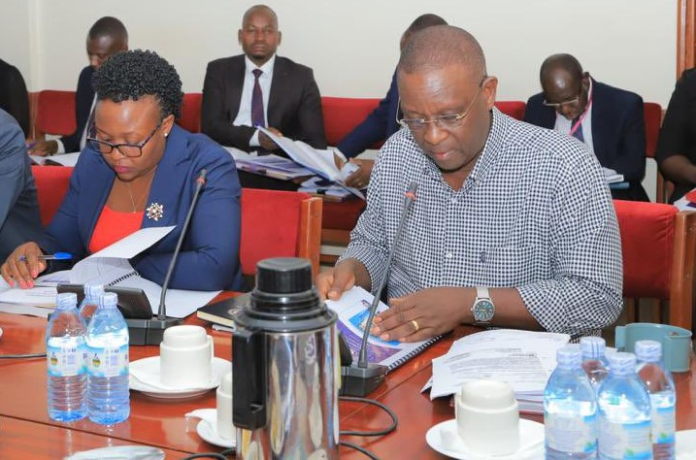
Members of Parliament have questioned the Secretary to Treasury, Ramathan Ggoobi’s caliber following his decision to reduce Parliament’s budget by 50%.
Nathan Byanyima (Bukanga North) wondered what had befallen the Ministry of Finance because in the previous years, the occupants of the office of Secretary to Treasury were people of high caliber and wondered why Ramathan Ggoobi, the current Secretary to Treasury would announced a 50% budget cut to Parliament and also make statements that Parliament has no powers to alter budgets submitted by the Ministry of Finance.
“I have seen a paper that the Parliamentary budget will be cut by 50%. Where does such a person (Ggoobi) get powers? There is a rule that we must respect each other, treat other people the way you want to be treated. We have been demeaned to nothing. But when the Secretary to the Treasury goes to a Committee of Parliament and says that we have no role to play in the budget & appropriation, it defeats my understanding, has this country changed? I don’t see why we are wasting our time going into the budget. It doesn’t make sense,” said Byanyima.
The development comes at the time Parliament has been in the spotlight over alleged corruption and wasteful expenditures, although, it is not known whether Finance’s decision was informed by findings from these social media allegations.
Speaker Anita Among described the decision as humiliating and demeaning to the Legislature.
“Our deduction of 50%, shall we be paid salary? You even have the courtesy to put it in bold, on a statutory vote that Parliament shouldn’t get money,” Among said.
Sarah Opendi (Tororo DWR) also claimed that while appearing on NBS TV this morning, Ggoobi alluded to the same sentiments, saying that Parliament has no power of budgeting that this is an executive function.
“He said Parliament has no powers to move money from one vote to another because budgeting for this country isn’t our responsibility. That it is the executive that knows the priority of this country. So, what is our role as Parliament? And the challenge we have in this country is picking people who haven’t grown in public service and placing them in such sensitive positions because a Secretary to Treasury used to rise from the bottom and when you pick someone from somewhere, they don’t respect leaders,” remarked Opendi.
However, Henry Musasizi, Minister of State for Finance has asked Parliament to disregard statements made by Ggoobi about Parliament not having powers of appropriation saying such statements are not representative of the Ministry of Finance.
“To the best of my knowledge and experience, appropriation powers rest with Parliament. If the Secretary to Treasury expressed his views and opinions, I am not privy to what the Secretary to Treasury said, but I know and I know the Secretary to Treasury doesn’t have a chance to speak on this microphone. I would like to invite colleagues to disregard what the Secretary to the Treasury said. We should always take what we say as the Ministry of Finance on this microphone. If whatever he said, wherever he said offended the Committee of Parliament or Parliament in general, I would like to apologize on his behalf,” said Musasizi.
Previous holders of that docket include former Auditor General James Kahoza, late Governor Emmanuel Tumusiime Mutebile, late Chris Kasami and late Keith Muhakanizi.
This website failed to obtain Mr Ggoobi’s response to the legislators over his caliber status.
CIM Chief, Maj. Gen. Birungi talking to Director of the Confucius Institute – Makerere University, Dr Gilbert Gumoshabe and others during the launch.
The Chief of Military Intelligence, Major General James Birungi, has launched the languages wing and officially opened the Arabic and Chinese courses that will be conducted in partnership with the Makerere University School of Languages at the School of Military Intelligence in Nakasongola district.
Maj Gen Birungi lauded the Dean School of Languages, Makerere University for partnering with the Uganda Peoples’ Defence Forces on the noble cause for the country.
“This is indeed an important milestone for the entire UPDF fraternity and the country,” said Maj Gen Birungi.
He observed that the course comes at a time when the new world order, globalization and advances in technology have brought new opportunities and challenges that require effective communication skills to avoid ambiguities and the possibility of being misunderstood and navigating through multicultural and intricate partnerships.
Maj Gen Birungi implored the participants to be focused and have a positive attitude to be able to harness as much knowledge as they can to succeed in the course.
“This training will prepare you to become certified linguists on your job specification especially interpretation, translation, and being subject matter experts on cultural Issues, among others.”
Col James Muhumuza the Commandant of the School said that the course aims to produce trainees who can effectively read, listen, write, speak and translate.
He cited from the historical perspective the power of language as a power of unity in the Bible during the building of the Tower of Babel which the same was used as a defensive tool to disintegrate the people and save God’s kingdom.
The Director of the Confucius Institute – Makerere University, Dr Gilbert Gumoshabe expressed gratitude for entrusting Makerere University in the formation of the new language curriculum adding that there is a need for knowledge of other foreign languages besides English.
Pius Bigirimana, the flamboyant PS to the Judiciary.
Pius Bigirimana, Secretary to the Judiciary, has revealed that cases worth Shs77 trillion are trapped in the Commercial Division of the High Court as backlog because of lack of adequate funds to adjudicate them.
He said that if the funding was available and these cases were disposed of, Uganda wouldn’t even need to borrow money from the World Bank to finance its national budget.
“I have got a list of case categories which come to a total of Shs83 trillion as of December 2023 but now, they have reduced to Shs77 trillion because of the Judges who were put in Commercial court, and it has reduced a bit. This money which is tied up in the Commercial court, we don’t even have to go and borrow money from the World Bank. These are cases in construction, banking, insolvency positions, intellectual property and loans. All this is money tied up there, but I think Finance also has some issues,” Bigirima said.
While appearing before the Legal and Parliamentary Affairs Committee to defend the Judiciary’s Ministerial Policy Statement for financial year 2024/24, Bigirimana informed the lawmakers that if this backlog is to be reduced, more Judges have to be recruited to hear the cases and also promote alternative dispute resolution.
Documents available to the Legal Committee indicated that as at February 2023, case backlog stood at 42,907 cases against a caseload of 179,984 pending cases.
Bigirimana also protested the decision by the Ministry of Finance to reduce the budget for the Judiciary from Shs392 billion to Shs362 billion in the coming financial year. He said that in the medium term, the Judiciary had requested for a budget increase to at least Shs600 billion.
“The Ministry of Finance gave us a budget ceiling of Shs362 billion and we thought that that was very unfair and unreasonable because you cannot reduce the budget for the Judiciary when actually, you are supposed to be adding on. I am under strict instructions from the Chief Justice that he has never broken the law, he doesn’t intend to break the law now and in future and therefore, what the Ministry of Finance has done is to try trap him in the trap of breaking the law, so he isn’t about to do that, said Bigirimana.
The Secretary to Judiciary added that the protest being put up by the Judiciary has seen the institution being locked out of the System put in place by the Ministry of Finance.
“This morning, I had a phone call with Secretary to Treasury, he was asking me, why we haven’t submitted our budget details I told him that I don’t want to break the law and he said if you don’t submit to us and we submit to Parliament we shall leave you out, and I told him, if that is your choice go ahead. So, I have left him because in the system, you can’t make budget estimates proposals when you don’t follow the ceiling they have given you. You can’t submit because the system can’t allow me in,” said Bigirimana.
Bigirimana also revealed that President Yoweri Museveni is expected to commission the newly constructed Supreme Court and Court of Appeal buildings in Kampala on April 12, 2024.
“We are waiting for President Museveni to come and commission. I have already communicated in writing that we shall invite you on the April 12, 2024,” Bigirimana noted.
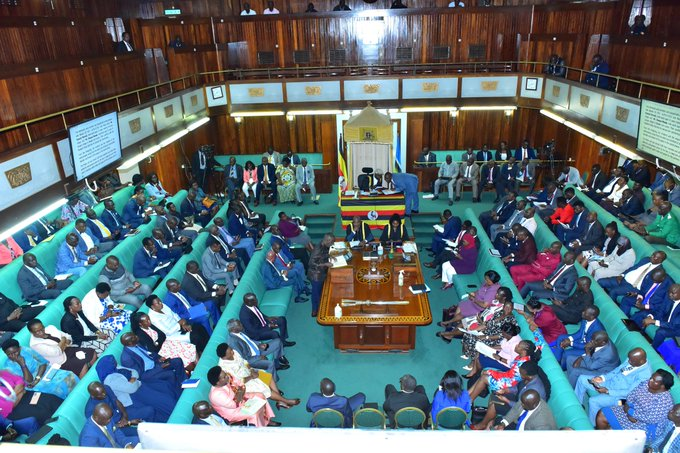
Members Parliament have expressed regrets over their decision to impose a tax on diapers, which they initially claimed were being used to promote homosexuality in Uganda and are now admitting that the tax has instead made diapers expensive for the elderly and people with disabilities who rely on diapers in order to protect their dignity in society.
In June 2023, Parliament passed into law the Value Added Tax Amendment Bill 2023, approving an 18% VAT levy on all diapers, despite the proposal from Government limiting this tax to only baby diapers that were described as a luxury, as opposed to adult diapers whose exemption was sought on medical grounds.
Although some MPs opposed the tax saying it would push women into spending more time in unproductive labour, or washing nappies, other MPs argued that adult diapers are mostly used by homosexuals, so imposing a tax on adult diapers would reduce homosexuality in Uganda. A decision was reached to end the tax exemption on all diapers, so 1st July, 2023, the cost of diapers went higher due to the 18% tax levy.
Flavia Kabahenda (Kyegegwa DWR) has noted, “On the World Disability Day in Mbarara, I realized that the people with hydrocephalus and spina bifida are living on pampers and these pampers have become expensive from the time we slapped a tax on pampers. I think we made a mistake as Parliament to impose taxes on diapers because we thought we would help parents to reduce use of diapers in order not to spoil their children, but we have discovered that there are elderly people who need to use diapers and there are also people with disability that rely on diapers in order to protect their dignity in society. So, I want to implore my fellow MPs to allow that we rescind the tax on pampers.”
Prosper Muhumuza, Commissioner in Charge of Disabilities at the Ministry of Gender, Labour and Social Development, 12.4% Ugandans are living with disabilities and of these, over two million are children living with Hydrocephalus and Spina bifida and families of these children spend 39% of their income on caring for these children.
Rose Obigah (Terego DWR) asked MPs not to go back and forth with the diapers tax, arguing that the tax was imposed because diapers are a luxury & there was need to reduce their excessive use because diapers had started to impact on fertility of men in Uganda.
“People from Karamoja and my village (Terego District), they perform well, their fertility lasts longer but you see these men brought up in good homes, they have challenges with sperm count. It was on that ground that we wanted to reduce this excessive use of pampers. Diapers are a luxury, we would prefer to use nappies,” said Obigah.
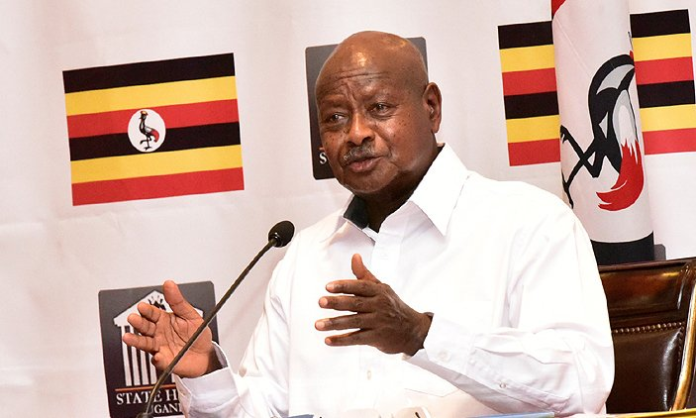
President Yoweri Museveni has urged political, cultural, and religious leaders, private sector players, and civil society to comply with and support the execution of the fourth national census scheduled to take place in May.
The national census is scheduled to take place on May 10, 2024. Currently, Uganda is estimated to have over 41 million people. The estimates can, however, only be verified after the national census.
Currently, the Uganda Bureau of Statistics (UBOS) is conducting the geo-mapping of household and enumeration area boundaries for the creation of an interactive map that shall be used in the enumeration exercise.
“I would like to announce the 6th National Population and Housing Census (NPHC) that will start on May 10, 2024.” Museveni said.
Museveni said the information from the National Population and Housing Census will support the government, the private sector, cultural and religious institutions, civil society, and development partners in service delivery. It will also provide the basis for planning the provision of social services such as education, health, and transport, among many others, at the national and local level.
“When data collectors come to your homes during the census, please avail yourselves and provide them with honest answers to their questions. This is in order to enable them to process the most accurate information about you, your household, institutions, and community,” he said.
He noted that the successful execution of the census will influence the well-being of all Ugandans and progress the country towards the desired socio-economic
The Bank of Uganda (BoU) has authorized ABC Capital Bank (U) Limited, Guaranty Trust Bank (U) Limited, and Opportunity Bank to transition from a Tier I Commercial Bank License to a Tier II Credit Institution License effective July 1, 2024.
These three institutions have been granted a transition period of three (3) months, starting from April 1, 2024, to June 30, 2024, during which they will make adequate arrangements to phase out products and processes that require a Tier I License.
Michael Atingi-Ego – Deputy Governor says this is intended to ensure a smooth service transition for their customers and to mitigate any disruption to financial sector stability.
“The change of status of the three commercial banks to credit institutions follows decisions by the respective boards of directors, to adopt a strategic shift and reposition these institutions to serve their core customer base better. The institutions are adequately capitalized and meet the minimum capital requirements for a Tier II License,” he said in a statement.
The BoU reassures the public that it remains committed to ensuring stability of the financial system.