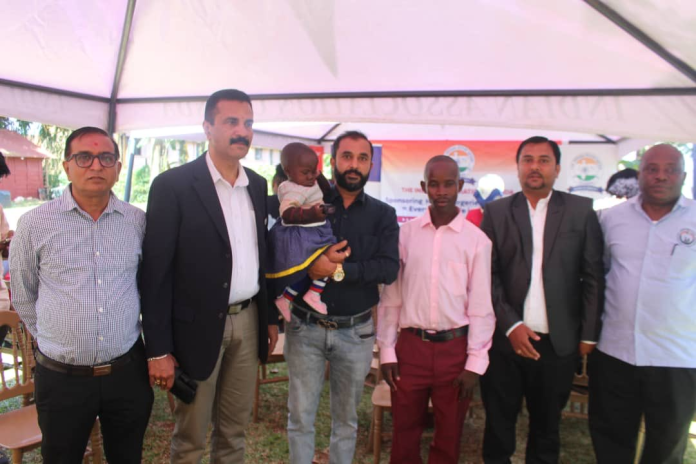
The Indian Association of Uganda will this year send 150 Ugandan children with heart complications to undergo open heart surgeries in India. The support will cover the operations, air tickets, upkeep for each patient and the caretaker.
Confirming the commitment, the Association through its X handle noted that yesterday, the third batch of five heart patients was sent off for surgery in India.
“Indian association (U) today did send off to the 3rd batch of 5 heart patients for surgery in India. We thank India in Uganda for free visas to all patients and caretakers, the Uganda Airlines for concession on tickets and Rotary Ssese Kampala for support in surgery,” read the post on X handle.
Previously, the association sponsored five children for open heart surgery in India. However, the Uganda Heart Institute started a fundraising campaign to have 150 children operated.
City Tycoon Sudhir Ruparelia is one of the trustees of the Indian Association of Uganda.
According to the Uganda Heart Institute – UHI, the common heart complications in children in Uganda include Rheumatic Heart Disease, Coronary artery, and abnormal heartbeats. Persons with Coronary Arteries require a Coronary Artery Bypass Graft (CABG) procedure, in which the blocked portion of the coronary artery is bypassed with another piece of blood vessel.
The Uganda National Examinations Board (UNEB) has released sample examination papers for the Uganda Certificate of Education competency-based assessment under the new lower school curriculum.
The sample papers cover 36 subjects in the categories of humanities, sciences, vocational and languages, each with a corresponding scoring guide.
In a statement dated March 25, 2024, UNEB Executive Secretary, Mr Dan Odongo noted that the purpose of the sample papers release is to expose both teachers and learners to the question format of competency-based assessment.
“With these tools, schools will now be comforted, and know how the assessment will go. The sample papers are however just dummies of what is likely to come in the end-cycle Assessment. The final scenarios will certainly be different,” said Odongo.
Odongo added that head teachers can now access the sample papers via the UNEB portal at all UNEB examination centres and hard copy booklets to schools without centre numbers.
He further called upon teachers to familiarise themselves with the sample papers, guide the learners and come up with similar or related scenarios and questions to expose the learners to a variety of test items.
The Ministry of Education and Sports through the National Curriculum Development Center introduced a competence-based curriculum in secondary schools in 2020 and has since held training sessions for teachers across the country on how to implement the new curriculum.
The Competency-Based Assessment emphasises learner-centred pedagogies and the integration of technological and practical innovations in the teaching/learning process.
The 2020 secondary school Language Competence-Based Curriculum replaced the 2008 Integrated English teaching syllabus that emphasised the use of integration at either subject or unit level as opposed to the teaching of language in isolated compartments like grammar, vocabulary, comprehension or writing.
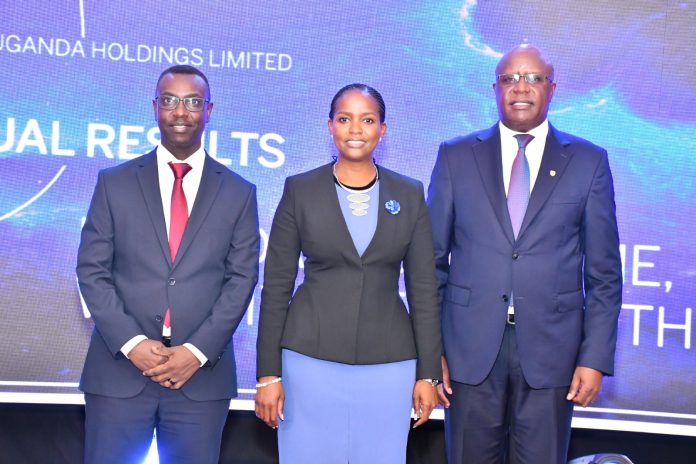
Stanbic Uganda has announced a profit after tax of Shs412 billion for the period ending December 2023 representing 15.2 percent growth from Shs357 billion earned the previous year.
SUHL Chief Executive Francis Karuhanga attributed the strong growth of the franchise to sustained exceptional performance by its anchor business Stanbic Bank across its retail, business, and investment banking portfolios.
“Despite the operating challenge in 2023, our business demonstrated resilience and sustained double digit growth with Return on Equity of 22.5 percent and shareholder returns increasing to Shs1.9 trillion in 2023 from Shs1.78 trillion in 2022. As a result, we shall increase our dividend pay-out to 68 percent for financial year 2023, from 66 percent the previous year subject to regulatory approvals,” said Karuhanga.
Anne Juuko, Chief Executive Officer Stanbic Bank Uganda said given the prevalent high interest rates in 2023, the bank had to devise innovative approaches, as we have done over the last four years to ease the burden of borrowing on clients especially smallholder farmers, women owned businesses, civil servants, and government of Uganda which enabled them to access credit under friendly and flexible terms.
“For instance, in 2023, we boldly extended the repayment tenure of existing personal loans to up to seven years, from five and created the much needed legroom for top-up lending which enabled access to money to finance pressing needs such as school, medical and household expenses. As a result, our consumer loan book grew by Shs369 billion in 2023 from Shs309 billion the previous year 2022,” said Juuko.
Driving Uganda’s growth
In 2023, Stanbic disbursed over Shs160 billion in affordable loans to farmers, women owned businesses, through the SACCO lending and capacity building programme, and Stanbic4Her.
Through Stanbic4Her alone, loans worth nearly Shs80 billion were disbursed at 15.5% while over 50, 000 women have undergone capacity building training. Meanwhile, over two million members attached to 6000 SACCOs accessed affordable credit at 10 percent to the tune of Shs85 billion indirectly impacting 10 million Ugandans.
FlexiPay which is Stanbic Uganda’s response to the rising popularity of digital wallets in the industry saw good growth in users with wallets increasing from 390, 000 to over 840, 000 generating a transaction value of Shs464 billion in 2023.
Stanbic Uganda’s revenues increased to Shs1.19 trillion in 2023 with operating costs accounting for Shs584 billion. Of the expenses, Stanbic says Shs169 billion was paid to local suppliers, more than the Shs137 billion paid the previous year. “We remain committed to supporting economic growth by giving business to local suppliers. Out of the 672 registered suppliers, at least 520 of them are local vendors; this has increased from 394 the previous year,” said Karuhanga.
Karuhanga said, in terms of paying taxes, Stanbic paid Shs354 billion, having increased from Shs272 billion. “We are proud to be among the country’s top ten largest taxpayers. The banking subsidiary alone paid Shs314 billion in taxes,” he said.
Through the Stanbic Business Incubator, over 900 local businesses received capacity building training to enhance their efficiency in management, market competitiveness, bidding processes, tax management and recordkeeping. The Stanbic Business Incubator was also honoured by the Uganda National Oil Company as the best local content partner in appreciation of its contribution to supporting local enterprises to participate in the oil and gas economy.
The Deputy Coordinator of Operation Wealth Creation Maj Gen Sam Kavuma has been promoted to the rank of Lieutenant General and sent to Somalia as Command of African Union troops in Somalia to replace the newly appointed Deputy Chief of Defence Forces Lt Gen Sam Okiding.
The new changes were announced by the UPDF Deputy Spokesperson, Col Deo Akiiki. Hongera Sana (Congratulations) General Sam Kavuma for being apointed ATMIS Force Commander and promoted to the rank of Lt Gen. Gen Kavuma replaces Lt Gen Sam Okiding who was recently appointed Deputy CDF,” he tweeted.
The Monday announcement came after President Yoweri Mueveni appointed Gen Muhoozi Kainerugaba as the new Chief of Defence Forces and will be deputized by Lt Gen Sam Okiding whose new appointment cut short his tenure as African Transition Mission in Somalia formerly known as AMISOM.
Gen Kavuma, who has previously served in Somalia as Uganda’s Contingent Commander in 2014. Before his deployment in Somalia, he had commanded the regional task force against the LRA in Sudan.
He takes over the command as African Union troops prepare to hand over national security to the Somali National Army by the end of this year.
Her first major undertakings in the nascent petroleum industry went largely unnoticed until September 2022 when screenshots of registration documents of the proposed East African Crude Oil Pipeline (EACOP) started making arounds on the microblogging site X, formerly Twitter.
The UK companies’ registry documents detailed Ms Samantha Muhwezi as a shareholder of the $4 billion (Shs15 trillion) EACOP, that will transport Uganda’s 6.4billion barrels of oil from Hoima to Tanga Port in Tanzania en route to the international market.
The documents caused a stir, with many Ugandans online expressing bewilderment and consternation of how Ms Muhwezi could be signatory on behalf of EACOP whose shareholders are TotalEnergies, Uganda National Oil Company (UNOC), Tanzania Petroleum Development Corporation (TPDC), and CNOOC.
The EACOP holding company was incorporated in the UK as a neutral jurisdiction with strong rule of law and home to the London Court of Arbitration.
Ms Muhwezi, then as Company Secretary of the EACOP company seated at Course View Towers along Yusuf Lule Road in Kampala, was signatory to the document as legal director of TotalEnergies.
A graduate of Law from UK’s London School of Economics, she joined the company as legal counsel, then known as Total E&P, in 2016.
At the time, the French oil company—which pushed Uganda to settle for the 1,443km southern route to Tanga as the least cost for the pipeline—was coordinating majority activities of the pipeline.
The Tanga route was chosen over Kenya’s route to Lamu and Mombasa on among other grounds, convenient constructability (flat terrain), highest availability (fully functional), lowest environmental footprint, and provides the shortest schedule for Uganda to see first oil export—earliest mid-2025.
It is upon this basis that Total seconded her as legal director in what eventually came to be the EACOP company.
At several oil-related functions, Ms Muhwezi—her height, a lofted by high heels, and a good sense of fashion— always stood out, usually, in company of her French bosses. If there is one thing that is not in doubt; her brilliance.
“She is smart, intelligent, and a go-getter,” a former co-worker told this website. “She just stepped on many toes along the way; was always aloof, and the-know-it all kind.”
At the time screenshots of the pipeline company’s registration made rounds in late 2022, Ms Muhwezi was facing tumultuous times in the EACOP company over allegations of conflict of interest.
In early 2023, the EACOP company removed her as legal director—and as a soft landing—sent her back to TotalEnergies. According to insiders, she first protested the transfer but eventually acquiesced to move.
The EACOP company later updated its registration details in the UK in July 2023.
“She could no longer fit in,” sources at Total told this website, adding: “Next thing we knew she was taking maternity leave, and later resigned. Next thing we learnt she was joining UNOC”
Ms Muhwezi is due to start work as Chief Operating Officer (COO) at UNOC next week.
The COO position was first advertised in January, involving among others offering strategic and technical leadership to all shared and technical support functions of UNOC, and setting up and offering leadership oversight to centers of excellence for supply chains, and national content.
UNOC’s handling of the recruitment came under sharp focus a fortnight ago; fielding a candidate, who despite extensive legal knowledge, has zero operational expertise amid claims of influence peddling.
In a statement, UNOC defended that 10 candidates were shortlisted including internal applicants, among others economists, geologists, lawyers, engineers and commercial.
Sources told this website how the matter had reached President Museveni who instructed intelligence agencies to look into the matter.
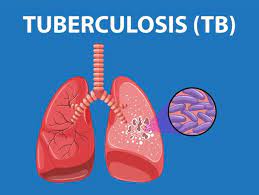
About 70% of tuberculosis (TB) cases in the African region are now being diagnosed and treated, marking the highest case-detection rate in the region ever, thanks to concerted efforts by countries to address the threat of the disease.
Although the case detection rate has been on the rise since 2018, the region saw a significant increase between 2020 and 2022, rising from 60% to 70% of cases being detected, according to the World Health Organization (WHO) Global Tuberculosis Report 2023. There has also been a notable reduction in the region in the number of people with TB who miss diagnosis. An estimated 700 000 people missed diagnosis in 2022, a 10% reduction compared with 2021. To further rally efforts to end the disease through concerted global efforts to advance detection, diagnosis and treatment, World TB Day is being marked this year under the theme “Yes! We can end TB”.
In the African region a range of factors have helped boost TB diagnosis rates. During the COVID-19 pandemic, many countries-maintained TB notification services, ensuring that cases were detected and treated. In Nigeria, which has a huge TB burden, case notification nearly tripled over the past five years to 285 000 cases in 2022 from 106 000 cases in 2018. Improvement in the management of HIV infection, a significant driver of TB, has also bolstered TB detection rates in the region.
“More efforts are still needed to reduce the devastating impacts of this disease on families and communities. As WHO we continue working closely with governments to address the barriers to effective response and speed up the momentum to make TB history,” said Dr Matshidiso Moeti, WHO Regional Director for Africa.
The region, which accounts for 23% of TB cases and 33% of deaths globally, is making steady progress towards ending the disease. For example, Cabo Verde, Eswatini and South Africa have achieved at least a 50% reduction in TB cases. The WHO End TB Strategy calls for countries to reduce TB deaths by 75% and cases by 50% by 2025 compared with the 2015 levels.
Across the region TB deaths fell by 38% and new cases declined by 23% in 2022 compared with 2015. High-burden TB countries have surpassed the 2025 milestone to lower TB deaths.
Despite the progress, further efforts are needed to meet the 2030 global End TB Strategy targets to cut TB deaths by 90% and cases by 80%. These include increased investments in TB control programmes. In 2022, in the African Region, the Global Plan to End TB 2018-2022 estimated that US$ 3.9 billion were required annually to achieve the targets, but only around US$ 890 million were mobilized for TB prevention, diagnosis and treatment. Domestic funding represented about 46% of total funding for TB (54% from international funding) in 2022.
Limited access to health services, inadequate health infrastructure, insufficient quality of care, inadequate human resources for health and inadequate social protection are also impeding progress to ending TB.
Globally TB continues to claim millions of lives annually. In the African region Africa, TB was the second leading cause of death from a single infectious agent, with nearly 2.5 million people falling ill and 424 000 lives lost in 2022.
Parliament has vetted the ministerial nominees as minister of defence, of state, ministers of youth and children affairs, minerals, trade, and others.
Last week, President Yoweri Museveni made a mini reshuffle where he dropped a seasoned minister for minister of defence and affairs, Vincent Ssempijja, and replaced him with Jacob Marson Oboth Oboth.
According to the reshuffle, Museveni named Balaam state minister for youth and children affairs, replacing Sarah Mateke, who has since been named state minister for security.
Lillian Aber, Kitgum Woman MP, who is an ardent supporter of Gen Muhoozi Kainerugaba, was appointed Minister of State for relief, disaster preparedness, and refugees, replacing Esther Anyakun, while Phiona Nyamutoro, the National Female Youth MP, was named Minister of State for minerals.
Appearing before the nomination committee, which was chaired by Speaker Anita Among, the nominees were vetted by designated ministries.
Speaking shortly after his nomination, Balaam applauded the speaker and all the other members of the committee for professionally handling this exercise.
“Like I recently stated, the mission is partly to socially and economically better the lives of the Ugandan youth as well as improve their health and that of the children in Uganda,” he said.
“This morning, I was vetted as the designated Minister of State for Energy and Mineral Development (Minerals) by the Appointments Committee chaired by Speaker Anitah Among. I am grateful that the journey to adding more blocks to Uganda’s development is relentless,” Nyamutoro said.
“I have successfully been vetted by the Appointments Committee at Parliament. Thank you, speaker, and the entire committee for the good work,” Aber said on Twitter.
In the wake of COVID-19 and all global crises, most people have started looking for ways to earn a passive income because, in a crisis like this, even long-lasting and reliable jobs can disappear anytime. Among the many options, we bring you the best. Here, let’s learn how to earn passive income with the best free cloud mining in 2024.
According to the Global News Agency, 2024 will be the peak year for the sharp rise of cryptocurrencies and various online assets. Cryptocurrencies such as Ethereum, Bitcoin, Litecoin, and others have all experienced tremendous growth, while some emerging digital assets are also performing amazingly.
All of this growth is possible due to the growing global acceptance of cutting-edge digital assets and popular cryptocurrency technologies. Now, with cryptocurrencies booming, most people are looking for passive income through mining. Unfortunately, traditional mining methods require huge investments and other technical knowledge, which is the biggest barrier for ordinary investors. Therefore, cloud mining is the most popular and affordable option.
Cloud mining
Cloud mining is a technology in which a person participates in mining cryptocurrencies such as Bitcoin and Ethereum without owning or running hardware or mining software.
Instead, users pay to rent mining power from the company that operates and owns the associated processes and hardware.
Cloud mining companies allow users to open accounts and participate in cryptocurrency mining digitally for a basic price, making mining accessible to many people around the world. Since this mining method is completed through the cloud, it solves problems such as direct energy charges and related equipment maintenance. Furthermore, if you really want to experience remote control investing, cloud mining is the best choice.
Step-by-step guide to starting cloud mining
Do you want to participate in cloud mining investment? Here, follow the step-by-step guide to get started.
Step 1: Decide on a Cloud Mining Platform
There are many options for cloud mining; ARKMining is the safest and most well-known cloud mining provider and the best source of earning passive income through cryptocurrency. It has been one of the world’s major mining companies and your most trusted partner for three decades.
To take the game to the next level, ARKMining has launched a free Bitcoin mining program that allows you to passively earn Bitcoins. They make Bitcoin accessible to everyone, regardless of whether you have cryptocurrency or other technical knowledge. All you need to do is mine 50 USDT Bitcoin, which you can trade to your account and start trading immediately. Any profits you make are yours and can be withdrawn from your wallet at any time.
Step 2: Register an account:
For example, you choose ARKMining as your cloud mining platform; now go to your chosen provider and sign up to create a new account.
ARKMining provides a simple registration process. All you need to do is enter a valid email address and create a new account. After signing up, individuals can start mining Bitcoin immediately.
Step 3: Choose a mining package:
Currently, ARKMining also offers various mining contract options, such as packages for $200, $600, and $1,200. Each has a unique ROI and specific contract length.
You will unlock more passive income when participating in the following contracts:
Contract price
Contract terms
Fixed return
Daily rate
$50
1 Days
$50+$1
2%
$200
1 Days
$200+$5
2.5%
$600
3 Days
$600+$29.70
1.65%
$1200
5 Days
$1200+$108.00
1.8%
$3600
6 Days
$3600+$410.40
1.9%
After purchasing any contract, you can start earning income immediately after the second day. When you have collected 200USDT, you can withdraw it to your crypto wallet or purchase more packages.
Other affiliate programs
Well-known mining platforms offer affiliate programs that allow users to earn commissions. Likewise, ARKMining launched its affiliate program that will enable users to perform tasks by recommending websites. So, even if you don’t like investing, you can still make money. Users who proactively refer a specific number of invites will receive a flat bonus of over $2,000. The more referrals you get, the more earning potential you have.
ARK Mining Platform Advantages
Here are some of the unique benefits of ARKMining:
● There are no other administrative fees or service charges.
● Active users can be generated in 5+ currencies by deploying this provider.
● Offer this platform to others and earn commissions up to $2,000.
● It provides various mining packages, taking into account multiple levels of investment and risk rates, ensuring that every miner can gain something.
● The provider incentivizes active users through an affiliate program and rewards them for making the program available to more people around the world.
● The newest users are invited to receive generous bonuses, which allow them to start mining without start-up investment.
This is an excellent opportunity for new players to explore the capabilities of this type of mining provider.
Summarize
If you want to earn passive income with the best free cloud mining in 2024, then ARKMining is the most profitable option. So, handle this mining right. Some digital opportunities can help you grow your cryptocurrency automatically with zero investment. Additionally, cloud mining requires less time to make money than any other type of investment. Passive income is everyone’s dream, so you can easily achieve it with ARKMining.
To learn more about the cloud mining platform, visit the ARKMining page. www.arkmining.com
DTBU seeks to leverage Godfrey Sebaana’s two-decade, multi-discipline banking experience that spans global and local corporates, SMEs and retail banking to continue and accelerateitsgrowthmomentum.
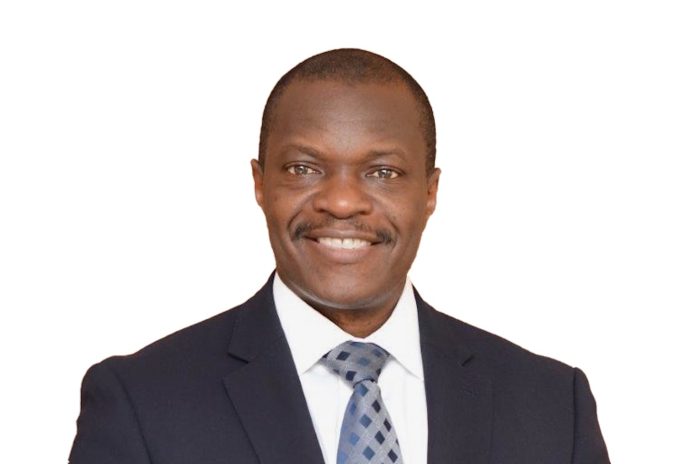
KAMPALA, UGANDA — March 25, 2024: The Board of Directors of Diamond Trust Bank Uganda Limited (DTBU) has named Godfrey Sebaana, a seasoned banker with over twenty years of experience, as its new Chief Executive Officer and Managing Director.
The appointment is effective April 2nd, 2024.
Mr. Sebaana succeeds Mr. Varghese Thambi, who has driven the Bank’s transformation and growth since July 2007 and is retiring from the Bank at the end of March 2024 but will remain available for a time afterwards to ensure a smooth transition.
Commenting on Mr. Sebaana’s appointment, Mr. Azim Kassam, the DTBU Board Chairman, said that the Bank is looking forward to building on the legacy left behind by Mr. Thambi to accelerate the Bank’s progress on its future growth trajectory.
“I am delighted to welcome Mr. Godfrey Sebaana into the DTB family and look forward to leveraging his rich domestic and regional banking knowledge and expertise to accelerate our future growth,” said Mr. Kassam.
Mr. Sebaana has worked in Uganda and Tanzania and was most recently the Executive Director and Head of Corporate, Commercial, and Institutional Banking at Standard Chartered Bank Uganda. During his extensive career, he has developed a broad experience in areas ranging from mergers, acquisitions, corporate advisory and financial institutions management, across various industry segments including global and local corporates, SMEs and retail. Mr. Sebaana is a qualified accountant and a fellow of the Association of Chartered Certified Accountants (ACCA) UK and holds a Master in Business Administration (MBA) from Heriot-Watt University Edinburgh Business School.
“Godfrey joins us at a very exciting time, almost halfway through our 5-year, post-Covid-19 business growth strategy that started in 2022, at the core of which is an ambitious and aggressive digitally-driven customer acquisition and retention strategy. The Board is confident that the skills, experience, local knowledge and passion that Godfrey brings to the table will accelerate our transformation towards being a digital-first, innovative, top-tier bank that places customer needs and responsiveness at the heart of our offering. We are very fortunate to have someone of Godfrey’s calibre and top-notch credentials taking over from Mr. Thambi at the helm of the Bank, and we are all very much looking forward to working with him in the months and years ahead,” added Mr. Kassam.
Mr. Kassam also expressed the Bank’s immense gratitude to Mr. Thambi for laying a firm foundation for the Bank in Uganda.
“In the last 17 years, DTBU has grown from just one branch to become one of Uganda’s most respected, successful and strategically important financial institutions. It now has 37 branches across the whole country and its staff complement has grown from less than 60 in 2007 to 680 today, of whom 56% are female. Whilst the whole DTBU family has contributed to this growth and success, at the centre has been the unstinting effort and unwavering dedication of Mr. Thambi. He leaves the Bank as it emerges from the industry-wide challenges of the past few years showing huge promise and potential, and on a very strong platform from which to propel itself into the future. He takes with him the deep gratitude and very best wishes of the Board, the staff, and the innumerable customers that he and the Bank have supported over the years,” noted Mr Kassam.
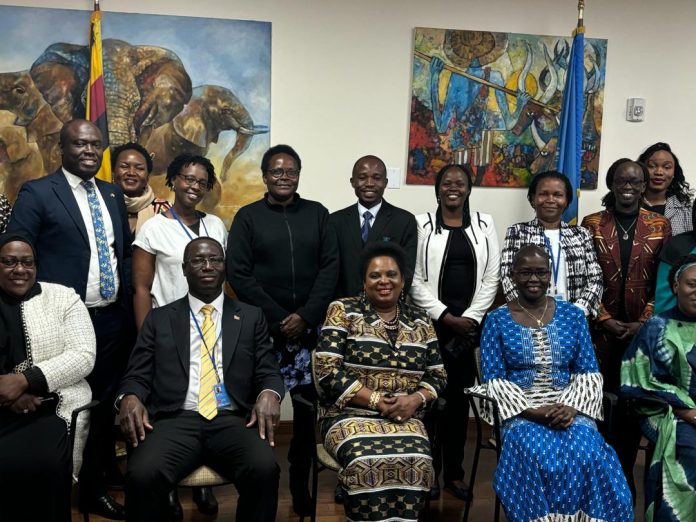
Minister Amongi, PS Kibenge and other African representatives.
New York-Uganda chairs the Africa Union Specialised Technical Committee on Gender Equality and Women’s Empowerment (STC GEWE) and in effect is at the whelm of pushing for the Africa position at negotiations.
The Minister of Gender Labour and Social Development Betty Amongi Ongom told a meeting of members of the Africa Group which included AU Ministers in charge of Gender &Women Affairs that following their General Statements, effective representation and participation this week during negotiations should shape the General Conclusions and Observations.
The consultative meeting at the Permanent Observer mission of AU to UN in New York was also attended by Ambassador Fatima Mohammed, Permanent Observer Mission of the AU to the UN, Honorable Sallah Njle Janet Ramatoulle, Special Rapporteur on Women in Africa, Representatives of UN Agencies, Representatives of AU Partners as well as Technical Teams of the AU Women, Gender and Youth Directorates.
Amongi implored Technical Teams to pay close attention to the ongoing negotiations and ensure that the African Union Priorities are accorded due attention in the General Conclusions and Observations of the CSW68 including the final outcome document.
Negotiations revolve around the Priority Theme on “Accelerating the Achievement of Gender Equality and the Empowerment of all Women and Girls by Addressing Poverty and Strengthening Institutions and Financing with a Gender Perspective.”
Amongi said the theme resonates well with the critical challenge most of the Members States are facing with shrinking fiscal space for the delivery of gender equality and women’s empowerment.
As chair of the African Union Specialised Technical Committee on Gender Equality and Women’s Empowerment (STC GEWE) Uganda is charged with presenting the African Union Position on the Priority Theme which was done by Amongi.
The African Women’s position calls for among others innovative and sustainable solutions towards the empowerment of African women and recognizes digitization at the core of the financial inclusion agenda.
It also calls for the establishing of a network of regional and national champions to increase the reach and inclusion of women and youth; Leveraging the African Continental Free Trade Area (AfCFTA) agreement to strengthen intra-regional trade; Investing in access to digital financial services for women and youth, especially MSMEs to drive financial inclusion; Collecting disaggregated data by gender and youth to inform policy development and program execution.
It further calls for leveraging the education sector by including financial literacy in the school curriculum; creating more opportunities for women and youth in governance and leadership positions to ensure representation and inclusivity in decision-making; creating financial products and services that specifically meet the needs of women and youth, particularly in rural areas and the borderlands.
And finally calls for strengthening accountability mechanisms and the need for the ratification of the Maputo protocol; and cascading mechanisms to ensure grassroots movements, CSO and Women’s rights organizations remain at the center of interventions in order to translate macro-level strategies into micro level impact.