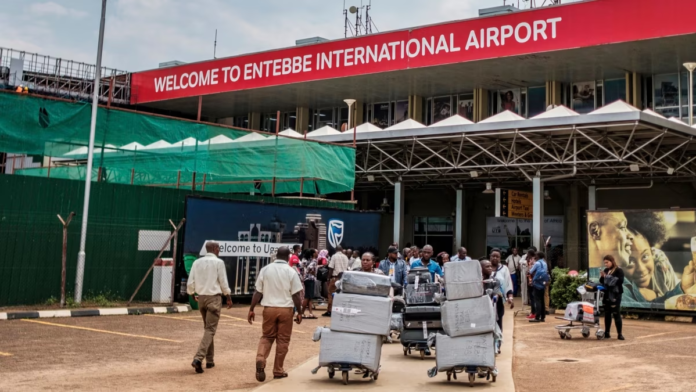
The Uganda Civil Aviation Authority has temporarily suspended all study tours to Entebbe International Airport citing congestion due to increasing numbers and the on-going expansion works.
The announcement has been revealed by Vianney Mpuuga Luggya the Manager Public Affairs at Uganda Civil Aviation Authority
Vianney Mpuuga said, “Owing to a growing number of users of the facilities at Entebbe International Airport and in light of the on-going expansion works, which have led to condoning-off of some areas of the car parking, study tours have been temporarily suspended to reduce on the congestion.”
Vianney Mpuuga added that the move is aimed at enhancing service provision as the facilities are being upgraded for a better passenger experience.
“Members of the public will be informed as soon as the suspension of study tours is lifted. We regret the inconvenience caused,” he noted.
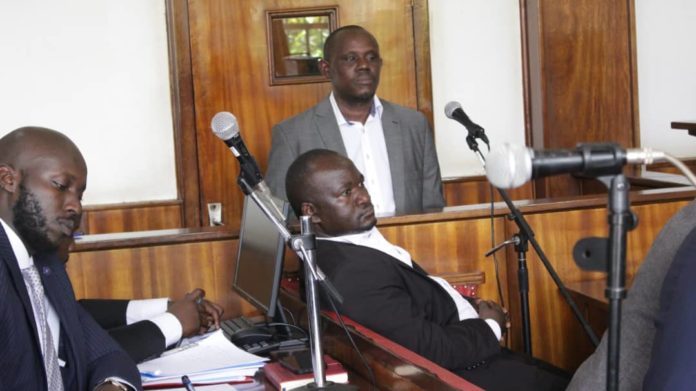
Asiimwe in the dock being pinned on Wednesday October 11, 2023.
A city businessman and company director at Taifa Partners Limited, Emmanuel Asiimwe was yesterday October 11, 2023 arraigned before Buganda Road Chief Magistrate and pinned for forging and uttering false documents.
The trial which was postponed on September 26, 2023 after Asiimwe changing a lawyer, the proceeding kicked off despite the accused lawyer raising unsubstantiated concerns to adjourn the matter. Having failed to convince the Chief Magistrate, the trial started at 11:30am with the first witness and former shareholder Charles Okello telling the fully parked court that while he was upcountry doing official work for the company, his co-director Asiimwe forged his signature and made special company resolutions without his knowledge. The certified documents were submitted to His Worship Ronald Kayizzi and put on court record.
Okello, a former worker at Asiimwe’s other company, Integrated Agritech Uganda Ltd as a mechanical engineer was appointed director after he bought 5 percent shares in Taifa Partners Ltd. He told court that after allotting him 5 shares, 10 shares were also allotted to Assa Tumwesigye (also director with powers of attorney) and Asiimwe was appointed the Managing Director with 85 shares in the company.
While serving as the Managing Director, he made a special resolution on November 23, 21 and appointed Okello a company secretary. After a short time, he made another resolution transferring the 10shares meant for Tumwesigye to himself. He possibly did this to acquire 95 percent shares possibly to make it difficult for other shareholders to demand for a poll in making decisions. As an MD with a sole signatory role, he accessed all the company accounts. At some point, Asiimwe recalled Okello from upcountry and told him to raise money so that they further grow the company to which the latter was not in position to do. Asiimwe coerced him to sell his 5shares and they were allotted them to another investing company, Dapanti Union whose directors were not mentioned in court. With Okello and Tumwesigye ceasing to be directors at Taifa Partners Limited, Dapanti Union came on board. Later Okello was stripped of the role of company secretary. He continued working as a mere company mechanical engineer till February this year when he ceased to have any business with Taifa Partners Ltd.
However, around August this year, Tumwesigye whose shares were transferred through a special resolution without his knowledge confronted Okello and blamed him for conniving with Asiimwe to revoke the powers of attorney to sign contracts with Uganda Prisons and Rwimi Agro processing plant.
It was at this point that forgery was detected, Okello started realizing that most of the documents carried his name as company secretary with a forged signature since he would not even be in Kampala at the time the documents were signed.
On landing some documents with his name and a forged signature, he gave instructions to a law firm to dig up other documents from various offices including URSB. To his utter shock more than 5 documents that were tendered in court without Asiimwe’s lawyer objection were forged.
Tumwesigye also petitioned the URSB and a ruling to reinstate his powers of attorney was made. On August 11, 2023, the matter came up before Solomon Mulisa of Companies at the Uganda Registration Services Bureau and upon reading the petition, the declarations in support, reply and rejoinder and perusing the written arguments the petitioner’s lawyer, the petitioner (Tumwesigye) succeeded on merit. It was ordered that “…the special resolution dated July 15, 2022 appointing Emmanuel Asiimwe as authorized representative for the contract awarded by Uganda Prisons Services for the construction and commissioning of a grain processing and storage plant facility at Ibuga Prisons Farm and registered on July 20, 2022 together with Powers of Attorney registered on July 20, 2022 under instrument no. G22070-6077 be expunged from the register and rendered to be of no legal effect. The powers of Attorney registered on August 31, under instrument no. G210831-4681 in favor of Assa Tumwesigye be reinstated for having been unlawfully revoked. As the trial kicks off, Asiimwe remains in trouble since forging resolutions to give self, powers of attorney – once prosecuted well may attract a life sentence. The matter was adjourned pending Okello’s cross-examination to November 6. 2023.
Government is set to pay Shs240,900,000,000 ($66M) to businessman Patrick Bitature as a bailout from the loan demanded by South African Company Vantage Mezzanine Fund II.
In a sensitive revelation, cabinet members convened on Monday and unanimously passed a cabinet paper to give the green light to a Shs240 billion deal favoring Bitature’s Electromaxx Thermal Plant purchase. Notably, it is believed that this deal was brokered by Bitature’s personal friend, State Minister for Privatization and Investment, Evelyne Anite.
If the deal, as obviously expected, is passed by Parliament, the well-connected businessman will have solved all his financial burdens and uncertainties that had put at stake his entire known livelihood! The deal, according to the cabinet paper snippets in our possession, is disguised in a purchase by the government, of Bitature`s Electromaxx Thermal Plant premised in West Nile.
It is this thermal plant that the government has chosen to purchase, as a backup to the Umeme grid, but in total disregard of the Auditor General (AG)`s recommendation to the contrary. The AG, Mr. John Muwanga had based his advice on the heavily debt-impregnated Electromaxx, legal disputes and land issues surrounding the company reputation. But to bail him out of the quagmire, the government has ignored all for Bitature.
Patrick Bitature owes $35 million to his creditors of M/s Vantage Mezzanine Fund II Partnership. His efforts to have it quelled by Ugandan Courts failed, leading to an arbitration court away, in London. Here, he also lost and was ordered to proceed and pay up. It is at this trying moment that Bitature was supposedly saved by his close friend Anite, who offered to resurrect and broker the Government-Electromaxx deal.
In his report, the Auditor General offered a comprehensive analysis of the technical, legal, and financial aspects of the Electromaxx deal with the government, raising several red flags. The report explicitly cautioned government against proceeding with the purchase of the power plant, citing significant reasons including the hitherto ongoing legal disputes and indebtedness surrounding the company.
“I noted that Electromaxx is indebted to the tune of $13,978,900 and Shs138,537,919 in regard to ascertained debts being taxed costs attendant to litigation; and unascertained debts of Shs1,412,477.76 relating to pending or threatened litigations. These may cause an impediment on the ability of Electromaxx to transfer facility assets to the Government,” read the report.
It was also revealed that Electromaxx held significant debts amounting to millions of dollars, both as ascertained and unascertained debts, stemming from various litigation processes. This precarious financial situation, suggested the AG, could potentially hinder the seamless transfer of facility assets to the government. He further stressed the need for a resolution of the outstanding debts between Electromaxx and the government during the decision-making process.
Additionally, he highlighted the tangled web of land ownership, particularly in relation to the thermal power plant’s location, which is still subject to a mortgage with Absa Bank. The AG further counseled that the settlement of the indebtedness of Electromaxx in regard to litigations should prior, be agreed between the company and Government during the decision-making process, just in case they insisted on entering the risky deal.
Muwanga also called for clarity on land ownership and the resolution of the mortgage agreement with Absa Bank. Furthermore, he uncovered that Electromaxx had not acquired the necessary Petroleum Refinery License and had not complied with various required development permits, leading to potential legal and regulatory compliance risks.
The background to this ordeal laid in Bitature’s attempts to alleviate his financial troubles. The businessman, who serves as the group CEO of Simba Group, sought government intervention by selling them the Electromaxx Thermal Power Plant, in a bid to address his debt owed to South African lender Vantage Capital.
However, the hoped-for bailout took a dramatic turn when the Auditor General’s report cast serious doubts on the feasibility of the power plant acquisition. The report highlighted critical issues such as debt burdens, legal disputes, and questionable land ownership. Bitature’s financial woes had multiplied, with revelations of his failure to repay a $10 million investment from Vantage Capital, which has since ballooned to around $35 million.
This situation led to a legal battle over ownership of his assets as Vantage Capital sought to recover the unpaid debt. The situation escalated further when the International Chamber of Commerce Court of Arbitration in London, ruled against Bitature, ordering him to repay the hitherto contested loan to Vantage Capital.
The court ruling highlighted the complex nature of the dispute, stemming from Bitature’s alleged non-repayment of the loan. This turn of events plunged Bitature into a whirlwind of pressure, causing his financial standing to deteriorate even further. The legal battles and unresolved financial obligations have since put his reputation and business interests at stake, leaving him to navigate a precarious and uncertain future.
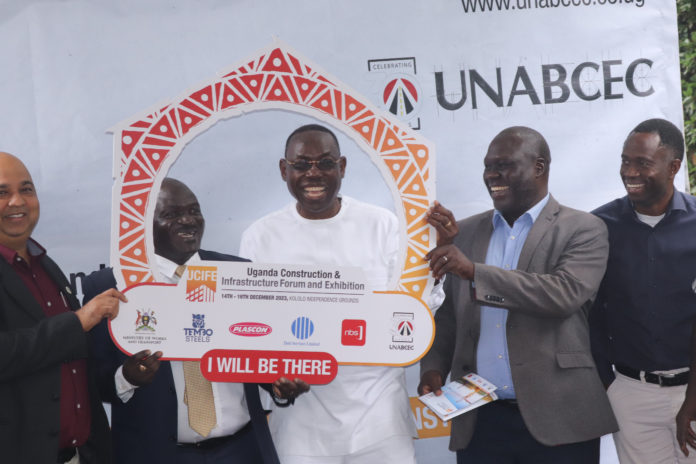
The Minister of Works and transport, Katumba Wamala has today launched the Uganda Construction and Infrastructure (UCIFE) Forum and Exhibition and The Contractors Run 2023.
The two momentous events that will take place on December, 14th to 16th, 2023 are set to redefine the construction industry in Uganda endeavoring to underscore the pivotal role of the Uganda National Association of Building and Civil Engineering Contractors (UNABCEC) and its members in shaping Uganda’s construction and infrastructure landscape over the last 30 years.
The Chief Guest for UCIFE 2023 will be H.E. Yoweri Kaguta Museveni, the President of Uganda and the KeyNote Speaker is Prof. PLO Lumumba, a notable Pan-Africanist, who has delivered several speeches about African solutions to African problems.
In partnership with the Ministry of Works and Transport and the Government of Uganda, UCIFE 2023 emerges as an annual gathering that brings together industry stakeholders to exchange ideas, share best practices, and tackle critical industry matters.
“It is my pleasure to announce that this year, UCIFE themed “Celebrating UNABCEC’s 30 Years of Shaping Uganda’s Construction Industry”. Alongside UCIFE, I am also pleased to announce that the inaugural Contractors’ Run 2023 will be held on December 16th 2023, in support of improving the Emergency Response Assistance to road accident victims admitted by Regional Referral Hospitals.
Minister Wamala further applauded UNABCEC for its unwavering commitment to the growth and development of Uganda’s construction industry. Saying, “UNABCEC has emerged as a beacon of excellence and professionalism, serving as a driving force behind the industry’s transformation and growth. Over the past three decades, this organization has consistently championed the interests of contractors and industry stakeholders.”
“The construction industry, often referred to as one of the cornerstones of our nation’s development, holds tremendous significance. It breathes life into our infrastructure, fuels economic growth, and provides livelihoods to countless individuals and families across Uganda. The construction and infrastructure sectors contribute significantly to our Gross Domestic Product (GDP), accounting for 12% of our nation’s economic prosperity,” Wamala said.
He added, “Our commitment to infrastructure development is steadfast. The 2023/24 budget designates a substantial 13% allocation for infrastructure projects, reaffirming our priority to enhance Uganda’s infrastructure, a cornerstone for economic growth and prosperity.”
He revealed that the government is currently executing multiple road construction projects across the country. Among these, the Kampala-Jinja Expressway as well as actively working on numerous affordable housing projects nationwide to address the housing shortage. Furthermore, expansion projects for Entebbe International Airport and Kabaale International Airport in the oil-rich Albertine Graben are underway. In addition, we are actively seeking investors for various construction projects through public-private partnerships. These efforts underscore the importance of collaboration between the government, private sector, and industry stakeholders. UNABCEC and its members remain integral to these endeavors, offering their expertise, innovation, and unwavering dedication.
“We are merely at the dawn of Uganda’s infrastructure potential. UCIFE provides opportunities for us all to come together, share knowledge, and collectively contribute to a better future for our industry and our nation,” Wamala concluded.
Speaking at the launch, UNABCEC President, James One Olonya said that the forum and exhibition will focus on all aspects of the construction industry including; industry standards and regulation, engineering, materials, technology and innovation, equipment, contract financing, management solutions, architecture, real estate, among others.
He said that the discussion topics under consideration include: Performance of Uganda’s Private Sector in the last three decades, Investment Opportunities in the Construction Industry, Green, Digital, and Intelligent construction and infrastructure, Standardization of Construction Materials and Positioning the Construction Industry to take advantage of the East African Community market and the African Continental Free Trade Area, among others.
He further noted that the event will attract over 500 participants and there shall also be a launch of a new brand aimed at making the Association an inclusive umbrella body of all practitioners in the construction contracting sector.
Olonya said the Inaugural Contractors’ Run 2023 emphasizes the industry’s commitment to social responsibility – symbolizing pledge to give back to communities.
“The World Health Organization’s “Global Report on Road Safety 2018” indicates that about 1.35 million people die each year on the world’s roads and between 20 and 50 million sustain non-fatal injuries. The recent study commissioned by the Parliamentary Committee on Health in October 2022 revealed that the number of road accident victims admitted by Regional Referral Hospitals around the country have been steadily increasing from 14,809 in 2019/20 to 21,313 in 2020/21 to 24,554 in 2021/22. This is despite the government’s efforts to reduce and control road accidents in the country. The study further emphasizes the need for improvement in Emergency Response Assistance to road accident victims as the number one key recommendation,” Olonya noted.
Olonya revealed, “UNABCEC, being an umbrella body of key players in the road infrastructure network, has organized The Contractors Run 2023 under the theme: “Running for Road Accident Victims” to mobilize industry stakeholders to support the improvement of Emergency Response Assistance to road accident victims. With the target of mobilizing more than 10,000 runners, the proceeds will be used to purchase hospital beds and mattresses for selected Regional Referral Hospitals in collaboration with the Ministry of Health, to improve emergency response assistance for road accident victims.”
The Contractors’ Run 2023 will combine virtual and physical modes; The Virtual Run which will take place from 14th October to 10th December 2023, where partners shall be participating through a mobile app to join a network of runners and participate in various races and challenges at their convenience.
The Physical Run will take place on Saturday, 16th December 2023, at Kololo Independence Grounds, offering different routes of 10km and 5km, from 6:00 AM to 10:00 AM.
There will also be Blood Donation Drive from 14th to 16th December 2023 to ensure the availability of safe blood in hospitals for accident victims. And the Contractor Magazine (Souvenir Edition) – a special issue that will be reflecting UNABCEC’s journey, celebrating significant milestones, showcasing outstanding projects, and providing insights into the future of the industry will also be published.
These events have been initiated as part of our 30th Anniversary celebrations but moving forward, they will be annual events under different themes. As they look back on the last 30 years of existence, marveling at the incredible journey that UNABCEC has undertaken.
The Official Partners for UCIFE 2023 include: Tembo Steels (U) Limited, Kansai Plascon U Ltd, Dott Services Ltd, and Next Media. The events are also supported by industry associations including; Uganda Association of Consulting Engineers (UACE), Uganda Institution of Professional Engineers (UIPE), Uganda Society of Architects (USA), Institution of Surveyors of Uganda (ISU), Association of Real Estates Agents (AREA), Construction Management Association of Uganda (CMAU), UMOJA Painters Association, among others.
Lands Minister Judith Nabakooba has presented a new bill to Cabinet dubbed ‘The Real Estate Bill’ to regulate the real estate business in Uganda.
She made the revelation recently while officiating at the 2nd National Housing Symposium which also marked the World Habitat Day celebrations at Mestil Hotel in Kampala.
“I presented it (Real Estate Bill) to Cabinet and they approved its principles but tasked us to expound on our consultations and benchmarking in a few countries on how they are running their real estate services,” she stated. A team from the Ministry of Lands has since visited South Africa, India, and Kenya where they benchmarked on how best the real estate business can be regulated to stem illegal transactions and fraud.
Important to know is that Real estate land is currently a highly marketable commodity in Uganda’s economy and both small and large real estate developers can acquire land legally.
The new bill proposed by Minister Nabakooba is not the first to address issues in the real estate sector. Different processes and legislations have been put in place to improve the real estate sector in Uganda. Below are some laws that govern real estate in Uganda:
The Land Act
The Land Act of 1998 established a comprehensive land registration system in Uganda. This system is designed to provide secure and transparent land transactions and reduce land disputes. Under this system, all land in Uganda must be registered, and any transfer of ownership must be recorded with the government.
The land registration process in Uganda involves several steps. The first step is to obtain a certificate of title, which provides proof of ownership. The certificate of title contains information about the property, including the size, location, and any encumbrances. Once the certificate of title is obtained, the property can be transferred to a new owner through a sale or gift.
The land registration process can be complex and time-consuming, but it is essential to ensure that the transaction is legal and valid. Any mistakes in the registration process can result in disputes and legal issues down the line.
The Real Property Act of Uganda
This guides the real estate transactions in Uganda and outlines the rights, duties and liabilities of parties to a transaction. According to Article 26 of the Constitution of Uganda, every person has the right to own property individually or with others. While this suggests that women also have the same right to own property, it also recognises that husbands have the right to own property already registered in their name.
The Condominium Property Act, 2001 provide for the division of buildings into units and common property; provides for individual ownership of those units by issuance of certificates of title in relation to the units; provides for ownership of common property by proprietors of units as tenants in common; and provides for the use and management of the units and common property and for other connected matters.
The Mortgage Act, 2009 is the major law governing mortgages in Uganda defines a mortgage to include any charge or lien over repayment of an existing or future or contingent debt or other money’s worth or performance of an obligation and includes a second or subsequent mortgage and a third-party mortgage.
Survey Act, 1939 This Act concerns official survey of lands on order of the Commissioner of Lands or the Minister. It also establishes the Surveyors Licensing Board and provides for licensing of land surveyors.
Registration of Titles Act makes provision with respect to the registration of and certification and rectification of titles respecting land. It also provides rules relative to lease of land and other matters regarding land such as mortgage and legal actions regarding land and the bringing of land under this Act. Certificates of title shall be in one of the forms in the Third Schedule to this Act.
The Tenant and Landlord Act 2022 is meant to regulate the relationship between landlords and tenants. It will also reform and consolidate the law relating to the letting of premises and related responsibilities.
Types of land real estate ownership in Uganda
Customary Land
In some parts of Uganda’s real estate industry, a communal land ownership system exists, where certain groups in specific areas hold the land. The elders, clan leaders, or a designated administrative body typically govern the use of the land under this tenure. This customary tenure system is prevalent in the North, Eastern, North-east, North-west, and some parts of Western Uganda and covers over 70% of the country’s land.
In some cases, individuals may possess land with corresponding rights to it, but lack official land titles. According to Uganda Real Estate Laws, tenants may mark these specific areas with distinct and agreed-upon boundaries, often marked by ridges, trenches, and trees.
Freehold Land
The system allows for permanent land ownership and was established through an agreement between the Kingdoms and the British Government. Land in freehold was primarily given to church missionaries, academic institutions, and a small number of individuals. Under English law, Freehold is the main type of private land ownership and is recognized by the Land Act as one of the four ways to obtain access to land rights. This type of ownership includes perpetual registration of title and complete power of ownership, which allows for the use, abuse, and transfer of the land. The Registration of Titles Act governs real estate transactions with freehold land in Uganda, but it is not commonly used as a form of land tenure.
Mailo Land
Mailo tenure system is a type of land tenure mostly found in Buganda (Central region) and some parts of Western Uganda. The tenure system was established during the colonial period, where the colonial government granted freehold ownership to Buganda in return for political alliances under the 1900 Buganda Agreement. The system operates in a feudal manner and acknowledges tenants, commonly referred to as bibanja holders. The 1998 Land Act regulates the relationship between tenants and landlords. Mailo land is registered under the Registration of Titles Act, just like freehold land. All transactions related to Mailo land must be recorded in a register that is guaranteed by the state. If you own a Mailo land title, you have absolute ownership of that land. However, if the government needs the land for national interests, you may lose ownership but will be compensated for relocating peacefully.
Leasehold Land
In Uganda, there is a system where you can temporarily own land for 49 or 99 years by obtaining a lease from an individual, a local authority, or the government. This leasehold Real Estate process is based on a contract that allows both parties to set the terms and conditions for land use that work for them. A piece of land can be granted to someone by the owner of freehold, customary or Mailo, or by the Crown or Uganda Land Commission, for a specific duration of time. The person who receives the lease for the agreed period is entitled to a certificate of title.
Public Land
In Uganda, the government controls land ownership and can lease it to companies or individuals with specific terms and conditions. This type of land tenure is primarily for business and is usually located in urban areas like Kampala. Non-citizens can only obtain a leasehold interest in Ugandan land as the country’s land real estate belongs to its citizens.
Conclusion
Uganda real estate laws provide a comprehensive legal framework for property ownership, land tenure, and land registration. Understanding these laws is essential for anyone looking to invest in Uganda’s real estate sector. While there are some challenges in the country’s land tenure system, such as the ongoing conflict between customary and mailo systems, the government has implemented policies to address these issues and protect the rights of all landowner
President Yoweri Museveni has urged foreign investors to invest in Uganda, saying that there are a lot of investment opportunities with a readily available market.
“When you produce a good or a service, who will buy the product? In the case of Uganda, you have the possibility of both. When you are here, you produce a good or a service and you will be assured of the market,” he said.
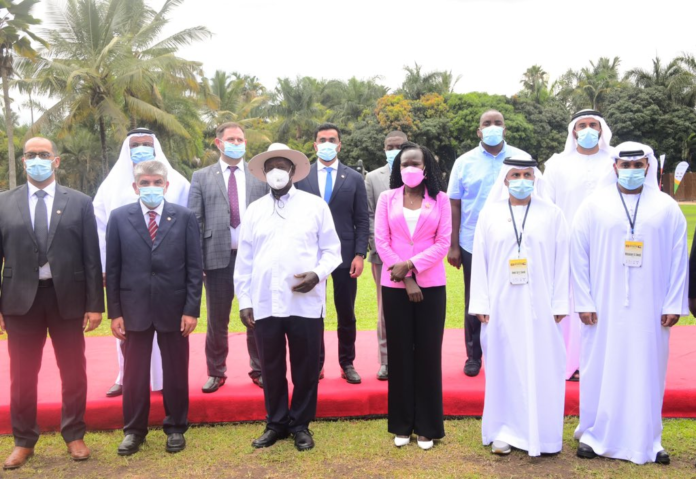
The President made the assurance while officiating at the ongoing Uganda- United Arab Emirates (UAE) Investment and Business Forum at Speke Resort Munyonyo.
President Museveni explained that Uganda has a big market consisting of 46 million Ugandans and 300 million East Africans as well as that of 1.5 billion Africans which African countries are currently working on under the Continental Free Trade Area (CFTA).
“We were clear from the beginning that we needed these markets, that is why we worked on the issue of regional integration. So, you have the market of East Africa of 300 million people. Those Ugandan women are producing a lot of children, and are very active with children so by 2050, the population of Africa will be 2.5 billion. It will be the biggest population on earth. Up to now Africa has been underpopulated because you can hear that even today, the population of Africa is 1.5 billion, we have just overtaken India and China but remember that India is 1 million square miles of land, Africa is 12 million square miles of land so you can fit India into Africa 12 times. Africa has the capacity to accommodate more population. Therefore, in terms of business planning, when you are here, you are in the right place at the right time,” Museveni added.
Museveni further assured the investors that apart from the Uganda, East African and African markets, Uganda has been able to negotiate with the United States of America under the African Growth and Opportunity Act (AGOA) where they sell products to the United States.
“You know there are many Africans in the United States, and we also have trade agreements with China and with the European Union. Therefore, you have the internal, regional, continental and the third-party market including the one of UAE.”
President Museveni further informed the businesspeople that Uganda has already put in place all the necessary infrastructure required for the smooth running of business.
“The infrastructure such as roads, electricity, water among others helps to connect the producer of the good or service to the consumer. Now all these are in place or are being put in place here,” he noted.
“Then you need the natural resources and Uganda has got a wide spectrum of these resources from which you can produce a good or a service. As you can see, we have got very good agriculture. Recently, there were problems in the world such as war in Ukraine, Corona and many people in other parts of the world had a lot of problems, inflation went up; here it went up temporarily up to 10 percent, but it is now 2 percent, one of the lowest in the world. Why? Because we have got everything here, we have got food, raw materials for everything else in agriculture. Our agro-processing sector is a huge area; to process grains, milk, beef, fruits and everything, the raw materials are there. We also have forest products. The trees here grow very quickly and it is very easy to produce forest products here like papers and furniture.”
President Museveni on the other hand told the investors that the country is soon starting to produce lithium car batteries for their electric cars which are already in production.
“Then we have the knowledge-based industry like automobiles which our people are already engaged in. We have been buying British vehicles for a long time, then we started buying some German vehicles, then we started buying Japanese vehicles and all this time we have been begging these friends to even assemble here, they wouldn’t listen but now they have lost that opportunity and we are now going to make our own cars. I don’t want to hear assembling of vehicles here, it’s too late,” he expounded.
“We also have a pathogenic economy. People have been making money from our diseases through vaccines, but we are now going to make this money ourselves so that we treat our diseases.”
Museveni also underscored the role of the private sector in the economic development of any country.
“Our movement which started as a student movement in the 1960s as part of the Anti-Colonial Movement has been able to tell our people that we need to work with the private sector from wherever because if somebody comes regardless of where he comes from and puts a factory here, we are going to share benefits with him. Initially, Africans here did not understand the importance of the private sector; the African leaders made a lot of mistakes in the 1960s and 70s because they did not understand the anatomy of private sector and I tried to talk to some of them, but they did not listen otherwise Africa would be far now,” the President asserted.
“Our leaders made a mistake with the private sector, they confiscated private property in the name of nationalization. This is one of the main reasons why Africa lagged behind. You can imagine that here in Uganda we had our Indians who had come from India and became Ugandans, and they were very active in business but one of our leaders Idi Amin chased them and stole their property. Why was he chasing these people, yet they were working for the country? But when we came, we brought them back,” he added.
President Museveni also cautioned Ugandans especially policy makers against frustrating and wasting time of investors, explaining that they are very vital in building the economy of the country.
“You should clarify to our friends from the UAE that this area is very good for doing business and most of the requirements are in place. It’s not very crucial that you (investors) should work with a local partner, if you get a reliable partner go on, if you don’t, come alone because Uganda will still benefit. You Ugandans should welcome Foreign Direct Investment, don’t waste their time and don’t talk in your confusing language that “the factory of an Indian”, there’s no Indian factory here, all the factories here are Ugandan regardless of who builds it.”
The Minister of State for Investment and Privatisation, Evelyn Anite commended President Museveni for his visionary leadership that has since enabled to revive and develop Uganda’s economy that had collapsed before the National Resistance Movement (NRM) government came into power in 1986.
“You inherited a collapsed economy, the British left us with an enclave economy which was 3Cs (Coffee, copper and cotton) and 3Ts (Tea, Tobacco and tourism) that collapsed in the hands of Idi Amin but Mr. President when you came in power in 1986, you did give assurance to Ugandans that this was not just a change but it was a fundamental change,” Anite said.
“At a time, you took over the economy of Uganda, it was at $3.5 billion, today our economy stands at $48.2 billion and Mr. President I know your resolve, you want it to grow to $00 billion and you are on the track.”
The Minister also thanked President Museveni for strengthening the cooperation between Uganda and UAE, from just diplomatic to commercial and economic relationship.
“Today, the exports of Uganda to UAE have increased by 37.8 percent. Uganda’s export to the UAE now stands at $1.4 billion. The Foreign Direct Investment stands at $3 billion,” she stressed.
The Ambassador of Uganda to the United Arab Emirates (UAE), H.E Kibedi Zaake elucidated that due to President Museveni’s continuous engagements with the investors in UAE, the Foreign Direct Investment has managed to grow from $1 billion to $3 billion.
“Your Excellency, by the time you came for the Dubai expo 2020, the Foreign Direct Investment from UAE to Uganda was at $1 billion but after the engagements you held with the President of UAE and some of the rulers plus the companies you met, Your Excellency, the FDI grew by three-fold this year; it has now come to $3 billion,” Amb. Kibedi informed the President.
The leader of the delegation from UAE, Mr. Rashid Karim revealed that in UAE they are looking for a sustainable growth of their economy based on knowledge and innovations and that is why they are working with countries like Uganda to discover such opportunities.
“What we expect from the forum is that we want to attract and increase the FDI because we believe that a successful business cannot happen unless there’s facilitation on both sides. We also want to promote knowledge transfer for both our countries,” he said
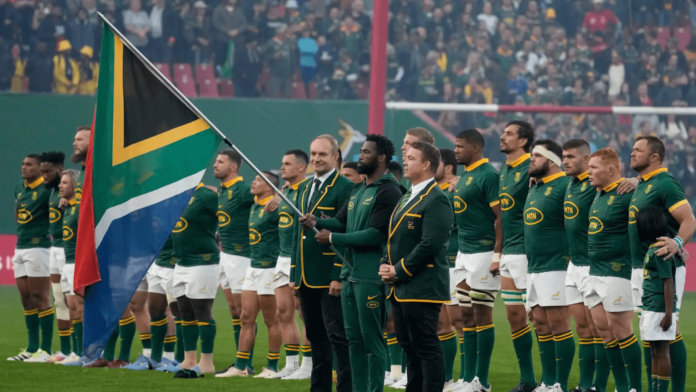
Hot on the heels of Italy’s elimination from the Rugby World Cup at the pool stage, a leading Irish pundit has called for the country to be removed from the Six Nations Championship so that room can be made for the Springboks.
Hugh Cahill, an Irish TV commentator and rugby reporter, made the remarks after Italy were defeated 96-17 by the All Blacks in Lyon.
How have Italy Fared in the Six Nations Championship?
During this time, they’ve regularly gone long stretches without a win. For example, their 22-21 victory against Wales in 2022 was their first win in the competition since 2015. In 2023, they once again went winless and claimed the competition’s wooden spoon.
What did Cahill Say?
Cahill said that conceding almost 100 points was proof that the Italian rugby team was no longer good enough to feature in Europe’s premier international rugby competition.
“Only a matter of time before South Africa replace Italy in 6N’s. Rugby calendar won’t allow seven teams. Love Italians and everything about the country, but professional rugby there has not evolved or progressed to a sufficient degree. Tonight is the proof.”
Could South Africa Actually Join the Six Nations?
It’s possible, but the pathway isn’t straightforward. Although South Africa’s domestic sides now play in Europe the United Rugby Championship (the Stormers have featured in two finals, winning one), it’s difficult to see how the Springboks can break into the Six Nations (particularly at the expense of one of the sides already in the competition).
This is largely thanks to the current ownership structure, which sees all six national unions (including Italy) as well as private equity arm CVC have an equity stake in the competition. It goes without saying that convincing Italy to vote for their own expulsion from the competition would be near impossible.
Plus, Italian fans point to the fact that their country is currently enjoying a lot of success at the age grade level and that the national side may benefit from this promising crop over the next few years.
What Would Happen if South Africa Joined the Six Nations?
That said, it’s impossible not to think about what would happen if South Africa did join the tournament (perhaps as the seventh team rather than replacing Italy entirely). After all, they’re one of the best and most physical teams in the world and adding the Springboks to a tournament that already includes France and Ireland would mean the Six Nations would feature three of the four best teams in the world at the moment.
But, although South Africa would undoubtedly be a force in the competition (we’ve just seen how easily they dispatched Scotland at the Rugby World Cup), their success would not be guaranteed. After all, European rugby is now more competitive than ever and the Springboks have found it difficult to win in the Northern Hemisphere – they’ve gone 0-3 vs Ireland and France since November 2022.
Overall, it’s highly unlikely that the Springboks will join the Six Nations in the next five years. But, if Italy continue to underperform and other European countries like Georgia and Romania don’t make enough of a case for inclusion, then South Africa could be well positioned to join the next time the tournament expands. If they do, it will be fascinating to see what happens.
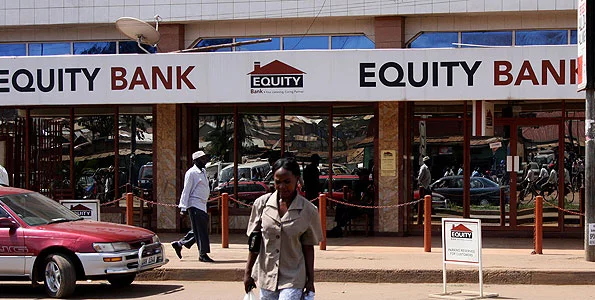
Equity Bank is investigating messages circulating on social media in relation to an alleged fraudulent activity on the account of one of their customers amounting to Ushs 10 million.
In a video that has gone viral on social media, the customer claims that the bank “stole” his money and that he is being tossed around without any much assistance. In the video, which he took at the bank’s head office in Kampala, the complainant claims that the people he was given to assist him are dodging him.
“I am here crying for my 10 million and there is no one to help me. Here is another customer who lost 1.5 million. They have given me a security assistant to help me yet he does not know how the bank operates,” the customer claimed.
He added that Equity Bank pleads to us to open up the accounts but only to steal our money.
“The police and court of law are aware of the cases in this bank but have kept silent,” the customer exclaimed.
In a statement, Equity Bank said, “We are engaging and supporting the affected customer as well as working with the relevant authorities to resolve this matter as quickly as possible.”
“Whereas we are bound by the client confidentiality rule and therefore cannot disclose customer interactions in the media, we wish to reiterate our message to all our customers that in the event of loss of their phone, they should immediately report to the bank through our 24/7 customer helpline 0312327000,” Equity Bank added.
Katikkiro Charles Peter Mayiga has tipped Ugandans to up their environmental conservation efforts, to curb the effects of climate change.
Katikkiro said during the launch of the Ekibira Kya Kabaka Initiative (EKKKI) at Bulange Mengo. According to Mayiga, the EKKKI which was launched by Buganda Kingdom in partnership with Uganda Biodiversity Fund and Absa Bank Uganda among other partners is aimed at amplifying the campaign to protect nature, and county leaders have already established land on which indigenous trees will be planted.
“Uganda was called the Pearl of Africa because of the beauty of nature. We have the duty to restore the beauty of this country and we can do it; we need to put young people at the forefront in the conservation of nature. Let’s plant trees on all sorts of events, imagine if we planted 1000- 1,500 trees every week,” said Mayiga.
He wondered why some investors continue establishing factories in wetlands.
“Are the wetlands places for establishing factories? Why does someone acquire a license to establish a factory in a wetland? The National Environmental Management Authority (NEMA) should stop giving people licenses to construct factories.”
Nicolas Magara, a Commissioner at the Ministry of Water and Environment who represented the State Minister in Charge of Environment Beatrice Anywa applauded the Buganda Kingdom for the conservation initiative and asked other kingdoms to do the same.
“Replicate this in other Kingdoms such as Toro, Busoga, etc. The EKKKI is good and timely, therefore I thank the Buganda Kingdom for the program that perfectly fits in Government programs. I look forward to supporting this initiative as a pilot project for agro-forest restoration,” he stated.
Magara asked all the Local Governments in the 18 counties that make up Buganda Kingdom to be part of the EKKKI program.
The Absa Bank Uganda Executive Director/ Chief Finance Officer Michael Segwaya said environmental conservation is a way to go in a bid to address climate change which poses a significant risk to our people in the areas of environmental degradation, food security, and the overall economic impact to source of livelihoods as a largely agricultural nation.
“That is why we should all care. The impact of climate change affects us all and calls for collaboration between government, cultural institutions, the private sector, and development partners alike to address it,” he stated.
“We are also aware that the success of initiatives such as these can only yield results if we all embrace them and secure the support of communities to play an active role towards the protection of biodiversity and natural ecosystems.”
Dennis Mugaga, the Head of the Climate Finance Unit at the Ministry of Finance Planning and Economic Development said that to undertake climate initiatives including biodiversity in all sectors, Gov’t needs financing of $28.1b.
“As Government, we are investing in sectors related to climate initiatives such as renewable energy, and agro-industrialisation. We also need to make sure that people can benefit from carbon markets from what we are doing; keeping that coffee or trees should be able to get you money,” he said.
The Executive Director of Uganda Biodiversity Trust Fund Ivan Amanigaruhanga said that Uganda has been losing an average of over 80,000 hectares of forests annually, according to Global Forest Watch from 2001 to 2021, which is a big worry.
“Out of the top 8 districts which were responsible for 54% of all tree cover loss in Uganda over the same period, Luwero had the highest tree loss at 90,600 hectares compared to the national average. Other Buganda districts where tree loss was worrying included Mubende (79,500 hectares) and Mukono at 56,000 hectares,” he stated.
Amanigaruhanga said it is timely that EKKKI is supported by the public to restore the degraded forest lands.
The Committee on National Economy will scrutinise government proposals to borrow funds to upgrade roads and finance the Climate Smart Agricultural Transformation Project.
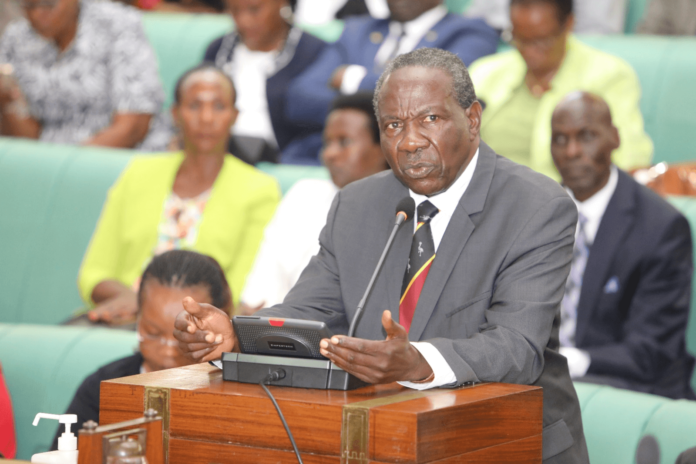
The requests were tabled by the finance minister, Hon. Matia Kasaija, during the plenary sitting on Tuesday, 10 October 2023.
Government seeks to borrow US$295 million from the Islamic Development Bank and US$30 million from the OPEC Fund for International Development, to update the National Roads Project.
Under the project, the government will contribute US$22 million.
According to the minister, implementation of the project will increase the stock of transport infrastructure, reduce freight transportation costs and reduce travel time.
The funds will facilitate the upgrade of 70 kilometres of Katine-Ochero Road connecting Soroti and Kaberamaido districts, and will also include a link to the ferry landing site for the Bukungu-Kaberamaido-Kagwara ferry.
The loan will also facilitate the construction of Masindi Port Bridge as well as upgrading 68 kilometres of the Kyenjojo-Bwizi-Rwamwanja-Kahunge and 37 kilometres of the Mpara-Bwizi Road.
Kasaija observed in the proposal that Uganda’s debt remains sustainable with the nominal value of public debt to GDP of 47.1 per cent as at June 2023, compared to 48.4 per cent as at June 2022.
Relatedly, to finance the Uganda Climate Smart Agricultural Transformation Project, the government seeks to borrow US$325 million from the International Development Association of the World Bank Group, along with a grant worth US$25 million.
Under the project, the government will contribute US$4.7 million.
The funds aim to reverse the country’s low agricultural productivity trajectory through investing in efficient irrigation, agricultural mechanisation and enhanced farm infrastructure.
The funding proposal by the finance minister indicates that the agricultural project will be implemented in 69 districts including seven refugee hosting districts in the six agro-ecological zones of Uganda.
Kasaija noted that the value chains promoted in the project are consistent with those of the Parish Development Model, and will benefit 13.4 million individuals directly and indirectly, including refugee hosting communities.
The Deputy Speaker, Thomas Tayebwa tasked the committees scrutinising the loan requests to report back to the House in time.