The Ministry of Internal Affairs has warned Ugandans against fraudsters posing as ‘DNA Agents’or people that can quickly, easily and discretely get one DNA result.
Simon Mundeyi, Internal Affairs Spokesperson said that this cartel is targeting mostly civil servants, politicians, high end Ugandans and anyone else they can convince to do the DNA tests.
“They approach unsuspecting people either in person or through phone calls but usually through social media where they advertise their services,” Mundeyi said.
He added, “They then proceed to ask you for hair, nails and such things they claim will be used for the DNA tests after which they deliver ‘results’ sometimes almost instantly after you have paid usually money beyond a million shillings. We urge the public to desist from such.”
We refer to the public to the statement by the Minister of Health of 10th July 2023 that stated that there are only two accredited laboratories to carry out DNA paternity testing; the Government Analytical Laboratories (DGAL) Wandegeya and MBN Clinical Laboratory Nakasero.
The authorization of the two medical laboratories came in due to increased demand for true DNA status of children, from men decrying the marital infidelity of their partners which has made them sire children out of the marriage wedlock and raise them without their true paternity.
The Ministry of Finance, Planning and Economic Development has released Shs4.833 trillion to be spent by the government of Uganda for the first quarter (July – September) of the new financial year 2023/24.
The released funds represent 16% of the discretionary budget.
Of this, Shs1.824.589 trillion (25%) goes to wages while non-wage takes Shs2.698.292 trillion. Government Development is Shs198.350 billion while arrears are Shs1.111 billion.
Shs169.968 billion has been released to cater for payment of pension for the retired civil servants and Shs147.778 billion is provided to cater for Gratuity payments in the quarter.
Under the Education sector, the capitation grants for schools have been fully provided to cater for Term Three of the school year.
Shs140.241 billion (25% of the approved annual budget) has been provided to National Medical Stores for the purchase of essential medicines and drugs; while Ushs50 billion has been provided to UNRA and MoWT to pay for certificates for the ongoing projects.
Shs91.013billion has been provided to universities in line with the semester requirements.
Of this, Makerere University takes Shs31.181 billion, Kyambogo University-Shs17.481 billion, MUBS – Shs8.678 billion, UMI – Shs3.877 billion, Mbarara University- Shs3.908 billion and Gulu University- Shs4.146 billion etc.
Shs44 billion has been provided for road maintenance under Local Governments, translating into Shs250 million per Local Government.
Shs111.687 billion has been provided to cater for arrears under institutions, of which Shs10.446 billion is for salary arrears and Shs101.240 billion is for pension and gratuity arrears.
Ramathan Ggoobi, the Finance ministry Permanent Secretary, said the Quarter One release has been informed by the need to keep expenditures within the available resources to ensure fiscal discipline, controlled borrowing and macroeconomic stability;
He tasked all Accounting Officers to ensure that they pay wages, salaries, pensions and gratuity by the 28th of every month.
“There should be a display of the payrolls for salaries and monthly pension on Government institutions’ notice boards every month. Accounting Officers must prioritize payment of service providers on time and clearance of domestic arrears,” he said
Businessman Sudhir and media team showing the area he is refiling along the lakeline.
This video of Speke Resort Munyonyo works was trending on social media yesterday. As you might aware, Uganda will host the Non-Aligned Movement & G-77 Conferences next year. Venue: Munyonyo Common Wealth Resort, as such the compound is being raised to prevent flooding of the gardens.
The approval given required management to replant grass that was removed from the same area. However, NEMA will follow up to ensure compliance with approval particularly maintenance of L. Victoria integrity.
Water front developments are approved world over, to attract tourism. This is a chance for Uganda to tap into #BlueEconomy potential
Also, please recall that the law gives Government permission to build projects (in the interest of public good) on public lands eg roads, railway lines, marinas etc in wetlands provided they follow conditions given by NEMA.
Tycoon Sudhir conducting a site interview with the media at the construction site of Convention centre.
Construction of the one-of-a-kind 4400-seater Speke Resort Convention Centre is on schedule and will be completed in time for the 19th Summit of the Non-Aligned Movement to be held in January 2024 in Kampala, Uganda. Tycoon Sudhir Ruparelia and proprietor of Munyonyo Commonwealth Resort has said.
The Ruparelia group conducted an on-the-spot media tour of the construction grounds and provided proof that it is not degrading and or refilling the lake, but instead securing its own land affected by the historic unprecedented rise in Lake Victoria levels in 2021 and 2022.
The Ruparelia Group, is in a joint venture with the Uganda Development Corporation (UDC), constructing the state-of-the-art convention centre to not only host the NAM Summit and Followed by G77 China but also boost the country’s Meetings, Incentives, Conferences & Exhibitions (MICE) potential and competitiveness.
UDC is the investing arm of the Government of Uganda whose mission is to establish and or invest in sustainable investments in areas strategic to Uganda’s social and economic transformation, and prosperity of Uganda.
Sudhir Ruparelia, the Group’s Chairman told the media on a tour of the facility, that everything is on course.
“Ruparelia Group, through our two subsidiaries, Speke Hotels and Meera Investments, is sparing no effort to ensure that we deliver this key strategic national facility on time,” Sudhir told the media.
In addition to the 4400-seater auditorium, the convention centre will also have a multipurpose hall, 12 high-end conference/breakaway meeting rooms and a floating restaurant that can host more than 900 guests, with an extraordinary view of Africa’s largest freshwater lake⏤ Lake Victoria.
The Speke Resort Convention Centre is being developed on a 105-acre luxury resort complex that already has two luxury lake-side resorts⏤ Speke Resort Munyonyo and Munyonyo Commonwealth Resort, also owned by the Group. The three iconic properties combined, bring to Uganda’s hospitality sector about 40 indoor meeting and banqueting facilities of various sizes, with a capacity to host 19,000 people! This is in addition to several other outdoor venues. Away from meeting venues, the complex boasts 476 accommodation rooms, including 54 presidential suites and 3 ballrooms.
We are not degrading the lake
As part of the larger preparations, the entire facility is also undergoing some indoor and outdoor refurbishments and upgrades. While on the tour, the Group also took media and stakeholders on an on-the-spot fact-finding tour of the entire facility to clarify some online allegations that the Group is refilling Lake Victoria as part of the construction.
“Being adjacent to Lake Victoria is one of the unique attractions of this facility. It is an asset that we guard jealously,” Sudhir told the media, adding: “Ahead of the August-December rainy season, we are only upgrading and securing (against flooding) of our grounds that were affected by the May 2022 unprecedented rise in Lake Victoria levels.”
It should be remembered that a year of extraordinarily heavy rains, that started in April 2019 pushed the lake’s water level up to 13.4 metres (44 feet) by May 2022, breaking the previous 1964 record, according to the Lake Victoria Basin Commission.
Even though the lake water levels later receded, Uganda’s National Environmental Management Authority (NEMA) and the Uganda National Meteorological Authority (UNMA) in May 2023 warned of abnormal rains. Indeed, in the same month, there was significant flooding in the Lake Victoria basin, marked but the washing away of the River Katonga bridge on the Kampala-Masaka Road.
“All these occurrences, necessitated us to raise the grounds adjacent to the lake and secure them against any possibility of flooding. This has however been done in liaison and in compliance with all the relevant environmental and municipal regulatory authorities and laws,” said Tycoon Sudhir said.
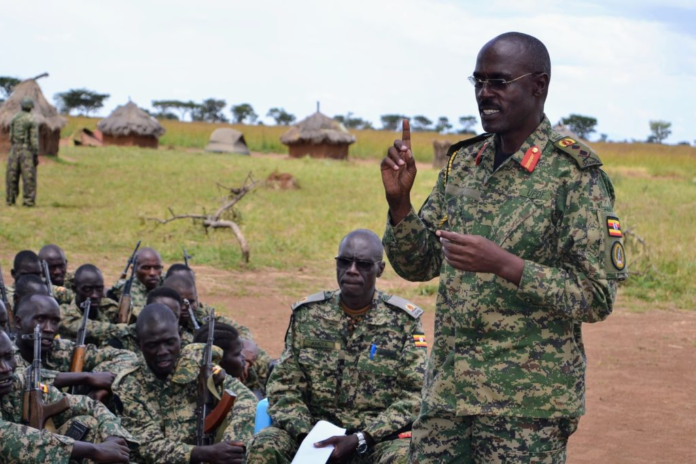
Major General George Igumba, the Commandant, Senior Command and Staff College, Kimaka has called upon African Military Chief Instructors to formulate proposals to their commandants on how to promote compliance and enhancement of professional military standards and how to support the process of preparing middle-level officers for higher responsibilities in both command and staff function.
Maj Gen Igumba made the remarks during the opening of the 16th Chief Instructors’ workshop for The African Conference of Commandants at Silver Springs Hotel, Kampala Uganda. The workshop is slated to run from 17 – 20 July 2023 and will cover the assessment of contemporary security challenges and the changing nature of Peace Support Operations in the African Union among others.
Maj Gen Igumba, underscored the importance of the workshop which brings together to discuss issues affecting different staff colleges saying this is a clear illustration that the militaries of the African Continent are heading in the right direction towards finding African solutions to Africa’s problems.
“The importance of such a gathering cannot be over-emphasized because the world and particularly Africa is now facing numerous security challenges; more so, diversified security dynamics which should be dealt with from time to time,” said Maj Gen Igumba.
Maj Gen Igumba urged the delegates to interrogate the different aspects that enable staff colleges to improve on their respective curricula and add value to the training and education offered to the officers that are gearing to take over the mantle.
The Workshop has attracted delegates from Botswana, the Democratic Republic of Congo, Egypt, Ghana, Libya, Malawi, South Africa, Uganda, the United Republic of Tanzania, Zambia, and Zimbabwe.
President Yoweri Museveni under the advice of Judicial Service Commission (JSC) has appointed six acting registrars of the High Court.
The registrars appointed are; Pamela Ocaya, Prossy Katushabe and James Mawanda, Allen Owembabazi and Thadius Tumwebaze and Simon Zirintusa.
Commenting on the appointments, the Chief Justice Alfonse Owiny Dollo extended his gratitude to the President for fulfilling his promise of ensuring that the judiciary has the necessary manpower for efficient and effective administration of justice.
The Chief Justice also observed that filling the manpower gaps will ensure that the judiciary fully implements its transformation agenda of enhancing access to justice which is already underway.
In regards to the numbers, the Chief Registrar, Sarah Langa Siu noted that the appointment brings the total number of full registrars to 12 representing 100% of approved structure of that category of judicial officers.
About the appointed registrars
Pamela Ocaya joined the judiciary in 2009 as a Magistrate Grade I and has grown through the ranks at the time of her appointment; she has been substantively the deputy registrar at the Anti-Corruption division of the High Court.
She holds a Master of Laws degree in International Legal Studies from Georgetown University Law Centre, USA. She equally holds Master of Business from the Uganda Management Institute (UMI).
Prossy Katushabe is a career judicial officer who has risen through the ranks over a period of 14 years. At the time of her appointment, she was serving as the deputy registrar at the Family Division of the High Court.
She holds a Master’s degree in Management Studies from UMI and a Post Graduate diploma in Social Justice from Makerere Univesity.
She is the current vice president of Uganda Judicial Officers Association.
James Mawanda boasts 27 years of working experience in the judiciary. Prior to his latest appointment, he has been serving as deputy registrar at the Registry of Magistrates Affairs and Data Management.
He is also a member of the Judiciary Council, representing the lower bench.
Simon Zirintusa joined the judiciary in 2004 as a Magistrate Grade I and rose through the ranks to the position of assistant registrar which portfolio he has been holding until his recent appointment.
At the date of his appointment as registrar, he was deployed at the Civil Division as the deputy registrar.
He has undergone specialised judgment writing at Seattle School of Law, USA and also trained on the critical role of the judiciary in combating trafficking in human beings at Golda Meir Mount Camel International University.
Allen Owembabazi has been working at the Judicial Service Commission, and at the time of her appointment, she was serving as the deputy registrar Anti-Corruption Advisory and Inspection.
Thadius Tumwebaze is a deputy registrar currently managing a special assignment as Private Legal Secretary to the Chief Justice.
He holds a Masters of Laws degree from Makerere University.
The Emeritus Archbishop of the Mbarara Archdiocese, Paul Kamuza Bakyenga has died at the age of 79.
In a statement issued by the Archdiocese of Mbarara, Paul Kamuza Bakyenga breathed his last at Rubaga Hospital Kampala.
“The Most Rev. Lambert Bainomugisha, the Archbishop of Mbarara, with dee sorrow announces the death of the Most Rev Pal K Bakyenga, the Archbishop Emeritus of Mbarara which occurred on 18 July 2023 at Nsambya Hospital,” reads a death announcement by the Archdiocese of Mbarara.
“The burial arrangements will be communicated later. Let us pray for the peaceful repose of his soul.”
Bakyenga was born on 30 June 1944, in Bumbaire Village, Igara sub-county, in present-day Bushenyi District in the Western Region of Uganda. He attended pre-primary school in the church building at Bweeza, Bushenyi District.
He went on to attend Ibaare Primary School, before he joined Ibanda Preparatory Seminary from 1958 until 1960. In 1961, he joined Kitabi Seminary, where he graduated with a High School Diploma.
He was admitted to Bukalasa Minor Seminary, in present-day Kalungu District for his A-Level studies but he did not complete. He was expelled, along with others, for “indiscipline”.
After teaching briefly at Rushoroza Seminary, in Kabale District, he was then admitted at Katigondo Major Seminary, in Kalungu District to study philosophy but abandoned the course after two years. At this point, Bishop John Baptist Kakubi of Mbarara, sent him to study at St Andrews College in Scotland, where he obtained a degree in Theology.
He was ordained a priest on 11 July 1971 at Mbarara at the age of 27. He served as priest in the Roman Catholic Archdiocese of Mbarara, until 6 March 1989.
He was appointed Coadjutor Bishop of Mbarara, Uganda on 6 March 1989. He was consecrated as bishop on 24 June 1989 at Mbarara by Bishop John Baptist Kakubi, Bishop of Mbarara, assisted by Bishop Adrian Kivumbi Ddungu, Bishop of Masaka and Bishop Serapio Bwemi Magambo†, Bishop of Fort Portal.
On 23 November 1991, he succeeded as bishop of Mbarara, replacing the late Bishop John Baptist Kakubi, who resigned. He was appointed Archbishop of Mbarara on 2 January 1999.
Pope Francis accepted his resignation on 25 April 2020 and appointed Auxiliary Bishop Lambert Bainomugisha as the Archbishop of Mbarara, Uganda.
The ninth edition of the FIFA Women’s World Cup is about to kick off in Australia and New Zealand. Although there are more teams from Africa than ever before, there will be no Uganda team. The Crested Cranes have never made it to the finals but will hope to use their qualification for the 2022 Women’s Africa Cup of Nations as a springboard for future success.
There will be four African nations at this year’s World Cup though. Nigeria, Morocco. Zambia and South Africa will all be competing – and there might have been three more if they had made it past the final play-off tournament. Betting sites like those profiledat VegasBetting.com can tell you who the favorites for the trophy are. But we are going to look at the history of African teams at the finals – and how this year’s representatives might get on.
Africa at the Women’s World Cup
There have only ever been eight African nations at any Women’s World Cup in the nine editions of the tournament – and two of those will be making their debut this year. In a sport where money and investment are crucial to success, many of the countries from our continent have unfortunately been left behind.
But things are changing and the increased media attention on the competition can only be beneficial for the women’s game across Africa. The country that has definitely led the way for women’s football in Africa has been Nigeria. The Super Falcons have qualified for every single finals but have only gotten past the first round on two occasions.
That lack of progress at the finals is a familiar story. Equatorial Guinea, Ghana, Ivory Coast and South Africa have all failed to get out of the group stage – with the Black Queens of Ghana failing at three consecutive tournaments. Only Cameroon (apart from Nigeria) has made it further, when the Indomitable Lionesses lost to England in the round of 16 in France in 2019. Can the African sides do better this year?
Nigeria
The Super Falcons have long been the leaders in African women’s football. But there is also a sense that the rest of the continent may finally be catching up. Defeat to Morocco and South Africa at WAFCON – and then to Zambia in the third place play-off – suggests that Nigerian dominance has come to an end.
There is still a huge amount of talent in Randy Waldrum’s squad though. The main threat will be Barcelona’s Asisat Oshoala, who has just won the Champions League with her team. But there is more depth than ever before, with the midfield looking especially good. The usual issues surrounding unpaid bonuses plague the team though, so it will be interesting to see if Nigeria can get anywhere near bettering its 1999 run to the quarter-finals.
South Africa
Banyana Banyana worried Spain in their first ever World Cup game four years ago. It wasn’t until just over an hour had passed before the European giant drew level, and then scored two late goals to claim the points. Two defeats followed that opening match for South Africa – but a lot has happened in the last four years.
Winning the Women’s Africa Cup of Nations last year was a statement of intent and there is real talent up front, with Thembi Kgatiana, Hildah Magaia and Jermaine Seoposenwe all capable of troubling opposing defenses. A tough group draw may mean that we have to wait to see this team progress, however.
Morocco
Massive investment in the women’s game in Morocco has seen the Lionesses of Atlas develop at an incredible rate over the last few years. Bringing in top coaches and using family connections to hand debuts to second-generation, European-born players has been a successful tactic.
All the hard work almost paid off handsomely at the 2022 WAFCON, before Morocco was beaten by South Africa in the final. But getting past Nigeria in the semi-finals was a huge achievement in itself and now there is much to be hopeful about. Getting out of the group will be difficult but this team will only get better before hosting the next WAFCON in 2024.
Zambia
The Copper Queens are the other African debutants at this year’s World Cup andthe 3-2 win over Germany – in Germany – in a pre-tournament friendly has gotten everyone associated with the Zambian team very excited indeed. This is still a work in progress, but it is a very talented squad.
Zambia was able to beat Nigeria to finish third at WAFCON and also won the Cosafa Women’s Championship for the first time last year. Two top players were missing from that triumph as well so there should be some excitement, at least, from Zambia at this tournament.
African teams will need to beat the likes of the US if they are to triumph
What Next for African Women’s Football?
Although this is a very exciting time for women’s football in general – and African football in particular – there are also the problems that face the men’s game on a regular basis. Unpaid bonuses and internal strife have long plagued football in Africa and impeded the chances of the best countries to do well at major international tournaments.
It would be a real shame if Nigeria was unable to progress because of off-field issues. The Super Falcons have been by far the best team in Africa for decades but there are others coming through – and that has to be an exciting development. If Nigeria and even just one of the other sides get through the opening phase, it should really be treated as a success.
Looking forward, it would be a major step for the women’s game in Africa if South Africa were named the host of the next Women’s World Cup in 2027. There is some stiff competition but we all remember how the 2006 men’s World Cup galvanized the continent when it was held in South Africa.
With a chance that there could be even more teams from Africa qualifying for that tournament, there would surely be further investment with the aim of showcasing the very best that the women’s game has to offer.
President Macky Sall, he is part of the five African heads of states that advocate for peaceful resolution of the Russia-Ukraine war.
The President of Senegal Macky Sally will tomorrow arrive in Uganda for a two-day official visit.
The visit was confirmed by the Presidential Press Unit (PPU) on Monday afternoon.
“The Presidential Press Unit (PPU) informs the General Public that the President of the Republic of Uganda, H.E Gen. (Rtd) Yoweri Kaguta Museveni, will host the President of the Republic of Senegal, H.E Macky Sall, on a two-day official visit from Tuesday 18th to Wednesday 19th July 2023,” PPU stated.
According to the PPU statement, “the visit is intended to deepen bilateral cooperation between the two sister countries.”
He will jet into the country from Kenya where he is meeting President William Ruto.
President Sall has been at the centre of controversy back home as he intends to amend the constitution for a third term. He announced that he would seek an election next year.
Kampala businessman and rice trader Farouk Nsubuga has cried out for assistance after a lady who claimed to have connections to State House as threatened to harm him over a deal to sell scrap generated from the construction of Karuma hydroelectric dam.
The lady, Nsubuga said, first identified herself as “Katushabe from State House. |But he later learnt that her real names are Christine Mbabazi. She is the lady one who publicly claimed to be late AIGP Felix Kaweesi’s girlfriend after his gruesome murder in 2017.
A fearful Nsubuga said he had won the contract to sell scrap generated from Karuma dam in December 2022 after going through a competitive bidding process.
“After winning the tender, I received a call from a one Katushabe saying we should do business together,” Nsubuga said.
Nsubuga said that she told her they needed to first draft an agreement and thereafter, she had to deposit at least Shs2 billion within one week. The woman said she had the money and organized to meet him.
When Mbabazi came to Nsubuga’s office in Nakulabye, she came with an Indian businessman who she identified as a business partner.
“We drafted the agreement and I told them to deposit Shs2 billion in my account if they were serious. They paid Shs2 million to my lawyer as legal fees for drafting the agreement,” Nsubuga said.
Later the Indian businessman came back and told me he had failed to find the Shs2 billion so he withdrew from the deal.
“The same woman came with another businessman, this time a Ugandan and said this one had money. That is when I started smelling a rat,” Nsubuga said.
Nsubuga claimed after all these attempts failed, Mbabazi went to Karuma and tried to snatch the contract from him but this too failed.
Nsubuga says Mbabazi then went to Old Kampala Police station and reported that he (Nsubuga) had taken her Shs2 million (the money paid to the lawyer for legal fees) and that he had threatened her.
“The good thing is that the OC at Old Kampala is my friend and knows my character. I went there and explained everything and they told me that I had no case,” Nsubuga said
Mbabazi, Nsubuga says, then started calling him relentlessly threatening to harm him if he did not do business with her.
“She told me she is powerful and connected to State House that is why she is guarded by soldiers,” Nsubuga said.
But Nsubuga told her off and told her to use legal channels if she feels aggrieved in any way.
Mbabazi declined to talk to us and switched off her phone when we tried to seek her side of the story.