Stanbic Bank
Stanbic Bank
25 C
Kampala
Stanbic Bank
Stanbic Bank
Home Blog Page 518

Tayebwa warns EU against homosexuality, abortion practices in Uganda

Deputy Speaker of Parliament, Thomas Tayebwa

The Deputy Speaker of Parliament, Thomas Tayebwa has warned the European Union not to force its beliefs of homosexuality and abortion onto African societies.

Tayebwa says the influence of Western lifestyles risks destroying family units and society.

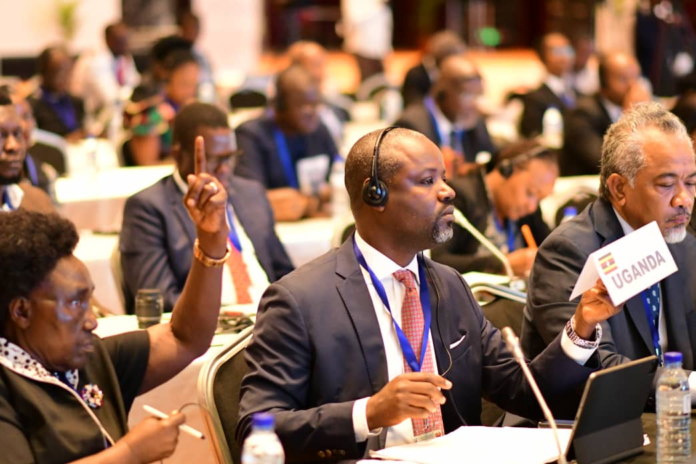
The Deputy Speaker addressed the issue while speaking at the sidelines of the ongoing 61st session of the Organisation of the African, Caribbean and Pacific States Parliamentary Assembly (OACP SPA) and 42nd Session of the ACP-European Union joint Parliamentary Assembly (ACP-EU JPA) in Maputo City, Mozambique where he is leading a Ugandan delegation that includes Members of Parliament.

Tayebwa said Uganda would continue to oppose any plans by pro-gay nations to impose the promotion of homosexuality and abortion as new conditions for trade and aid relationships with European Union.

“We are demanding that we broadly define the issue of human rights because we have discovered that with the Post Cotonou agreement, there are hidden clauses around human rights. Clauses to do with Sexuality, promotion of LGBT/homosexuality and clauses to do with abortion,” he said, describing such practices as ‘un-Africa’.

“While the EU is demanding that we take a certain root, they should also know the character of our society. We are a society that isn’t ready for homosexuality and we are society that’s not ready for abortion,” he said.

He added: “We as Africa, believe that the institution of the family is at the core of whatever we are doing”.

Representatives from the pro-gay nations insist on an amendment to the ACP -EU rules to have the debate on the rights of homosexuals even after objections African members.

Other Members on the team included, Mr. Theodore Ssekikubo the MP for Lwemiyaga County, Mrs. Cecilia Barbara Atim Ogwal, the Woman MP for Dokolo District, Mr. Maurice Kibalya the MP for Bugabula South, Mr. Elijah Okupa, the MP for Kasilo County, Dr Samuel Opio Acuti MP for Kole North and Hon Lucy Okello.

The joint sitting was on Monday officially opened by President Filipe Nyusi of Mozambique who commended the Organisation for its prime role in the economic and social development of its member states.

President Nyusi also called upon them to focus more on the climate agenda and how to deal with risks related to Natural disasters.

UG Standard understands that the joint sitting also discussed issues related to climate change and food security; health and the fight against terrorism; women empowerment for political leadership; migration and sustainable growth, among other current matters.

The Ugandan deputy speaker said member countries are also engaging on the post Cotonou Agreement which governs the ACP-EU relations.

Diplomatic, trade and aid relationships between the European Union and ACP states are governed by the Cotonou Agreement.

The agreement includes a dialoge on ‘’political issues of mutual concern or of general significance’’ and ‘’discrimination of any kind’’.

Meanwhile, the ACP-EU described Uganda’s women’s emancipation as one of the most successful ventures an African country has ever undertaken.

Tayebwa also said that Uganda was lauded on other key grounds including passing important laws to combat money laundering and allowing youth to legislate on their affairs.

Uganda has the youngest Parliamentarians with an average age of 33.

Other countries in Africa, Caribbean and Pacific have an average age of 55 and beyond.

Cecilia Ogwal backed Tayebwa’s stance —saying Africa isn’t comfortable with EU’s conditions on sexual orientation and abortion.

“We are all geared up to make sure that whatever decision we take, it is in the interest of the people whom we represent.”

On Money laundering, Ogwal commended the Parliament of Uganda and President Museveni for being proactive.

“Uganda has been able to pass the law of 2013 (amended in 2015) and recently we passed another amendment, Uganda is on course as far as taking control of the situation when it comes to money laundering”.

The ACP–EU Joint Parliamentary Assembly was created to bring together the elected representatives of the European Union (the Members of the European Parliament) and the elected representatives of the African, Caribbean and Pacific states (“ACP countries”) that have signed the Cotonou Agreement.

Since the entry into force of the Treaty on European Union and EU enlargement it has acquired a more prominent role.

A substantial part of the work of the JPA is directed towards promoting human rights and democracy and the common values of humanity, and this has produced joint commitments undertaken within the framework of the UN conferences.

The Joint Parliamentary Assembly meets twice a year in plenary session, alternately in the European Union and in an ACP State.

With a view to strengthening regional integration and fostering cooperation between national parliaments, meetings between EU and ACP members of parliament may be arranged at regional or sub regional level.


Stories Continues after ad

Bamuturaki wins Africa Travel and Tourism 100 Award in Lagos

Embattled Chief Executive Officer of Uganda Airlines, Jenifer Bamuturaki, has won the Africa Travel and Tourism 100 Award in Lagos, Nigeria, recognizing exceptional women in the travel and tourism sector.

Bamuturaki received the award in the presence of Stilson Muhwezi, the second Secretary in Charge of Trade and Investment at the Uganda Embassy, Nigeria and Barbara Namugambe, the Under Secretary of the Ministry of Works and Transport.

Bamuturaki served as the Commercial Director of Uganda Airlines, responsible for Commercial, Sales and Marketing, scheduling and network planning end-to-end management and sales and service support to all markets and Countries of operation. Previously, she worked for Air Uganda and East African Airlines.

Bamuturaki was in July 2022 appointed the CEO of Uganda Airlines after serving in acting capacity for six months. Her appointment was confirmed by Gen. Edward Katumba Wamala, the Works and Transport Minister in a letter dated 5th July 2022 to the chairperson of the Uganda Airlines board.

She was named CEO after the suspension and sacking of Cornwell Muleya, some board members and staff over allegations of corruption and mismanagement of the National airline.

Bamuturaki has been under scrutiny for lack of academic documents and mismanagement of the airline. According to the Parliamentary Committee on Commissions, Statutory Authorities and State Enterprises (COSASE) Bamuturaki has no academic transcript and the Uganda Certificate of Education (UCE) result slip despite all claims that she graduated in 1994.

The MPs claim that the CEO of Uganda airlines has to have among other a bachelor’s degree and a post-graduate diploma however the Airline CEO Jennifer didn’t meet the minimum academic requirements at the time of appointment. She only had a B.A SWASA and lacked postgraduate training.

Stories Continues after ad

BoU loses billions in foreign investments

Bank of Uganda

Bank of Uganda earns most of its income from investing the bulk of Uganda’s foreign exchange reserves in bonds, a practice referred to as investment in fixed income assets.

While profits and losses aren’t typically thought of as a consideration for central banks, the financial deficit that BoU incurred in the bond market has resulted in paper losses on various holdings.

Central banks, experts say, use sale of bonds as a tool to increase bank reserves and lower interest rates. When they buy bonds, money flows from them to individual banks in the economy. Conversely, they reduce supply on money through selling bonds.

According to BoU’s annual report for 2022 which was released earlier this month—whereas some returns had been made on investments in the financial year that ended in June 2021; there was negative return on investments made in the financial year that ended on June 30 this year.

The negative returns come at a time when BoU’s expenditure, sometimes referred to as an operating deficit shot through the roof, eclipsing income by Shs233 billion in the period ended June 30, 2022.

“Return on foreign assets experienced a slump, from 0.62 percent as at end June 2021, to -0.89 percent at close of June 2022,” the report reads in part.

Covid impact

The report blamed the situation on volatility in the markets caused by a variety of factors, including the Russia-Ukraine war, continued lockdown restrictions in parts of China and the emergence of other Covid19 variants.

The toxic cocktail, the report says, precipitated major shifts in the monetary policies of major central banks to emphasise tightening instead of easing monetary policies. It also prompted central banks to bring in aggressive interest rates aimed at containing inflation.

“Policy rates were raised across the globe, causing sovereign bond yield curves to flatten with shorter dated yields rising higher than longer dated yields,” the report further noted.

According to sources within the institution, BoU had invested in bonds with longer maturity dates. This left it disadvantaged by a policy that suddenly favoured those that had invested in bonds with shorter maturity periods.

According to the Daily Monitor, earlier in the week, Mr Adam Mugume—the director for research at the Bank—in an email to them, indicated that the new interest rates and the major policy changes culminated into a slump in the price of the bonds. This, he added, explains the losses.

“If the BoU were to sell the bonds before maturity, it would make a big loss. In other words, revaluing the bonds now at high interest rates and low prices imply low value of the reserves invested in fixed income assets” Mr Mugume explained.

The report also partially blamed the failure to cash in on the increase in interest rates on the foreign markets in government’s spending patterns.

“Furthermore, the Bank’s ability to take advantage of rising interest rates was curtailed by increased government foreign expenditure and intervention in the domestic markets to stem foreign exchange volatility. On the side of expenses, high domestic demand for currency contributed to an increase in currency costs.”

Shrink in reserves

According to sources at BoU, the situation was not helped by the fact that Uganda’s foreign exchange reserves had shrunk quite significantly during the period of volatility.

The annual report indicates that foreign exchange reserves reduced from the level of $4.2b or Shs16 trillion (equivalent to 5.48 months of import cover) at the close of June 2021 to $4.1b or Shs15.6 trillion (equivalent to 4.17months of import cover) as at the close of June this year.

That reduction in the amounts of the country’s foreign exchange reserves is deemed to have been a major factor in the losses posted.

“In FY 2021/22, BoU had foreign currency reserves of about $4.6 billion. The global interest rates in the year were around zero, meaning minimal income earned on reserves. Global interest rates started rising this financial year when reserves had declined,” Mr Mugume explained to the Daily Monitor.

Breach of EAC policy

The reduction in the foreign exchange reserves breaches the forex reserve policy that requires member states of the East African Community to maintain reserves equivalent to 4.5 months of import cover.

Uganda is performing worse than neighbours Kenya, Tanzania in terms of amounts of dollars, but not necessarily in terms of import cover.  Kenya recently reported that its reserves had fallen to $7.321 billion (equivalent to 4.13 months of import cover); Tanzania’s amounted to $5.1b (equivalent to four months of import cover) as at the end of June 2022.

Rise in cost of operations

The cost of operating the bank, which has over the years been on the rise, reached unprecedented figures. Whereas it was not possible to immediately establish what the bank earned in the year ending June 30, 2022, the report indicates that the bank’s expenditure overshot income by a staggering Shs233 billion—implying a Shs191 billion rise compared to how much it spent in the year ended June 30, 2021.

The report indicates that the bank’s expenditure in the period that ended June 30, 2021 overshot income by Shs42 billion.

Mr Mugume explained that the bank usually spends on, among other things, meeting the cost of printing and issuing secure currency, supervising financial institutions and conducting monetary policy.

The bank attributed the increment in the operation deficit to the hostile global and domestic economic environment including inflation.

Stories Continues after ad

Shillings trade within a narrow range throughout the week

Uganda Shilling notes

The shilling has maintained trading within a narrow range between Shs 3800 and Shs 3820 throughout the week. Healthy month-end inflows from NGOs and other sectors and flows from commodity exporters covered the pockets of demand seen from the usual sectors keeping the unit more or less range-bound. As we close October, we should continue to see the usual month-end flows and unless demand picks up significantly, the unit is likely to remain range-bound between the 3780 -3840 trading range in the near term.

Catherine Kijjagulwe, Head of Trading at Absa Bank Uganda said Money Markets were fairly liquid during the week with overnight yields trading between 10% – 11.50%. Bank of Uganda held a Treasury Bill auction and yields in the 91-day, 182-day and 364-day tenors cleared at averages of 11.498%, 13.689% and 15.503%. Bank of Uganda will hold a 2-year and 10-year Treasury Bond auction on Wednesday 2nd November 2022.

The Kenya shilling is still under pressure despite interventions by the Central Bank in the past few days and there is continued demand for dollars. The unit traded within the 121 -126 levels and the unit is anticipated to remain weak and trade within the same range in the short term.

The dollar was strong on Thursday on the back of better-than-anticipated economic data, US GDP printed at 2.40% slightly surpassing expectations.

The Euro which had been strong earlier during the week slipped below parity as the European Central Bank hiked its benchmark rate by 0.75% to 2.00%. The Euro touched lows of $0.9965 (Shs 3794) before ending the session at $0.9971 (Shs 3796).

The Pound also retreated from its highs on Thursday as news of the appointment of the new Prime Minister slowly faded. It touched highs of $1.1645 (Shs 4433) but later slipped to close at $1.1564 (Shs 4403).

Oil prices dipped marginally but are anticipated to remain high after a positive US GDP data print, continued demand and also the prospect of tightening supplies. Brent Crude traded at $95.95 (Shs 365,340) a barrel and West Texas Intermediate traded at $87.68 (Shs 333851) a barrel.

Gold traded at $1648 (Shs 6.2million) an ounce.

Stories Continues after ad

Woman accused of drugging and robbing men arrested in Kasangati

Police in Kasangati, has in custody a female suspect, identified as Nakiyizi Lydia Asiimwe alias Karungi Hope, on allegations of drugging men, before robbing them.

According to spokesperson Fred Enanga, on the October 13, 2022, a male victim identified as Creffin, went to Afro Club in Kasangati for leisure movements after, he left and went to Queens Palace in Mpererwe, where he ordered for more drinks. He was surprisingly, joined by the suspect whom she had earlier seen at Afro Club. She came and sat next to him and further engaged him in a conversation. They later exchanged contacts.

Eventually, the victim went for a short call but upon his return, he found when the suspect was pouring his beer into his glass without permission. When he inquired why she was tampering with his drink, she claimed she thought it was her drink. And they continued drinking together.

The complainant allegedly started feeling unwell and excused himself, so as to return to his home. It was at that stage that the suspect also said she was leaving. They moved out together, but while sloping out of the bar, the victim became unconscious and blacked out.

The following day, he woke up and found himself in a lodge, while stripped naked. All his items stolen including two ATM cards for Equity and Centenary Bank and cash totalling Shs3 million, and withdraws up to a tune of Shs10 million, before blocking his ATM cards.

The suspect Nakiyizi Lydia Asiimwe alias Karungi Hope is being processed on numerous charges of administering an overpowering drug or substance, theft and trafficking in persons.

“Our investigations remain active and going due to the possibility of other victims, who are reluctant to report. We encourage them to come forward and seek justice. Drink spiking can happen to any type of drink, whether alcoholic or non-alcoholic,” Enanga said.

The effects can be unpredictable but are likely to be more serious, if someone who has had their drink spiked, has also consumed more alcohol or other drugs. This is because of the combination effects from the different drugs working at the same time.

Different types of spiking can include; alcohol, date rape drugs, illegal drugs and prescription drugs (e.g. stimulants, tranquilizers, sedatives, opiates.)

Stories Continues after ad

Bukwo LC5 chairperson arrested for aggravated defilement and human trafficking

Handcuffs

The Joint Security Teams of CID and Crime Intelligence, have arrested Julius Chelimo, the LC5 Chairperson of Bukwo district, who was on the police wanted list, for the alleged Aggravated Defilement, forceable confinement and trafficking of a 16-year-old girl victim and S.3 student in one of the schools in Sebei region.

It is alleged that the suspect during the month of May 2022, trafficked and sexually assaulted, the 16-year-old victim, at various places in Mbale, Bukwo, Kapchorwa and Budaka district.

According to Fred Enanga, the police spokesperson, they gathered crucial evidence on the victim, exhibits of material value and very good account of witnesses. “We additionally sent out summons to the suspect, which he defied. He instead started evading arrest for over three months and resorted to the use of blackmail and threats to whoever he suspected of tracking and trailing him for arrest.”

“It was after several failed attempts, that our joint task teams obtained information about his hide out in Bukwo district, which we located and arrested him. He was further transferred to the CID Headquarters, in Kibuli for further interviewing and court action.”

Enanga called upon all local leaders and politicians, that it is absolutely paramount that girl victims feel safe in society under their guidance and protection as role models who are always held to high standards.

The IGP applauded the task teams from CID for the brilliant work they did in tracking down the wanted suspect. “This serves as a warning to all wanted criminal suspects, that we will relentlessly pursue them using all available resources and make sure they are brought to justice.” IGO Okoth Ochola said.

Stories Continues after ad

Two police officers gunned down at Busiika police station

A group of armed assailants shot and killed two police officers on duty, injured two others, one critically, and thereafter, robbed two police guns from them at Busiika police station on Monday evening.

The facts gathered indicate, that the assailants who were about 7, emerged from 3 different sides, two infront and one from behind, were armed with a pistol and guns.

They shot and killed, D/IP Wagaluka Alex, the in-charge CID and PC Ongol Moses, both attached to Busiika Police station. During the attack, the assailants injured two other police officers, who included; PC Ochom Adrian and PC Odama Stephen, who remains in critical condition.

“Both injured victims were rushed to Bombo Military General Hospital for further medical treatment. They also burnt several casefiles and attempted to burn the station. The fire was however, successfully put off by the community at Busiika Town Council. We do applaud the efforts of all persons who responded and saved the police station,” police spokesperson Fred Enanga said.

The lGP has extended deepest condolences to the family, friends, relatives and workmates of the late D/IP Wagaluka Alex and PC Ongol Moses. He further wished the two injured officers, a quick recovery. And further reiterated that there was no justification, whatsoever, for the attack and acts of violence against police officers, on duty. We do honor the deceased officers; D/IP Wagaluka Alex and PC Ongol Moses, for their ultimate sacrifice, while serving the community in Busiika, Luweero and the country at large.

Although the motive of the assailants is not yet determined, the fact that they killed, injured and robbed two guns, clearly reveals how they targeted guns, police personnel and the facility. The scene was cordoned by forensic experts for thorough documentation. A pistol that fell as the assailants fled from the scene, was recovered, and will be subjected for further ballistic examination.

“Our specialist task teams are working diligently to identify and apprehend the suspects behind the deadly attack. We shall not rest until when they are arrested and brought to book. In addition, an emergency alert and deployment of extra manpower, has taken place.” Enanga said.

Stories Continues after ad

Over 5,000 Ugandans lost jobs in DRE sector as a result of #Covid-19 – report

Covid-19 testing kits

The “Energy Access Workforce Uganda” report by Power for All, in collaboration with the global campaign to end energy poverty, and Uganda National Renewable Energy and Energy Efficiency Alliance-UNREEEA, has revealed that COVID-19 led to a drastic reduction in the sale of DRE technologies by nearly 20 percent leading to the loss of over 5,000 jobs. 

According to the report, the Pandemic shrunk jobs in Uganda’s Decentralized Renewable Energy sector by 15 percent and the slow growth is expected to persist.

“The Ugandan decentralized renewable energy-DRE sector has seen a 15 percent reduction in its employment workforce in the last two years due to COVID-19 and the measures put in place by the government. Furthermore, unless market conditions improve, employment creation is expected to remain stagnant with no additional jobs until 2025,” the report reads.

The study found out that Uganda’s DRE sector–which includes pico-solar appliances, solar home systems-SHS, and commercial and Industrial-C&I standalone systems–employed close to 30,000 workers in 2021, down from 35,000 in 2019, prior to the COVID-19 pandemic. 

It has also revealed that the economic downturn brought about by the pandemic, coupled with stringent government lockdowns, resulted in a drastic contraction of the SHS market. The sales volume of SHS products declined by 18 percent annually, which directly contributed to a loss in jobs in the DRE sector.

According to the report, the bulk of the jobs in the DRE sector was in the home solar systems sub-sector, accounting for 99 percent of the sector’s employment.  With the other 1 percent going to both the mini-grids and commercial and industrial (C&I) systems.

The country’s economic downturn due to the pandemic and the stringent government lockdowns, led to a drastic reduction in solar home systems (SHS) sales by nearly a fifth, from 400,000 products sold in 2019 to 263,500, in 2021. 

The loss of jobs was not unique to the DRE sector only. According to a survey by the Uganda Bureau of Statistics and the World Bank, Uganda’s employment rates dropped by almost 12 percent towards the end of 2021 compared to the pre-pandemic employment level in 2019.

In addition, the study found the participation of women in the DRE sector in Uganda was low at 28 percent, significantly lower than the country’s overall economy at 49 percent.  On a positive note, the sector is close to achieving pay parity between men and women employed in the sector. 

The report highlights areas of potential intervention to develop the sector, including building the capacity of the DRE workforce. The study identified 12 key areas in which further training is required by Ugandan DRE firms. These include soft skills, such as communication, interpersonal skills, and time management, and hard skills, including installation and commission, marketing, maintenance, and project management. Installation and maintenance skills, necessary to support growth in larger scale mini-grids and C&I, were also highlighted by DRE companies as important focal areas for training. 

Developing Uganda’s DRE sector will require concerted efforts from government agencies and the private sector. It will also need sound policies and adequate regulations to scale up the rollout of micro- and mini-grids. 

Benard Mbaine, the Vice Chairperson of Uganda National Renewable Energy Efficiency Alliance-UNREEEA, noted that DRE has always contributed to achieving Uganda’s targets faster, sustainably, and cost-effectively, therefore, the stagnation of employment in the sector is not good news for the country’s efforts to achieve its development agenda.

“The private sector has been at the forefront of advancing DRE technologies which have contributed up to 38 percent of the current national electricity access rate of 57 percent. Therefore, the government must work closely with the private sector in order to achieve 100 percent electrification by 2040,” says Benard Mbaine.

Mr. Mbaine further noted that Women are the most affected by lack of access to clean energy technologies since they spend most of their time at home and are exposed to indoor pollution from unclean cooking and lighting; therefore, women must be equally involved in DRE discussions and activities if we are to see the change that we want.

The Ugandan DRE sector employed close to 30,000 workers in 2021. Between 2019 and 2021, the sector exhibited a 15percent contraction in the workforce. If the current market situation prevails, employment creation within the Ugandan DRE sector is expected to remain static with no additional job creation in the sector until 2025.

Uganda is largely an informal economy with informal employment accounting for 90 percent of total employment in 2017. The level of informal employment in the Ugandan DRE sector may, in fact, be higher than 20 percent. Under-representation of smaller DRE firms, the source of the majority of informal employment, is likely due to challenges in locating formal addresses and reaching these firms.

Stories Continues after ad

Fighting in eastern DRC is having a devastating impact on children

It is estimated that over the course of a week about 40,000 people have been displaced in Rutshuru territory including about 6,500 people who are reported to have fled to Uganda.

UNICEF has expressed its utmost concern about the serious damage to children caused by recent fighting in the east of the Democratic Republic of Congo (DRC).

Violence has intensified over the last week after a period of relative calm, presenting aid agencies with a major humanitarian and logistical challenge.

Thousands of people have been displaced from the towns of Rutshuru and Kiwanja on the eastern side of the country, near the border with Rwanda and Uganda.

Many of those displaced are children – some unaccompanied – travelling on foot or by overladen motorcycles towards the city of Goma and other areas to flee the fighting.

It is estimated that over the course of a week about 40,000 people have been displaced in Rutshuru territory including about 6,500 people who are reported to have fled to Uganda.

That is in addition to about 200,000 people who were displaced over the last year before the latest surge in violence.

UNICEF is calling on all parties to the conflict to respect international humanitarian law and to protect children in particular.

“The latest fighting is having a devastating impact on children and their families,” said UNICEF’s Goma Office head Jean Metenier.

“They have been forced to flee their homes with only their most essential possessions. While some displaced people can live with family members thousands of people have been rendered homeless.

“That is why UNICEF is working around the clock to provide assistance to children and their families.”

UNICEF and partner NGOs are providing access to safe water and sanitation, child protection, essential emergency household goods, medicine, nutrition and emergency education to displaced families as they move to safer locations.

Stories Continues after ad

Prison warder shoots two fellow staff dead in Buikwe District

Otim Jacob, a 28-year-old prison warder No. 16734 at Bugungu Y.O Government prison in Buikwe district has shot two fellow staff members dead.

The deceased are No. 16699 wardess Abwot Eunice, 25 years old and No. 18061 warder Namanya Edward aged 29 at the same station.

Frank Mayanja Baine, Uganda prisons Spokesperson confirmed the incident saying that it occured in the morning where Otim signed for a gun to go for general duties but unfortunately shot the fellows. 

“The incident occurred at around 07:15 am in the morning when Otim Jacob signed for a gun to go for general duties only to head to the Senetry where Abwot Eunice was working and shot her dead instantly. On hearing the sound of the gun, the second sentry warder Namanya Edward came to establish the cause of the shooting. Unfortunately he was shot by Otim,” Baine confirmed.

“After shooting the two dead, Otim tried to commit suicide but failed. He was thereafter subdued by other staff on duty and detained,” he added.

Police were called in immediately and took over the crime scene,exhibits and the culprit for further management.

The late wardess Abwot Eunice hails from Laroo Sub-County, Gulu District and late warder Namanya Edward is from Rwamucucu Sub- County, Rukiga District.

Stories Continues after ad