Stanbic Bank
Stanbic Bank
25 C
Kampala
Stanbic Bank
Stanbic Bank
Home Blog Page 521

CONGO WAR: Kagame uses permanent interference in our internal affairs to maintain terror and loot – DRC

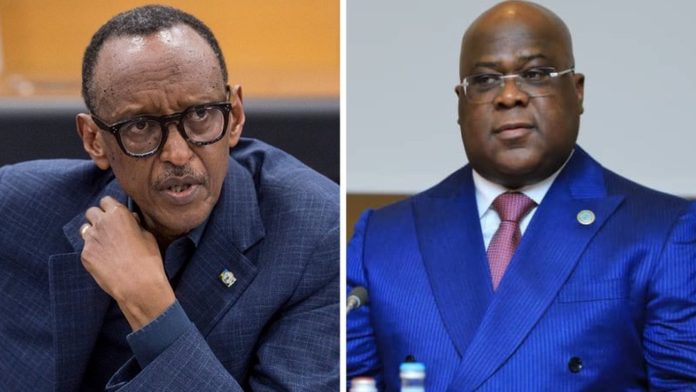
Rwanda president Kagame and Congolese President Felix Antoine Tshisekedi

The Democratic Republic of Congo has accused Rwanda of being behind the armed rebels of M23 asking why a foreign country would defend a terrorist group operating in another country.

In a press release dated October 25, 2022, the DRC said it had taken note of the press release issued by the Rwandan Government on Monday October 24, 2022.

“The content of the press release reveals a new and clear irrefutable admission that Rwanda is backing the M23. Why else would a foreign government defend an armed terrorist group operation in another state? How can a national army be denied its legitimate duty to fulfill a constitutional mission of protecting its population and the legal institutions of the republic against terrorists whose only objective is to sow death and despair?” reads the release from DRC.

The Congolese authorities further questioned the attitude of Rwanda in Congo stating that their interest is to looting of the country’s resources.

“The attitude of the Rwandan President, Paul Kagame, sufficiently demonstrates his strategy of permanent interference in the internal affairs of the DRC to maintain climate of terror in the East, thus enabling widespread looting which has been recognized around the world”

The Congolese statement says Rwanda’s position contradicts its commitments made in the various peace processes in Nairobi, Luanda and in New York with the French President, Emmanuel Macron, where all parties agreed to put to an end the armed groups, particularly the M23. The government of the DRC reiterated that there is no public incitement to hatred on the basis of ethnicity as alleged by Rwanda but instead said “The dangerous narrative propagated by Rwanda aims to sow division within our population”.

“If the M23 were truly defenders of a Congolese community, people would not be so displaced nor would so many die because of its barbarity. The government of the DRC categorically denounces the dishonest rhetoric of Rwanda and its military activities on Congolese soil, and reminds the Rwandan government that its interventionist and expansionist ambitions will never be tolerated”.

The Kigali government in an October 24, 2022 press release had accused Congolese President Felix Antoine Tshisekedi of not honoring his word on the peace process but instead has pushed for military escalation.

“Contrary to the assertion of the President of DRC that his country is focused on a diplomatic solution to insecurity in Eastern DRC, recent statements and actions show that the DRC government has decided on a course of continued military escalation. Furthermore, FARDC continues to operate alongside irregular armed militias, including FDLR”

Rwanda further accused FARDC’s buildup to renew attacks on M23, a Congolese armed group which they claim was in total violation of the agreed regional security mechanisms.

“Despite continued provocation by DRC authorities and armed forces, Rwanda reiterates its firm commitment to contributing to a sustainable, peaceful regional security solution within the agreed regional frameworks. However, the continual, unjustified attempts to make Rwanda a scapegoat for the internal political problems of DRC will continue to be categorically rejected” reads the Kigali statement in part.

Stories Continues after ad

ZTE reports gains in 9-month revenue and net profit

ZTE Corporation (0763.HK / 000063.SZ), a global leading provider of information and communication technology solutions, today has posted its financial results for the third quarter of 2022.

According to the results, for the nine months ended 30 September 2022, ZTE has achieved operating revenue of RMB 92.56 billion, increasing by 10.4% as compared with the same period last year. During the period, net profit attributable to holders of ordinary shares of the listed company reached RMB 6.82 billion, an increase of 16.5%, and net profit after extraordinary items attributable to holders of ordinary shares of the listed company amounted to RMB 5.55 billion, representing a year-on-year increase of 55.3%. Basic earnings per share was RMB 1.44. 

In the first three quarters, ZTE, despite the challenges of the complex external environment, strove for steady progress by collaborating with its industry partners and practising its own positioning as a “driver of digital economy”. During the period, the company strengthened its key technology and product competitiveness, with R&D expense reaching RMB 16.11 billion, 17.4% of 9-month operating revenue.  

During the period, ZTE, while solidifying its position with innovative initiatives, built its comprehensive DICT product series and solutions in three dimensions, specifically, efficient digital infrastructure of “connection and computing power”, flexible and agile digital capabilities, and application innovation of APPs services.

With the wave of global digitalization and low-carbon development, ZTE achieved year-on-year growth with its operating revenue in both domestic and international markets and the three major businesses (carriers’ networks, government and enterprise, and consumer business) as well.

Moving forward, ZTE, confronted with the complex external environment, will stay committed to continuous innovations for its high-quality growth.

Stories Continues after ad

NUP is sagging under the weight of gaffe-prone Bobi Wine

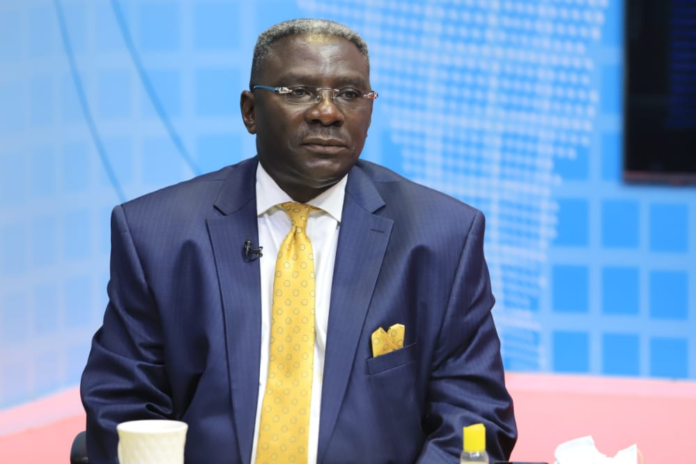
Ambassador Henry Mayega

By Ambassador Henry Mayega

National Unity Platform (NUP) and its right-thinking rank and file have been feuding over Bobi Wine’s galloping bravado that has manifested in form of a lack of knack to fully comprehend statecraft and international political dynamics. That Armageddon shaping up at NUP’s recessing political canvass is sucking out all the remaining elements of civility and it appears there are no visible signs of recovery.

First, a couple of months ago, NUP MPs turned down his plea to return the hot-button cash of Shs40 million given to all MPs for sensitizing their constituents about the Parish Development Model. Poor Bobi was snubbed not only by his MPs but by the Leader of the Opposition as well in an uptick of defiance. That in itself was a humongous signal of his lack of control over his Legislators. The massive fissures if not festering wounds that erupted thereafter between him and NUP’s members of the August house have neither healed nor recessed.

Secondly, Bobi’s inexperience in managing the entire opposition and his dismal performance as a national leader has conspicuously colluded to detach him from the rest of that political sector; for instance, the infamous assault on FDC’s Kiiza Besigye outside the CBS in Mengo by NUP goons some time back plus the incessant gross intolerance of the entire opposition have left swaths of the rest of that political canvass totally indignant towards the ill-famed and disreputable Magere cabal.

Many cogitate that the cabal’s supremo has been vacillating between one gaffe and another; NUP, according to those who promoted it as a “red coffee bean” and laced it with denominationalism, was supposed to be “the party with expertise at fixing our nagging and intractable gordian knots.” That competence thesis has been completely obliterated by the cabal’s quackery.

Approximately two years in, there is that growing sense amongst his ilk that he has lost his way, if any, vis-a-vis fulfilling his pledges to those he duped during the last electoral season. He faces a fledgling party riven by pre-existing if not simmering intra-party disenchantment partially because his MPs and others paid colossal sums to become flag-bearers while others were out rightly debarred from standing on account of lack of money; flag-bearer-ships were bought by the highest bidders.

Thirdly, Bobi’s bizarre if not grotesque support for the EU’s resolution against EACOP was most telling of his general lack of state and international craft. The FDC outsmarted him on the matter reasoning, partly, that the country had already massively invested in the oil sector and it could not afford the germless luxury of abandoning the venture. Lately, he has shrunk into a political pygmy unfitted to answer convoluted oil industry-related technical questions. This column understands that, privately, many upright NUP MPs, save for the few in whose DNA anarchy is perennially ingrained, are losing faith in him faster than he imagines.

Fourthly, his recent sojourning to Ukraine in an apparent contestation of Uganda’s neutrality towards the Russo-Ukraine debacle is grossly bizarre; our country will soon chair the non-aligned movement for a full year and common sense demands that we take no major cosmopolitan sides. It can, therefore, be someone with a cognitive deficit to ludicrously propound otherwise. Besides, Russia has religiously stood with us in both good and bad times unlike those who wronged us by colonially subjugating Africa; we can’t arrogate ourselves the irresponsibility of hating enemies of others– Uganda in particular and Africa, in general, will never do that bidding for our western lecturers. Bobi Wine and a few from his pedigree who recently visited Ukraine to commiserate with that country did so in accordance with the west’s playbook.

Fifthly, fledgling Bobi has always been gaffe-prone; his recent utterances in support of ADF’s former supremo, Jamil Mukulu were as preposterous as they were injudicious. His intention to impress his admirers and sponsors both at home and abroad simultaneously touched the raw nerve of the couth because that insurgent bunch has, globally, been declared a terrorist organization. The lack of international exposure should ideally be blamed for Bobi’s reckless remarks devoid of sensibilities earned with age and dexterity.

Sixth, Bobi’s abortive entry into the UAE to hold a “fundraiser concert” for stranded Ugandans; a gambit he assumed would reinvent him was instead most wacky and eccentric; his promoters with questionable intellectual resources initially tried to mobilize for his performances whilst oblivious of the legal requirements regulating such events. Fundraisers ideally go through an elaborate process before permission is granted. That pervasive incompetence on his part and by extension, his drillers, speak to the rejection they collectively suffered at the hands of Uganda’s bombastic voters during the January 2021 general elections.

Ambassador Henry Mayega

Consul General

Uganda Consulate General

Dubai, UAE

Stories Continues after ad

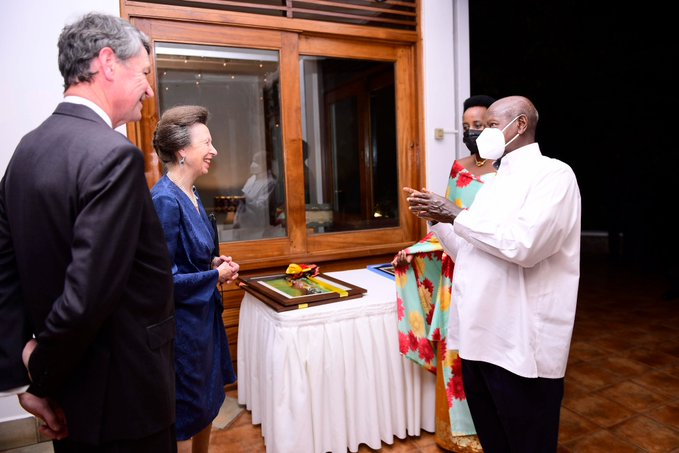
Princess Anne, Museveni meet at British High Commission Kampala

Princess Anne, President Museveni at British High Commission in Kampala.

Princess Royal Anne yesterday hosted President Museveni for dinner at the British High Commissioner’s residence in Kampala. The Princess Royal accompanied by her husband Sir Timothy arrived in Uganda on Tuesday and are set to carry out a number of engagements until Friday.

President Museveni confirmed the hostage by Her Royal Highness and her husband Sir Timothy Laurence at the British High Commissioner’s residence in Kampala via twitter.

Museveni said, “I was hosted to a dinner by Her Royal Highness, Princess Royal and her husband Sir Timothy Laurence at the British High Commissioner’s residence in Kampala. We talked about the different patronages she has come to support here. I welcome her and wish her good luck.”

The Princess Royal started the visit at the Medical Research Council (MRC), Uganda Virus Research Institute (UVRI) and London School of Hygiene and Tropical Medicine (LSHTM), Ugandan Research Unit. 

Her Royal Highness is Chancellor of LSHTM, and their Uganda unit is an internationally recognised centre of excellence.

During the visit, The Princess toured the facilities and learnt more about the unit’s work to conduct high quality, energy efficient research that is contributing to the development of strong health policies for the control of infectious and non-communicable diseases.

The busy programme will see the Queen’s only daughter open the first commercial bank in the Nakivale Refugee Settlement, an honour she will carry out as the patron of Opportunity International, an organisation providing people living in poverty with access to loans, financial training and savings. 

Among other engagements the royal will carry out in Uganda is one linked to Save the Children UK, with which Anne has been closely working for more than five decades. 

Stories Continues after ad

Gov’t blames stranded Ugandans in UAE on individuals and rogue recruitment firms

Migrant workers

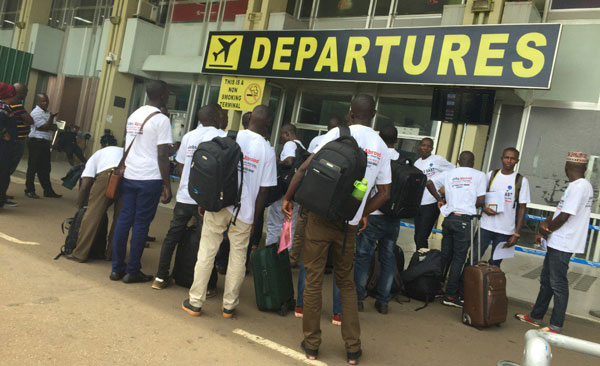
The Minister of State for Labour, Employment, and Industrial Relations, Col. Okello Charles Engola Macodwogo has blamed the huge number of illegal migrants on rogue labour recruitment companies and individuals who lure Ugandans for nonexistent jobs in the United Arab Emirates (UAE).

Currently, there is a crisis in the labour externalization business in the UAE where several Ugandans are turning into conmen, sleeping on the streets and doing other inhumane activities. Since September, the UAE government has deported over 700 Ugandans who were detained at Dubai Central Jail and other 20 detention centers.

The Ugandans had accumulated fines and expired visas. It is reported that most of the Ugandans accessed the UAE through Visit Visas with the hope of getting jobs during and after the six months Dubai Expo which ended in March 2022.

Speaking earlier today, Engola said due to inadequate information about formal channels of getting employment abroad, many youths are lured by human traffickers. Traffickers through false representation, deploy workers into unknown destinations with hostile working conditions.

“There is exploitation of Ugandan migrant workers by illegal Ugandan recruiters who are resident in host countries through false promises for better pay. They persuade workers to abscond or run away from their jobs,” he said.

“The illegal recruiters place these workers into illegal shelters under poor hygienic conditions. In cases where the illegal recruiters succeed to find employment for the migrant workers, it is the former who get paid and not the latter.”

He said there is a lack of an efficient and reliable rapid-response system for protecting migrant workers. Violation of the rights of especially domestic workers who sometimes are denied access to their travel documents, communication gadgets and even medical care.

Currently, there are about 100,000 Ugandans in UAE, 95 percent doing skilled work and 5 percent having challenges.

From migrant workers, the government annually collects US$1.2 billion (Shs4.5 trillion) globally, the Middle East alone sends in $600 million (Shs2.2 trillion) and $200 million (Shs762 billion) from UAE.

Stories Continues after ad

CJ Owiny-Dollo and Justice Kisaakye should know that when the Judiciary coughs, Ugandans catch a cold

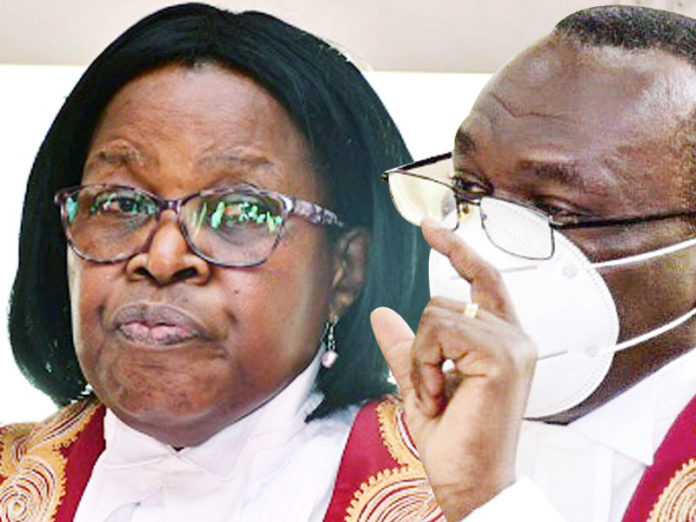
Justice Kisaakye and CJ Owiny-Dollo

By Richard Wanambwa 

Judiciary is one the three arms of Government of Uganda charged with the responsibility to oversee justice in the country. The Constitution of the Republic of Uganda Article 126 (1) spells out the mandate of the Judiciary: “Judicial Power is derived from the people and shall be exercised by the Courts established   under this Constitution in the name of the people and in conformity with the law and with the values, norms and aspirations of the people.”

The Chief Justice [CJ], in this case Alfonso Owiny-Dollo, is the head of the Judiciary providing leadership for the administration and supervision of all courts in Uganda including those that do not administratively fall within the judiciary.

Unfortunately, there is concern that all is not well in the Judiciary circles of the country after Supreme Court Justice Esther Kisaakyes sued Justice Owiny-Dollo and five others, seeking a permanent injunction restraining them from withholding funds drawn from the consolidated fund and refusing to pay her salary and other allowances without following due process.

Those accused say Justice Kisaakye is not telling the truth and that she is to blame for all that she has or she is going through.

However, Ugandans are wondering why those supposed to deliver justice in the country are fighting each other. Ugandans are worried that such uncalled for fights will impact on service delivery in the judiciary and indeed it has happened as Justice Kisaakye has accused her boss Owiny-Dollo of not assigning her roles.

One wonders why CJ has not assigned his junior duties yet she says she is available and ready for work. Despite the fights, legal minds say CJ is wrong if indeed he has not assigned Kisaakye cases to handle. “This decision, they say, may be meant to punish Kisaakye but at the end of the day, it is Ugandans who lose given that our courts have a backlog  of cases waiting to be heard so that justice is delivered in the shortest time possible. We know that justice delayed is justice denied,” a senior lawyer in Kampala said.

Another senior counsel said the CJ has not suspended or dismissed his junior, which means she must work. “If she is reporting on duty, then she must be given work to do. I think the CJ has erred by not giving Justice Kisaakye work,” he said, adding, “Shall we then believe him when he says the Judiciary needs more judges to handle the cases?”

Last year CJ Owiny-Dollo himself was concerned about the case backlog, saying that the judicial officers were over stretched and couldn’t dispose of the cases in time. The CJ explained  then that because of the increased population of Uganda estimated to be over 40 million people, the ratio of the judicial officers to this population for example at Supreme Court is that one Judge to 5 million people, Court of Appeal one to 3 million people, High Court one judge to 793,103 people and at the Magistrates’ level each has to attend to a population of 158,075 people.

As the CJ and his junior fight in court, we also remember that on January 18, 2022, heads of High Court circuits held a retreat to deliberate on strategies aimed at reducing case backlog. However, with the fights within the judiciary recurring, it is hard to achieve what the judicial officials set out to do.

One opinion  leader is not happy with the fights of bread and butter in the judiciary. He said: “Whether Justice Owiny-Dollo wins the case or not. Whether Justice Kisaakye wins the case or not, they must be reminded that it is a shame that they have exposed themselves in the public that is crying for quick service delivery.”

Stories Continues after ad

We are ready to join the EAC, Somalia President says

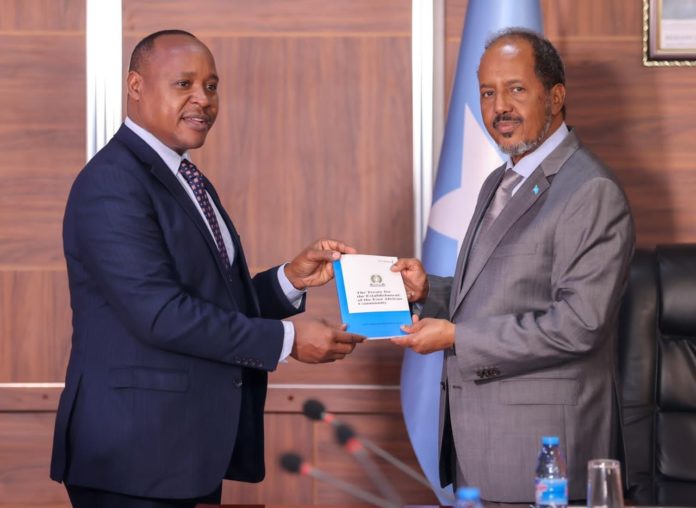
President H.E. Hassan Sheikh Mohamud (right) with EAC Secretary General, Dr. Peter Mathuki.

The President of the Federal Republic of Somalia, H.E. Hassan Sheikh Mohamud urged the East African Community to fast-track his country’s admission into the Community.

The president said Somalia joining the Community has been a delayed dream for the people and the Government of Somalia and urged the Secretary General, Hon. (Dr.) Peter Mathuki, to expedite the process of admission so that his country can be the 8th member of the EAC. 

The President made the call during the maiden visit of Dr. Mathuki to Mogadishu. Dr. Mathuki formally delivered the 22nd EAC Ordinary Summit’s directive to the Council to expeditiously fast-track the verification exercise for Somalia in accordance with the EAC procedures of admission of new countries into the Community. 

“Somalia belongs to the East African Community. There is no country among the EAC Partners States that is not linked by business with Somalia and existing historical linkages include language and culture,” said President Mohamud. 

President Mohamud told the Secretary General that his country was working tirelessly to remove all the security challenges with the support of some of the EAC member states.   

“We are counting on you Secretary General to send the verification team here in Mogadishu to start the process,” he added. 

The president reiterated the strategic position of Somalia saying that the Community will benefit significantly through increased movement of goods, services and people across the bloc in addition to expanding intra-regional trade the already established Somali businesses in the region.  

President Mohamud said that the Somalia’s long Indian Ocea Red Sea route that link Africa to the Arabian Peninsula was a vibrant economic zone, adding that the exploitation of Somalia’s blue economy resources such as fish and the expansive coastline would boost the regional economy. 

On his part, Dr. Mathuki commended the desire of the Federal Republic of Somalia to join the EAC and assured the president that the EAC Secretariat would do its part to make sure that Somalia admission process is expeditiously fast-tracked in accordance with the EAC Procedure for Admission of New Members into the EAC. 

The Secretary General told the president that after his maiden visit, the EAC Secretariat would write to Partner States to request for nominations for members to constitute the EAC Verification Team. The Team will comprise 3 experts from each Partner States and officials from the Secretariat. 

In addition, upon the receipt of the names from the Partner States, the Secretariat will submit the names to the Council for approval to conduct the exercise. 

Dr. Mathuki assured the President of his total commitment in leading the process of admission of Somalia into the Community as directed by the Summit. 

Stories Continues after ad

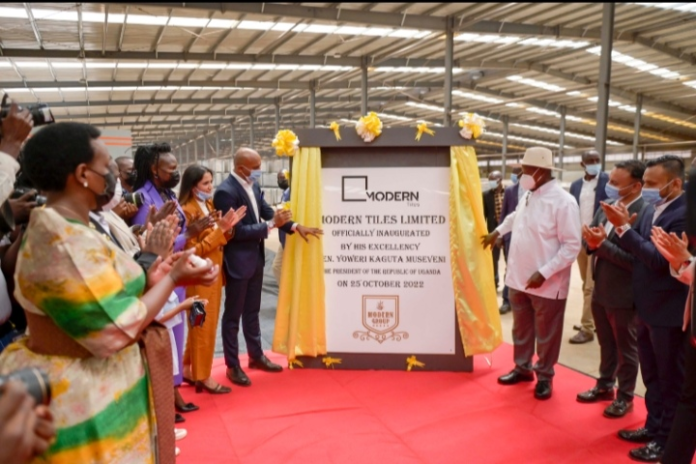
Museveni commissions Modern Tiles Factory in Buikwe District

President Museveni on Tuesday, 25th October, 2022 commissioned the Modern Tiles factory in Buikwe district which is the biggest in East Africa and Africa, currently producing 49,000 square metres of tiles per day, with production to triple to 150,000 square metres per day at full capacity. 

The factory sources its raw materials locally from the districts of Mukono and Buikwe. This is in line with the National Resistance’s principled approach to economic development and growth specifically in the priority area of creating wealth and jobs.

The President lauded Modern Tile Company proprietors for responding to the government’s call of using raw materials purchased locally.

“By purchasing the raw materials locally, our people get jobs,” Museveni noted.

He cautioned that the availability of infrastructure like good roads put up by the NRM government has attracted investors to set up factories in the area.

He added that he will engage his Kenyan and Tanzanian counterparts to forge a way on how to improve the transport network and make it cheap for Ugandans and business people in the region.

“I will talk to the Kenyan government to streamline transport by railway from Mombasa to Kisumu. Another route in Tanzania from Tanga to Mwanza leading to Ishungyezi to exploit iron ore mines. This can make this part of Africa an industrial base. The population of 1.3 billion Africans is a huge market,” the President observed.

“We shall rationalize the transport chain by reducing the use of trucks from Mombasa or Tanga because it is not smart.”

Museveni further attributed some of the causes of uprisings in some African countries to youth unemployment.

“What government is doing now is to set up as many factories as possible to ensure that the youth are employed. This helps to prevent them from being diverted by economic and political saboteurs,” he said.

The Minister of State for Investment and Privatization, Evelyn Anite, appreciated President Museveni for creating a conducive environment that has enabled investors to set up big factories in Uganda. She said this has helped Uganda to develop economically.

“Uganda should thank you, Your Excellency. It’s your effort that there is zero ceramics and tiles importation in the country,” she said adding, that the country has stopped donating money to foreign countries because of Museveni’s able leadership.

The Minister however, pointed out challenges that are being faced by sugar factories in Uganda like lack of sugar canes which has led to limited production.

“Your Excellency, we should engage all sugar stakeholders so that we find a lasting solution to the problem,” she remarked.

On his part, the Chairman of Uganda Investment Authority (UIA), Mr. Morrison Rwakakamba said the current government did not take on a revolution to serve only as leaders but also to revive the country’s economy which was as ‘good as dead’ by 1986.

“This factory and others are some of the fruits of the revolution,” Mr. Rwakakamba said.

According to Ashish Monpara, Modern Group’s Chairperson said that the factory currently employs 500 Ugandans directly adding, “At full capacity, the factory will produce 150,000 metres of tiles per day, employing 1,600 Ugandans directly and 3,000 indirectly.”

Mr. Monpara also expressed sincere gratitude to President Museveni for creating a conducive and favourable environment that has enabled their company to prosper in the East African country.

“Your Excellency, our total new investment in the next five years will be more than 400 million USD,” Mr. Monpara assured.

He also disclosed that the group is looking forward to set up a pharmaceutical vaccine plant in Uganda.

“For this, we are already in discussions with Minister Evelyn Anite and Uganda Investment Authority to secure the appropriate land. Our budget for this pharmaceutical vaccine plant is 100 million USD.”

Stories Continues after ad

Rev. Fr. Dominic Eibu appointed new Bishop of Kotido Diocese

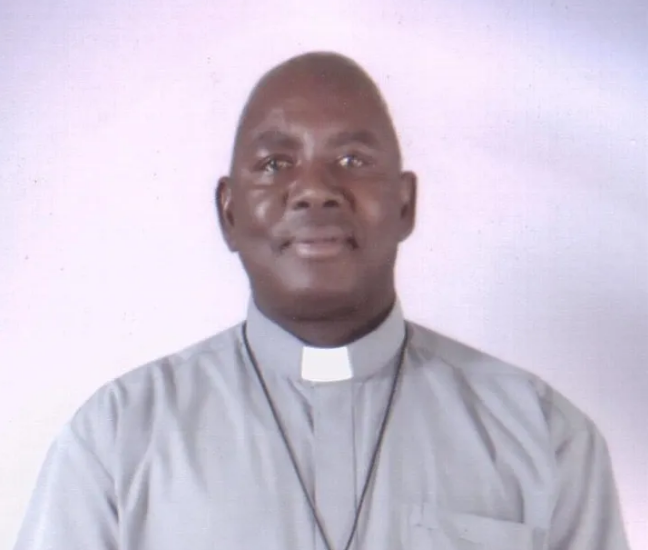
Reverend Fr. Dominic Eibu

Rev. Fr. Dominic Eibu has been appointed Bishop of Kotido Catholic Diocese. The news was announced by the Papal Francis representative, Archbishop Luigi Bianco on Tuesday October 25, 2022.

He replaces Bishop Giuseppe Filippi (M.C.C.J.) who resigned from the pastoral care of the same diocese upon reaching the canonical age limit.

Bishop Dominic Eibu, was born on 30th April 1970 in Lwala, in the diocese of Soroti, Uganda. After studying philosophy at the Queen of Apostles Philosophy Centre in Jinja, he gave his first religious vows on 16 May 1998 at the Institute of Comboni Missionaries in Namugongo, Kampala.

He subsequently completed his studies in theology at the Pontifical Gregorian University in Rome. He gave his perpetual vows on 12 January 2002 and was ordained a priest on 15 August 2002. He was subsequently awarded a licentiate in Arabic and Islamic studies in Cairo, Egypt, and then at the Pontifical Institute of Arabic and Islamic Studies in Rome.

He has held the following offices: director of the Comboni Primary School in Khartoum (2005-2016); vice superior general of the Combonian Province of Khartoum (2008-2013); member and secretary of the College of Consultors (2013-2016); secretary of the Presbyteral Council (2013-2016); secretary for education (2013-2016) and since 2017, school director and deputy parish priest in Cairo.

He is currently parish priest of the Sacred Heart of Jesus parish in Cairo, vice superior general of Egypt-Sudan, and member of the Education Committee of the United Nations High Commission for Refugees.

Stories Continues after ad

One month after declaration of Ebola in Uganda

Since 20 September, 2022, the day the Ebola epidemic was declared in Uganda, Médecins Sans Frontières (MSF) has been working alongside the Ministry of Health to support medical care in the country.

Since the start of the outbreak and as of 23 October, 90 patients were confirmed with Ebola and 28 people were reported to have died from the disease. Another 32 people have recovered and been discharged from treatment centres.

Given the challenges posed by the lack of a currently licensed vaccine or treatment for the Sudan strain of Ebola, and based on experience from previous outbreaks, we’re focusing our response in three areas. Teams of doctors, nurses, logisticians, infection prevention and control specialists, and health promoters are currently working to limit the spread of the epidemic, reduce mortality, and facilitate epidemiological monitoring, research, and innovation.

Since 20 September 2022, the day the Ebola epidemic was declared in Uganda, Médecins Sans Frontières (MSF) has been working alongside the Ministry of Health to support medical care in the country.

Since the start of the outbreak and as of 23 October, 90 patients were confirmed with Ebola and 28 people were reported to have died from the disease. Another 32 people have recovered and been discharged from treatment centres.

Given the challenges posed by the lack of a currently licensed vaccine or treatment for the Sudan strain of Ebola, and based on experience from previous outbreaks, we’re focusing our response in three areas. Teams of doctors, nurses, logisticians, infection prevention and control specialists, and health promoters are currently working to limit the spread of the epidemic, reduce mortality, and facilitate epidemiological monitoring, research, and innovation.

They also provide medical and social support to people who have been forced to isolate themselves for 21 days after coming into contact with an Ebola patient through the distribution of basic necessities such as hygiene products, food donations, and communication equipment. This support is intended to compensate for the loss of income-generating activities and allow the person to isolate themselves in acceptable conditions.

MSF health promoters are also involved in identifying and monitoring contacts in order to quickly identify those at risk of carrying the disease and to raise awareness about how to prevent it and what to do if they develop symptoms. Finally, we’re preparing to support the affected health centres to help them provide free primary health care to the communities affected by the epidemic.

In parallel, MSF continues to support the Ugandan Ministry of Health in the medical treatment of sick people in Mubende district. One 40-bed Ebola treatment centre has been completed, and another 40-bed facility, which will have the capacity to provide intensive care, is under construction in Mubende town for confirmed patients. An eight-bed treatment unit in Madudu for those in the early stages of the disease is now up and running.

“In addition to the construction of the units, we have donated medicines and protective equipment, and provided training to medical staff working in the health facilities, particularly on how to care for patients but also on hygiene measures to be implemented, which is crucial to avoid nosocomial transmission,” says Denis BASDEVANT, project coordinator in Mubende.

“We have also provided the Ministry of Health with MSF staff experienced in managing cases of haemorrhagic fever, such as doctors and nurses,” he says.

In Kampala, the country’s capital, we will develop similar measures: health promotion activities, social support for contacts, support to health facilities in terms of prevention and infection control, and support for non-Ebola-related health care. MSF is also expected to become involved in patients’ care in the near future.

Finally, on the epidemiological side, Epicentre is collaborating with the Ministry of Health, in support of epidemiological activities, including surveillance and infection control and prevention. We also expressed interest and availability to participate in research that will begin in the coming weeks on vaccines and treatments for the Sudan strain of Ebola virus.

“The approval of effective vaccines and treatments for the Zaire strain of Ebola in 2018-2019 in the Democratic Republic of Congo and the management of subsequent outbreaks have been crucial tools in controlling the spread of the virus,” says John Johnson, MSF’s vaccine and epidemic response expert. “While we know that these can be developed and tested in advance to determine their safety, their effectiveness can only be tested during an outbreak.”

“As such, and as was the case with the clinical trials conducted for the Zaire strain vaccines and treatments in the Democratic Republic of Congo in 2019, MSF is prepared to invest heavily in this research,” says Johnson.

Stories Continues after ad