Stanbic Bank
Stanbic Bank
18.3 C
Kampala
Stanbic Bank
Stanbic Bank
Home Blog Page 548

Speaker Among donates Shs50 million for Buyende maternity ward

Speaker Anita Among (2nd R) hands over a dummy cheque to Mpindi (L). In the centre is area MP, Moses Magogo

Speaker Anita Among has donated Shs50 million to support the completion of a maternity ward in Kagulu-Igwaya trading centre in Buyende District.

Among handed over the money to Prossy Mpindi, the founder of Maliya Foundation Health Care Centre, a private charity organization that is running a health facility to provide highly subsidized treatment to the community. 

Flanked by Budiope East Member of Parliament Moses Magogo, the Speaker commended the organization for offering health care to the people and pledged to support them.

“As you are aware, there is no hospital around Igwaya and as legislators, our work is to complement what government does. And we are aware that the foundation is giving treatment at almost no cost. And we are here today to help, support and complement what she is doing,” Among said.

The Speaker called upon the local people and other stakeholders to join hands to develop Buyende District.

“Let us join hands together with government and develop this area. I believe when we support this foundation, then we would have supported this entire area. We are in leadership to improve the humanity of our people,” she said.

Among also urged the people of Buyende to form SACCOs in order to tap from government programmes such as the Parish Development Model (PDM) where government intends to use parishes as centres of wealth creation.

“Whereas government is trying its best, we should also help government. Now PDM is here, we should be able to make good use of it; let us put ourselves in groups to help ourselves,” Among said. 

Among also contributed Shs30 million for the completion of the girls’ dormitory at Kagulu Primary School. 

On the sidelines, the Speaker hosted the Kyabazinga of Busoga, His Royal Highness William Wilberforce Nadiope Gabula IV at her home in Budiope, Buyende District where they discussed unity and socio-economic transformation of the people of Busoga.

The meeting was attended by Moses Magogo, Buyende Woman MP Mary Annet Nakato, Martin Muzaale (MP Buzaaya County) and Bukooli North MP Solomon Silwanyi.

Stories Continues after ad

Raila Odinga challenges presidential results in Kenyan Supreme Court

Raila Odinga challenges presidential results in Kenyan Supreme Court

Raila Odinga, who came second in Kenya’s presidential election, has filed a legal case challenging the result, his lawyers have said.

According to the electoral commission, Mr Odinga took 48.8% of the vote, losing to William Ruto’s 50.49%.

However, four of the seven electoral commissioners refused to endorse the outcome alleging that the way the final results were tallied was “opaque”.

The seven judges at the Supreme Court will have 14 days to make a ruling.

One of the arguments that Mr Odinga’s Azimio coalition is putting forward is that there were just over 140,000 votes that were cast but were not included in the final tally, according to an extract from the legal documents seen by the BBC.

This number could be enough to prevent Mr Ruto from reaching the 50%-plus-one-vote threshold needed to avoid a second-round run-off.

Supporters of Mr Odinga gathered outside the court in a suburb of the capital, Nairobi, on Monday morning waiting for the lawyers to hand over the physical documents. Their placards read: “Protect our Vote” and “Electoral Justice Now!”

They cheered and chanted as the presidential candidate and his running mate, Martha Karua, arrived at the court to formally submit the case.

Speaking last week, Mr Odinga described the result as a “travesty”, adding that the election should be declared “null and void”.

This is the third time in a row that he has gone to court to get an outcome overturned.

In 2017, the veteran politician successfully challenged the result of that year’s presidential election, which he lost to Uhuru Kenyatta, and the Supreme Court ordered a re-run. The case highlighted logistical issues in the way the results were collated.

This time the Independent Electoral and Boundaries Commission (IEBC) tried to make the results process as transparent as possible by publishing the polling station tallies as soon as they were available.

An independent Kenyan monitoring group said the IEBC’s final result was in line with its own projection.

A week ago, there were chaotic scenes at the national tallying centre moments before the final result of the 9 August poll was about to be read out.

Some of Mr Odinga’s political allies stormed the stage and scuffles broke out. Two electoral commissioners were injured and four others left the compound to hold a press conference to denounce the outcome.

Nevertheless, IEBC chairman Wafula Chebukati proceeded with the announcement and handed Mr Ruto the certificate confirming that he was the winner.

Last week, Mr Ruto said he would respect the court process, which is part of the country’s electoral law.

“I’m a democrat. I believe in the rule of law. I respect our institutions,” he told journalists.

Stories Continues after ad

My Turning Point: From Internet Café Attendant to CEO during #Covid-19 lockdown

Deborah Kuteesa Knitting

By Wesibade Halima

If anyone had told 28 years Deborah Kuteesa that her fortune would turn around during the global crisis that was Covid-19 she would probably laugh out loud. And yet what was a very difficult time in her family turned out to be the silver lining in the cloud of her life.

In March 2020 Uganda went for its first Covid-19 lockdown. The uncertainty that came with the pandemic left thousands from different walks of life affected socially, economically, and to some degree physiologically. But it also birthed opportunities for hundreds more.

Deborah Kuteesa is an entrepreneur whose crocheting and knitting business had just started gaining momentum when the first lockdown happened. She used that time of confinement at home to improve her skills in crocheting and also learned knitting which saw the birth of her embroidery company. “The second lock down wasn’t hard as the first because it found us wiser, I managed to find my way to work and I got orders here and there,” she states.

DEBORAH KUTEESA

Deborah was one of those who went into a COVID lockdown so uncertain only to emerge with a successful embroidery business employing several youth. “Running a business during lockdown was a buildup so I never felt the burden, I won’t say mine wasn’t affected but am not the type that gives up I was able to buy a machine , made a lot of noise on social media because am very good at online marketing and taking good photos which persuaded people to buy from me, also the lockdown created a middle-ground in business which made it easy to penetrate the market, and above all God saw us through, it was indeed my turning point,” she states.

Deborah had been employed at an Internet café before the lockdown but when the virus continued surging she left her job to stay home because of her mother’s heart condition which rendered her vulnerable to the virus.

As the lockdown restrictions continued to be lifted many Ugandans expressed an agile and innovative attitude towards business, Companies adapted and adjusted their business models using technological innovations. In a United Nations Socio-Economic Impact Assessment of COVID-19 in Uganda May 2020. The most popular adaptation measures included the use of digital and communication technologies as well as new procurement/supply delivery channels, use of telephone communication to reach out to customers and receive orders and payments.

DEBORAHS TEAM

It is following the effects of the lockdown that Deborah started crocheting as a pastime. Deborah further stresses that the lockdown opened her up to the possibilities presented by social media. She started to use it as a sales channel and in time her sales grew during the lockdown. “The only bit was it being slow, rent issues but my landlord was very generous to let me clear at my pace, but after lockdown that’s when I fully launched into sweaters. Luckily I got a client who took my samples and when schools opened up opportunities found me prepared I got my biggest order of 200 sweaters which was a very big milestone,” she says.

Today Deborah has over 200 orders and has been able to train seven youths whom she then employs. .“ For me training others is one way to make money, but I also desired to employ people that I have personally trained because I get to pour myself into them besides the knitting,” says Deborah.

DURING A TRAINING SESSION

After suffering the loss of her father Sarah Nantege, 19 years old Deborah’s trainee wasn’t able to continue with her studies, she dropped out of school in form three. However Miss Nantege did not stop dreaming until she was presented with an opportunity to train at Dmolds (Deborah’s company).

“Acquiring these skills has been life-changing because I have been given a career to identify with regardless of the fact that I was not able to complete my studies, thanks to my mother who agreed to me joining this company,” says Sarah.

SARAH NANTEGE -TRAINEE

Meanwhile Joan Nabulime an employee and trainer at DMolds embroidery never really pictured her self-doing knitting, but in looking for what to do after seating her final high school exams thoughts of what to do while she waits to join university started shooting and luckily Deborah Kuteesa was willing to train her “I am very proud of who I’ve become through Dmolds, I am able to sustain a living from the salary I get, and most importantly this job has taught me not to look down at jobs,” Nabulume emphasized that the youth tend to reject certain opportunities in search for white color jobs yet at times what you look down on is your calling.

JOAN NABULIME -TRAINER

At only 28 years Deborah Kuteesa has at least six families benefiting directly from her company; however, she feels that her dream will only come to pass when she starts to import her yarn (thread), have an established training school, be able to produce a variety of products and open up a shop for her finished products.

According to a 2020 Economic Policy Research Centre (EPRC) effects of Covid-19 survey report, the containment measures such as transport restrictions, quarantine, and social distancing. Micro and small businesses like Deborah’s experienced a larger decline in business activity compared to medium and large firms since most of the micro and small businesses could not meet the standard operating Procedures (SOPs) such as the provision of on-site accommodation for employees, In addition, employees of SMEs used public transport—which was banned on 25th March 2020. However, the same survey showed the Ministry of Finance, Planning and Economic Development, and Bank of Uganda reports that the economy is recovering steadily which could be attributed to the coronavirus crisis which created a practical and ethical imperative for people to do more work that matters.

SOME OF DEBORAHS FINISHED PRODUCTS


This publication was produced with the financial support of the European Union. Its contents are the sole responsibility of Wesibade Halima and do not necessarily reflect the views of the European Union. 

Stories Continues after ad

URA hunts for Temporary Road License violators

Some of the violators

The Uganda Revenue Authority (URA) has started to hunt for Temporary Road License violators in the country.

According to a statement released by URA, a Temporary Road License (TRL) is a document issued to foreigners intending to come into Uganda with their foreign registered vehicles or Ugandans working abroad with valid work permits.

“With the Temporary Road License, a person is granted a maximum of 90 days and once they expire, they are supposed to return to their countries. However, some foreigners and Ugandans living out of the country commonly known as “ba-summer” violate the TRLs. They choose to stay and test their luck,” URA said.

“A clean up is currently ongoing around the country to net culprits misusing these regulations. Last week, 11 high performance vehicles that included Jeeps, Hummers and BMW X6 were impounded by our intelligence team.”

👉🏽 https://bit.ly/3QbThjU

The impounded vehicles were from; Kabalagala, Kololo, Ntinda, Munyonyo, Entebbe and Ggaba. Most of these had foreign plates with expired TRLs; Some had sold the vehicles to different individuals; and others had no documents.

Stories Continues after ad

Traffic Police cracks the whip on EPS defaulters

Traffic Police cracks the whip on EPS defaulters

Traffic Police has today commenced operations to crack down on all traffic penalty defaulters, who the Police say, owe the government Shs8 billion.

The operations are targeting vehicles with unpaid Express Penalty Scheme (EPS) tickets, during the stop and search traffic operations, as well as tracking them from the CCTV camera centres.

The EPS scheme was introduced under Section 165 of the Traffic and Road Safety Act, 1998, to purposely manage minor traffic offenders.

The primary objective of the scheme was to deter road users from committing offences, by levying express penalties that would help to decongest courts. The EPS ticket has 25 codes for traffic offences, whose fines vary, depending on the traffic offence committed. The codes range from Shs20,000 to Shs200,000, which the offender has to pay or clear within 28 days.

Police spokesperson Fred Enanga said those who do not know their EPS status, can cross check it, by downloading the UPF Mobi App, on an Android Smartphone and check for it up. Motorists can also go to the nearest traffic office, and check for the EPS status while at the station, any traffic officer, with an EPS tracking gadget, can check if your driving permit has an EPS ticket pending payment or not.

👉🏽 https://bit.ly/3QbThjU

Police said they also have plans of publishing the list of EPS defaulters in the print and electronic media.

“Motorists are advised, to carefully read the tickets issued to them, and follow instructions therein. It is essential that one pays their ticket in a timely manner, as payment automatically leads to closure of the offence,” Enanga said.

“If you establish that you have a pending EPS ticket, please go to the bank and pay the traffic fine using the EPS Ticket, or on mobile money, PayWay or any Agent banking dealer. Do not ignore to pay a traffic ticket because it is an obligation for a traffic violator or defaulter, to respond to a traffic ticket within the stipulated time. Failure to do so, you will be deemed guilty by the law. As a result, one may face a surcharge for late payment of 50%, or have their motor vehicle impounded, their driving licence not renewed, pending clearance of the traffic ticket or taken to court. All these actions may be very inconvenient, disruptive or costly.”

Enanga said that police records are very well kept. “Those who think they can avoid payment of the traffic ticket, are totally wrong. For instance, we have records of all traffic defaulters/violators to the pending EPS arrears of Shs8 billion.”

“At any stage, a traffic defaulter will find him or herself, involved with the police, who will arrest or impound their vehicle. Defaulters do not have a choice but to clear their arrears. Imagine if you are a driver who lives or earns by driving, it is your way of life, you need to protect, your job, by jealously guarding your driving record.”

Stories Continues after ad
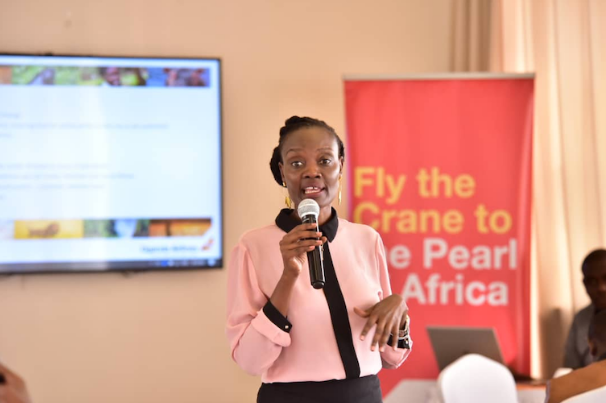
Jennifer Bamuturaki to meet African Airlines Association Secretary General Abderahmane

African Airlines Association Secretary General Abderahmane

The Chief Executive Officer (CEO) of Uganda Airlines Jennifer Bamuturaki is set to host the African Airlines Association (AFRAA) Secretary General, Mr. Abderahmane Berthé.

The meeting will focus on strategic cooperation in areas that accelerate African Air transport growth to play bigger on a global scene. 

The meeting comes at a time when Bamuturaki is under scrutiny over lack of academic documents. According to the Parliamentary Committee on Commissions, Statutory Authorities and State Enterprises (COSASE) Bamuturaki has no academic transcript and the Uganda Certificate of Education (UCE) result slip despite all claims that she graduated in 1994.

The MPs claim that the CEO of Uganda airlines has to have among other a bachelor’s degree and a post graduate-diploma however the Airline CEO Jennifer didn’t meet the minimum academic requirements at the time of appointment. She only had a B.A SWASA and lacked post graduate training.

👉🏽 https://bit.ly/3QbThjU

Berthe will later have a strategic meeting with the Minister of Works and Transport.

In 2018, Uganda mooted an idea to revive its airline and hence ordered four Bombardier CRJ900 regional Aircrafts. In 2020, the government of Uganda received four Bombardier CRJ900 regional Aircrafts that were ordered by Uganda National Airlines Company in July 2018 and two airbuses which were delivered in 2020 and 2021.

Following the arrival of airbuses, the country launched its long-range operations with non-stop intercontinental flights to the Middle East, Europe and Asia.

Established in May 1976, Uganda Airlines, started operations in 1977 and was liquidated in May 2001 after efforts to privatize the company failed due to massive debts it had incurred.

Uganda Airlines is competing with Africa’s best such as South Africa Airways, Ethiopian Airways, Kenya Airways, Rwandair and others on the continent, not forgetting International ones such as Emirates Airways, Qatar Airways and Turkish Airways among others that land at Entebbe International Airport.

Stories Continues after ad
DRC investigates suspected Ebola case in North Kivu

Health workers

Health authorities in the Democratic Republic of the Congo are investigating a suspected case of Ebola virus disease, in the country’s eastern province of North Kivu. The country’s National Institute of Biomedical Research (INRB) is in the process of testing samples to determine if the patient contracted Ebola.

The suspected case is a 46-year-old woman who died on 15 August 2022 in Beni, a town located in North Kivu. The case received care at the Beni Referral Hospital, initially for other ailments, but subsequently, exhibited symptoms consistent with Ebola virus disease.

“While the analysis is ongoing, WHO is already on-the-ground supporting health officials to investigate the case and prepare for a possible outbreak,” said Dr Matshidiso Moeti, World Health Organization (WHO) Regional Director for Africa.

WHO staff are working with health authorities to identify anyone who came in contact with the suspected case and monitor their health. WHO will also work to ensure proper infection prevention and control measures are in place, that treatment can be made available for those who need it, and to raise awareness about Ebola among local communities.

Stories Continues after ad

Deputy Speaker Tayebwa pledges support to Indian community

Deputy Speaker, Thomas Tayebwa was chief guest at the centenary celebrations of Pramukh Swami Maharaj.

The Deputy Speaker, Thomas Tayebwa has said that government will ensure that Indians in Uganda have peace and are treated as equal citizens.

Tayebwa made the statement on Friday, 19 August 2022 at Nsambya Railways Ground where he was chief guest at the centenary celebrations of Pramukh Swami Maharaj.

Pramukh is the founder, spiritual teacher and guide of the BAPS, a major branch of the Swaminarayan Sampradaya, a Hindu denomination.

Pramukh traveled around the world to teach people about spirituality and positivity and was an inspiration to millions worldwide with his motto, “In the joy for others lies our own”.

Tayebwa assured the Indian community support and called for respect of the Indians. “We are also doing all we can to ensure that Indians in Uganda do have peace and are not treated as second class citizens, but equal citizens of Uganda with all the benefits,” Tayebwa said.

Tayebwa was accompanied by the Indian High Commissioner to Uganda, HE Shri A. Ajay Kumar.

He also commented on the works and times of Pramukh saying that he worked hard for the joy of others and not for himself.

Tayebwa said that one cannot sustain happiness if it is only them and their families.

“He has also shown us the virtues of hard work because he couldn’t sleep; he was always working but his life also showed us devotion to God. It showed us that at any time you can devote your mind to God whether you are alone or in the crowd.” He says.

Tayebwa also said that Parliament will pay tribute to Pramukh Swami who he said was selfless and dedicated his life to serving and inspiring others for the greater good of the community.

Pramukh visited Uganda in 2004 and opened the new assembly hall at the BAPS Shri Swaminarayan Mandir (Hindu Temple) in Kampala.

Stories Continues after ad

What the opening of Uganda’s Consulate in Dubai means

Ambassador Henry Mayega

Last October, President Yoweri Museveni visited the United Arab Emirates to amongst others officiate at the October 3, 2021 Uganda national day celebrations which took place in the 2020 Expo Dubai opportunity district; while here, he met the then Crown Prince and now President as well as the commander-in-chief of the armed forces of the UAE, Sheikh Mohamed bin Zayed and the Vice President, Prime Minister, Minister of Defence of the UAE as well as ruler of Dubai, Sheikh Mohammed bin Rashid Al Maktoum; those conclaves between those principals spoke of the existence of robust and snuggly bilateral relations between the two countries thereby reaffirming the notability of south-south cooperation for mutual benefit.

Consequently, given those relations, the government of Uganda, with approval from the UAE authorities opened a liaison office in Jumeira district of the Emirate of Dubai–a feat particularly construed as one of the beneficial spin-offs from our country’s participation in the 2020 expo Dubai. The liaison office’s life span of six months i.e from October, 2021 to March, 2022 was purposed to coordinate Uganda’s participation in the expo activities by way of offering consular and protocol support to expo-bound government officials, business delegations as well individuals; a vocation that was successfully done. That coordination nerve centre was delightedly inaugurated by the Special Envoy of the President, Rt. Hon. Dr.RuhakanaRugunda on October 15, 2021.

The UAE government granted virtuous our country permission to open a consulate on April 6, 2022; that diplomatic mission, having morphed from a liaison office, is currently operational and it is representing Uganda’s interests as well as facilitating diplomatic services in Dubai and the other esteemed northern emirates including Sharijah, Ajman, Fujairah, Ras Al Khaimah and UmmAl Quawain.

Our diplomatic presence in Dubai has made it affordable and bargainous to offer both protocol and consular support to Uganda government officials who are either transiting through or visiting Dubai. Likewise, the ever-burgeoning Ugandan diaspora folks in the northern emirates will deftly access consular support from cheek by jowl proximation; these are services that have, in the past, been dispensed from Abu Dhabi, a distance of 180km away from Dubai destination.

Atop of those bilateral relations, this administration’s stratagem of commercial and economic diplomacy guides Uganda’s diplomatic missions on matters of increasing: the volume of trade, tourist numbers, FDIs and mobilizing the diaspora for development (TTFM). Uganda, will achieve severally on all those fronts; with requisite tooling, the consulate is positioned to tap into Dubai’s bubbly and ebullient financial, investible funding, huge tourism industry and its numerous trade opportunities. 

An Emirati investor, for instance, is being sought to establish an Arab cultural centre near a national park for use during the oppressive summer heat for relaxation in a cool and serene environment and appreciation of Uganda’s touristic variety. The consulate is exploring ways of encouraging Uganda’s exporters of food and other products to form  companies that can bulk-sell them in Dubai. Simultaneously, ways and means are also being explored to link those exporters with the chamber of commerce and the equivalent of an investment vehicle here to ensure quality of those very exportables.

The Emirate of Dubai with a GDP of US$102.67billion and a population of 3.4million people is UAE’s financial and commercial hub; it is a centre of excellence for regional and international trade, tourism, aviation, real estate and financial services which uniquely combine toplace it in a position from which Uganda will benefit by increasing the volume of exports of, particularly, fresh and processed agricultural goods including avocado, pineapples, mangoes, matooke, cassava, sweet potatoes etc. Precious metals will also be emphasized given the huge appetite for them here.

The consulate will earnestly work in concert with the ministries of Trade and Industry, Energy and Mineral Development, Agriculture Animal Industry and Fisheries and the private sector to ameliorate the existing supply chain bottlenecks and quality issues.

In tandem with this administration’s strategy of mobilizing the diaspora for development, the consulate, together with the UAE-based diaspora are planning an annual convention themed “Uganda: the cardinal Trade and Investment Hub within the African Continental Free Trade Area (AFCFTA)”which will take place at Hyatt Regency in Deira, Dubai from October 29-30, 2022; hundreds of participants plan to promote their varied cultural heritage and source for new bouts of investments, tourist visits and technology transfer as well as trade opportunities for Uganda’s development. The UAE-based Uganda diaspora remits more than $200m back home.

The inauguration of a Uganda Airline’s flight to Dubai during the 2020 Expo, Dubai means a lot in terms of cargo transportation to the UAE; in essence, there is a real possibility of the career dominating other players in transporting both passengers and cargo from Uganda as well as the East African region most especially from the DRC and South Sudan by doing round trips even through Abu Dhabi. That way the passenger numbers, and correspondingly, the volume of trade with the UAE and the Arab world will surge to unprecedented levels.

Ambassador Henry Mayega

Consul General

Uganda Consulate

Dubai, UAE

Stories Continues after ad

CEPCOM urges gov’t to show political will to conserve and protect the environment

The Executive Director of Center for Peace and Conflict Mitigation Uganda (CEPCOM-Uganda), Stephen Kuteesa has urged the government to show political will to conserve the environment.

Kuteesa avers that the government is taking long to implement policies on, for instance, prohibition of plastic production to save the environment from the glaring side effects of plastic waste pollution.  

Kuteesa made the call while speaking at Buganda Tourism Expo being hosted for 10 days at Lubiri Palace, Mengo.

Uganda currently generates over 600 tons of plastics every day. However about 41 percent is recycled and 51 percent of this is littered, hence posing a threat to the environment. The poor disposal of waste in drainage channels has resulted in clogged and contaminated water sources, flooded drainage channels, and plastic waste polluted land for agriculture.

The above dangers, according to Kuteesa, are the force behind CEPCOM’s efforts to collect plastics and handle them in a useful manner in partnership with communities and other stakeholders.

Kuteesa said if a community fails to protect the environment and cut trees for charcoal, people will continue to face floods and landslides. “If we indiscriminately keep on disposing of waste especially plastics and clog up in water channels, we shall have floods. When you see floods and drought, just know that somebody has been cutting trees. Clogged flooding comes as a result of indiscriminate disposing of waste,” he said. 

According to Kuteesa, CEPCOM is mobilising and sensitising communities about the dangers of poor waste disposal. Their engagements, and operations, he said, are based on communities that collect plastics thrown on the roads and other areas like garbage pits and landfills.

He said that it is everyone’s responsibility to protect the environment.

“We mobilise and empower communities to be the primary champions in fostering activities geared towards protection, conservation and regeneration of the environment. We also organise sports activities on various themes about environmental protection.”

Kuteesa said some of the activities have been held in Entebbe Municipality and Makindye Ssabagabo Municipality. “This is all aimed at rallying people to conserve, protect and regenerate the environment,” he said.

He said since 2009, EPCOM has done remarkable projects under plastic recycling and reusing, adding that the organisation has empowered communities in various cluster groups composed of women, youth and men.

“The groups have since been introduced to the fact that what we term as waste, can be used as a source of livelihood and many have benefited from the mooted idea, ” he said, adding that the youth collect all sorts of plastics which the organisation buys in accumulated volumes.

Kuteesa says other groups do the sorting of the plastics gathered. “The sorting is done according to colors, size and density,” he says.

In partnership with GIZ, EPCOM, he said, skilled other youth to reuse plastics by transforming them into useful items like dustbins from used plastic bottles, flower vessels, kitchen gardens.

The organisation said the excess plastic material is sold to recycling plants such as Plastic Recycling Industries Uganda Limited (PRI) and Standard Manufacturing Limited.

EPCOM has since put its emphasis on adding value to the collected plastic materials to save Ugandans from huge taxes and cost they pay to foreign plastic manufacturing companies.

“The plastic material is crushed, exported and is returned as new bottles. We aim at acquiring machines and producing products ready for use,” Kuteesa said.

Before the outbreak of covid-19 pandemic, Kuteesa said they used to collect 30 tons of plastics every month but currently the tonnage has drastically decreased to 15 tons. The decrease is alluded to the reduction in consumption due to economic hardships that the country is facing.

He said Ugandans need to change social behaviour and mindsets and know that throwing a bottle along the way while travelling is littering the environment.

For instance, someone going to Mbale buys a soda, removes the lid and drops it in Nakawa, a bottle in Mukono and a label in Mabira. That means he has littered three places. We want taxis and car owners to have small containers where passengers can dump the waste,” he said.

“When you go to dumping places, you find all sorts of waste. You find medical waste, glasses, plastic and others. We need to sort our waste because they can become a source of income,” he said.

Kuteesa said Ugandans living in the mountainous areas should not cry about landslides when they are cutting trees.

He said the country continues to receive rain because some of the wetlands have been destroyed. “We are not getting rain because the wetlands are all cleared for land refill and construction,” he said.

Kuteesa said the government should show the political will to conserve the environment, noting that the country has the best conservation laws and guidelines.

“Sometimes I wonder when they say we have independent authorities such as the National Environment Management Authority (NEMA), the National Planning Authority (NPLA), and the National Metrological Authority (NMA). What kind of authority do they preside over when the population is mismanaging the environment?” He asked.

He urged the authorities to work together to mitigate all forms of climatic change. 

Established in 2009, CEPCOM-Uganda has been working to promote peaceful coexistence and unity among Uganda’s very diverse communities, while creating opportunities for socioeconomic improvement for children, youth, women and other vulnerable groups within those communities.

Stories Continues after ad