Stanbic Bank
Stanbic Bank
27.6 C
Kampala
Stanbic Bank
Stanbic Bank
Home Blog Page 700

Uganda Cranes squad off to Europe, Asia for build-up ties

Micho during training

Uganda Cranes head coach Milutin Sredojevic confirmed the final team that left for the upcoming international build up matches in Europe and Asia.

The delegation left Entebbe International Airport at 3:00 PM aboard Ethiopian Airlines to Bole International Airport in Ethiopia.

Uganda will play five international build up matches against Iceland, Botosani and Moldova in Turkey.

Two other build ups will be held in Asia; against Iraq in Baghdad and Bahrain in Bahrain city.

The first match against Iceland on 12th January 2022 in Turkey.

The second match will be played on 15th January 2022 against Botosani and the third match shall come on 18th January 2022 against Moldova. All matches in Europe will be played in Antalya.

In Asia, Uganda Cranes shall then face Iraq on 21st January 2022 in Baghdad city, and finally Bahrain on 27th January 2022 in – Bahrain city.

The team returns home on the 28th January 2022. The matches in Europe are organized by Global Sport Management.

Players:

Goalkeepers: Charles Lukwago (Saint George, Ethiopia), Isima Bin Abdul Rashid Watenga (Chippa United, South Africa), Benjamin Ochan (KCCA)

Defenders: Gavin Kizito Mugweri (SC Villa), Innocent Wafula Esimu (KCCA), Abdu Aziizi Kayondo (Vipers SC), Eric Senjobe (Police), Halid Lwaliwa (Vipers), Enock Walusimbi (Express), Kenneth Semakula (Sc Villa)

Midfielders: Bobosi Byaruhanga (Vipers), George Kasonko (BUL), Ashraf Mugume (KCCA), Bright Anukani (Vipers), Martin Kizza (Express)

Forwards: Kaddu Patrick (Unattached), Ibrahim Orit (Vipers), Milton Karisa (Vipers), Travis Mutyaba (SC Villa), Muhammad Jagason Shaban (Onduparaka), Rogers Mato (KCCA), Steven Mukwala (URA), Sentamu Yunus (Vipers).

Uganda Cranes international build ups in Europe & Asia Programme:

10th January 2022: Travelling to Turkey

12th January 2022: Iceland Vs Uganda – Antalya, Turkey

15th January 2022: Botosani Vs Uganda – Antalya, Turkey

18th January 2022: Moldova Vs Uganda – Antalya, Turkey

21st January 2022: Iraq Vs Uganda – Baghdad

27th January 2022: Bahrain Vs Uganda – Bahrain city

28th January 2022: Return to Uganda

Stories Continues after ad

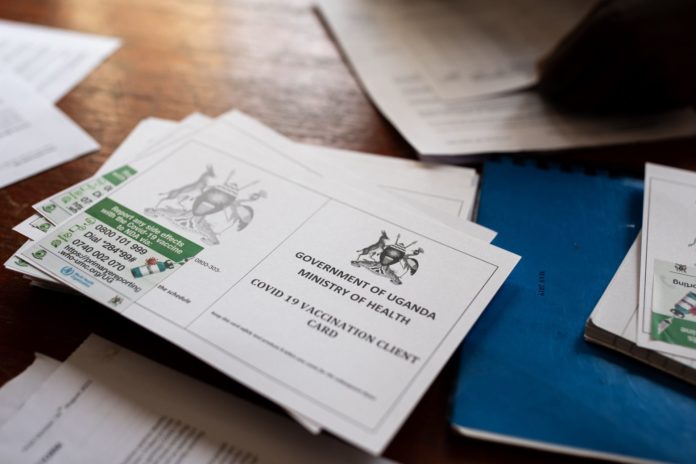
Three arrested for vending #Covid-19 vaccination cards

vaccination cards

Police in Hoima has in custody 3 suspects, for theft, forgery and utterance of falsified COVID-19 vaccination cards.

The preliminary facts indicate that on the 6th January 2022, the police were tipped about a suspect who was vending the Ministry of Health, vaccination cards at Shs50,000 each to unvaccinated people.

As a result, a trap was set-up and the culprit who was identified as Bigirwa Ivan, a 34-year-old, cleaner at Butema Health Centre III, in Hoima district arrested. Upon interrogation, he admitted to selling genuine vaccination cards to unvaccinated people within Hoima district.

Bigirwa further revealed his accomplices as Enyong Emmanuel, a Health Assistant and Aheebwa Rhoda the in-charge Butema Health centre III, who supplied him with the vaccination cards. He would then proceed to sell them and insert names, dates and phones, vaccination dates for the unvaccinated buyers.

“The public should know that the vaccination card is a valuable document amidst the unprecedented challenges of COVID-19. A number of governments have started adopting it as a requirement to get into certain work places. The strict rules for the unvaccinated, could have given opportunity for fake and falsified COVID-19 vaccination cards,” Police said.

Police said that their task team is expanding investigations into the matter. “We are also at a national level taken interest into concerns surrounding the manufacturing and forgery of COVID-19 vaccination cards with electronic devices especially along Nasser road and other places. The perpetrators have gone underground, but we shall definitely round them up.”

They warned the public, especially unvaccinated but eligible persons and unscrupulous dealers that using fake COVID-19 vaccination cards bearing the Ministry of Health Logo is a crime.

“Therefore, all those found with fake or falsified COVID-19 vaccination cards should know that they are in serious breach of the COVID-19 protocols and must be prepared to face serious punishments for conspiracy, forgery, utterance of false documents and for negligent acts likely to cause the spread of an infectious disease.”

Police further said that all Ministry of Health vaccination cards are stored in the database and will be conducting proof of vaccination, from the digital vaccine verification database, once it is activated.

Stories Continues after ad

UPDF accuses a new armed group for trying to sabotage its Shuja operations in DRC

UPDF spokesperson Brig. Flavia Byekwaso

The Uganda People’s Defence Forces (UPDF) has accused a new yet to be identified armed group of trying to sabotage its Shuja operations in Democratic Republic of Congo (DRC).

In a joint statement, the joint forces of Uganda People’s Defence Forces (UPDF) and the Congolese army (FARDC) said the armed group has plans of using the UPDF uniform to commit atrocities against civilians and instead blame the Ugandan army.

“The FADRC and the UPDF wish to alert the public that they have critical information about the existence, in the region in which they lead military operations, of an armed group harboring sinister clandestine plans deliberately intended to sabotage the joint military action against the ADF active in the East of DRC and discredit operation SHUJA,” the statement read.

The vicious mission thus plotted aims not only at sparking and promoting hostility towards the UPDF and the FADRC among the local population that they have been mandated to protect but also to create generalized panic and stampeded in this same population which welcomed and supported the coalition forces since the launch of operations against the enemies of peace.

The brief facts are that on 6th January 2022 a commercial truck (Registration no. withheld) carrying assorted goods was intercepted by the Customs Officers (DGDA) in Butembo and on inspection of the cargo inside the truck the officers discovered clothing similar to the UPDF uniform.

The consignee was a reknown businessman at Butembo. The truck had been cleared through Mpondwe border on 3rd day of January 2022 (entry No. also withheld). The truck, its cargo and handlers are all still held at the Customs Office – Butembo.

“By wearing the UPDF uniform and insignia, the members of this group plan to resort to subterfuge to camouflage themselves to be able to go on an atrocious rampage to wreak un-scalable havoc including massacres in order to badly injure the image of the UPDF; ultimately creating the belief that it is the UPDF attacking the people they have saved and protected so far,” the statement noted.

The two forces reassured the public that they will not be distracted nor diverted from their mission to definitively neutralize the enemy. They affirm that in the conduct of operation to restore peace, security and state authority, they respect human rights, international law and humanitarian aid and rules of engagement.

Stories Continues after ad

Court orders Ronnie Ndyareeba to pay his Cousin Shs230m

Ronnie Nydareeba

The Commercial Court has dismissed an application by Ronnie Ndyareeba and ordered him to pay Shs230 million to his relative and business colleague Joseph Arinaitwe.

In the main suit, Joseph Arinaitwe claims that sometime between the year 2017 and 2018, Ndyareeba Ronald approached him for some cash advances to assist the latter in his businesses. The two were related as Cousins and business colleagues.

Arinaitwe advanced to Ndyareeba monies at different intervals to the tune of Shs257,150,000. Ndyareeba issued to Arinaitwe post-dated cheques as security for payment of the borrowed monies.  However Ndyareeba was unable to pay within the agreed period.

By a memorandum of understanding dated 7th December 2018, the parties agreed to a payment schedule by which the last payment was to be effected by 19th April 2019. Ndyareeba only made part payment of UGX 27,000,000/= leaving the balance of Shs230,150,000 which Arinaitwe claims in the summary suit.

According to Ndyareeba in his application before Court, he does not owe Arinaitwe the alleged sum of Shs230,150,000 or at all because he (Arinaitwe) was not licensed to advance and/or lend money in his individual capacity.

Joseph Arinaitwe, the Respondent, in his defence stated that the application by the Applicant (Ndyareeba) was devoid of any merit, is frivolous, vexatious and a mere waste of the court’s time. He stated that he is neither a money lender nor does he carry on a business of money lending. He only made advances to Ndyareeba as a business colleague free of any interest unlike what a money lender would have done in the ordinary course of business.

At the hearing, the Applicant was represented by Mr. Tumwesigye Wycliffe from M/S TALP Advocates while the Respondent was represented by Mr. Akampurira Jude from M/S MACB Advocates. It was agreed and directed that the matter proceeds by way of written submissions which were duly filed by Counsel for both parties.

Hon. Justice Boniface Wamala stated in his ruling; “In the present case, I have not seen an unequivocal denial from the Applicant that he did not receive the sum of money claimed by the Respondent or any sum of money at all. I have also not seen a denial of the allegation that, of the sum of money allegedly borrowed, the Applicant made a part payment of UGX 27,000,000/=.”

“In all therefore, my finding is that the Applicant has not raised any bona fide triable issue of fact or law that would entitle him to being granted leave to appear and defend the suit. I have therefore found no merit in the application by the Applicant and the same ought to be dismissed.”

“I make the following orders: The application for leave to appear and defend the summary suit has no merit and is accordingly dismissed. Payment of UGX 230,150,000/= by the Applicant to the Respondent. The costs of the application and of the main suit,” he ruled.

Stories Continues after ad

DPP drops charges against Bobi Wine

Bobi Wine

The Director of Public Prosecutions (DPP) Jane Frances Abodo has withdrawn charges of giving false information and uttering false documents against the National Unity Platform (NUP) party president, Robert Kyagulanyi Bobi Wine.

In a letter to the Law Development Centre (LDC) Magistrate, the DPP said she has dropped the charges against the former MP.

“This is to inform the court that the DPP has decided to discontinue proceedings against Kyagulanyi Ssentamu Robert charged with obtaining registration by false pretense contrary to section 312 of the Penal Code Act cap 120,” she said.

In August 2020, City lawyer Male Mabirizi filed an application contesting the MP’s academic documents and the year of birth. Mabirizi averred that the singer was not fit for the admission for a Diploma in Music Dance and Drama (MDD).

He was charged for giving false information contrary to section 115 (a) of the penal code act, obtaining registration by false pretense contrary to section 312 of the penal code act and uttering false documents contrary to section 315 and 347 of the penal code act.

In September 2020, the DPP took over the matter and asked Mabirizi to furnish the DPP office with all reasonable information, assistance and documents or other matters in his possession or under his control in regard to the case.

Stories Continues after ad

Uganda Cup 2022: Round of 64 draw held

Uganda Cup trophy

The draw for the 48th edition of the Stanbic Uganda Cup round of 64 draw has been held on Monday 10th, January 2022 at FUFA House in Mengo.

The matches will be played between 18th and 30th January.

“The round of 64 will be played on a one-leg basis. In case of a draw in normal time, the games will be decided on kicks from the spot. There shall not be extra time,” FUFA Competitions Director, Hajjat Aisha Nalule said.

“We had a total of 250 teams from the Regional Leagues, 4th divisions and non-league taking part in the preliminary round. It is from here that we managed to get 37 that will join the 16 from Uganda Premier League and FUFA Big League to make a total of 64,” she added.

Vipers SC are the holders after thumping BUL FC 8-1 in the final last year.

The winner of Uganda Cup represents Uganda in the CAF Confederation Cup. This historic tournament has been played since 1971.

A total of UGX 179M has been set aside as cash prize: Winners – Shs50 million, Runners Up – Shs25 million, Semifinalists – Shs 12 million, Quarterfinalists – Shs 6 million, Round of 16 – Shs3 million and Round of 32 – Shs2 million.

Stanbic Uganda Cup Round of 64 fixtures

Rusekere FC vs Kataka FC

Heros FC vs Gadafi FC

Booma FC vs Nyamityobora FC

Seeta Utd FC vs Tepa FC

Kajjansi Utd FC vs MYDA FC

Six O’Clock FC vs Mbarara City FC

Kiyinda Boys FC vs Wakiso Giants FC

Kalongo Utd FC vs Adjumani TC FC

Bushenyi Veterans FC vs Police FC

Paidha Utd FC vs Onduparaka FC

Kigezi Homeboyz FC vs Vipers SC

Kireka Young FC vs Kitara FC

SC Tawai vs Ndejje University FC

Basere FC vs Luwero Utd FC

Super Eagles FC vs SC Villa

Total FC vs URA FC

Busia Utd FC vs KCCA FC

Nsambya SC vs Kyetume FC

Ateker FC vs Lugazi Municipal FC

Jinja North Utd FC vs Maroons FC

PCCP FC vs Express FC

Bujumbura Utd FC vs Paidha Black Angels FC

Iganga Young FC vs Calvary FC

Tipsa FC vs Arua Hill FC

Five Stars FC vs Tooro Utd FC

Impala Hill FC vs Proline FC

NEC FC vs Admin FC

Kisugu FC vs Busoga Utd FC

Bundimasoli FC vs BUL FC

Mbale Heroes FC vs Blacks Power FC

Soroti FC vs UPDF FC

Free Stars FC vs Bright Stars FC

Stories Continues after ad

Catch-up clubs to stop children dropping out after world’s longest school closure

School Children

Children in Uganda head back to the classroom today as the world’s longest school closure ends, however lost learning may lead to high dropout rates in the coming weeks without urgent action, Save the Children said.

In March 2020, all schools across the country shut down as the COVID-19 pandemic took hold. Since then, Uganda has kept schools fully or partly closed, putting some children’s education on hold for 83 weeks.

Last November, Save the Children revealed that up to one in five children in fragile countries, including Uganda, had dropped out of school because of rising poverty, child marriage and child labour, which have been exacerbated by the pandemic.

The agency is now warning of a ‘second wave’ of dropouts as returning students who have fallen behind in their learning fear they have no chance of catching up.

To tackle the learning crisis in Uganda, Save the Children has launched Catch-up Clubs — an innovative approach to accelerate the recovery of lost learning during the pandemic and help children successfully return to school.

The clubs assess children and teach them at the required level to help them regain literacy and other learning, with child protection support and cash assistance for families struggling to send them to school.

Despite efforts to provide remote learning, many children were unable to access online lessons during the pandemic because they had no computer or a poor Internet connection.

The Catch-up Clubs provide the boost that vulnerable students like Ben, 11, need to avoid having to repeat a year or drop out forever.

“Before I joined Catch-up Clubs, I didn’t know how to use letter sounds. I was confused by very long words [in books],” explained Ben, who is enrolled in a Catch-up Club in Wakiso, Uganda. “Games and songs helped me learn how to pronounce and read long words. I am now able to understand those words whenever I find them in my homework and storybooks.”*

Catch-up Clubs are specifically aimed at children falling behind in Grades 3-5, when their learning can be accelerated relatively easily. After about 12 weeks, at least 80% of participants can read and write to a standard that allows them to learn independently.

Edison Nsubuga, Head of Education at Save the Children in Uganda, said: “As schools begin to reopen across the country, it is critical that all girls and boys have access to the support they need to successfully return to the classroom.

“Many children have fallen behind in school as a result of the COVID-19 pandemic. Children who are behind in their learning are less likely to unlock their potential as adults. However, when children receive the learning boost they need and have access to quality education, they can reach their full potential.

“The Catch-up Clubs program is a holistic approach to education that benefits all levels of the community. The clubs have been a lifeline for many children in Uganda while the majority of schools remained closed for nearly two years. Without the clubs, some of these children may not be returning to school today.”

Save the Children has also been working with the Ministry of Education and Sports in Uganda to encourage families across the country to prepare and take their children back to school, including pregnant girls and teenage mothers.

Alongside Uganda and Colombia, Save the Children plans to launch Catch-up Clubs in Myanmar, Malawi, Bangladesh, the Democratic Republic of the Congo and Nigeria in the coming months, with further countries to follow in an effort to reach over a million children by the end of 2022.

As schools begin to reopen in Uganda and elsewhere around the world, Save the Children is calling for governments and donors to support every child’s return to class, ensure families and teachers are supported to make up for lost learning, and build back better and more resilient education systems. The organisation is also calling for governments to keep learning alive through inclusive distance learning if schools close their doors again.

Stories Continues after ad

Choosing the right dietary fat foods for your body, heart

Nutritionist Lucy Chege

It is a week since people around the world ushered in a new year and, as is common with a new year, a number of things crop up, particularly the promise of a new start and…predictably those habitual “New Year’s resolutions”.

One of the most common resolutions people try to achieve is leading a healthier lifestyle, be it going to the gym consistently or watching what one eats.

Regardless of which fitness/health goal you want to achieve, gym instructors and nutritionists will always tell you one thing: you are what you eat.

An important component of what one consumes includes fats, which are essential to the body’s development and well-being but can also be harmful. Fats have long been misconstrued and misinterpreted to the extent that the mention of the word itself implies automatic weight gain and/or an unhealthy food.

According to nutritionist Lucy Chege, too little nutrition information about dietary fats can mislead consumers and while also too much detail can overwhelm them, especially with messages about fats constantly changing.

Chege pointed out that there are some “good” fats (unsaturated fats) and “bad” fats (saturated fats) from the body’s point of view.

“Some fats support health whereas others damage it, and foods typically provide a mixture of fats in varying proportions. The saturated and trans-fats, indeed, seem mostly bad for the health of the heart. Aside from providing energy, which unsaturated fats can do equally well, saturated and trans- fats bring no indispensable benefits to the body,” Chege said.

Saturated fats and trans-fats are fats that raise blood cholesterol leaving someone susceptible to a range of cardiovascular diseases.

Sources of saturated fats include butter, coconut oil and palm oil, cakes, biscuits, fatty cuts of meat, sausages, bacon, cheese, ice cream and milkshakes, to mention a few.

“Over a third of the fat in most meats is saturated. Similarly, half of the fats from cheese, butter, cream, coconut, palm used heavily by food manufacturers and are commonly found in many commercially prepared foods contain saturated fats.”

Diets extremely low in saturated fat may include fatty fish, nuts, seeds, and vegetable oils, which are all valuable sources of many essential fatty acids, phytochemicals, vitamins, and minerals. Importantly, the fats from these sources protect against heart disease.

“Fatty fish from less contaminated water bodies are a good source of Omega-3 fatty acids and help to protect against heart disease by reducing blood triglycerides, preventing blood clots, protecting against irregular heartbeats, lowering blood pressure, defending against inflammation and serving as precursors to eicosanoids.”

Cooking oils such as olive oil, canola, and oils from avocado, nuts and seeds are rich in mono-unsaturated fatty acids which help to protect against heart disease.

“Nuts such as walnuts, peanuts, macadamia may protect against heart disease because they provide monounsaturated and polyunsaturated fats in abundance, have few saturated fats, good source of fiber and vegetable protein, and other valuable nutrients, including the antioxidant vitamin E and many phytochemicals that act as antioxidants,” Chege noted.

It is important to remember that cholesterol travels through the blood on proteins called “lipoproteins”. There are two types of lipoproteins which carry cholesterol throughout the body: LDL (low-density lipoprotein), sometimes called “bad” cholesterol, and HDL (high-density lipoprotein), or “good” cholesterol.

High levels of LDL cholesterol raise one’s risk for heart disease and stroke while HDL absorbs cholesterol and carries it back to the liver which then then flushes it from the body.

When one’s body has too much LDL cholesterol, it can build up on the walls of their blood vessels causing the insides of the vessels to narrow and block blood flow to and from their heart and other organs.

Chege said some of the ways of achieving a heart-friendly diet are limiting intake of fatty meats, whole-milk products, tropical oils and hydrogenated foods.

“To reduce the susceptibility of cardiovascular diseases, reduce fats from convenience foods and fast foods; choose small portions of meats, fish, and poultry; and include fresh foods from all the food groups each day. Take care to select portion sizes that will best meet your energy needs. Also, exercise daily.”

Lucy Chege is a registered and licensed nutritionist based in Kenya, proficient in medical nutrition therapy. She is also the founder of Nutrition Therapy by Lucy.

Stories Continues after ad

Fly Emirates resumes passenger flights to Entebbe

emirates plane

Fly Emirates has resumed its passenger services between Uganda and Dubai. The development follows United Arab Emirates’ (UAE) decision to lift suspension on all flights from Uganda.

Last month, UAE temporarily suspended flights from Uganda to Dubai for allegedly forging Covid-19 PCR travel certificates. UAE said at least 48 Ugandan travelers were carrying forged Covid-19 PCR certificates and that prompted them to suspend all flights from the pearl of Africa.

Emirates operates five weekly flights to Dubai and onwards to over 120 global destinations on the airline’s network. Emirates flight EK730 departs from Entebbe at 16:25hrs, arriving in Dubai at 22:40hrs. EK729 departs Dubai at 10:00hrs, arriving in Entebbe at 14:25hrs.

Passengers travelling to Dubai on direct flights and passengers transiting via Uganda to Dubai need to present a negative COVID-19 PCR test certificate with a QR code, and the test should be taken within 48 hours of departure.

A negative COVID-19 Rapid or Real Time PCR test certificate with a QR code conducted at the departure airport must also be presented and should be valid within 6 hours of departure. Passengers with Dubai as their final destination will undergo an additional Covid-19 PCR test upon arrival, and should remain in self-quarantine until the results of the test are received. Children under the age of 12 are exempted.

Since it safely resumed tourism activity in July 2020, Dubai remains one of the world’s most popular holiday destinations, especially during the winter season. The city is open for international business and leisure visitors. From sun-soaked beaches and heritage activities to world class hospitality and leisure facilities, Dubai offers a variety of world-class experiences. It was one of the world’s first cities to obtain a Safe Travels stamp from the World Travel and Tourism Council (WTTC) which endorses Dubai’s comprehensive and effective measures to ensure guest health and safety.

Dubai is currently hosting the world for Expo 2020, happening between October 2021 and March 2022. Through the theme of Connecting Minds, Creating the Future, Expo 2020 Dubai aims to inspire people by showcasing the best examples of collaboration, innovation and cooperation from around the world.

Its programme is packed with experiences to suit all ages and interests, including a rich line-up of themed weeks, entertainment, and edutainment. Art and culture fans as well as food and technology enthusiasts can explore exhibits, workshops, performances, live shows and more.

Stories Continues after ad

Record legal shipment nudges Africa towards $7bn cannabis market

cannabis

Canada-based Instadose Pharma Corp completed a world record shipment of 2.125 tonnes of medicinal cannabis from South Africa to North Macedonia on 25 December 2021, according to a statement released by the company, boosting hopes that the African cannabis market will be worth over $7bn annually by 2023.

A 2020 report by Prohibition Partners estimates that the bulk of the market will reside in five countries: Nigeria ($3.7bn), South Africa ($1.7bn), Morocco ($900m), Lesotho ($90m) and Zimbabwe ($80m), if the necessary legislation is introduced.

However, according to Sibusiso Xaba, co-founder and CEO of the Africa Cannabis Advisory Group, writing on bizcommunity.com, the most significant recent developments have been in South Africa, the market that he expects to be the largest by revenue.

According to Xaba, over 15 tonnes of legal cannabis were exported by the continent to the rest of the world in 2021, representing a tenfold increase on 2020, with South Africa, Lesotho and Uganda among the main exporters.

Despite industry concerns about regulation, he says that progress in South Africa is “undeniable”. The country produced a cannabis master plan and has taken steps to allow the commercial cultivation of hemp, a botanical class of cannabis that contains less THC, the psychoactive compound that causes a “high”.

Going a step further, University of Cape Town lecturer Nqobile Bundwini claims in a recent research paper that if cannabis were destigmatised and allowed to flourish, it could revive the ailing South African economy.

Despite being the world’s most commonly cultivated drug, getting investors on board to develop the industry remains a problem, she says.

“The cannabis industry is massive. But the stigma attached to it results in endless challenges. A lack of knowledge about the industry, legal red tape, a lack of funding and limited banking options, and widespread social disapproval are just a few of the pain points,” she told Iémah Davids of the University of Cape Town News.

“I feel that South Africa has a tendency to lag behind and not optimally use its rich resources. And if we don’t, we will get left behind – in a situation where we should in fact be the pioneers, and leading from the front.”

Stories Continues after ad