Stanbic Bank
Stanbic Bank
27.2 C
Kampala
Stanbic Bank
Stanbic Bank
Home Blog Page 796

Kyambogo University releases blended Graduation program

Kyambogo University Senate

The Academic Registrar Kyambogo University Prof Annie Begumisa (Ph.D) has released the graduation programme for the long awaited 17th edition.

The 17th Graduation Ceremony will be held on Tuesday 21st, Wednesday 22nd and Thursday 23rd September, 2021, from 09:00 a.m to 1.00 pm each day.

According to Prof Annie, graduands for both Postgraduate and Undergraduate shall be presented according to their respective Faculties/School on the following days:

Tuesday, September 21st 2021

Faculty of Special Needs and Rehabilitation

School of Management and Entrepreneurship

Wednesday, September 22nd 2021

Faculty of Arts and Social Sciences

Faculty of Vocational Studies

Thursday, September 23rd 2021

Faculty of Education

Faculty of Science

Faculty of Engineering

The Ceremony will be virtual, with limited physical presence only by invitation. In this regard, Graduands, Parents/Guardians and the General Public shall follow the live streaming of the Ceremony on the University YouTube channel. The event will also be streamed on Television and its social media platforms.

The registration exercise for the Graduation will take place online at Register-Kyambogo University Graduation 2021 on the following link https://kyu.ac.ug/graduation/register/

The Academic Registrar went ahead to outline that the following are the fees for graduands:

Graduation fee – 100,000

Transcript fee – 30,000

Certificate fee – 30,000

Convocation fee – 10,000

However, some students from the School of Social Works and Social Administration are in panic over the issues of missing marks on their portals.

“For over one and half years, we have been going to the department inquiring why our results are not on the portal. Mr. Jimmy who fills in marks would say he had the results but needed confirmation from Dr Mugisha to upload them. We listened to him thinking that it will be worked on,” one of the graduands who preferred confidentiality revealed.

“At first, they said they never gave an appointment letter to the lecturer who taught us after going through their documents then they said he was signed to teach mop ups. The word mop up; it’s our first time to hear it in the whole session of orientation and fresher’s ball no one mentioned it,’’ he added.

“The syllabus was new which is a good thing but we never had any one to take us though what is on the syllabus and what is out so all our confidence was put to the department that do guide us on what we do. We therefore, request the university management to look into this matter seriously so that we don’t lose another year by telling us to re-do the paper yet we are about to graduate,’’ he concluded.

Stories Continues after ad

Byabashaija reshuffles prisons officers

Uganda Prisons Commissioner General Dr. Johnson Byabashaija

The Commissioner General of Prisons, Dr. Johnson Byabashaija has moved senior prisons officers in the latest reshuffle and deployed cadets.

18 senior officers have been moved while 97 cadet Assistant Superintendents of Prisons have been deployed to different areas around the country. Byabashaija announced the changes in an August 31 notice.

“These orders take immediate effect unless otherwise stated and all leave must strictly be taken outside the institutions. The Director of Administration to facilitate execution of these orders without delay,”Dr. Byabashaija said.

In the changes, James Emotu, Ag. CP, Staff Administration and Counselling, Prisons Headquarters, is appointed Ag. CP, Policy and Planning.  He hands over to Stephen Lugonda, Ag. CP, Human Resource Planning and Development, who is appointed Ag. CP Staff Administration and Counselling.

Francis Henry Tugume, ACP, Inspectorate and Quality Assurance, Prisons Headquarters is appointed Ag. CP Human Resource Planning and Development. Geoffrey Natabona Mangeni, SP, Officer in Charge U.G. Farm Prison Kitalya, proceeds on accumulated leave.  He hands over the Station to Kenneth A. Byekwaso, ASP, Officer in Charge, U.G. Prison Nyabuhikye, who is appointed Officer in Charge, U.G. Farm Prison Kitalya.

Pascal Kyesimira, SP, Officer in Charge, U.G. Prison Kampala Remand, proceeds on accumulated leave.  He hands over the Station to Ernest Nabaasa, SP, U.G. Prison M/Bay, who is appointed Officer in Charge, U.G. Prison Kampala Remand.

Juliet Kabami, ASP, Officer in Charge, U.G. Prison Kigo Women, is appointed Manager, Prisons Industries Showroom.  She hands over the Station to Juliet Najjuma, ASP, U.G. Prison Elute, who is appointed Officer in Charge, U.G. Prison Kigo Women.

Jackson Koojo, ASP, Staff Officer South Western Region, is appointed Officer in Charge, U.G. Prison Kyazanga.  He hands over the Office to the Regional Prisons Commander, South Western Region until a substantive Staff Officer is appointed.

Viola Biryomumaisho, ASP, Officer in Charge, U.G. Prison Jinja Women is appointed Officer in Charge, U.G. Prison Lugazi.  She takes over from Daisy Atimango, ASP, who is appointed Officer in Charge, U.G. Prison Bugembe.

Amosi Alinaitwe, ASP, Officer in Charge, Barracks and Security, Luzira Prisons Complex proceeds on accumulated leave.  He hands over the Station to Alex Magoola, P.O.I Officer in Charge, U.G. Prison Kihihi, who is appointed Officer in Charge, Barracks and Security.

Isaac Aruo Ekateti, ASP, Officer in Charge, U.G. Prison Nwoya proceeds on leave pending retirement.  He hands over the Station to Daniel Magoma, ASP, U.G. Prison Bushenyi Main who is appointed Officer in Charge, U.G. Prison Nwoya.

Peter Simon Alunyu, ASP, U.G. Prison Nyabuhikye is appointed Officer in Charge, U.G. Prison Nyabuhikye. Lillian Kusasiira, ASP, U.G. Prison Jinja Main is appointed Officer in Charge, U.G. Prison Jinja Women. Felix Abner Mugiya, ASP, U.G. Prison Kitalya Mini Max is appointed Officer in Charge, U.G. Prison Ntenjeru.

Jane Ayikoru, ASP, Prisons Headquarters, is appointed Officer in Charge, U.G. Prison Arua Women.  She takes over from Patience Pheobe Namara, P.O.II, who is transferred to Prisons Headquarters for duty. Samuel Kabitanya, P.O.I, Officer in Charge, U.G. Prison Kabula, proceeds on accumulated leave.  He hands over the Station to Aramanzan Kakonge, P.O.II, U.G. Prison Kiruhura, who is appointed Officer in Charge, U.G. Kabula.

Stephen Nabongho, P.O.I, Officer in Charge, U.G. Prison Butagaya proceeds on accumulated leave.  He hands over the Station to John Othieno Ndelo, P.O.II, who is appointed Officer in Charge, U.G. Prison Butagaya. Mark Ogwang, P.O.II, Officer in Charge, U.G. Prison Serere proceeds on accumulated leave.  He hands over the Station to.James Biteba, ASP, U.G. Prison Amita, who is appointed Officer in Charge, U.G. Prison Serere.

Gordon Baati P.O. II, U.G. Prison Kigo is appointed Officer in Charge, U.G. Prison Kihihi. Raphael Olinga, CP Product Promotion, Prisons Headqpuarters, proceeds on accumulated leave.

Stories Continues after ad

UBL launches Sustainability Report geared towards creating inclusive and sustainable world

Florence Grace Adongo, Director of Water Resources at the Ministry of Water and Environment receives the EABL Sustainability Report from Jane Karuku, EABL Group MD & CEO

Uganda Breweries Limited (UBL) has launched East African Breweries Limited (EABL) Sustainability Report highlighting different interventions that the brewery is undertaking to for betterment of the community.

The report shows various efforts made by UBL under three pillars, that is to say; Positive Drinking; Inclusion and Diversity and Inclusive Communities; and Preserving Water for Life, Accelerating to a Low Carbon World and Becoming Sustainable by Design.

The report is the result of two years of study and design under Diageo’s Society 2030: Spirit of Progress, a 10-year action plan to help create a more inclusive and sustainable world while also contributing positively to the communities in which the business operates.

Speaking at the Launch,  Florence Adongo, Director of Water Resources Management who represented the Minister of Water and the Environment  Sam Cheptoris said:”This report shows that UBL and EABL will increase output without significantly reducing natural productive capacities, which is a step forward in making Uganda’s Green Growth Development Strategy a reality. Uganda Breweries Limited is the lead private sector partner of the Ministry of Water and Environment in several angles of ministry interventions.”

She applauded UBL for taking the direction of development and business growth without depleting the natural resources on which we depend on.

UBL, which is celebrating 75 years of consistent operations in Uganda this year, has invested over Shs 4 billion in projects that have improved access to potable water for over 2 million people all over the country.

Eng. Ronald Balimwezo, the MP for Nakawa East appreciated UBL for the various people-centred interventions over the years. ”I want to appreciate you because I remember when I had just become mayor, I visited you and found a state of the art Effluent Treatment Plant, which is the best in the country. How I wish others would emulate you.” he said

Nakawa East MP Eng. Ronald Balimwezo commended UBL for their involvement in providing clean and safe water to the people of the communities in which they operate.

“I have known UBL for a very long time as one of the biggest tax payers in the country. I want to thank them for observing sustainable development goal six in all their business activities. They have ensured access to clean water & sanitation which is a critical issue that needs a lot of attention,” Balimwezo said.

In 2015, UBL unveiled a Shs 20 billion water treatment plant to ensure that water flowing from the brewery is safer and cleaner than it was when extracted from Lake Victoria. This is in addition to a Shs 14 billion in a water recovery plant to reduce water usage by reducing the volume of water extracted from Lake Victoria, through which 395,000 m3 of water is saved annually.

Alvin Mbugua, UBL’s outgoing Managing Director, said, “We want to continue to be a positive example within Uganda, the region, and the world. We hold ourselves accountable to the communities in which we operate and strive to ensure that as we grow, so do they. We believe that this is not just the right way to do business, it is the only way.”

“As a business, we believe in drinking better as opposed to drinking more. Responsible drinking is at the core of our activities. We know that this is beyond just business; we have to grow with the communities in which we operate” Alvin said

“Notwithstanding the pressures of COVID-19, we have worked hard to develop our first sustainability report. This report allows us to be transparent with our targets, as well as share all of the incredible work being done across the board.” he said

Jane Karuku, Group Managing Director and CEO of East African Breweries Limited (EABL) said; “At EABL, we recognize that we are in a unique position to respond to global and regional challenges faced by our communities every day. We continuously work towards ensuring that the core objectives of sustainability are well integrated into our business model.”

“Over 5,000 bartenders have received exceptional training through our Diageo Bar Academy, 66% of which are women. Through the academy, we empower our bartenders with bar skills, bar management, brand knowledge, hygiene and safety.” Karuku said.

“The past year has been a difficult one as the world grappled with the COVID-19 pandemic. To support our communities, we raised US$5 million to directly support our bars & restaurants negatively impacted by the pandemic.” she said

She applauded the staff-driven program E-Green Team that focuses on environmental conservation and restoration through tree planting. This group has planted millions of trees.

Stories Continues after ad

New test finds no evidence of Ebola virus in Côte d’Ivoire

The government of Cote d’Ivoire has informed the World Health Organization (WHO) that a second laboratory has tested samples from a patient suspected of having Ebola and has found no evidence of the virus.

The tests by the Institut Pasteur in Lyon, France follow tests conducted by the Institut Pasteur of Côte d’Ivoire, which led health authorities to announce their first Ebola case since 1994. With the new results from the laboratory in Lyon WHO considers that the patient did not have Ebola virus disease and further analysis on the cause of her illness is ongoing.

The suspected case was a young woman who travelled from Guinea to Cote d’Ivoire. Since Cote d’Ivoire announced the case more than 140 contacts have been listed in the two countries. No-one else has shown symptoms for the disease or tested positive for Ebola.

Ebola is a severe, often fatal illness affecting humans and other primates. Case fatality rates have varied from 25% to 90% in past outbreaks. To prevent the spread of Ebola it is important to act urgently. Cote d’Ivoire health authorities alerted WHO of the case as required by the International Health Regulations 2005 and rapidly launched all key public health measures.

After Cote d’Ivoire announced the Ebola case, in line with the no-regrets policy followed by WHO, immediate actions were implemented in both Cote d’Ivoire and Guinea. Around a dozen WHO experts were mobilized to support the country’s efforts and 5000 Ebola vaccine doses which WHO had helped Guinea procure were sent from Guinea to Cote d’Ivoire. In addition, WHO released US$ 500 000 from its Contingency Fund for Emergencies to support the country initiate a quick response.

The no-regrets policy encourages adopting measures immediately before all the dimensions and consequences of an emergency or outbreak are known with the aim of saving as many lives as possible.

WHO is now downgrading its actions in Cote d’Ivoire from response to readiness mode.

In support of the government’s response efforts, WHO worked with other development and health partners.

Stories Continues after ad

Public warned against dealing with unlicensed persons offering financial advice

Keith Kalyegira CEO of CMA

The Capital Markets Authority (CMA) has cautioned Ugandans against dealing in securities through unlicensed entities or entities that are not approved, some of whom maybe operating through online platforms, as they risk losing their investments.

A security means shares, bonds, debentures, options, notes, depository receipts, derivatives, or investment contracts among others.

The CMA has noted a rise in fraud related complaints mostly from unlicensed persons and entities – some of whom operate online.

The CMA Act gives the Authority powers to among other things, license investment advisers, securities brokers and fund managers as well as grant approval to any entity that wishes to sell securities to the public.

Furthermore, the Collective Investment Schemes (CIS) Act, 2003 also gives CMA powers to authorize the operation of a CIS as well as license CIS managers.

Any person who undertakes any of these activities without approval or a license from the Authority is in breach of S.19 and S.30 of the CMA Act, and is liable to prosecution.

All persons offering capital markets services (a list of which can be accessed on the website; www.cmauganda.co.ug) are required to have a valid license or approval issued by CMA.

The public is encouraged to verify on the CMA website the licensing or approval status of any entity providing capital market services or offering securities before, committing hard earned resources for investing.

“All brokers or investment advisors involved in the process of offering securities to persons in Uganda require a license issued by the CMA. The Authority, in conjunction with the Uganda Police Force, will take appropriate enforcement action against any persons or entities illegally collecting funds from unsuspecting members of the public purportedly for investment,” Keith Kalyegira, CEO of the CMA said.

“Anyone that has been affected or has become aware of such illegal services is advised to report to the Authority to aid investigations. The public is urged to be vigilant and exercise utmost caution when making financial investments,” he added.

Kalyegira urged Ugandans with any complaints relating to such unlawful operators and activities through E-mail: ms@cmauganda.co.ug for appropriate action to be taken.

Stories Continues after ad

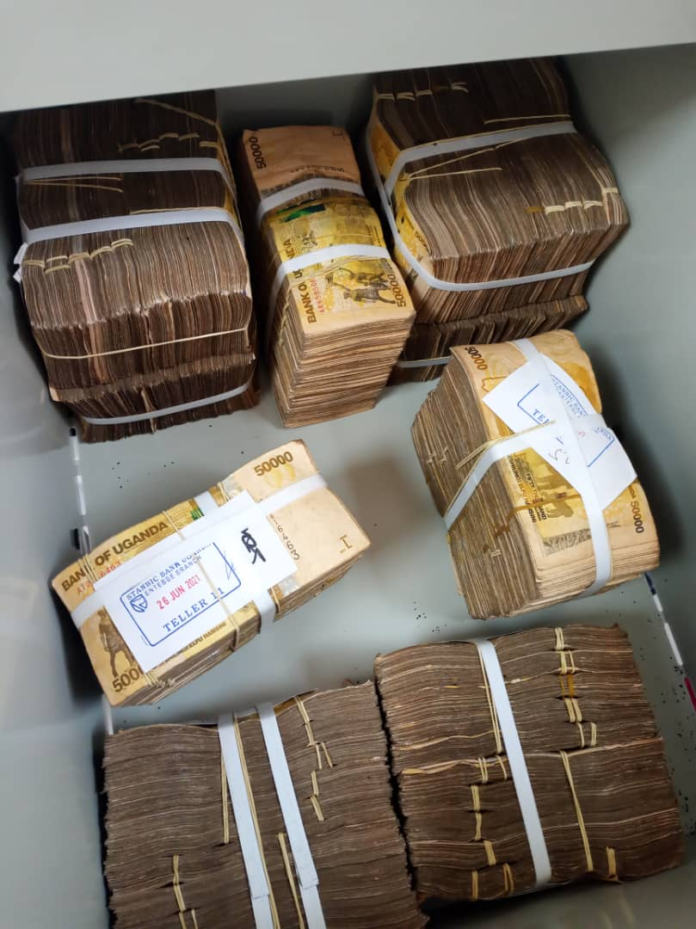
Police recovers Shs600 million of the Shs3 billion embezzled by UPPC top management

Police have recovered Shs 600 million from some suspects who are implicated in swindling of Shs 3 billion from Uganda Printing and Publishing Corporation (UPPC).

According to the spokesperson of the Directorate of Criminal Investigations (CID) Charles Twine, the money was destined for another accomplice in crime, and was part of the Shs 3 nillion loot that had passed through an account of a fictitious Commission agent.

“Detectives at CID headquarters have recovered Shs 600 million from some suspects of Uganda Printing and Publishing Corporation,” Twine said.

Last week, Police arrested Prof. Waswa Tomas Davis, the Managing Director Uganda Printing and Publishing Corporation (UPPC) for alleged Embezzlement of Shs 3 billion.

His arrest followed his interdiction and other the top leadership at the UPPC by the Minister for Presidency, Milly Babirye Babalanda.

“I have today officially interdicted the managing director, board, company secretary and internal auditor of UPPC to pave the way for investigations into allegations of corruption and other irregularities,” Babalanda said.

He was replaced by James Tweheyo, a presidential advisor and former Uganda National Teachers Union secretary general.

Stories Continues after ad

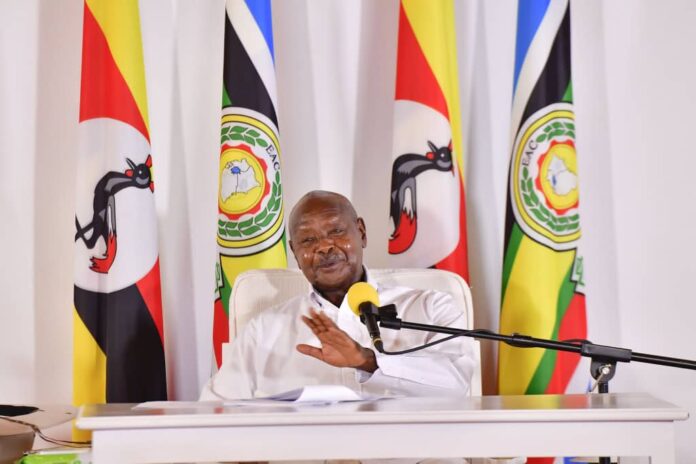
Alcohol is bitter, I pity those who drink – Museveni

President Museveni

President Yoweri Kaguta Museveni has urged the newly commissioned cadets, Assistant Superintendents and non-commissioned officers of Uganda Prisons to desist from taking alcohol and prostitution for service delivery.

While passing out 364 prison officers at Kololo independence grounds, Museveni said alcohol is only bitter and there is nothing good about it.

“Don’t squander yourself with alcohol and umalaya. As an old man, I can tell you the advantage of discipline is good. You see, in September I will be 77 years old but I don’t have space for alcohol. I have never known why people drink alcohol,” he said.

Museveni said: “I had never tasted alcohol before, then one of my friends convinced me to. I tried beer; it’s so bitter like omululuza (bitter leaf). I asked why they were drinking it, he told me ‘you’ll know the sweetness later.’ I tried Johnnie Walker and it was like fire.”

“I am going to be 77 and I can walk any distance. Health is wealth; don’t play around with your life. Exercising is part of discipline and if you have health, you get time to do more things. The longer you live, the more contribution you can make if you are healthy,” Museveni said.

Stories Continues after ad

Standard Chartered Bank, Unicaf partner to provide exclusive scholarship opportunities to its employees and clients

Standard Chartered Bank, Unicaf partner to provide exclusive scholarship opportunities to its employees and clients

Standard Chartered Bank Uganda has partnered with Unicaf to increase its clients’ access to quality higher education.

The Bank’s clients and employees can earn up to a 75% Scholarship and take advantage of Unicaf’s Professional Development Short Courses designed to boost their skills and knowledge. The partnership offers employees and clients an opportunity to earn internationally recognised degrees and enhance their professional expertise.

In tandem, Standard Chartered Bank clients will enjoy exclusive scholarships on a range of undergraduate and postgraduate degrees as well as Professional Development short courses at Unicaf University and its partner universities; Liverpool John Moores University (UK), the University of East London (UK), and the University of Suffolk (UK).  Unicaf University has established a state-of-the-art campus in Kampala, Uganda.

Unicaf University in Uganda is a licensed university regulated by the National Council for Higher Education (NCHE) of Uganda. The university offers Bachelor degree programmes in a blended delivery mode.

Remarking about the partnership, Moses Rutahigwa, the Head Consumer Private and Business Banking, Standard Chartered Bank said: “We are excited to partner with Unicaf to bring online learning programmes to our clients at significantly discounted rates. Learning today is limitless; we are being challenged to learn new skills at every stage of life so that we stand out and be more competitive. Even when we land the job or start a business of our dreams, we shouldn’t settle but strive to find new ways to achieve more success.”

“As a Bank, we are passionate about delivering convenient digital solutions to our clients as we believe our relationship with them should go beyond financial services into areas that resonate with their day-to-day lifestyles and interests. Online learning has never been more relevant than it is today as it gives all of us the freedom to study anywhere, anytime. We are therefore excited to partner with Unicaf to bring discounted online learning programs to our clients at significantly discounted rates and provide added value to them as we continue to enhance their relationship with us.” he said

Professor George William Nasinyama, the Vice Chancellor Unicaf Uganda said: “Unicaf University prides itself in pursuing excellence in teaching, research, and engagement, focusing on student achievement and satisfaction.  It combines traditional face-to-face complementary tutorials with the active use of digital learning tools through an innovative blended learning approach. Through the Unicaf Scholarship Programme, students earn higher qualifications and gain expert knowledge to improve their career prospects and solve real-world challenges.”

Stories Continues after ad

Uganda’s group revealed for FIBA World Cup 2023 African qualifiers

UG Basketball team

Five African nations will qualify for the 32 country field that comprises the FIBA Basketball World Cup 2023.

The teams will qualify through six tournament windows over 15 months. The Qualifiers run from November 2021 to February 2023, with sides playing home and away games in each of these event windows.

FIBA announced Tuesday that Uganda will be in Group A for the first round of the African qualifiers beginning this November alongside Cape Verde, Mali and Nigeria.

Set to take place in two years in the Philippines, Japan and Indonesia, the FIBA Basketball World Cup’s 2023 edition marks the first time multiple countries will host this showpiece event.

Eighty countries across four regions — Africa, Americas, Asia/Oceania and Europe — are looking to secure their place among the 30 nations that will join hosts Japan and the Philippines in the 32-team World Cup.

First-round games are scheduled for three different windows: Nov. 20-30, Feb. 21-March 1 and June 27-July 5.

The FIBA Basketball World Cup 2023 will take place from August 25 to September 10, 2023.

African qualifier groups

Group A; Cape Verde, Mali, Uganda, Nigeria

Group B; South Sudan, Cameroon, Tunisia, Rwanda.

Group C; Ivory Coast, Guinea, Centrsl Africa Republic, Angola

Group D; Kenya, Egypt, Senegal, Congo

Stories Continues after ad

Educationists: Innovation needs to speed up for reopening of schools

Pupils of City Parents at their school.

Long before the second wave of the pandemic, questions about the future of education dominated public discourse in Uganda. Shamim Nirere of Izere Education not only had the question lingering on her mind, she found some answers too.

“The future of education will not be about the right answers. We already have education for that. The future will belong to critical thinkers, to creators, to problem solvers, to competent communicators and to solution thinkers,” Nirere says.

Through Izere education, Nirere brings 21st Century education to Ugandan children. She achieves this by imparting critical thinking, leadership, problem-solving skills and communication skills. To her, it is not just a matter of educating children but providing lessons that will be relevant going forward.

These skills are imparted with the aid of resource materials created by Izere Academy. Students have access to 20 courses and a Solution Thinkers Workbook.

Even though Nirere has always looked optimistically to the future because she is solution-oriented, the current climate of uncertainty around education in Uganda is weighing down her spirit.

The education sector in Uganda has suffered since March 2020 when schools were closed in response to the pandemic. Some schools adapted quickly to the new situation through the use of online learning but these were only a handful of schools from the urban centres. A majority of students sat out their school year as they waited on the government. In June 2021, a phased re-opening of schools that had students in upper classes return, was halted when the COVID-19 cases skyrocketed, ushering in the second wave of the pandemic.

Nirere, a teacher, has been providing private lessons to a few students and has watched as parents give up on waiting for schools to reopen. Some parents have taken their children to international schools while some are opting for neighboring Kenyan schools where learning is ongoing.

As an educator and parent, Nirere feels that even when schools open, after 18 months of not studying, many students will have fallen far behind. She says there will be a need for a rehabilitation programme for children even amid the pressure to finish the syllabus.

At the moment, Izere Education is doing its best to keep the learning process going not just among students whose parents are able to pay, but also in low-income communities where the teachers who have been trained and equipped with the solution thinkers workbook take on at least 20 students in a month.

While students in primary, secondary and higher schools of learning have been catered for to the best of the parents’ and schools’ ability through online classes, there is a portion of learners that has barely made it to the conversation: young learners under the age of six years. When schools reopened, the Ministry of Education and Sports said nursery schools would remain closed.

A child growth and development expert, Immaculate Nakanjakko under the umbrella of the Early Years Foundation has been doing the leg work needed to address the plight of learners and stakeholders in this category.

She says, “Majority of children below the age of eight have not gone to school for the past 18 months. While some have been doing online school, there are seven million learners in that age group and only 1500 have been able to access online learning via zoom, according to the data from UNICEF.”

Nakanjakko further says the closure of schools for this period of time has led to problems like the loss of centres for early childhood development and loss of qualified teachers to other countries or industries will remain long after the schools have reopened.

For a system that was already hurting, more damage has been done. The belief is that there could be more illiterate people in future than there are now due to this period where the country has failed to decide on how to move forward. “Anyone who can access the Center for Disease Control Website can see that children are least affected and that the scientific data further shows that children are at a much lower risk for infection than other populations,” she says.

As child growth and development experts, the brunt of their work during this time has been advocacy for practical and fact-based solutions towards the continuity of education for children below the age of six. With various stakeholders in one place, platforms like WhatsApp, zoom and webinars serve the purpose of sharing knowledge, references and materials on the education of children in the early years.

Since April 2021, The Early Years Foundation has been able to train 50 early learning centres in the COVID-19 Standard Operating Procedures and qualified them for clearing. By the time President Museveni put in place a second lockdown, 400 people had been trained.

With these results, the Ministry said it would open the schools in October to enable children to complete their academic year.

The Public Relations officer for the Ministry of Education and Sports Dennis Mugimba says the reopening of schools will be done in a manner that ensures the safety of teachers and learners at all levels.

One of the ways to ensure safety is to vaccinate all teachers with at least one dose of the COVID-19 vaccine before reopening.

To hasten the exercise, the Ministry of Education and Sports (MoES) is working with the Ministry of Health in setting up vaccination centres at various schools. So far, Kampala City Council Authority (KCCA) has set up 10 centres where vaccination is going on and the other districts will follow suit.

Mugimba adds that there will be a phased reopening of schools with the learning happening in shifts to ensure the observation of SOPs especially social distancing.

“We want the public to support us by mobilizing teachers and other staff for vaccination. Our target is to vaccinate 730,000 teaching staff in the whole country,” Mugimba says.

Mugimba says while the MoES is supportive of innovations in the sector, it is interested in supporting innovations that fulfil the mandate of the Ministry and these are innovations that encourage Equity and Equality in Education.

“At the back of innovators’ minds, they should know that we are a country without good internet coverage yet and electricity so any innovation shouldn’t cause a divide due to lack of access to the internet and electricity,” Mugimba says before adding that a calendar has been drawn for reopening schools but implementation is dependent on vaccination.

As the country waits for schools to reopen, The Innovation Village in partnership with The Mastercard Foundation and other stakeholders in the education sector has been holding conversations on how to ensure continuity of learning.

The EdTech Mondays Shows as they are popularly known now, are bringing to light critical conversations on the use of technology for teaching and learning.

Innovation Manager at The Innovation Village, Amanda Liz Tukwasiibwe says the show which has been held on National Television in different countries like Kenya, Rwanda and Nigeria has been imperative in highlighting the gaps, challenges but most importantly the innovations that we as a nation can plug into to solve our current concerns.

With six sessions held so far, the show is enabling the visibility of solutions in technology like the use of online learning platforms and other solutions that can not only enable education to continue but improve it.

Our hope right now is that technology will be used to patch up these gaps and that as these challenges emerge, all stakeholders see the necessity to invest in innovative solutions.

Stories Continues after ad