Stanbic Bank
Stanbic Bank
17.7 C
Kampala
Stanbic Bank
Stanbic Bank
Home Blog Page 878

We don’t see you as enemies rather concentrate on the shared goals – Museveni hits at EU Ambassadors

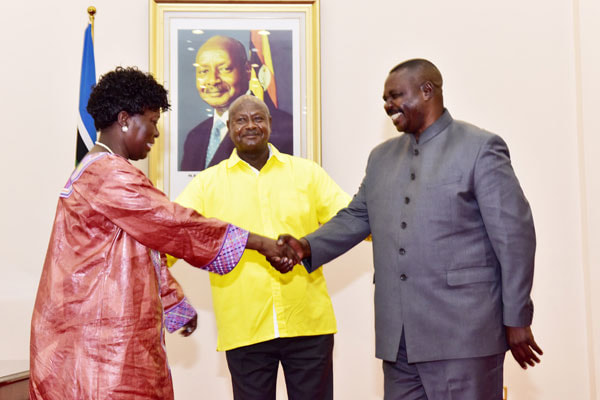
Museveni meets EU Ambassadors

President Yoweri Museveni has urged European Union to focus on strengthening their shared goals with Uganda asserting that Uganda and the European Union are not adversaries.

“For us we don’t see you as enemies, remove all the diversions and concentrate on the shared goals and help one another for the prosperity of our people,” said President Museveni.

The President said while meeting European Union envoys at State House Entebbe. The envoys were led by their head of delegation, Attilio Pacifici.

Others were Per Lindgarde of Sweden, William Carlos (Ireland), Rudi Veestraeten (Belgium), Jules Armand Ania Mbossou (France), Nicolaj Itejberg Peterson (Denmark), Massimiliano Mazzanti (Italy), Mathias Schauer (Germany), Karin Boven  (Netherlands) and Dr. Roswitha Kremser of Austria.

President Museveni, who reminded the envoys of the political history of Africa in general and Uganda in particular, also discussed a wide range of issues with his guests covering political, social and economic sectors.

The President however cautioned the envoys against involvement in matters that they are not conversant with, something that could have “serious consequences”.

“By involving yourselves in matters that you don’t understand, even if you do understand, you should not get involved because this kind of misconduct can lead to many serious consequences and suffering of the people like it happened in some African countries,” he said.

President Museveni further advised the envoys to always consult with government officials in case they want clarification on any issues.

He promised to share with the envoys a report on the investigations being carried out by security agencies following the November 2020 riots in Kampala and other urban areas where lives were lost.

The envoys appreciated the cordial and friendly relationship existing between the European Union and Uganda.

Ambassador Per Lindgarde of Sweden expressed their readiness to continue supporting development programmes in Uganda.

The meeting was attended by the Prime Minister Dr. Ruhakana Rugunda, Foreign Affairs Minister Sam Kutesa and other senior government officials.

Stories Continues after ad
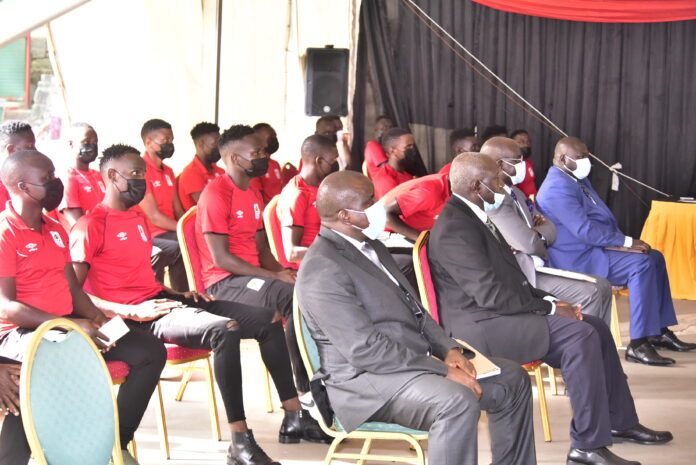
Shock as Makerere University Professor is found dead in his house

A courtsey Photo of Professor Kerali.

An Associate Professor at Makerere University has been found dead in his house. Anthony Geoffrey Kerali, was found dead at his Kololo based home at Plot 1 Prince Charles Drive on Thursday evening.

Kerali, whose cause of death was not established, was a lecturer at Makerere University in the College of Engineering, Design, Art, and Technology-CEDAT.

Relatives account that the Professor didn’t wake up as he usually does. They also said that when it reached at around 3pm, the house maids knocked his door to find out, all they got was no response which tempted them to force the door to find him dead.

According to the existing literature, Professor Kerali was born in 1962 in the village of Erusi, Otanyi Sub County in Nebbi district. His parents are Laudio Mamba and Zebia Kerali.

He attended Makerere University where he graduated with bachelor’s degree in Science in Civil Engineering and later joined Loughborough University of United Kingdom where he studied his Masters’ degree in Construction Economics. He then got his PhD from Warwick University of Material Science. He leaves only two sons and a wife. His body is currently at Mulago Hospital for further treatment.

Stories Continues after ad
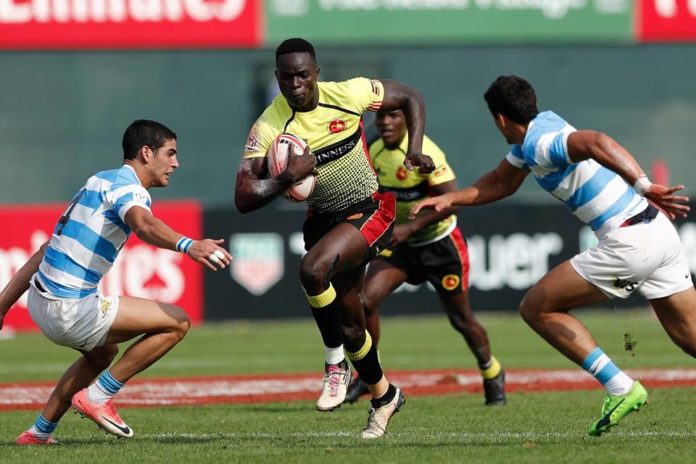
Who is Lt Col Namanya, the officer who commanded the beating of journalists and Bobi Wine’s supporters in Kalangala and Busega

Lt Col Namanya

On Wednesday, security forces of military police and the army pounced on journalists and beat them as former presidential candidate Kyagulanyi Ssentamu Robert delivered a petition to the United Nations Human Rights Council (UNHRC) offices in Kampala.

During the scuffle, scores of journalists were injured and admitted to various health facilities for medical care. The assaulted journalists include; Irene Abalo (Daily Monitor), John Cliff Wamala (NTV), Timothy Murungi (New Vision) and Josephine Namakumbi (NBS).

And yesterday, the Commander of Defence Forces (CDF) Gen David Muhoozi apologized for the inhuman actions of his soldiers. Moments later, seven Uganda people defence forces (UPDF) soldiers were arraigned before General court martial chaired by Lt. Col. Gai Mpadwa.

They were sentenced as follows; Capt Odwenyi was sentenced to 90 days of detention in Makindye military barracks, L/CPL Zirimenya Kassim was also charged with 60 days while Captain Nimusiima Justine was sentenced to severe reprimand and caution while Pte Kisakye Victoria and Pte Opiyo Isaac were sentenced to 62 and 60 days in the military prison respectively.

However their commander Lt Col Namanya Napoleone Kyabihende, Director Operations Military Police, was neither arrested, charged nor reprimanded. He previously served under the Special Forces Command (SFC), a force mandated to protect the president.

He was named in the shooting at Kasubi tombs on 16th March 2010 which saw several people dead and injured.

He commanded the military interception on Bobi Wine and his supporters in Busega on 27th December 2020 as they rushed Ashraf Kasirye to Rubaga hospital after he was shot on the head during their campaign in Masaka.

In Busega, as they pleaded to be allowed to rush Ashraf to hospital, Napoleon and his men, driving a military police truck, ran over Frank Senteza and killed him and some of their supporters were brutally beaten and are still nursing wounds.

He also commanded a raid on Bobi Wine’s campaign team in Kalangala Island on 30th December 2020, an ambush which saw over 100 of his members arrested. Most of them are still languishing in Kitarya prison. He personally beat up NTV journalist John Cliff Wamala.

Stories Continues after ad

Continental body FAJ condemns violent attacks against journalists

Continental body FAJ condemns violent attacks against journalists

The Federation of African Journalists (FAJ), the pan-African organisation of the International Federation of Journalists (IFJ), notes with serious concern and condemns in the strongest terms, the continuing attacks on journalists and media freedom in Uganda by the security forces.

Several journalists suffered grave bodily injuries and psychological trauma on February 17, when the military police pounced on them as they covered the handing over of a petition against the deteriorating human rights situation in the country, to the United Nations Human Rights Office in Kampala, by the National Unity Platform (NUP) leader, Robert Kyagulanyi Ssentamu, aka Bobi Wine.

Broadcast journalists John Cliff Wamala – NTV, Josephine Namakumbi – NBS TV, Joseph Sabiti -NBS and their print colleagues Irene Abalo – Daily Monitor and Timothy Murungi – New Vision among others, were left bleeding and with sprained limbs after they were chased and beaten by military police.

FAJ takes note of the deteriorating environment for safety of journalists in Uganda and calls on President Museveni as Commander in Chief to be accountable and restrain his troops from engaging in unprovoked attacks against journalists and other citizens.

“We note with concern that attacks against journalists which started during the campaigns for presidential elections continue to date and appear to have become an operational norm for Ugandan security personnel. The public has a right to know and this is only possible when journalists can operate in an environment that is secure and free of threats from any quarters. We wish to remind Ugandan authorities that they have a duty to protect journalists and other citizens from the arbitrary actions of the uniformed services,” said FAJ President Sadiq Ibrahim Ahmed

The journalists were clearly identifiable and this attack represents a dangerous trend of targeted attacks against the media that is gaining ground in Uganda. The Federation wishes to remind the Ugandan government that journalism is not a crime.

FAJ also censures the continued human rights violations, including abductions, killings and detention in ungazetted places, of people perceived to be opposition supporters.

FAJ calls on the African Union and the wider international community to stand by journalists and the people of Uganda, to condemn and take action against the growing impunity and disregard for the rule of law by the Ugandan state.

“We stand by our colleagues at the Uganda Journalists Union (UJU) who have taken a firm stance against these attacks which are a violation of Article 29 of the Uganda Constitution which guarantees press freedom and other liberties as well as Article 41 which guarantees the right to access to information,” added FAJ president.

The Uganda Journalist Union (UJU) President, Lucy Anyango Ekadu, ,said there is no way journalists will continue working under such conditions when they are beaten and their equipment damaged. She also called on all journalists who have been beaten and their equipment destroyed to open up cases against perpetrators of crimes against the media.

“UJU is calling on partner organisations and journalists to consider imposing a complete blackout on all government events if their safety is not guaranteed”, she stated.

IFJ General Secretary, Anthony Bellanger, said: “We are deeply concerned about the continuous attacks against press freedom in Uganda. Journalists shouldn’t be suffering physical and psychological attacks just for doing their job. The government must stop this outrageous harassment.”

Stories Continues after ad

Workers to access savings after Parliament passing NSSF Bill

NSSF building

Parliament has passed the National Social Security Fund (NSSF) Bill, which will see contributors aged 45 and above have mid-term access to their savings.

The Bill was stood over in September 2020, over a contentious Clause after lawmakers failed to agree on the categories of people to have mid-term access.

The report proposed that mid-term access provides for additional benefits and relief to members of the Fund before they reach the age prescribed by the law.

“A person with a disability who lacks gainful employment or fails to generate income and unable to make contributions to the Fund for a period of not less than one year should access up to 75 per cent of their contributions upon application,” the report reads in part.

However, in his minority report, Bulamogi County MP, Hon. Kenneth Lubogo said that members who lose their employment and remain unemployed for a period of not less than three years should, upon application, be entitled to 40 per cent of the balance on the member’s account.

While presenting the amendments by the committee on Gender during plenary sitting on Wednesday, 17 February 2021, Committee Vice Chairperson, Hon. Agnes Kunihira suggested that members who has made voluntary contributions should be allowed mid-term access to their benefits accrued from the voluntary savings.

“A member who is employed and is 45 years and above or has contributed to the fund for at least 10 years is eligible to mid-term access of a sum not exceeding 20 per cent of his or her accrued benefits,” she added.

The clause was further amended to allow members with disabilities who cease to be employed for a period not less than one year to withdraw 75 per cent of their accrued benefits.

“The Minister shall in consultation with the Board describe statutory instruments, terms and conditions and procedure for accessing the accrued benefits,” stated Kunihira.

The State Minister of Gender, Labour and Social Development, Mwesigwa Rukutana, however, said that government maintains its position on the main objective of social security, saying that it is to ensure that persons getting secure retirement and therefore mid-term access should only be maintained on voluntary contributions.

“To open up mid-term access on standing contributions under article 24 (a) undermines the cardinal principal of social security of ensuring secure retirement.”

He added that allowing persons with disabilities (PWDs) who ceased to be employed for over one year is worse because PWDs are disproportionally affected by old age.

He proposed that instead of allowing mid-term access of the voluntary contributions, the Board may in consultation with the Minister by statutory instrument prescribe additional benefits including mid-term access of standing contributions.

The House, however, voted to adopt the amendments made by the gender committee.

The committee also maintained a position on the deletion of Clause 12 that proposed direct lending by NSSF to government.

In practice, NSSF already lends to government through government securities, treasury bills and bonds, or other instructions sold in open markers.

Hon. Kunihira said that lending through the open markets ensures that members’ funds are protected from transactions below market interest rates, high costs are not imposed on savers and the financial market is not distorted since NSSF is a key player in the Uganda market.

Stories Continues after ad

Journalists react on brutality against them by security agencies

One of the journalists after being injured in Kololo on Wednesday. (Photo by Nicholas Bamulanzeki)

Following the brutal violence by military police on Wednesday in Kololo Kampala, a number of media personalities have condemned the acts of brutality that have continuously unleashed on them, saying that journalism is not crime.

Journalists, after covering the presser by the National Unity Platform-NUP officials which took place in Kamwokya at NUP’s Secretariat, they followed Robert Kyagulanyi Sentamu to cover the handover of the petition to United Nations Human Rights-UN offices, located at Prince Charles Drive, Kololo, on alleged human rights violations that marred the electoral process, however, this did not go well with whoever was trailing the NUP delegation.

A number of journalists sustained serious injuries after the scuffle between military and journalists who were covering the event. These include; Irene Abalo Otto of daily monitor, John Cliff Wamala of NTV, Timothy Murungi and Henrely Ssekanjako of New Vision, Josephine Namakumbi, Joseph Sabiti and Thomas Kitimbo of NBS, Amina Nalule of Galaxy among other journalists.

Moses Mulondo, the President of Uganda Parliamentary Press Association-UPPA, in a statement said the continued acts of brutality against journalists on duty by security forces are in violation of press freedom guaranteed in article 29 of the Uganda constitution.

Mulondo said that in the past, there have been so many other nasty incidents of police and military officers assaulting journalists with impunity.

He called upon the media owners, managers and editors to cooperate with their reporters in undertaking tough measures against the impunity of security forces like boycotting the coverage of their activities until commitment to end the barbaric acts is made.

Uganda Journalist Association-UJA issued a statement condemning the act and said that, this act is a continuation of unprecedented illegal assaults and brutality against journalists performing their constitutionally mandated duty of keeping the public informed.

“While we have engaged the security agencies on the issue of guaranteeing, the Safety of journalists, our efforts have been shamelessly and rudely ignored.” The statement reads in part.

Halima Athumani took it to her social media platforms and wrote that whenever journalists are out covering especially potentially risky stories, they always gather and tell each other that the most dangerous security officer in the field is a military police officer, the ones with red berets.

“We have always agreed that if a military police officer confronts you, you either try to charm them as you move away from the risk or just give them your equipment if they ask for it. We know how lethal they are and never want to get in their way,” she writes.

Damali Mukhaye of daily monitor noted that “someone cries telling you that I am a journalist but you continue beating them. Some journalists never learn a lesson. Every journalist should know that the Police/military don’t have friends when it comes to beating, so colleagues always watch out.”

Some journalists called upon fellow journalists to stop covering activities of government until they start respecting the works of media personnel. Joseph Balikuddembe of CBS said that “I argue with fellow scribes to stop covering the NRM government until it exits power because it does not value the work of journalists”.

Andrew Mwenda, the CEO of Independent news paper and magazine wrote on his social media platforms that NRM government, in characteristic style, used military police to unleash violence against a group of activists escorting Bobi Wine to the UN Human Rights office to deliver a petition.

Mwenda says it was the same old style, with added level of brutality this time mercilessly employed against journalists.

“I am even more shocked some Ugandan elites think this is new. The use of violence has been a characteristic feature of NRM from its inception” Mwenda noted.

Robert Ssempala of Human Rights Network of Journalist of Uganda called this a misfortune, adding that the fact that it has been repeated several times and the security agencies are not showing any changes in their brutal acts, it should be handled on a serious note.

The Kampala Metropolitan Police Spokesperson, Patrick Onyango in a press statement, said that it was done due to overcrowding of people yet they had warned people to avoid converging, as one way of preventing the spread of Covid-19 virus.

“Due to the acts of overcrowding at the security perimeters near UN offices, there was a great potential of breaching the security perimeter, which led to additional reinforcement that helped disperse the uncontrolled crowds. Unfortunately, a few people sustained injuries including journalists,” Onyango adds.

On several occasions, security agencies have battled journalists without any reason given. Security accuses the media of failing to be neutral when it comes to reporting on security issues.

In one of the security press briefings at Naguru Police Headquarters, the IGP Martin Okoth Ochola said police batting journalists intended to stop them from being harmed and he dared never to apologize for police’s acts of brutality towards journalists.

Stories Continues after ad

UPDF sentences 7 for assaulting journalists

UPDF officers

The Uganda People’s Defence Force-UPDF has sentenced seven of its officers who assaulted journalists in Kololo on Wednesday afternoon.

The journalists were covering the National Unity Platform-NUP’s former presidential candidate Robert Kyagulanyi as he delivered a petition to the United Nations Human Rights Council (UNHRC) over human rights violations in the country.

The officers are; Capt Jessy Odwenyi, Cpl Nimusiima Justine, Pte Wasswa Peter, Pte Tsame Imran, Pte Kisakye Victoria, Pte Opiyo Isaac and L/cpl Zirimenya Kassim.

Capt Odwenyi was sentenced to 90 days of detention in Makindye military barracks, L/CPL Zirimenya Kassim was also charged with 60 days while Captain Nimusiima Justine was sentenced to severe reprimand and caution while Pte Kisakye Victoria and Pte Opiyo Isaac were sentenced to 62 and 60 days in the military prison respectively.

Some of the assaulted journalists include; Irene Abalo (Daily Monitor), John Cliff Wamala (NTV), Timothy Murungi (New Vision) and Josephine Namakumbi (NBS).

“This is a deterrent measure to other members of the force not to engage in acts prejudicial to the good order and discipline of UPDF,” UPDF Spokesperson Brig Gen Flavia Byekwaso said.

Earlier today, the Chief of Defence Forces (CDF) Gen David Muhoozi apologized for the actions of soldiers who beat up journalists and said that UPDF will cater for their medical bills.

Stories Continues after ad

For the sake of fairness the tax on bank withdrawals should stand


By Stephen Hardings Massa


Last week a leaked proposal by the finance ministry to tax bank withdrawals caused an uproar in certain sections of the urban elite.

Under the proposal finance ministry was considering levying a 0.5 percent levy on all bank
withdrawals done over the counter, from ATMs or bank agents.
The main critics of the proposal complained that this amounted to double taxation as a lot of money held in the bank belongs to salary earners who have already paid Pay As You earn (PAYE) on their income.

They also warned that people will withdraw all their money from banks defeating another
government objective of widening the access to financial services.
However these are all red herrings. Thankfully in our immediate past we have seen government levy the same fees on mobile money transactions and the sky did not fall on our heads.

In 2018 government introduced a 0.5 percent levy on mobile money, after initial opposition to the face value of mobile money transactions reduced to sh66.9trillion in 2018 compared to shs 73 trillion in 2017, this reluctance has been overcome as shs 80 trillion in transaction in 2019 indicates.

What seems to have changed is the average value of individual transactions. There were 1.3 billion transactions in 2017 versus 2.5 billion transactions in 2018 and 3.1 billion in 2019. The high value transactions, this seems to suggested moved to other platforms – maybe the banks, with the small transactions more than bridging the initial deficit.
This in turn suggests that rather than discourage small users, who are in dire need of access to financial services, there has been an increase in activity.

Going by this example alone the banks need not fear that their depositors will take flight.
When withdrawal levy was being imposed on mobile money the banking industry was conspicuous by its silence. It is no secret that mobile money channels have not only reached prior to this untapped markets –the bottom of the pyramid, but the speed at which they have done it has forced a rethink of the banks’ business models, including them opening themselves to collaborations with the mobile money
players.

In classic divide and rule tactics the government first levied the fees on the less influential telecom companies and have now three years later, rounded on the banking industry.
The banks have now recommended that the levy on withdrawals, for both mobile money and banks,be scrapped and instead an excise duty on transaction fees be levied across the board. It is true as some people argued that two wrongs don’t make a right, but in the interest of fairness you either persist with the Injustice or eliminate ot for both the mobile money and banking industries

The writer is an economist with 15 years of experience in banking

Stories Continues after ad

DStv customers get 50% off Showmax subscription

showmax

DStv subscribers are set to get 50% off their Showmax subscription on DStv Access, Family, Compact and Compact Plus. The revelation was made by Mr. Colin Asiimwe the Head of Marketing at MultiChoice Uganda.

Speaking at the launch Asiimwe said; “Showmax is an online streaming service that can be watched on any two different devices simultaneously. DStv Premium customers in Uganda will get Showmax at no extra cost. Customers can binge-watch all their favourite series uninterrupted.”

“Showmax also has data saving settings and allows content to be downloaded to smartphones and tablets to watch later offline,” he said.

The Public relations and communication Manager, MultiChoice Uganda, Joan Semanda Kizza said; “We are delighted to announce even more perks for our customers. Premium customers in Uganda get Showmax as an extra service to their bouquets at no extra cost, when they simply added it to their bill.”

“Now even more customers will have access to the reward as DStv Access, Family, Compact and Compact Plus customers can get Showmax at a half the price,” Joan said.

Stories Continues after ad

How six children died in a bomb blast in Adjumani

Crime scene

Police in Adjumani district are investigating an incident of a bomb explosion which killed six children and injured five at Maji ll Refugee Settlement.

It is averred that a group of children residing at Maji ll Refugee Settlement went to the bush on a playing spree and picked an object which they didn’t know properly, tried to cut it through using Panga knife, incidentally, the object exploded killing six of them and injuring five.

According to Police spokesperson in West Nile SP Angucia Josephine, Victims are admitted to Adjumani hospital and relevant statements recorded to guide Investigations.

She said pieces of Panga knife and some fragments were recovered from the scene. All the 6 bodies are at Adjumani Hospital pending postmortem. The dead include; Joseph Otto (06yrs) Ma’di by tribe, Drago James (9yrs) Ma’di by tribe, Duku Emmanuel (7yrs) Kuku by tribe, Amaruma Isaac (11yrs)Ma’di tribe, Edema Thomas (10yrs)Ma’di by tribe and Mandre Justine (14yrs) Ma’di by tribe.

The 5 victims who are currently receiving treatment at Adjumani Hospital include; Wani Jonathan (10yrs) old Ma’di by tribe, Abao James (7yrs old), Andruga Dominic (14yrs old) and Bazio Joyce (12yrs).

“Police observation indicates that these bombs could have been suspected left behind in the bushes by former Konyi rebels who infested the area in late 1980s to early 90s as Adjumani District by then was one of the areas harboring the rebels. But now, coupled with burning of bushes in the dry spell, children are moving around the burnt bushes picking things anyhow for playing hence exposing them to such incidences,” she said.

She said; “It is therefore important for members of the community and dealers in the scrap metal business to guard against dealing with suspicious looking metallic objects found in the bushes as they could be bombs. Guardians should specifically advise their children not to play anyhow with such suspicious looking metals in order to prevent such deadly incidences.”

Stories Continues after ad