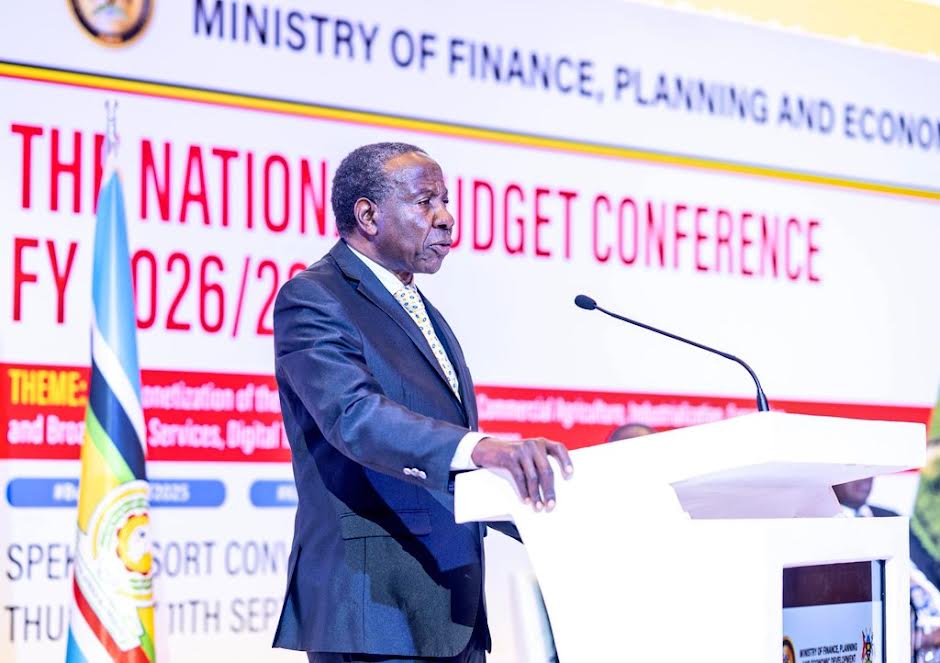
Finance Minister Matia Kasaija has reassured Ugandans that the country’s growing public debt remains sustainable despite concerns over increased borrowing.
Speaking at the opening of the National Budget Conference for the Financial Year 2026/27 on Thursday, September 11, 2025, held at Speke Resort Convention Centre, Kasaija revealed that Uganda’s total debt stock had risen significantly in the past year but still falls within safe thresholds.

“By the end of June 2025, the total stock of public debt was $32.33 billion (Shs116.21 trillion), up from $25.63 billion (Shs94.72 trillion) as at the end of June 2024,” Kasaija said.
He added, “Of this, domestic debt was $16.8 billion (Shs60.34 trillion) and external debt was $15.54 billion (Shs55.88 trillion). This translates into a debt-to-GDP ratio of 51.3%, remaining within sustainable thresholds in the short to medium term.”
The Minister attributed the rise in debt to increased financing for major infrastructure projects, noting that the share of domestic debt had also grown significantly.

“The share of domestic debt as a percentage of the total debt stock rose to 51.9% by June 2025, up from 42.9% the previous year. This was within the approved medium-term debt strategy and annual borrowing plan,” Kasaija added.
Despite the surge, Kasaija said government borrowing remains guided by a strict strategy aimed at balancing fiscal needs with sustainability.
“The increase in public debt reflects higher external disbursements and expanded domestic borrowing to finance major infrastructure projects,” he said, emphasizing that debt sustainability frameworks remain intact.
Kasaija also used the conference to unveil Uganda’s Tenfold Growth Strategy, a bold economic blueprint designed to transform the country into an upper-middle-income economy before 2040.
“Uganda has diversified its exports beyond the traditional three Cs — Coffee, Cotton, and Copper — and the three Ts — Tea, Tourism, and Tobacco. We are now opening up regional and continental markets with a shared national consensus to grow the economy tenfold by 2040,” he declared.
The strategy, anchored on boosting value addition, scaling up innovation, strengthening enablers like energy and transport, and enhancing regional integration, is expected to push economic growth to 7% in FY 2025/26 and into double digits after commercial oil production starts in 2026.
Prime Minister Robinah Nabbanja urged all ministries and agencies to align with the new priorities while reducing reliance on borrowing.
“Our collective responsibility is to deepen the implementation of the anchor sectors of agro-industrialisation, tourism, mineral-based industries, and science, technology, and innovation. We must boost revenue collection to secure Uganda’s development path,” Nabbanja said.
With a current debt stock of Shs116.21 trillion and borrowing trends still on the rise, the government is banking on its new fiscal strategy, structural reforms, and the oil and gas windfall to drive growth while keeping public debt within manageable limits.