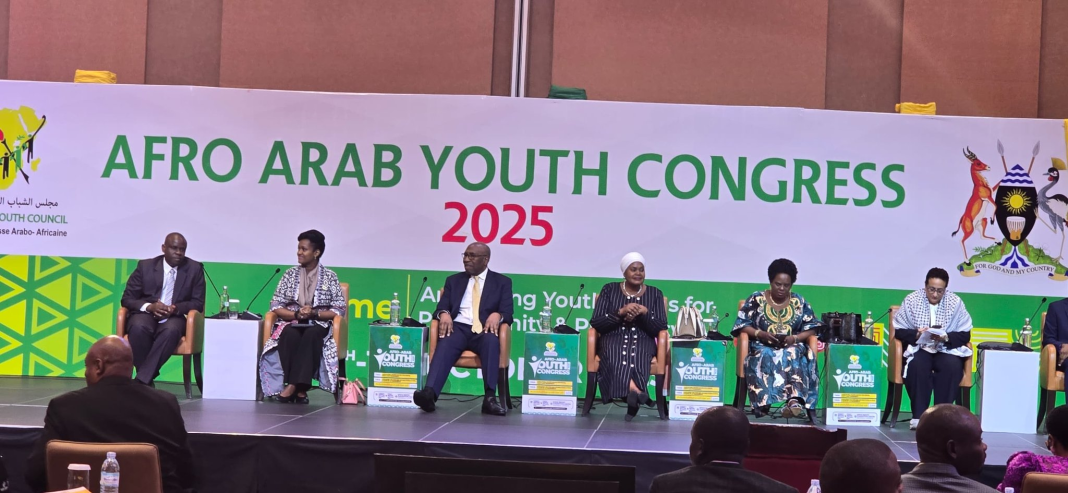
The 2025 Afro-Arab Youth Congress has officially opened at Speke Resort Munyonyo, bringing together thousands of young leaders, policymakers, and innovators from across Africa and the Arab world. The event, hosted under the theme “Amplifying Youth Voices for Peace, Unity, and Prosperity,” aims to strengthen Afro-Arab cooperation while empowering youth to lead in peacebuilding, innovation, and sustainable development.
Representing President Yoweri Kaguta Museveni, the Third Deputy Prime Minister and Minister Without Portfolio, Rukia Nakadama, commended the Ministry of Gender, Labour and Social Development and the Afro-Arab Youth Council for successfully hosting the conference in Uganda.

“Bringing all these young people together for a common cause is not an easy task, yet they have successfully done so. On behalf of His Excellency, I warmly welcome you all to Uganda and to this year’s Afro-Arab Youth Conference. We are truly honored to host such a distinguished gathering of young leaders, thinkers, and change-makers from across Africa and the Arab world,” Nakadama said.
She emphasized that the congress provides a unique opportunity for intercultural understanding, collaboration, and the building of networks that will advance shared goals of peace and prosperity.
“In a world that is increasingly complex, your presence here today is both a symbol and a commitment to solidarity and a shared destiny,” she added.

She further noted, “The Afro-Arab Youth Council stands upon a strong foundation—a reminder that our shared commonalities are powerful enough to unite us.”
Highlighting the intertwined cultural and linguistic ties between Africa and the Arab world, Nakadama illustrated how Kiswahili reflects this fusion.
“In Kiswahili, the first ten numbers demonstrate the blend of Arabic and Bantu languages—moja, mbili, tatu, nne, tano from the Bantu dialect, and sita, saba, nane, tisa from Arabic,” she noted.
She added, “This linguistic connection is a simple yet powerful reminder that our histories have long been intertwined.”
She called on the youth to embrace ideological clarity, unity, and purpose in shaping their collective destiny.
“The future is not shaped by chance, but by the clarity of your ideology and the strength of your conviction. We encourage all youth to promote an ideology of shared interests and unity rather than division,” she said.
Adding to the discussions, the Minister of Gender, Labour and Social Development, Hon. Dr. Jane Ruth Aceng, underscored the central role of young people in Uganda’s development agenda.
“I want to state that, for us in the Ministry of Gender, Labour and Social Development, His Excellency the President of Uganda guided us to focus on youth because, statistically, young people now constitute over 73% of Uganda’s population. Therefore, youth are a key priority for both the Ministry of Gender and the Government of Uganda, Aceng said. ”
She explained that President Museveni approved Uganda to host the headquarters of the Afro-Arab Youth Council, reaffirming the country’s commitment to youth empowerment and global cooperation.
“When the Secretary General of the Afro-Arab Youth Council approached us with a request to establish the Council’s headquarters in Uganda, His Excellency the President did not hesitate. He approved it and instructed the Ministry of Foreign Affairs and our Ministry to ensure that the Council remains based here,” she revealed.
Aceng highlighted that Uganda’s youth programs are designed to address poverty, the root cause of instability, through economic empowerment.
“We have several initiatives including the Youth Livelihood Program, the Youth Venture Capital Fund that provides affordable financing and capital, and youth skilling programs,” she said. “At the rural level, we also implement the Parish Development Model, where the youth are allocated 30 percent of the funding.”
She added that inclusion in governance is another key pillar of Uganda’s youth policy.
“In Parliament, we have five representatives dedicated to the youth. This demonstrates that in Uganda, young people are not just the leaders of tomorrow; they are part of the current generation shaping the national agenda and influencing government decision-making,” she emphasized.
Aceng further urged the youth to embrace tolerance, coexistence, and Pan-Africanism as guiding values for peace and unity.
“We must first see ourselves as human beings before anything else,” she noted.
She added, “Without coexistence and tolerance, we cannot promote peace and unity. Pan-Africanism, coexistence, and patriotism remain key pillars of our approach to youth development.”
Minister of State for Youth and Children Affairs, Hon. Balaam Barugahara, highlighted Uganda’s continued commitment to harnessing the potential of young people through innovation and technology.
He said, “This lecture highlights the various programs being implemented to harness the potential of young people, including ICT innovation, preparing youth for the digital economy, nurturing start-ups, and enhancing innovation capacity. It also emphasizes the establishment of the National Youth Council, which is fully funded by the Government of Uganda.”
Barugahara reaffirmed that Uganda views young people as assets, not problems.
“These initiatives reaffirm Uganda’s belief that youth are not a problem to be solved, but rather a solution to national and global challenges,” he stated.
He noted that Uganda continues to lead in advancing youth cooperation and inclusion at regional and global levels within the East African Community and beyond.
“We are harmonizing youth policies, promoting cross-border innovation, and enhancing mobility. At the African Union, Uganda aligns with Agenda 2063 and the Africa Youth Charter to ensure meaningful youth participation in governance, climate action, and peacebuilding,” he added.
Barugahara revealed that Uganda remains honored to host the Afro-Arab Youth Council, symbolizing South–South cooperation and solidarity.
“The council was recently gifted 50 acres of land in Akaukalo, along Entebbe Road, a landmark step toward establishing a center of excellence for Afro-Arab youth cooperation,” he announced.
He invited applause for President Museveni for his generous donation and called on all partners to contribute toward the realization of the Afro-Arab Youth Headquarters.
“The government also commends the Council for launching a fundraising campaign to build the Afro-Arab Headquarters—a hub for innovation, leadership development, and intercultural collaboration,” Barugahara said.
He added, “All partners, including governments, development agencies, ambassadors, and private sector players, are called upon to invest in this vision and make it a reality.”
As part of the international addresses, Sadine Omutoni, youth representative from Rwanda commended Uganda for its hospitality and leadership in promoting youth empowerment.
“It is an honor to attend the Afro-Arab Youth Congress 2025 under a theme that resonates deeply with Rwanda’s transformation journey,” she said.
She added, “After the 1994 genocide against the Tutsi that claimed over one million lives, young people worked with elders to save their country, reunite the people, and restore hope under the leadership of President Paul Kagame.”
She emphasized that Rwandan youth have become architects of national unity, leading reconciliation efforts and fostering peace through initiatives such as the Ndumunya Rwanda campaign—meaning “I am Rwandan.”
“Through youth-led dialogues in schools, universities, and communities, the spirit of unity beyond ethnicity or background is promoted, turning a painful legacy into a foundation of national strength,” she explained.
The minister further highlighted that across Africa and the Arab world, youth are driving innovation in entrepreneurship, technology, agriculture, and creative industries. She noted that programs like Youth Connect Africa, active in over 37 countries, are helping young people access funding, mentorship, and global networks.
“Rwanda’s continued investment in education, skills development, and digital literacy affirms a key truth: the future belongs to the youth, but only if they are empowered today,” she concluded.
The Afro-Arab Youth Congress continues throughout the week, with President Museveni expected to preside over the closing ceremony.