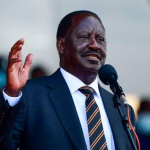
Kenya’s former Prime Minister and Orange Democratic Movement (ODM) party leader, Raila Amolo Odinga has died at the age of 80 while receiving treatment in India.
Sources close to his office on Wednesday confirmed that the veteran politician passed away in the southern Indian city of Kochi, where he had been recuperating after undergoing treatment for an undisclosed condition.

According to Indian media reports, “the 80-year-old leader suffered a cardiac arrest during a morning walk before being rushed to Devamatha Hospital in Koothattukulam, where he was pronounced dead.”
President William Ruto and the Odinga family, led by his elder brother Dr Oburu Oginga, are expected to address the nation on the tragic news later today.
Mr Odinga had travelled to India on October 3 for what his secretariat initially described as a “routine medical check-up.”

At the time, his office stated, “Raila travelled out of the country on Friday evening – one of the many trips he has made this year, and definitely not the last. He is not indisposed.”
Dr Oginga, who also serves as the Odinga family spokesperson, had later clarified that Mr Odinga had been unwell but was steadily recovering.
“Raila, just like any other human being, was indisposed a few days ago but at the moment he is doing fine. He went for a check-up in India and he is now recuperating,” he said.
Mr Odinga’s wife, Ida Odinga, had also dismissed reports about her husband’s deteriorating health.
“As someone who lives with him, I know his health better than anyone. How could someone who doesn’t reside with him claim to know more about his condition than I do? What I’ve shared with you is the truth,” she said.
Despite reassurances from his family, Mr Odinga’s prolonged absence from public events, including major ODM rallies in Kisii, Wajir, and Narok counties, had intensified speculation about his health.
He, however, made a brief public appearance last Friday after chairing a consultative meeting at Serena Hotel in Nairobi to prepare for the party’s 20th anniversary celebrations.
Mr Odinga’s political journey is deeply woven into Kenya’s history. He served as Prime Minister between 2008 and 2013, following a disputed presidential election that led to post-election violence and the formation of a grand coalition government brokered by the late UN Secretary-General Kofi Annan.
He contested the presidency five times in 1997, 2007, 2013, 2017, and 2022; coming close to power but never securing the top seat. His relentless push for democratic reforms and constitutional change made him one of Kenya’s most influential and resilient political figures.
Earlier in his career, he served as Minister for Energy under President Daniel arap Moi and played a key role in the political realignments that birthed the National Rainbow Coalition (NARC), which swept Mwai Kibaki to power in 2002.
In 2010, Mr Odinga underwent a head surgery to relieve pressure that had built up outside his brain a procedure that led to regular medical check-ups abroad in later years.
Known affectionately to his supporters as “Baba”, Mr Odinga was admired for his charismatic leadership and unyielding pursuit of social justice, multiparty democracy, and constitutional reform.
His death marks the end of an era in Kenya’s politics, one defined by resilience, reform, and a lifelong struggle for democracy.
A family statement is expected soon, followed by a national address from President Ruto and members of the Odinga family.