Permanent Secretary and Secretary to the Treasury, Ramathan Ggoobi has revealed that Uganda’s economy has all the essential fundamentals required to generate wealth and shared prosperity, crediting sustained economic reforms by the NRM government for laying a strong foundation for long-term growth.
Ggoobi said the reforms implemented over the years have created a resilient, stable and fast-growing economy capable of supporting Uganda’s socio-economic transformation.

“The NRM government will continue to take deliberate actions to achieve faster socio-economic transformation and to strengthen its position in the global economy,” Ggoobi said.
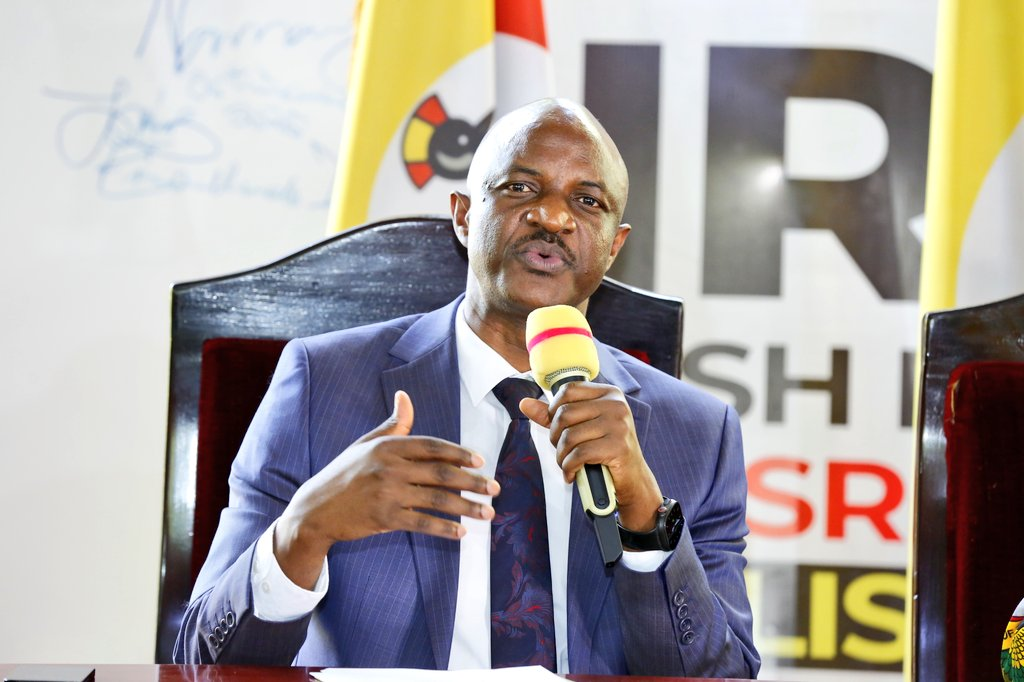
He made the remarks on Wednesday while speaking on behalf of Finance Minister Matia Kasaija at the NRM Party Secretariat on Kyadondo Road in Kampala, where he was invited to brief the public on the progress, reforms and future direction of Uganda’s economy under the NRM administration.
Flanked by NRM Deputy Secretary General Rose Namayanja, Ggoobi outlined key policy reforms that have shaped the structure of the economy, including the elimination of price controls, liberalisation of the economy, liberalisation of the foreign exchange market, and opening up of the current and capital accounts. He also cited export diversification, privatisation, and the rationalisation of state enterprises as critical interventions.

He further highlighted prudent macroeconomic management aimed at controlling inflation, the establishment of the Uganda Revenue Authority (URA) in 1991 to enhance domestic revenue mobilisation, and sustained investment in infrastructure as pillars of economic stability.
According to Ggoobi, these measures have delivered tangible results, noting that the size of Uganda’s economy is projected to have expanded 17 times since 1986. By June 2026, the economy is expected to reach Shs68.4 billion.
Ggoobi also revealed that Uganda has met all the requirements for graduation to lower-middle-income status and is currently undergoing assessment by the United Nations. He said Uganda’s per-capita Gross National Product stood at Shs1,278 in the 2024/25 financial year, compared to about Shs570 a decade ago.
“This compares favourably with the benchmark of USD 1,136 required for a country to be classified as lower-middle income. Our projections show that per-capita income will rise to USD 1,324 by the end of FY 2025/26,” he said.
He added that improvements in economic performance have translated into better household welfare, with poverty levels declining from 21.4 percent in 2016 to 16.1 percent in 2025. The proportion of households engaged in subsistence production has also dropped significantly, from 68.9 percent in 2010 to 33.1 percent by the 2023/24 financial year.
Looking ahead, Ggoobi said the government is targeting to expand the economy to Shs500 billion by 2040 and create more jobs by concentrating resources on the four anchor sectors under the ATMS framework and their key enablers.
“The NRM Government remains resolute in transforming Uganda into a modern, inclusive and competitive economy that works for all Ugandans,” he said.