The Uganda Human Rights Commission (UHRC) has released a detailed preliminary assessment of the 2026 General Elections, identifying logistical delays, widespread failures of biometric voter verification technology and notable human rights concerns.
However, UHRC acknowledged that Ugandans were largely able to exercise their right to vote in a peaceful and secure environment.

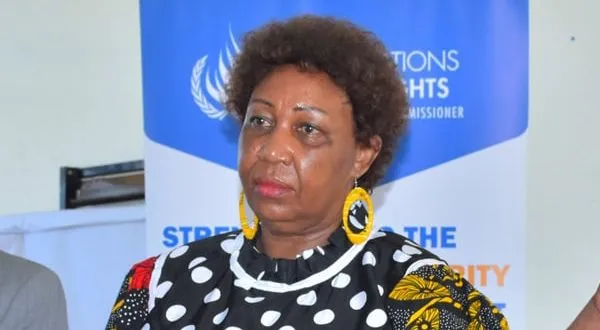
In a statement issued on January 18, 2026, UHRC Chairperson Mariam Wangadya said the delivery of polling materials was timely at most polling stations observed across the country. However, significant delays were recorded in Kampala, Wakiso, and Mukono districts, resulting in the late opening of polls at several locations.
“Polling materials were delivered on time at the majority of polling stations observed. However, delays were recorded in Kampala, Wakiso, and Mukono, with some materials arriving as late as 10:00 a.m.,” Wangadya noted, adding that voting at some stations only commenced between 9:00 a.m. and 11:30 a.m.
According to the Electoral Commission, Uganda had 21,649,068 registered voters, of whom 11,366,201 cast ballots in the presidential and parliamentary elections. This translated into a voter turnout of 52.50 percent, a decline of 6.85 percentage points from the 59.35 percent recorded during the 2021 “scientific” elections.

“Higher voter turnout was observed in rural areas compared to urban centres, with particularly low participation recorded in Kampala and Wakiso districts,” the UHRC observed, noting that voters generally arrived as early as 6:30 a.m. and remained calm despite delays in the opening of polls.
The Commission expressed concern over the performance of the Biometric Voter Verification Kits (BVVKs), which were introduced by the Electoral Commission to strengthen transparency and electoral integrity. While each polling station was allocated a primary and backup kit, the UHRC documented widespread technical failures on polling day.
“The BVVKs functioned effectively at only a limited number of polling stations visited,” Wangadya said, citing parts of Kyankwanzi, Buliisa, Karenga, Kaabong, Moroto, Napak and Mbarara as among the few areas where the systems operated as intended.
The UHRC further noted that some polling stations in Yumbe and Wakiso did not receive the biometric kits at all. At about 9:30 a.m., polling officials were directed to revert to the use of the manual National Voters’ Register where the digital systems failed, a move the Commission said ensured that eligible voters were not disenfranchised.
Polling officials were largely commended for professionalism, with the UHRC observing that they clearly explained voting procedures, complied with minimum requirements for opening polls, and effectively communicated guidance received from the Electoral Commission.
Security during polling was described as largely calm nationwide, with regular police patrols around polling stations that did not interfere with the voting process.
“The deployment of multi-agency security personnel was visible and consistent with Article 212 of the Constitution,” Wangadya stated, while cautioning that the presence of armed polling constables in some areas of Kampala, Sembabule and Mbarara highlighted the need for careful calibration of security deployments to safeguard free participation.
Vote counting and tallying were conducted in line with Electoral Commission guidelines, in the presence of candidates’ agents, voters and observers. Although most polling stations closed at 5:00 p.m., counting and declaration of results at some stations extended beyond 8:00 p.m. All candidates’ agents present were issued with copies of the Declaration of Results Forms.
The UHRC also raised red flags over human rights concerns linked to the electoral process, particularly the temporary limitation of public internet access ahead of polling day.
“This partial shutdown limited the right of access to information and freedom of expression and association,” the Commission noted, adding that disruptions to mobile money services disproportionately affected rural communities that rely on mobile money as an alternative to formal banking.
While voting was generally peaceful, the Commission documented incidents of violence at polling stations and tally centres in several districts, with media reports indicating deaths, injuries and arrests linked to election-related disturbances.
On the integrity of the vote, the Electoral Commission reported 11,090,848 valid votes and 275,353 invalid votes, many of which resulted from incorrect or absent marking of ballot papers.
“The number of invalid votes remains high,” the UHRC observed, recalling similarly elevated figures recorded during the 2021 general elections.
The Commission further noted imbalances in the deployment of candidates’ agents, with major political parties widely represented at polling stations, while smaller parties and some parliamentary candidates had minimal or no representation in many areas observed.
In its preliminary recommendations, the UHRC called for comprehensive training and large-scale testing of electoral technologies prior to polling, mandatory allocation of election financing to voter education, and the continued use of manual registers by candidates’ agents where digital verification is unavailable.
“Despite the challenges observed, Ugandans were able to exercise their right to vote in a generally peaceful and secure environment,” Wangadya concluded, adding that the Commission will continue to engage stakeholders and issue further statements as the electoral process unfolds.