Uganda’s remittance inflows reached Shs9.25 trillion ($2.5 billion) in 2025, the Bank of Uganda has revealed, showing the growing importance of diaspora contributions to the country’s economy.
The figures were disclosed during the launch of an interactive remittance dashboard developed by the central bank in collaboration with the International Fund for Agricultural Development in East Africa, a tool expected to improve the accuracy, frequency, and accessibility of remittance data.

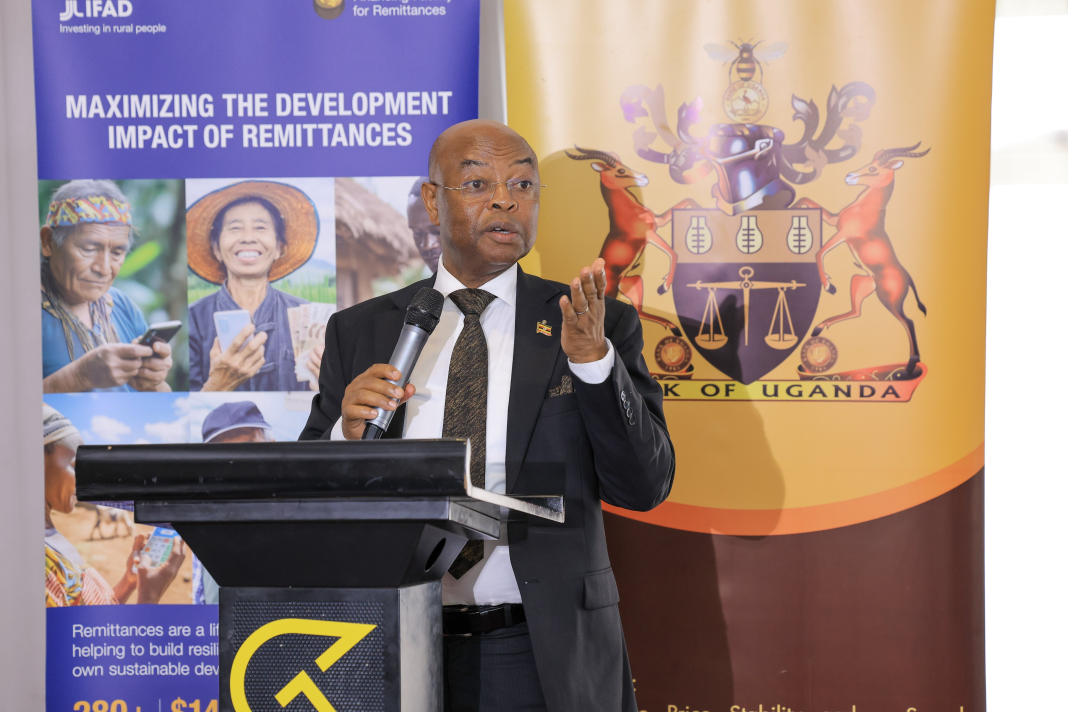
Launching the platform, Deputy Governor Augustus Nuwagaba described remittances as a critical pillar of Uganda’s economic stability and noted that they continue to rival traditional foreign exchange earners.
“Remittances are a lifeline. They are more than statistics, they represent the sacrifices of Ugandans abroad who work to earn this money,” Nuwagaba said.
He added, “They provide for families and households both formally and informally and have proven to be a sustainable source of foreign currency inflows, competing with other sources such as coffee and tourism, which supports our Balance of Payments.”

The new dashboard stems from an enhanced data collection framework that expands coverage to include remittance service providers across the financial sector, including mobile money platforms and fintech channels. This shift has significantly improved visibility into flows that were previously not captured.
According to Nuwagaba, the improved methodology has already led to the discovery of substantial additional inflows.
“This tool has already helped us capture an additional US$1 billion in remittances, significantly higher than previous estimates of around $1.5 billion, showing that inflows in 2025 reached approximately US$2.5 billion,” he said.
He added that beyond increasing the headline figures, the new system provides deeper insights into the origin, transmission channels and usage of remittances, which are essential for informed policy decisions.
“It is not simply a larger number but it is more accurate because it includes information on where the remittances come from, how they are sent, plus what they are used for. That distinction matters enormously for policymaking,” he explained.
Nuwagaba also commended Ugandans living abroad for their continued support to the domestic economy, noting that remittance inflows play a stabilizing role in the foreign exchange market.
“These remittances can be a wonder in building a country’s inflows which help stabilize the foreign exchange markets and relieve exchange rate pressures, which is an important aspect of economic fundamentals,” he said.
The dashboard replaces a system that relied largely on annual surveys and aggregated submissions from commercial banks and foreign exchange bureaus, which often came with limited detail and significant delays. Under the new approach introduced in May 2025, data is collected more frequently and at transaction level, improving both timeliness and reliability.
The platform will be updated monthly and will provide stakeholders with accessible insights into both inbound and outbound remittance trends. The existing Annual Personal Transfers Survey will continue to complement the system by capturing non cash and informal transfers that may not pass through formal financial channels.
The central bank emphasized that while the data currently published is subject to refinement as more inputs are incorporated, the new system brings in transparency and evidence-based economic planning in Uganda’s financial sector.