For years, the route into Uganda’s top government positions appeared predictable. When senior technocrats, ministers, permanent secretaries and policy leaders emerged, many traced their academic roots to one institution which was Makerere University.
Makerere built that reputation over decades as Uganda’s oldest university and one of Africa’s most recognised academic institutions, it became synonymous with producing the country’s governing class. Cabinet ministers, economists, public servants and administrators passed through its lecture rooms before assuming influential national positions.

But recent appointments increasingly suggest that another institution is gaining strategic visibility in the corridors of public leadership.
Victoria University, once viewed as a relatively young private institution competing for space in Uganda’s higher education sector, is increasingly being associated with leaders who are crossing from academia into major national assignments.
The latest developments have strengthened arguments that the centre of attraction for identifying technocratic talent may no longer rest exclusively with Makerere.

First came Dr. Stephen Isabalija, who served in leadership at Victoria University before being appointed chairperson of Uganda Electricity Generation Company Limited and later elevated to Permanent Secretary in the Ministry of Energy and Mineral Development.
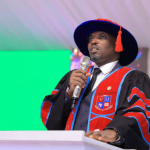
Now attention has shifted again following the appointment of Dr. Lawrence Muganga to government as the state minister for internal affairs.
Taken together, these appointments have intensified the perception that Victoria University is increasingly becoming a source of individuals trusted with national responsibility.
Unlike Makerere, whose influence was built over history and tradition, Victoria University’s rise appears connected to positioning itself around results, innovation, technology and a more industry aligned approach to higher education.
In a relatively short period, the university has deliberately projected an image of practical learning, modern teaching approaches and direct preparation for emerging labour markets.
At the centre of that transformation has been Dr. Lawrence Muganga.
Since taking over leadership of Victoria University, Muganga has become one of the most visible education reform voices in Uganda.
Rather than defending traditional academic models, he consistently argued that universities needed to prepare students differently for a rapidly changing world.
His message focused on shifting education away from memorisation and toward creativity, problem solving, digital competence and practical application.
That vision became visible in how Victoria University positioned itself.
Under Muganga’s leadership, the institution expanded its public profile and built a reputation around student experience, technology adoption and employability.
The university increasingly promoted work integrated learning, industry partnerships and digital delivery systems designed to expose students to real world environments before graduation.
But perhaps the strongest feature of Muganga’s leadership has been his early and sustained push for artificial intelligence in education.
At a time when many institutions remained cautious about AI, Muganga openly advocated integrating it into learning systems.
His argument was straightforward. Universities preparing students for modern economies cannot ignore technologies that are already transforming workplaces.
He repeatedly encouraged institutions to rethink assessment, redesign learning models and ensure graduates leave university ready to work alongside intelligent systems rather than compete against them.
Through conferences, public lectures and institutional initiatives, Victoria University positioned artificial intelligence not as a future conversation but as a present educational necessity.
The university began amplifying digital literacy, innovation culture and technology centred learning as part of its identity.
That positioning increasingly differentiated Victoria University from traditional institutions that continued relying heavily on conventional teaching structures.
Supporters argue that this approach made Victoria University attractive not simply as an academic institution but as a leadership incubation centre.
In their view, the university became associated with administrators who understand modern governance, innovation and implementation.
That perception appears to be gaining traction.
If government appointments are increasingly rewarding institutions producing visible leadership and practical outcomes, then Victoria University’s growing recognition may not be accidental.
Its rise suggests that excellence is no longer being measured only by historical prestige.
Instead, visibility, adaptability, innovation and national relevance are becoming equally important.
That does not erase Makerere’s contribution.
Makerere remains one of Uganda’s most influential institutions and continues to produce leading professionals across sectors.
However, recent developments indicate that when conversations turn to emerging centres of influence and technocratic leadership, Victoria University is now firmly part of that discussion.
For supporters of the institution, the question may no longer be whether Victoria University has entered the space. Their argument is that it already has.
And if recent appointments are anything to go by, Victoria University is seriously establishing itself as a preferred hunting ground for identifying a new generation of technocrats and public leaders.