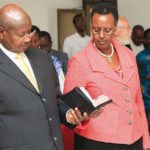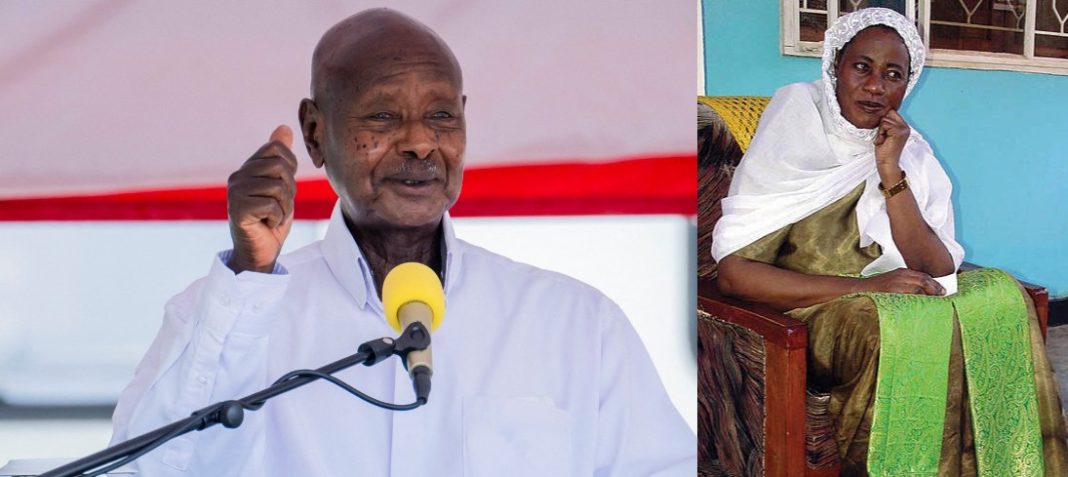
President Yoweri Museveni has directed the government to provide a house, a four-wheel-drive vehicle, medical insurance, and a monthly allowance of Shs15 million to Madina Najjemba Amin, the widow of former Ugandan president Field Marshal Idi Amin Dada.
The directive is contained in a letter dated February 15, 2024, addressed to Najjemba after she reportedly wrote to the President seeking assistance.

“I have seen your letter of the 9th November, 2023. How are you? It is good you wrote to me,” Museveni wrote.
The President then instructed the State House Comptroller to immediately facilitate a comprehensive welfare package for the former First Lady.
“By the copy of this letter, I direct the State House Comptroller (SHC) to buy you a car (4×4), build you a house, ensure you get medical insurance and give you an allowance of Shs15 million per month,” Museveni stated.

In a striking remark, Museveni also questioned the whereabouts of benefits that may have accrued to the family of the late former president.
“What happened to Idi Amin’s entitlements? Who took the money?” the President asked.
The intervention highlights Museveni’s continued efforts to extend state support to families of former national leaders despite Uganda’s often turbulent political history.
Idi Amin ruled Uganda from 1971 until 1979 after overthrowing then-president Milton Obote in a military coup. His government remains one of the most controversial in the country’s history, attracting both supporters and critics and leaving a legacy that continues to spark debate decades after his fall from power.
Following his overthrow by Tanzanian forces and Ugandan exiles in 1979, Amin fled into exile, eventually settling in Saudi Arabia where he died in 2003.
The relationship between Uganda’s three most prominent post-independence leaders; Milton Obote, Idi Amin and Yoweri Museveni has been marked by conflict, political rivalry and armed struggle.
Amin seized power from Obote in 1971, while Museveni later fought against Obote’s second administration through the National Resistance Army bush war that culminated in the capture of power in 1986.
Despite frequently criticizing the leadership failures of both the Amin and Obote eras, Museveni has over the years advocated national reconciliation and sought to engage the families of former leaders.
The gesture towards Najjemba reflects an approach by Museveni to separate historical political disagreements from the welfare of surviving family members.
The President’s decision is also likely to reignite questions about the status of benefits and entitlements due to former heads of state and their families, particularly following his public inquiry into what happened to Amin’s reported entitlements.
For Najjemba, the directive marks a significant intervention by the State, guaranteeing her housing, healthcare and a substantial monthly allowance.
For the government, however, Museveni’s pointed question may prove equally significant.
“What happened to Idi Amin’s entitlements? Who took the money?” he asked.
Museveni’s humility generates lovely treatment of former leaders’ families and the unresolved historical issues surrounding Uganda’s past administrations.