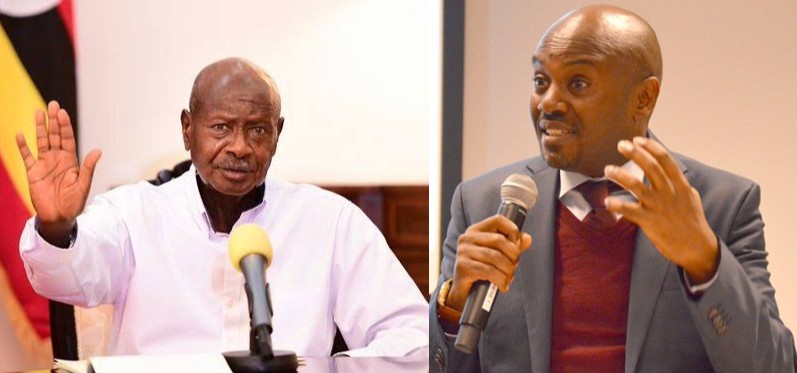
President Yoweri Museveni has warned journalist Andrew Mwenda to stop orchestrating dirty schemes aimed at frustrating Uganda’s industrialisation agenda.
Museveni said the veteran commentator had wrongly sought to discredit local innovators Dr. Matthias Magoola and David Ssenfuka before shifting his attention to a new controversy involving Stephen Nuwagaba.

In a statement issued on Monday, Museveni said Mwenda had failed in his earlier campaign against Uganda’s emerging pharmaceutical industry after branding Magoola and Ssenfuka as conmen and questioning the President’s judgment, and was now attempting to create what he called another national emergency.
“However, for today, I want to inform the Ugandans that the great journalist Andrew Mwenda is back with his schemes. Having failed to destroy our promising pharmaceutical industry by calling our innovators Magoola and Senfuka con-men, and declaring me senile, he has now discovered a new national emergency in Uganda. This is the young man known as Nuwagaba Stephen,” Museveni said.
The President said the facts surrounding Nuwagaba had been deliberately distorted, insisting the young man was not a threat to State House or the country’s security agencies as alleged, but rather a victim of torture who sought refuge under his protection.

According to Museveni, Nuwagaba, who in his mid-twenties, arrived at State House after allegedly being tortured, maimed and threatened with death by rogue elements within the security services. He said the injuries were so severe that government facilitated his treatment in hospitals both in Uganda and abroad.
“Nuwagaba is a young man in his mid-twenties who came to me as a fugitive, a victim of torture and maiming, whom some elements in the Security Services were trying to silence, including threatening with death,” Museveni said.
He added, “He has actually been a patient on account of torture and maiming, and trauma because of the torture, for many of the months he has been under my care. I had to send him to the hospitals in Uganda and abroad to save his life.”
Museveni revealed that some of the security officers allegedly involved in the torture are already facing prosecution before the courts, describing the incident as a betrayal of the values that Ugandans fought for during the liberation struggle.
“The terrible thing is that these alleged torturers and maimers were belonging to our security forces. Is this what we and the People of Uganda fought for? Do you know how much we, and all the People of Uganda, sacrificed to get freedom from killers, torturers and dictators?” he asked.
To underscore the sacrifices made during Uganda’s struggle for freedom, Museveni recalled the public execution of several members of the Front for National Salvation (FRONASA) by Idi Amin’s regime on February 11, 1973. He named Obwona and Labeja in Gulu, Masaba and Namirundu in Mbale, Nkoko and Ntale in Jinja, mathematician Karuhaanga in Mbarara, Abwooli Malibo and Kasolo in Fort Portal, Karambuzi, Bitwaari and David Kangyire in Kabale, among others, saying their deaths should remind Ugandans why torture and abuse of power can never be tolerated.
Museveni’s remarks come months after a public disagreement with Mwenda over government support for local scientific innovation. Mwenda had questioned the massive public investment in projects spearheaded by Dr. Matthias Magoola of Dei BioPharma and herbal medicine researcher David Ssenfuka, describing the two innovators as conmen and arguing that the President had been misled into financing unproven ventures.
The criticism prompted a detailed response from Museveni, who defended both innovators and challenged Mwenda to first visit their facilities before passing judgment. The President argued that Uganda could not achieve economic transformation without investing in local science, technology and manufacturing.
Following the President’s response, Mwenda visited Dei BioPharma’s pharmaceutical complex in Matugga, where he toured the manufacturing plant and held discussions with Dr. Magoola. After the visit, he publicly admitted that he had reached conclusions without first verifying the facts and apologised to both Museveni and Magoola.
“I want to apologize for mischaracterising you. I apologize for making a judgment about you without even talking to you. I apologize for making accusations against your work without visiting your plant,” Mwenda said after touring the facility.
He added that he was impressed by what he had seen, saying the pharmaceutical plant represented a serious industrial investment that deserved objective assessment rather than premature criticism.
Mwenda also apologised to David Ssenfuka, acknowledging that referring to him as a conman and witch-doctor before examining his research had been unfair.
Dr. Magoola is the founder and Managing Director of Dei BioPharma, one of Uganda’s leading pharmaceutical and biotechnology companies. The company is developing vaccines, mRNA technology, insulin, cancer medicines, antimalarial drugs and other advanced pharmaceutical products, while constructing one of Africa’s largest integrated pharmaceutical manufacturing facilities in Matugga.
The project is meant to reduce dependence on imported medicines and position the country as a regional centre for pharmaceutical production.
Ssenfuka is the founder of the Leonia-NNN Medical Research and Diagnostic Centre and Leonbiotec Foundation. For years, he has conducted research into plant-based medicines targeting diseases including diabetes and cancer.
His work has received government support for scientific validation, laboratory analysis and clinical evaluation as Uganda seeks to commercialise locally developed health innovations that meet internationally accepted regulatory standards.
Museveni insists that criticism should be based on verified facts rather than assumptions that could discourage local innovation and investment.