The government has directed the Uganda Investment Authority (UIA) to fast track the completion of critical infrastructure in industrial parks, saying improved roads, reliable electricity and water supply are essential to attracting investors, expanding industrialisation and creating more jobs.
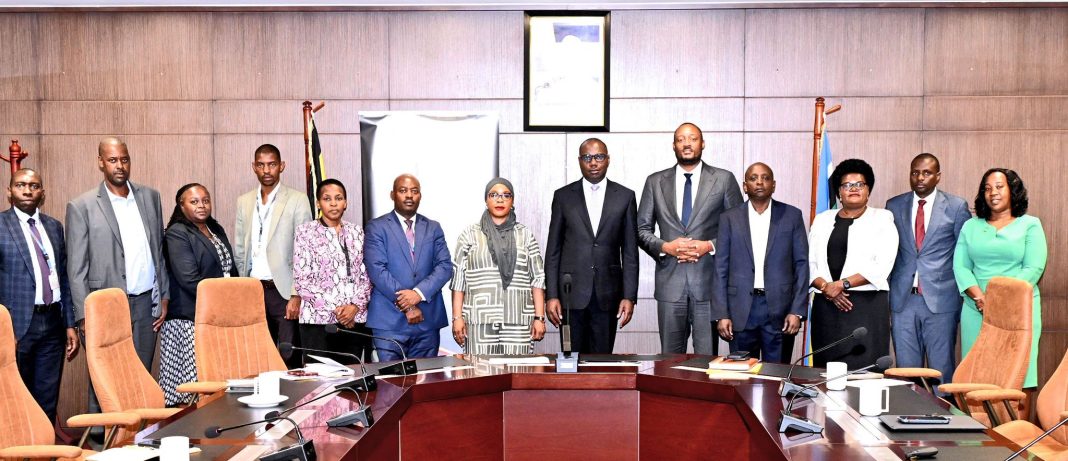
The directive was issued by Finance Minister Henry Musasizi during a meeting with the UIA management led by Director General Robert Mukiza, where officials reviewed the progress of industrial park development and discussed strategies to strengthen Uganda’s investment climate.

Musasizi stressed that industrial parks should only be licensed once they are equipped with the essential infrastructure needed for businesses to operate efficiently.
“Infrastructure development in industrial parks must be a priority. Roads, water and power are critical to facilitating industrial growth and attracting investors,” Musasizi said.
He added that investment promotion and facilitation remains one of the core responsibilities of the Ministry of Finance, Planning and Economic Development, noting that government is committed to creating an environment that enables businesses to thrive.

The Uganda Investment Authority, which is mandated to promote and facilitate both local and foreign investment, has in recent years expanded the country’s network of industrial parks as part of Uganda’s industrialisation agenda under the National Development Plan. The authority is also responsible for operating the One Stop Centre, which brings together government agencies involved in business registration, licensing and investment approvals to simplify the process for investors.
Presenting the authority’s progress report, Mukiza said 14 of the planned 25 industrial and agricultural business parks are now fully operational.
He revealed that the parks currently host 463 operational companies, which have mobilised investments worth approximately US$5.881 billion and created about 164,230 direct and indirect jobs, with manufacturing accounting for the largest share of employment.
“The industrial park ecosystem has mobilised US$5.881 billion in investment, while 164,230 jobs have been created directly and indirectly, largely driven by manufacturing,” Mukiza said.
Despite the progress, Mukiza said more work is needed to improve investor services, particularly through decentralising investment facilitation.
He called for the operationalisation of regional One Stop Centres within functioning industrial parks to bring essential government services closer to investors.
“Regional One Stop Centres should be operationalised in the industrial parks so that investment facilitation services are brought nearer to investors,” he said.
Mukiza also appealed for increased government funding to support the development and maintenance of industrial parks, while urging authorities to negotiate more competitive electricity tariffs and establish dedicated substations to guarantee reliable power supply for manufacturers.
State Minister for Privatization and Investment Evelyn Anite Mukalazi underscored the need to strengthen investor aftercare and improve the licensing process to ensure challenges affecting investors are resolved promptly.
“The One Stop Centre should be strengthened with staff who can make decisions that ease and speed up the licensing process. All incentives available to investors should also be clearly communicated to prospective investors,” Mukalazi said.
She further proposed a review of land management within industrial parks, arguing that land allocated to investors but left idle for extended periods should revert to government for reallocation.
“Unutilised land in industrial parks should revert to government after a specified period so that committed investors can put it to productive use,” she said.
The discussions come as Uganda intensifies efforts to position industrialisation as a key driver of economic transformation, export growth and employment creation.
Government has identified industrial parks as strategic hubs for value addition, manufacturing and regional trade, with improved infrastructure expected to enhance the country’s competitiveness in attracting both domestic and foreign investment.