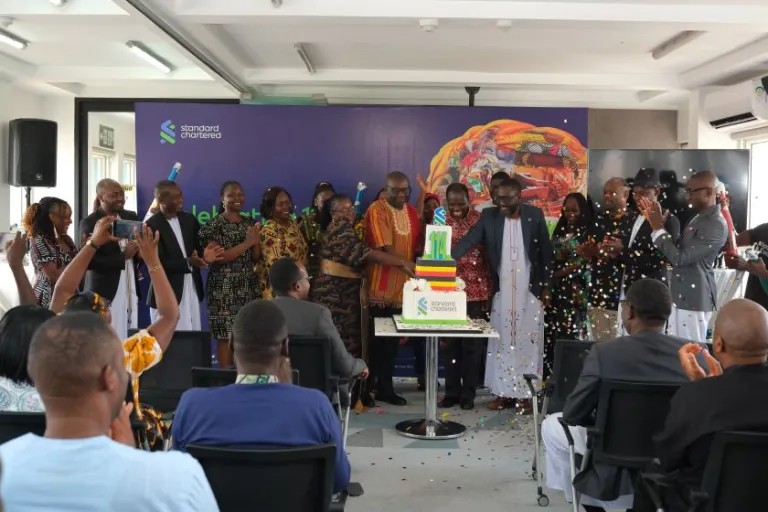
Standard Chartered Bank Uganda has marked 114 years of continuous operations in the country, celebrating its longstanding contribution to Uganda’s financial sector and its role in connecting local businesses and institutions to international capital, trade and investment opportunities.
The bank, which opened its doors in Kampala on August 12, 1912, marked the anniversary on Wednesday under the theme “Celebrating 114 Years: Honouring Our Heritage, Culture & Shaping Tomorrow.”

Standard Chartered is Uganda’s longest-established international commercial bank and has supported the country through different phases of economic development, while introducing a number of banking innovations.
Among its market milestones, the bank introduced Uganda’s first automated teller machine [ATM], Visa connectivity through its ATM network, Visa Electron and Visa Infinite cards. It also became the first bank to offer government securities trading as a primary dealer in Africa and introduced interest-rate and foreign-exchange derivative products.
The anniversary comes as the lender strengthens its focus on Corporate and Investment Banking following the transition and sale of its Wealth and Retail Banking business.

The bank said the strategy is aligned with Standard Chartered’s global focus on becoming a leading “super-connector” institution, linking clients and economies to international capital, trade and investment opportunities.
In Uganda, the bank said it will leverage its local market knowledge, international network and product capabilities to support businesses, institutions and public-sector priorities, particularly in areas where it can offer differentiated financial solutions.
Charles Katongole, Acting Chief Executive Officer of Standard Chartered Bank Uganda, said the bank’s commitment to Uganda remained unchanged despite the shift in its business focus.
“For 114 years, Standard Chartered has stood with Uganda through seasons of change, opportunity and progress. Our story is deeply woven into the country’s story, from enabling trade and enterprise to supporting infrastructure, innovation, inclusive growth and community resilience,” Katongole said.
He added that the bank’s next chapter would focus on connecting Uganda to global capital and markets while supporting the country’s development ambitions.
As part of the anniversary celebrations, Standard Chartered employees wore cultural attire representing Uganda’s diverse communities. The bank also recognised long-serving employees for their contribution to its operations.
Those recognised included John Mwesigye, who has served for more than 30 years; Moses Semugabi and Lydia Mukasa, each with more than 25 years of service; and Katongole, who has served the bank for 20 years.
A study by Steward Redqueen, commissioned to assess the bank’s wider economic contribution, estimated that Standard Chartered’s operations in Uganda generated US$ 896 million in value-added impact, equivalent to 3.5 per cent of the country’s gross domestic product, and supported 491,000 jobs, or 3.5 per cent of Uganda’s labour force, both directly and indirectly.
Beyond banking, the bank has implemented community programmes in health, education, youth empowerment, women’s entrepreneurship, disability inclusion, environmental restoration, access to safe drinking water and emergency response.
Its initiatives have included Seeing is Believing, Futuremakers, Women in Tech, RISE-E, Nets for Life and community relief programmes targeting vulnerable communities.
Standard Chartered Uganda has also received recognition from international financial publications and industry organisations, including Euromoney, emeafinance and The Banker. More recently, it was named Banking Brand of the Year Uganda 2026 and Best Corporate Bank Uganda 2026 at the Global Banking & Finance Awards.
The bank said its next phase in Uganda would be built around its client relationships, global network and local presence, with a focus on connecting capital, trade, ideas and partnerships to support the country’s sustainable economic growth.