Finance Minister Henry Musasizi has challenged the Uganda National Oil Company (UNOC) to explore alternative sources of financing to reduce its dependence on Government funding as Uganda moves closer to commercial oil production.
Musasizi said UNOC must develop sustainable financing mechanisms to support its expanding operations and major oil and gas investments without placing excessive pressure on the national budget.

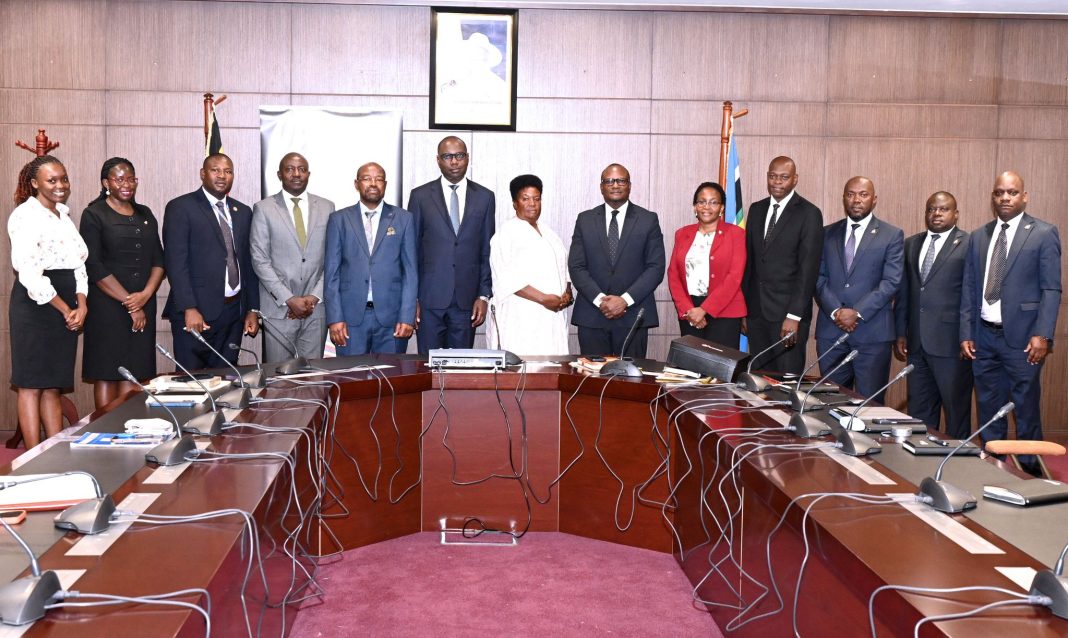
The Minister made the call during an engagement with the UNOC Board, together with State Minister for Finance Amos Lugoloobi and State Minister Cissy Mulondo.
He commended the national oil company for maintaining a steady supply of petroleum products despite disruptions in the international market caused by geopolitical tensions and conflicts in major oil-producing regions.
“Uganda has continued to have fuel available at relatively stable prices,” Musasizi said.

However, he questioned why motorists in different parts of the country continue to pay significantly different prices for fuel, citing variations in pump prices in Kabale, Masaka, Mbarara and Kampala.
The Minister’s concerns come as UNOC expands its role in Uganda’s petroleum industry, from fuel importation and storage to participating in major infrastructure projects expected to underpin the country’s oil economy.
UNOC prepares for first oil
UNOC reported that Uganda’s major oil and gas projects had made significant progress by the end of June 2026.
The East African Crude Oil Pipeline (EACOP) was 89.4 percent complete, while the Kingfisher Development Area stood at 79.36 percent and the Tilenga project at 74.2 percent.
With the projects advancing, UNOC expects its cash call obligations to rise as Uganda approaches first oil, with the company estimating requirements of about $72 million.
The financial demands are expected to increase further as UNOC takes on a greater role in the country’s petroleum value chain.
The company has already recorded growth in its petroleum supply business following the implementation of sole importation, with petroleum imports increasing by 39 percent.
UNOC said it is currently supplying 36 oil marketing companies, while its gross margins increased from Shs387 billion to Shs540 billion in the 2025/26 financial year.
$2b financing facility
UNOC is also leveraging external financing to support its operations.
Under a $2 billion financing facility secured from Vitol Bahrain, $150 million has so far been disbursed, while Shs536 billion has been transferred to the Ministry of Finance.
The financing is expected to support Uganda’s petroleum sector as the country prepares for first oil and develops infrastructure needed to handle, store and distribute petroleum products.
UNOC is simultaneously investing in strategic infrastructure, including the 320 million litre Kampala Storage Terminal and a 110 million litre storage terminal in Mombasa, Kenya.
The company is also pursuing plans for a 60,000-barrel-per-day refinery and infrastructure under Phase One of the Kabalega Industrial Park, where Shs37.96 billion has been secured.
UNOC wants greater financial independence
Despite its expanding portfolio, UNOC says it needs to develop a model that allows it to generate sufficient revenue to finance a greater share of its operations.
The company has proposed a sustainable self-financing model, arguing that its sole importation business generates approximately $3 million every month in administrative charges.
UNOC believes such internally generated revenue can form part of the foundation for greater financial independence, although it maintains that Government capitalisation remains necessary to enable it to take advantage of emerging opportunities in the petroleum sector.
“Government’s continued commitment to capitalise the company remains critical to unlocking its potential to drive Uganda’s economic growth,” UNOC said.
The push for alternative financing comes at a time when the government is seeking to limit pressure on the national budget while ensuring that strategic state enterprises have the resources required to deliver on their mandates.
For UNOC, the challenge is to transform the growing petroleum business into a financially sustainable operation capable of funding its expansion while also supporting the government’s broader objectives in the oil and gas sector.
The government established UNOC as its commercial arm in the petroleum sector, with responsibility for participating in the exploration, development, production, transportation, storage, and marketing of petroleum resources and products.
As Uganda approaches first oil, UNOC is expected to play an increasingly important role in ensuring that the country captures a greater share of the value generated from its petroleum resources.
Musasizi’s directive therefore places financial sustainability at the centre of UNOC’s next phase, with the company expected to explore innovative funding arrangements while continuing to benefit from Government support.
The ultimate goal, according to the government, is to build a stronger and financially sustainable national oil company capable of driving investment, strengthening energy security, and ensuring that Uganda derives maximum economic value from its petroleum resources.