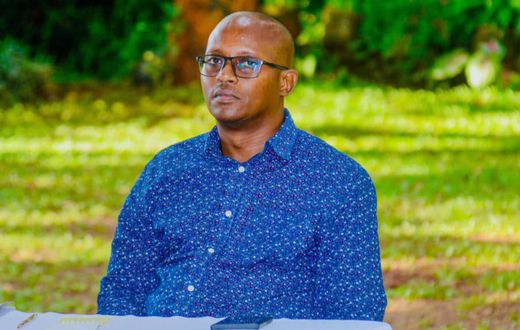
Ugandan national Michael Katungi Mpweire has appeared in a United States federal court following his extradition from Uganda to face charges over international conspiracy to supply military grade weapons to a Mexican drug cartel where he was linked to cocaine trafficking into the United States.
Katungi, 45, made his initial appearance on October 8, 2026, before the US District Court for the Eastern District of Virginia in Alexandria, where he faces charges of conspiracy to distribute cocaine, conspiracy to possess firearms, including machine guns and destructive devices, in furtherance of a drug trafficking crime, and conspiracy to provide material support or resources to a designated foreign terrorist organisation.

The US Department of Justice confirmed his appearance in a statement issued by the Office of the US Attorney for the Eastern District of Virginia, saying Katungi had been extradited from Uganda to answer the charges.
The case, registered under number 1:25-CR-102, centres on allegations that Katungi and three foreign nationals conspired to supply sophisticated weaponry to the Cartel de Jalisco Nueva Generación (CJNG), one of Mexico’s most violent and prolific transnational criminal organisations.
According to the indictment, the alleged conspiracy began at least in September 2022 and involved Katungi, Bulgarian national Peter Dimitrov Mirchev, Kenyan national Elisha Odhiambo Asumo and Tanzanian national Subiro Osmund Mwapinga.

Prosecutors allege that the four worked together to arrange the illegal supply of military grade weapons to the cartel, which they believed would use the equipment to support large shipments of cocaine into the United States.
“The weaponry included machineguns, rocket launchers, grenades, night vision equipment, sniper rifles, anti-personnel mines, and anti-aircraft weapons,” the US Department of Justice said.
The indictment alleges that the defendants intended to supply the cartel with weapons capable of strengthening its operations while helping it move large quantities of cocaine into the American market.
The CJNG was designated a Foreign Terrorist Organisation under US immigration law and a Specially Designated Global Terrorist under Executive Order 13224 on February 20, 2025. The designation has placed the cartel among the organisations targeted by the US government in its efforts to disrupt transnational criminal networks.
Court documents indicate that Mirchev allegedly took the lead in arranging the arms transactions after holding meetings with individuals claiming to represent the cartel. He allegedly agreed to organise and participate in illegal weapons deals while taking measures to avoid detection by international and American law enforcement agencies.
Mirchev allegedly recruited Asumo to obtain an End-User Certificate, a document used in international arms transactions to identify the intended recipient of weapons. Prosecutors allege that the certificate was obtained through a corrupt arrangement intended to conceal the weapons’ actual destination.
Katungi, Asumo and Mwapinga allegedly helped secure an End-User Certificate from Tanzania authorising the importation of AK-47 rifles.
According to the indictment, the certificate falsely presented the intended end-user of the weapons, concealing the alleged plan to supply them to the Mexican cartel.
Using the documentation, Mirchev and others allegedly arranged the export of 50 automatic AK-47 rifles, together with magazines and ammunition, from Bulgaria as a test shipment. Prosecutors allege that the weapons were ultimately intended for the CJNG despite the paperwork used to facilitate their export.
The alleged conspiracy reportedly extended beyond the initial shipment, with the defendants allegedly discussing plans to supply the cartel with more advanced military equipment, potentially including surface-to-air missiles, anti-aircraft drones and the ZU-23 anti-aircraft weapon system.
Mirchev allegedly prepared a list of weapons for the cartel valued at approximately 53.7 million euros, equivalent to about $58 million. Katungi, Asumo and Mwapinga allegedly agreed to provide additional arms control documents intended to conceal the cartel as the ultimate recipient.
Katungi’s extradition followed legal proceedings in Uganda after American authorities sought his transfer to face the charges.
He was arrested in Kololo on June 27, 2026, and appeared before Buganda Road Chief Magistrate’s Court on June 29 as proceedings to determine his extradition began. He was remanded to Luzira Prison while the matter was handled by the Ugandan courts.
The extradition process was contested, with Katungi’s lawyers challenging aspects of the proceedings, including the procedure used to initiate the request and claims relating to diplomatic immunity arising from his previous service in Nigeria.
The matter also encountered a temporary legal hurdle after the High Court halted the proceedings in July. However, the challenge was subsequently dismissed as premature, allowing the extradition process to continue.
On August 28, 2026, Chief Magistrate Ritah Kidasa Neumbe dismissed Katungi’s preliminary objections and cleared the way for his extradition after finding that the legal and evidential requirements for his committal under Uganda’s Extradition Act had been met.
Katungi remained in custody as the matter awaited the final decision on his surrender to the United States.
Justice and Constitutional Affairs Minister Norbert Mao subsequently authorised the surrender in a letter dated September 1, 2026. A surrender warrant provided for Katungi to be released by Ugandan prison authorities and handed over to an authorised representative of the US government for transfer to American jurisdiction.
The extradition involved cooperation between the US Justice Department, Uganda’s Ministry of Justice and Constitutional Affairs, the Office of the Director of Public Prosecutions and other international law enforcement agencies.
The US Justice Department’s Office of International Affairs worked with the Drug Enforcement Administration’s attachés at American embassies in Accra, Nairobi and Kampala to facilitate the extraditions of defendants in the case.
Other partners included Ghana’s Office of the Attorney General and Ministry of Justice, the Ghana Police Service and the Narcotics Control Commission; Spain’s Ministry of Justice and Guardia Civil; and Moroccan authorities, including the national police and the General Directorate for Territorial Surveillance.
The investigation was conducted by the DEA’s Special Operations Division Bilateral Investigations Unit, with assistance from the US Department of War. The international cooperation brought together law enforcement and justice institutions across several countries to pursue the alleged weapons and drug trafficking network.
The case has also resulted in arrests and guilty pleas involving Katungi’s co-accused.
Mirchev was arrested by Spanish authorities in Madrid on April 8, 2025, before being extradited to the United States on March 19, 2026, according to the US Justice Department.
Asumo pleaded guilty on July 23, 2026, while Mwapinga pleaded guilty on September 9, 2026, to conspiracy to distribute and possess with intent to distribute cocaine. Asumo is scheduled to be sentenced on November 4, 2026, while Mwapinga’s sentencing is scheduled for January 13, 2027.
Mirchev had previously been implicated in arms dealings involving Viktor Bout, who was convicted in a separate US case of conspiring to kill American nationals and government officers, acquire and export anti-aircraft missiles, and provide material support to a designated foreign terrorist organisation.
If convicted in the current case, Katungi faces a mandatory minimum sentence of 10 years in prison and a maximum of life imprisonment, according to the US Justice Department.
The department said the actual sentence would be determined by a federal district court judge after considering the US Sentencing Guidelines and other statutory factors.
Assistant US Attorneys Anthony T. Aminoff, Edgardo J. Rodriguez and Luke Albi are prosecuting the case. The announcement was made by Theophani K. Stamos, First Assistant US Attorney for the Eastern District of Virginia, and Frank Tarentino, Associate Chief of Operations at the DEA.
The prosecution falls under the Homeland Security Task Force initiative established by Executive Order 14159, titled *Protecting the American People Against Invasion*. The initiative brings together multiple US law enforcement agencies to investigate and prosecute criminal cartels, foreign gangs, transnational criminal organisations, and human smuggling and trafficking networks operating in the United States and abroad.
The Washington, DC, task force includes personnel from the DEA, FBI, Homeland Security Investigations, the Bureau of Alcohol, Tobacco, Firearms and Explosives, the Diplomatic Security Service, the US Marshals Service, the US Coast Guard Investigative Service, the Naval Criminal Investigative Service, the Transportation Security Administration’s Federal Air Marshals Service, US Customs and Border Protection, Enforcement and Removal Operations, and Washington Baltimore HIDTA.
The US Attorney’s Office for the Eastern District of Virginia is leading the prosecution.
The charges remain allegations, and he is presumed innocent unless proven guilty in court. Further proceedings and court documents are available through the US District Court for the Eastern District of Virginia and the federal PACER system under case number 1:25-CR-102.