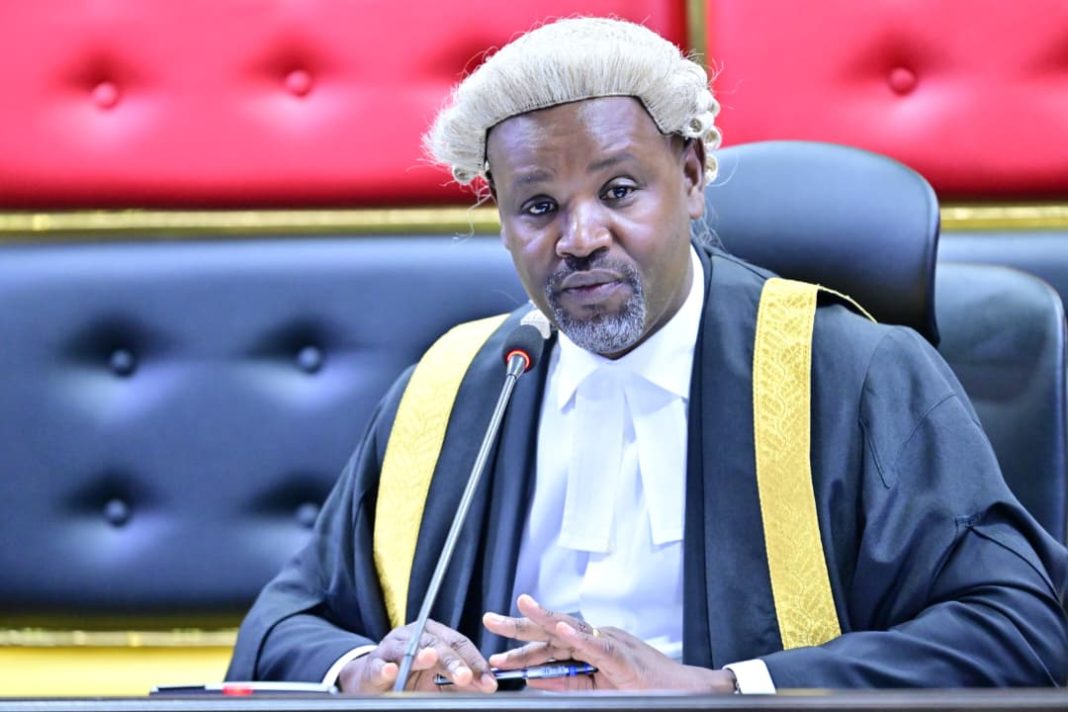
Deputy Speaker of Parliament Thomas Tayebwa has questioned the reliability of Uganda’s weather forecasting system, saying he would rather trust a village rainmaker than rely on some of the country’s meteorological predictions.
Tayebwa said inaccurate weather forecasts could leave farmers exposed to droughts, floods and other climate-related disasters, calling for increased investment in modern equipment and better systems for delivering timely weather information to farmers.

He made the remarks on Tuesday while opening a two-day induction for Members of Parliament serving on the Parliamentary Committee on Climate Change and the Committee on Natural Resources at Mestil Hotel in Kampala.
Tayebwa said Parliament had previously lobbied for about Shs12 billion to equip the Uganda National Meteorological Authority with modern technology, but questioned whether the investment had produced forecasts that farmers could confidently rely on.
“We lobbied for about Shs12 billion for UNMA to have the latest equipment. But now, with the equipment that we have, I rather trust my rainmaker,” Tayebwa said.

He said there have been occasions when farmers are advised to expect rainfall only for the predicted rain to fail to arrive, leaving them to make costly decisions based on information that may not accurately reflect conditions on the ground.
Tayebwa said the problem was not simply about producing forecasts but ensuring that the information reaches farmers early enough, in a language they understand and through channels they regularly use.
“We need to support Uganda National Meteorological Authority, give them the equipment they need to give perfect projections,” he said.
He urged Government to ensure that weather alerts and agricultural forecasts are sent directly to farmers through their mobile phones and translated into local languages so that communities can prepare before extreme weather events occur.
The Deputy Speaker’s concerns came as the Ministry of Agriculture, Animal Industry and Fisheries began a two-day engagement with district leaders on measures to protect farmers from the effects of harsh weather and prolonged drought.
Agriculture Minister Frank Tumwebaze said farmers across the country were reporting poor germination and crop failures as a result of what he described as highly unconventional weather conditions.
“Fellow farmers greetings and Pole Sana on the highly unconventional harsh weather! The drought has persisted and many farmers are reporting cases of poor crop germination and or crop failure,” Tumwebaze said.
He said Cabinet had discussed the situation and President Yoweri Museveni had directed the immediate conclusion of a plan for mass irrigation infrastructure to improve water conveyance to farms.
“Government is seriously monitoring the situation. In Cabinet yesterday, we discussed the matter and His Excellency the President directed the immediate conclusion of a plan for mass roll-out of irrigation infrastructure to facilitate water conveyance to farms,” Tumwebaze said.
The proposed irrigation intervention is expected to focus on enterprises considered critical to food and income security, including coffee, cocoa, maize, pastures and fish farming.
Tumwebaze said district leaders had been brought into the process to help Government identify the water resources, terrain and agricultural activities that should be prioritised in each district and sub-region.
“Their input will help us to design a mass intervention that is informed by the actual needs of each district and sub-region,” he said.
The Ministry’s Permanent Secretary, Maj Gen David Kasura Kyomukama, said the engagement with district leaders would focus on four major areas: development of a national irrigation development plan, implementation of compulsory Foot and Mouth Disease vaccination, strengthening the regulatory framework for wild-capture fisheries and fisheries resources management, and agricultural extension services.
Kasura said the discussions were intended to ensure that Government interventions translate into practical benefits for farmers rather than remaining at policy level.
“The farmer who wakes up every morning to cultivate, to rear animals or engage in fisheries must see a presence and benefit of government in his or her economic activities,” Tumwebaze said during the engagement.
Under the proposed irrigation plan, the Ministry is considering investment in water conveyance systems in communities where reliable water sources already exist but farmers lack infrastructure to move water to their gardens.
The Ministry also plans to develop on-farm water conveyance systems for farms located near seasonal rivers and streams where water can be safely abstracted.
Another component will involve profiling irrigation systems already developed by the Agriculture Ministry and the Ministry of Water and Environment but which are either not functioning fully or have stopped operating, with the aim of rehabilitating them and solving the last-mile challenge of getting water to farms.
In water-stressed communities, Government is considering developing bulk water systems that would later support on-farm distribution networks, while fish ponds are also being proposed for low-lying areas, including parts of Bukedi, Busoga, Luwero and Kigezi.
Tumwebaze also addressed concerns over agricultural extension services, saying farmers cannot receive effective technical support if extension workers are not available in the communities where they work.
“Our farmers need regular engagement, technical guidance and knowledge on improved agronomic practices. Extension workers cannot provide this service effectively if they are not available where farmers live and work,” he said.
He asked district leaders to provide information on approved extension positions, vacancies, available wage provisions and the reasons for staffing gaps.
Tumwebaze also said extension workers need reliable means of transport to reach farmers, including motorcycles and vehicles.
“We recognize that, in order to effectively serve farmers, extension workers must have the basic means of transport to reach them. This may be a motorcycle or, where appropriate, a vehicle,” he said.
He added that Government had invested in providing motorcycles and vehicles to district and sub-county extension workers but wanted district leaders to account for how the equipment was being used and identify remaining mobility gaps.
“Once you have staff and mobility, the last issue and perhaps the one every one uses as an excuse is facilitation. Government has progressively addressed the facilitation of extension workers through salary enhancements and the provision of extension grants,” Tumwebaze said.
The Agriculture Ministry is also using the engagement to address Foot and Mouth Disease, with State Minister for Animal Industry Bright Rwamirama telling district leaders that Government has provided funds for vaccines and the implementation of the disease-control programme.
According to Rwamirama, Government has procured 44 million doses of FMD vaccines intended to cover susceptible domestic animals, including cattle, pigs, goats and sheep.
He said farmers will contribute towards the cost of vaccination, with cattle and pigs attracting a charge of Shs8,000 per animal, while sheep and goats will cost Shs4,000.
Rwamirama said Government has also provided refrigeration facilities to districts, including solar-powered cold-chain systems in 53 districts, to ensure vaccines remain effective.
He urged farmers to treat disease control as an economic necessity because controlling FMD would help Uganda access better regional and international markets for meat and dairy products.
Back at the climate change induction, Tayebwa warned that Uganda must move away from repeatedly spending money responding to disasters after they occur and instead invest in measures that prevent or reduce their impact.
He cited recurring floods along River Nyamwamba in Kasese and the loss of land in Ntoroko as examples of climate-related challenges requiring long-term solutions.
He also called for greater use of climate-smart agriculture, including drought-resistant seeds, agroforestry, soil conservation and better-equipped agricultural extension workers.
“I do hope that we, as the 12th Parliament, can tie PDM funds to climate-smart agriculture, to drought-resistant seeds, to ensure we focus on agroforestry, soil protection, and also ensure that we have extension workers who are well equipped with knowledge to teach people on how they can do sustainable agriculture,” Tayebwa said.
He further urged Government institutions, schools and hospitals to invest in rainwater harvesting and renewable energy, particularly solar power, to strengthen their resilience against changing weather patterns.
Tayebwa also called for stronger protection of forests and wetlands, warning that environmental degradation was worsening the country’s vulnerability to climate-related disasters.
“We need to protect our forests. We need to keep these people in government who should protect our forests in check, on their toes,” he said.
He said Uganda loses about 80,000 hectares of forest cover annually and challenged Parliament to use its oversight role to ensure that institutions responsible for protecting natural resources perform their duties.
Tayebwa said the 12th Parliament should ultimately be judged by the practical measures it takes to protect Ugandans from climate-related disasters rather than the number of meetings and conferences it holds.
“History will judge the 12th Parliament not by how many sittings we had, or how many conferences we attended, but on how we prevented disasters from happening again,” he said.
The convergence of the two discussions puts irrigation, reliable weather information, extension services and environmental protection at the centre of Uganda’s response to increasingly unpredictable weather, with Government now seeking district-level information to shape a nationwide agricultural intervention.