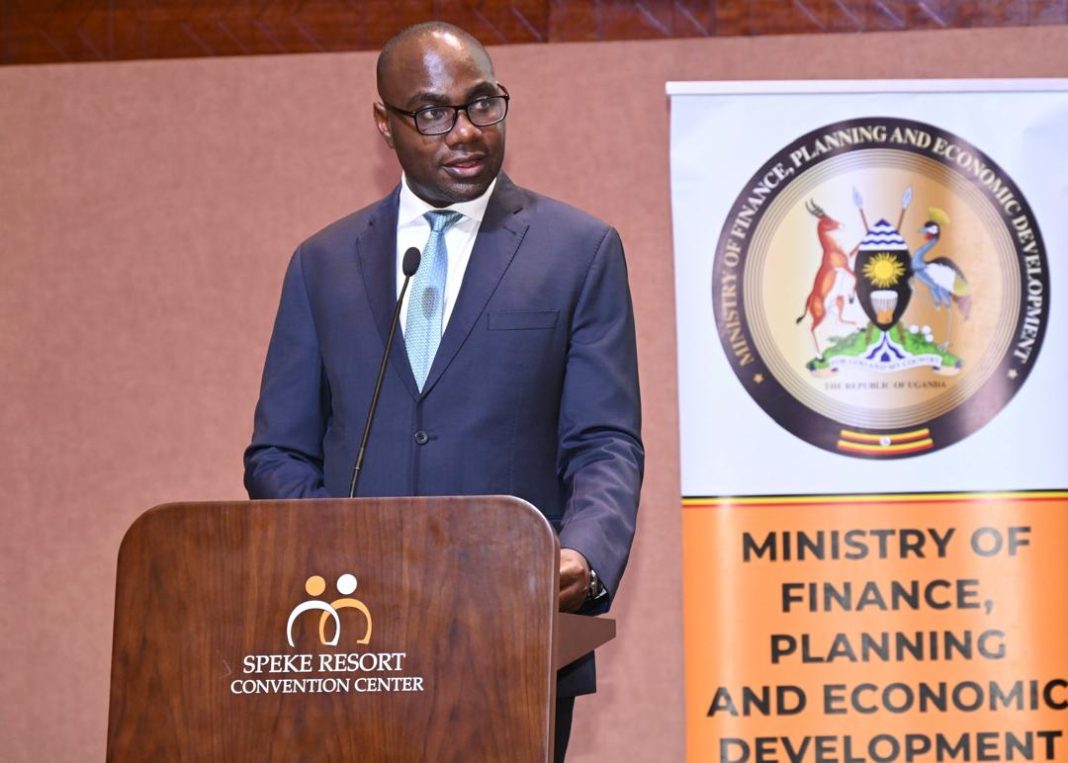
Finance Minister Henry Musasizi has called for stronger parliamentary oversight, tighter budget discipline and improved management of public resources as Uganda seeks to translate sustained economic growth into jobs, higher household incomes and increased national wealth.
Musasizi made the call on Friday while opening the 12th Parliamentary Committee on Finance, Budget and National Economy retreat at Speke Resort Munyonyo in Kampala.

The retreat brings together the Ministry of Finance, Planning and Economic Development and the parliamentary committee at a time when government is seeking to accelerate economic growth while strengthening fiscal discipline, domestic revenue mobilisation and accountability for public expenditure.
Musasizi said Uganda’s economy has continued to expand at more than five per cent despite global economic shocks, but stressed that the most important challenge now is ensuring that economic growth is felt by ordinary Ugandans.
He said growth must generate productive employment, increase household incomes, support enterprise development and create wealth, in line with the government’s Tenfold Growth Strategy.

“The next priority is to ensure this growth translates into tangible benefits for Ugandans through the creation of productive jobs, higher household incomes, enterprise development and wealth creation,” Musasizi said.
The government’s Tenfold Growth Strategy seeks to expand Uganda’s economy from about US$50 billion to US$500 billion by 2040, with a focus on agro-industrialisation, tourism, mineral development and the oil and gas sector, as well as science, technology, innovation and the wider knowledge economy.
Musasizi said the ambition to build a US$500 billion economy and eliminate poverty will require government to significantly improve the quality of public spending and ensure that resources allocated through the national budget generate measurable results.
He said government must move away from an approach that focuses largely on inputs and activities and instead place greater emphasis on outcomes, while strengthening public investment management and dealing with pressures arising from wages, debt servicing and statutory obligations.
“The emphasis should be on ensuring that every public shilling delivers value and contributes to improved public service delivery,” he said.
The Minister said Uganda already has most of the necessary Public Financial Management systems in place, arguing that the major challenge is now implementation, enforcement and accountability.
He identified strengthening internal controls and auditing, clearing government arrears, improving liquidity management, completing procurement reforms and strengthening the management of public assets as key priorities.
According to Musasizi, stronger controls in these areas will help reduce waste, improve value for money and ensure that public investments translate into better services for citizens.
The Finance Minister also placed domestic revenue mobilisation at the centre of Uganda’s economic transformation agenda, saying government wants to raise the tax-to-GDP ratio from about 13 per cent to 20 per cent during the current term.
He said achieving the target will require stronger domestic revenue mobilisation, firm government commitment and continued support from Parliament.
The Ministry of Finance has previously said the government intends to increase domestic revenue collection to finance development priorities while reducing reliance on borrowing. In the 2026/27 financial year, government projected domestic revenue of Shs45.96 trillion, including Shs40.16 trillion in tax revenue.
Musasizi said increased domestic revenue will be essential if Uganda is to finance its development priorities sustainably and reduce excessive dependence on borrowing.
He also stressed the need for stronger cooperation between Parliament and the Ministry of Finance, arguing that effective parliamentary oversight depends on timely, accurate and complete information from government institutions.
He said better coordination would help Parliament scrutinise government policies, budgets, borrowing decisions, expenditure and overall financial management more effectively.
The Minister further disclosed that, beginning this financial year, Accounting Officers will be required to sign a Budget Discipline and Accountability Charter designed to strengthen controls over supplementary budgets, recruitment, arrears and financial commitments.
The move is intended to reinforce accountability among government accounting officers and ensure that commitments made through the budget are matched with available resources and established financial procedures.
Musasizi said Parliament will have a critical role in ensuring that the reforms are implemented and that public resources are managed responsibly.
“Strong Parliamentary oversight will be critical in ensuring that these commitments are effectively implemented and that public resources are managed responsibly,” he said.
The retreat is therefore expected to go beyond discussions and produce concrete actions to strengthen the relationship between Parliament and the Finance Ministry.
Among the priorities are improved Ministry-Parliament engagement, designation of clear coordination focal points and agreement on timelines for responding to parliamentary requests for information.
The discussions come as Uganda seeks to accelerate its economic transformation while maintaining macroeconomic stability and improving the efficiency of public spending.
The Finance Ministry’s Tenfold Growth Strategy identifies improved budget effectiveness and efficiency, stronger returns from public investment, expansion of the formal economy and growth of Uganda’s entrepreneurial base as key components of the country’s economic transformation.
The strategy also seeks to raise Uganda’s economy to its double-digit growth potential and ultimately expand GDP to US$500 billion by 2040, making effective public financial management and accountability central to the ambition.
Musasizi said the success of the agenda will ultimately be measured not by the amount of money spent by government, but by the results that expenditure produces for Ugandans.
“Uganda’s development ambitions will depend not only on sound policies and strong Public Financial Management systems, but also on discipline, accountability and effective execution. These efforts are essential to ensuring that economic growth translates into meaningful improvements in the lives of ordinary Ugandans,”he said.