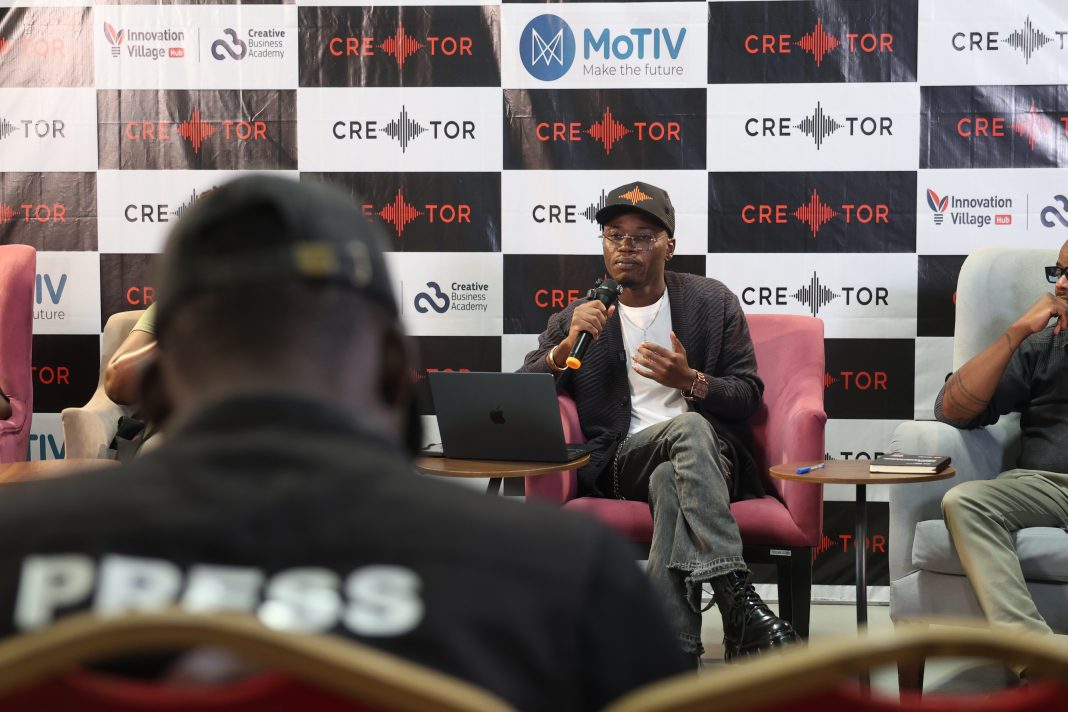
Uganda’s creative industry has received a big boost following the launch of Creator Academy, a new professional music development initiative designed to equip producers with the technical, business and professional skills needed to compete in Uganda and international music markets.
Creator, a professional music development company and creative ecosystem established by Practical Stream Uganda Limited, officially unveiled its flagship One-Year Professional Music Production Programme, marking the beginning of an ambitious plan to develop export-ready music professionals and strengthen Uganda’s position in the global music economy.

The programme is being introduced at a time when Ugandan music continues to gain audiences beyond the country’s borders, with local artists, producers, songwriters and other creatives increasingly participating in international markets.
However, the growth in artistic talent has also exposed a significant gap in the industry: the limited availability of structured professional pathways capable of turning creative talent into commercially sustainable careers.
According to Creator founder Moise Chitwara, the idea for the academy was born out of practical experience while developing Practical Stream’s global music licensing platform and pursuing commercial opportunities in international markets.

“While building Practical Stream, we realised Uganda doesn’t have a talent problem—it has an infrastructure problem. We have gifted producers, artists, and songwriters, but too few structured pathways that prepare them for international commercial opportunities,” Chitwara said.
“Creator was established to help close that gap. Our goal isn’t simply to teach people how to make music. It’s to develop professionals who can build sustainable careers, compete internationally, and contribute meaningfully to the growth of Uganda’s music industry,” he added.
Rather than operating as a conventional music school whose relationship with students ends at graduation, Creator is positioning itself as a wider professional ecosystem combining education, commercial music production, industry collaboration, creative services, consultancy, events and access to international opportunities.
The One-Year Professional Music Production Programme is structured around intensive practical training in music production, music business and character development. Students will be expected to develop professional portfolios while gaining practical knowledge of production workflows, commercial standards, monetisation and the broader demands of the music industry.
The programme is divided into three levels, with each level running for three months and costing Shs500,000. Participants who already possess production knowledge will, however, not necessarily have to begin at the foundation level.
Explaining the tuition structure, Carol Mugide, Project Manager at Innovation Village, said the academy was designed to accommodate people at different stages of their professional development.
“Tuition for three months is five hundred thousand. That is one level. When you go to the following level, you have to pay five hundred thousand, and when you go to the professional level, you have to pay five hundred thousand. So that is what covers the full year,” Mugide explained.
She said applicants with existing production skills will be assessed before being placed in an appropriate level.
“If you already have production knowledge, you don’t have to start from the foundation level. You can start from intermediate. So we give you assessment questions or assessment tests to see how you perform, and then we assign you to the level that is fit for you,” she said.
The academy is being developed through collaboration between Creator Academy, Innovation Village Hub and the Creative Business Academy, with the partnership intended to bridge the gap between creative talent and entrepreneurship.
Mugide said the partnership was deliberately structured to ensure that musicians and other creatives do not acquire technical skills without learning how to turn those skills into sustainable businesses.
“We realised that we can create more impact through partnership. Moise approached us with the idea of having a music school, and we sat down and came up with different ways that we could collaboratively make the music school more impactful,” she said.
According to Mugide, Creator brings the technical music component while Innovation Village contributes entrepreneurship, market access and business development expertise.
“For us as Village, as the Creative Business Academy, we are doing more of the entrepreneurship, ideation and all those things. So how do we combine the entrepreneurship element with the technical element that Moise is bringing on board?” she said.
The collaboration is expected to expose participants to areas that are often overlooked in conventional music training, including intellectual property, branding, partnerships, pitching, business development, legal compliance and taxation.
“Talent alone is not going to take you anywhere. You need the right skills, the right business skills and entrepreneurship skills to take you to the next level,” Mugide said.
The programme will also provide opportunities for participants to interact with industry experts, receive mentorship and coaching, access market linkages and understand the legal and administrative obligations associated with running a creative business.
Mugide said the academy would help creatives understand issues ranging from intellectual property and registration to taxation and compliance.
“These are things that you’re not going to just learn in an ordinary technical school that is teaching you music. Through collaboration with Innovation Village and the Creator Academy, we can support creatives who have challenges with legal compliance and help them understand how to build legitimate and sustainable businesses,” she said.
The partnership will also give participants access to infrastructure and equipment necessary for practical training, reducing some of the barriers faced by aspiring producers who cannot afford professional facilities.
“The equipment that you’ve been dreaming about, you’re going to find it already here. So you don’t have to look for equipment out there. Everything is going to be there,” Mugide said.
Beyond music production, Creator Academy intends to offer a broader range of courses covering sound, content creation and other creative disciplines.
Mugide said the academy would recognise the diversity of Uganda’s music industry by supporting creatives working across different genres and production styles, while also teaching them how to use modern digital tools to create and monetise their work.
The content creation component is expected to be particularly relevant as social media platforms continue to transform how music is produced, marketed and consumed.
Creator’s model also places significant emphasis on market access. Through its wider ecosystem, participants will be able to explore opportunities to exhibit their skills, connect with industry professionals and develop commercial relationships.
“People think being a musician, you can’t exhibit. You have to exhibit. Being a sound engineer, you can exhibit your skills in one way or the other,” Mugide said.
She added that participants would have access to local and international industry experts, mentorship and coaching as part of the academy’s broader approach to professional development.
One of the most ambitious components of Creator’s long-term strategy is the Creator Export Pipeline, which is intended to connect export-ready Ugandan music professionals with international opportunities in music publishing, licensing, synchronisation placements, distribution and other commercial markets.
The initiative is expected to build on Practical Stream’s experience in the international music licensing space, where the company has been pursuing opportunities to place African music within global commercial markets.
Creator says the production and monetisation principles being taught through the programme are based on real-world industry experience, with the founder and production instructors having applied similar approaches to music that has generated millions of streams across Europe and the United States.
This means students will not only be learning production techniques but will also be exposed to professional workflows and commercial considerations that determine whether music can successfully compete in international markets.
Mugide said the ultimate objective was to create a platform where creative professionals could continue developing after completing their training.
“The Creator Academy is going to be that one-stop place or academy where different creatives can come, perfect their sound. There will be elements of content creation, entrepreneurship and market access,” she said.
She explained that the academy would seek to ensure that training is followed by opportunities for creatives to apply what they have learned.
“After you have trained through the course, what else? That’s where Innovation Village comes in, with the entrepreneurship aspect. We tell you how to build your brand, how to sign a partnership, how to pitch and how to build your business,” she said.
Creator’s wider ecosystem will include the Creator Academy, Creator Production Hub, Creator Brand & Creative Campaigns, Creator Consultancy, Creator Events and Creator Export Pipeline, all aimed at supporting music professionals throughout their careers.
The organisation says the long-term goal is to create a stronger connection between education, production, business and international markets, while helping Uganda’s creative professionals earn sustainable incomes from their intellectual property.
The launch therefore represents more than the introduction of another music training programme. It is an attempt to address one of the biggest structural challenges facing Uganda’s creative sector: how to move from producing talented artists and producers to building professionals capable of operating successfully in a global creative economy.
For Chitwara, the ambition is to ensure that Ugandan creative talent is not only celebrated locally but is also commercially positioned for the international market.
Creator describes its philosophy in a simple statement: “Creator isn’t just where creators learn. It’s where creators become professionals.”
The academy’s founders believe that with the right combination of technical skills, business knowledge, professional discipline, infrastructure and access to markets, Uganda can transform its abundant creative talent into a stronger export industry capable of generating jobs, businesses and international revenue.
The launch of the One-Year Professional Music Production Programme is consequently being positioned as the first phase of a much larger journey, one intended to help build the people, systems and commercial pathways required for Uganda’s music industry to compete confidently on the world stage.