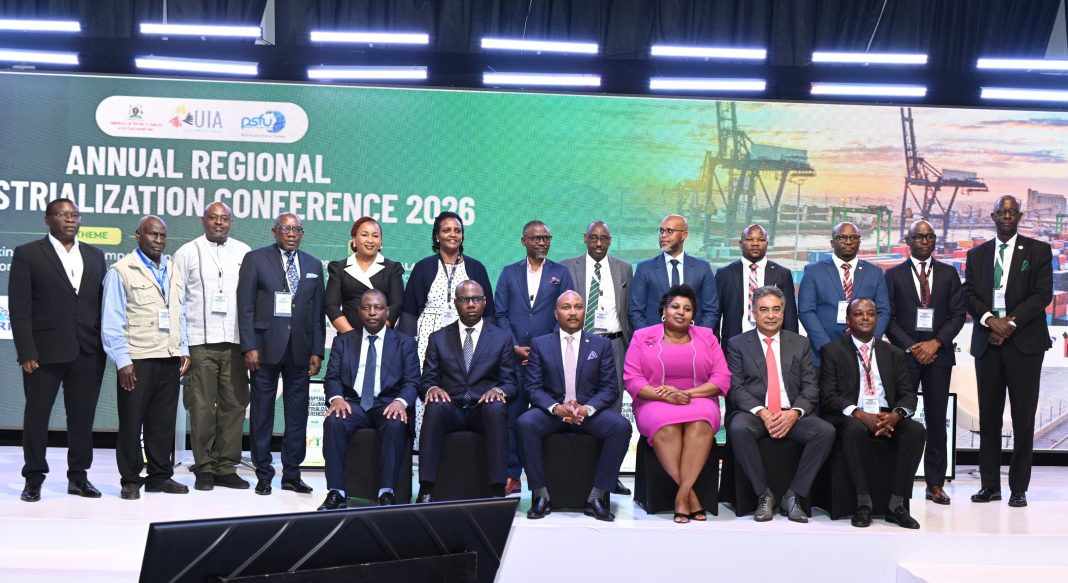
President Yoweri Museveni has called for a stronger partnership between government and the private sector to accelerate Uganda’s industrialisation, deepen regional integration and transform the country into a competitive manufacturing hub.
The call was delivered by Finance Minister Henry Musasizi on Tuesday as he represented President Museveni at the 3rd Annual Regional Industrialisation Conference 2026, held under the theme, “Unlocking Industrial Competitiveness through Innovation and Regional Value Chain Integration.”

The conference brought together policymakers, industrialists, financiers, and private sector leaders to discuss practical ways of increasing production, investment, employment, and trade across East Africa.
Musasizi said industrialisation remains central to Uganda’s structural transformation because it creates jobs, adds value to locally available resources, expands trade in manufactured goods and reduces the country’s vulnerability to external economic shocks.
“Industrialisation is central to structural transformation, as it creates jobs, adds value to natural resources, expands intra-regional trade in manufactured goods and reduces vulnerability to external shocks,” Musasizi said while delivering the President’s message.

He said Uganda’s industrialisation strategy is anchored in the country’s national development framework, with the development of industrial parks playing a key role in attracting investment and expanding manufacturing capacity.
The Kampala Industrial and Business Park at Namanve, which covers approximately 1,000 hectares, has continued to attract investments in manufacturing, logistics, food processing and agro processing, making it one of Uganda’s major production hubs serving both domestic and African markets.
Musasizi also cited the Sino-Uganda Bio-Industrial Park, covering about 619 acres, which hosts approximately 75 factories employing more than 12,000 people.
According to the minister, such industrial parks are being developed not only to meet Uganda’s domestic demand but also to produce competitive goods for markets across East Africa and the wider African continent.
He identified agro processing, leather, textiles, pharmaceuticals, petrochemicals, steel, construction materials and logistics as some of the key areas with potential to drive Uganda’s industrial growth.
Musasizi urged East African countries to stop viewing their economies as separate markets and instead treat the region as a shared economic space capable of supporting large scale production and investment.
“East Africa must be approached as a shared regional market rather than as separate national economies,” he said.
He noted that the East African Community has a consumer market of more than 400 million people, while the African Continental Free Trade Area provides access to a continental market of about 1.4 billion people.
Musasizi reaffirmed Uganda’s commitment to deepening economic integration within the East African Community, removing non tariff barriers, operationalising one stop border posts and expanding access to regional markets for Ugandan manufacturers.
He said closer cooperation between Government and businesses would also be critical to achieving Uganda’s long term ambition of transforming the economy into a US$500 billion economy under the country’s 10 fold growth strategy.
“Achieving the 10 fold growth ambition of a US$500 billion economy will require genuine partnership between Government and the private sector,” Musasizi said.
Minister of State for Trade, Industry and Cooperatives in charge of Industry, David Bahati, said East African countries must increase production and manufacturing capacity if the region is to become more competitive in global markets.
“East Africa must focus on producing more, manufacturing more and exporting more,” Bahati said.
He identified inadequate power, infrastructure challenges, limited irrigation, regional connectivity gaps and persistent non tariff barriers as some of the major obstacles that must be addressed to support industrialisation and cross border trade.
Private Sector Foundation Uganda Board Chairman Humfrey Nzeyi said manufacturing remains an important driver of economic growth in the region but warned that its contribution to the regional economy remains below the target set under the EAC industrialisation policy.
Nzeyi said manufacturing contributes between 9.7 and 11.8 percent of regional GDP, compared with the EAC industrialisation policy target of 25 percent by 2032.
In Uganda, he said, the manufacturing sector contributes more than 16.5 percent of GDP and supports approximately two million direct jobs, making it a major contributor to employment, exports, tax revenues and structural transformation.
“Manufacturing is central to employment, exports, tax revenues and structural transformation, but unlocking its full potential requires practical solutions to the constraints facing businesses,” Nzeyi said.
He called for increased access to long term industrial finance, improved infrastructure and energy supply, stronger enforcement of standards, measures against illicit trade and removal of non tariff barriers that continue to affect businesses operating across borders.
Nzeyi also urged governments and private sector players to strengthen cross border value chains so that industries in East Africa can source inputs, process products and access markets within the region more efficiently.
The conference is expected to strengthen collaboration between governments and the private sector and translate regional industrialisation commitments into increased production, investment, employment and trade.
The discussions come at a time when Uganda is seeking to expand its manufacturing base, increase value addition to locally produced raw materials and position its industries to benefit from the growing East African and continental markets.