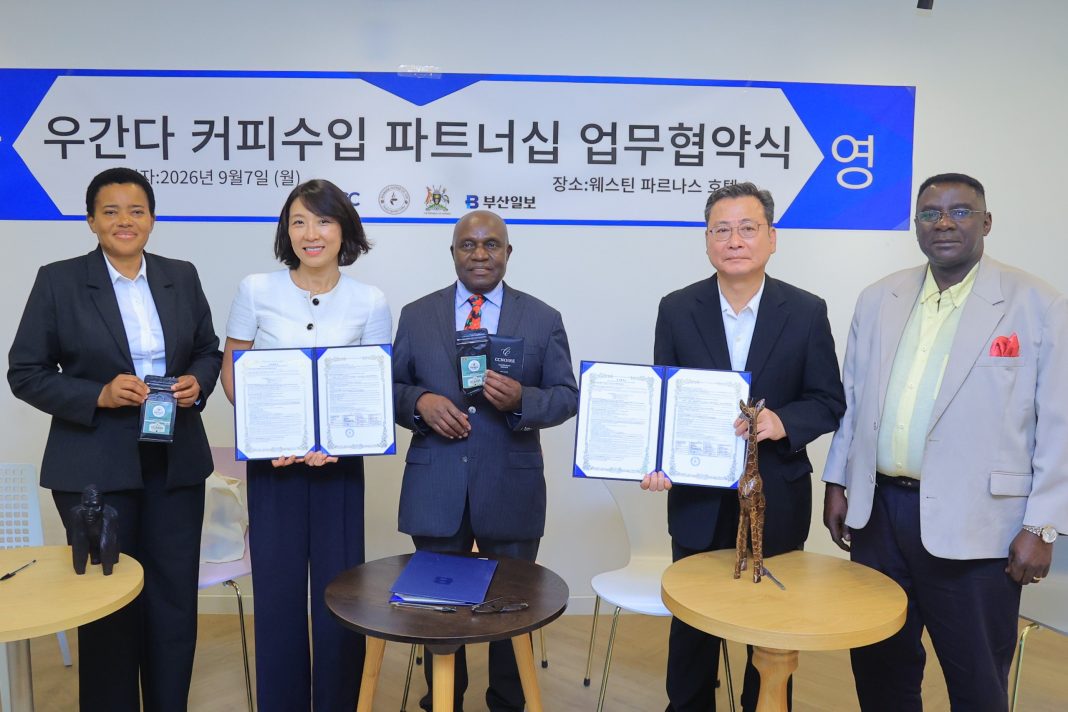
Uganda has secured a new coffee export partnership with South Korean company
GVCC Co. Ltd, a deal expected to open a major gateway for the country’s coffee into Asian markets and create demand for more than 3,500 tonnes of Ugandan coffee every year.
The agreement, signed on September 7 in Busan, positions Uganda’s Besmark Coffee Company Ltd as the exclusive supply partner, while GVCC will serve as the exclusive distributor in South Korea. The signing took place on the sidelines of the Uganda–Korea Trade and Investment Meeting, ahead of the main bilateral session held on September 8.

The first shipment, comprising two containers of Ugandan coffee, is already on its way to South Korea, marking the beginning of what both countries describe as a long term commercial partnership.
The deal is expected to significantly expand Uganda’s footprint in Asia by using Busan, one of the region’s busiest ports, as a processing and distribution hub for exports to Japan, South Korea and Southeast Asia.
Uganda’s Ambassador to Japan, Tophace Kaahwa, whose mission is accredited to South Korea, described the agreement as an early success of Uganda’s Economic and Commercial Diplomacy strategy.

“The company is targeting imports of one 20 tonne container every day, which translates to about 3,500 tonnes annually,” Kaahwa said.
He called on Ugandan farmers to increase production to meet the anticipated demand.
GVCC Chief Executive Officer Soo-jung Lim said the company had developed confidence in Uganda’s coffee after engaging with the Ugandan delegation during a coffee exhibition in Busan.
“We are ready to do business with Uganda,” Lim said, expressing confidence that the partnership would help introduce more Ugandan coffee to Korean consumers.
Beyond supplying roasted and green coffee, the partnership includes plans to process, package and re-export Ugandan coffee across the wider Asian market, adding greater commercial value to the product before it reaches consumers.
The agreement also features a promotional partnership with Busan based newspaper The Busan, which will publish stories and host events aimed at raising the profile of Ugandan coffee in South Korea.
Uganda’s Second Deputy Prime Minister, Dr Crispus Kiyonga, who led the delegation, welcomed the investment and assured the Korean firm of continued government support.
“Uganda wants, in time, to add value to its coffee at home rather than ship raw beans,” Kiyonga said.
He added that expanding exports to Asia forms part of the government’s broader strategy to diversify markets beyond Europe.
“President Yoweri Museveni has set a national target of producing 20 million bags of coffee annually, and government will support this partnership to help achieve that goal,” Kiyonga said.
He noted that most of Uganda’s coffee is grown by smallholder farmers on two to three acre plots, with minimal chemical use, giving the country’s coffee a naturally organic appeal that is increasingly attractive to international buyers.
The minister also highlighted the need to narrow the trade imbalance between Uganda and South Korea.
“Uganda exports about $10 million worth of goods to South Korea while importing about $100 million. We want to balance that trade,” he said.
Ambassador Henry Mayega described the agreement as a milestone for Uganda’s coffee industry, noting that coffee holds deep cultural significance in Ugandan society, including in marriage and bride price traditions.
The partnership comes as Uganda continues to strengthen its position as Africa’s largest coffee exporter after overtaking Ethiopia in 2025. The country is also among the world’s leading suppliers of Robusta coffee.
According to the Ministry of Agriculture, Animal Industry and Fisheries, Uganda exported 8.6 million 60 kilogram bags of coffee worth about $2.3 billion (Shs8.3 trillion) in the 12 months to May 2026, up from 7.4 million bags a year earlier.
Robusta accounts for roughly 80 percent of Uganda’s coffee exports, while Arabica continues to register faster growth in export value.
Europe remains Uganda’s largest coffee destination, taking about 62 percent of exports during the 2024/25 coffee year, followed by Africa at 23 percent and Asia at 13 percent.
Officials say the Busan agreement could substantially increase Asia’s share by establishing a reliable supply chain into one of the world’s most sophisticated coffee consuming markets.
South Korea, with a population of about 51.6 million, remains a relatively small destination for Ugandan exports, making the new partnership an important step toward expanding Uganda’s commercial presence in East Asia.
The agreement was coordinated by Uganda’s Embassy in Tokyo under the country’s Economic and Commercial Diplomacy strategy, launched in 2025 to promote exports of value added products and support Uganda’s ambition of building a $500 billion economy by 2040.